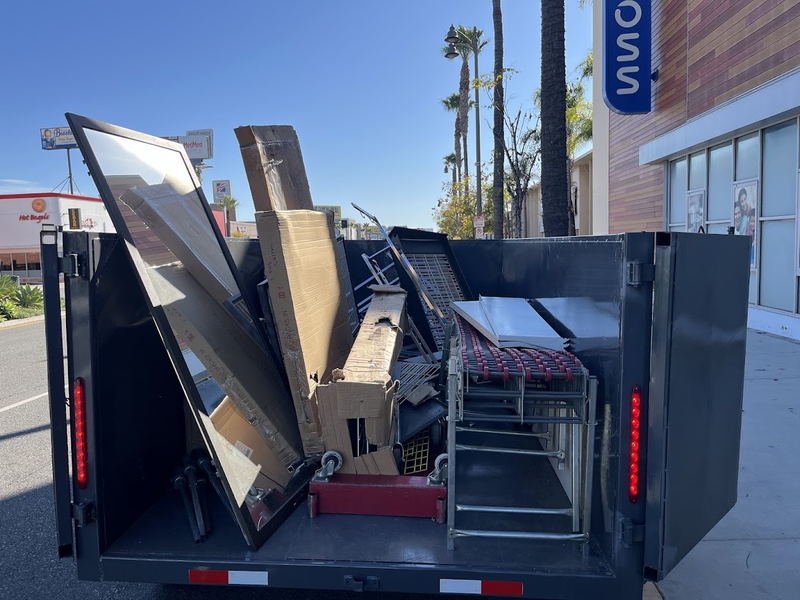
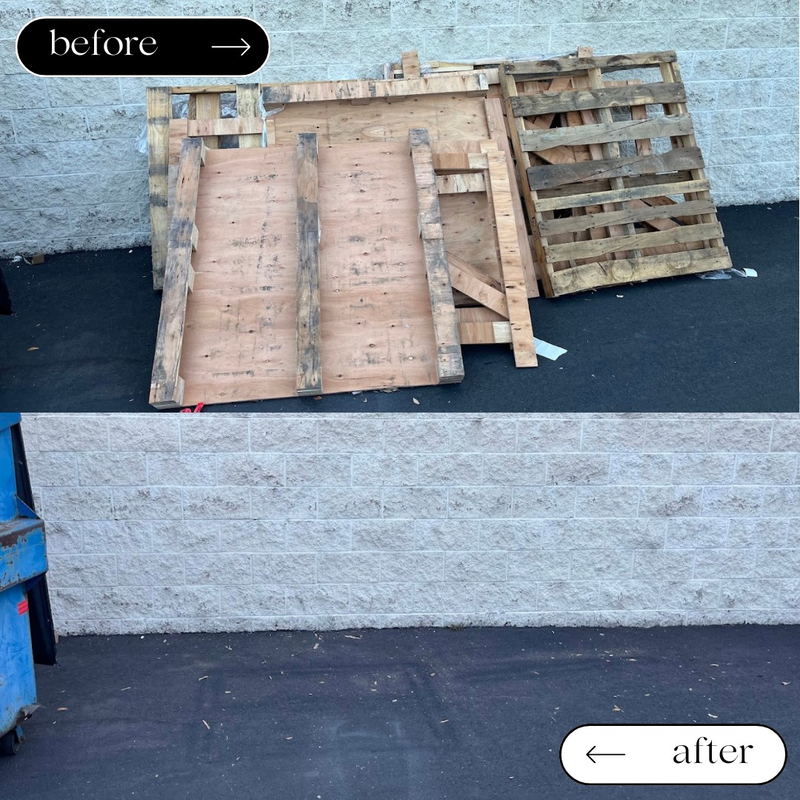
Working with Hunter and this company was great. Gave us a quick quote over the phone after sending photos and was able to help us the SAME day. Removal was fast and easy. We definitely recommend going with this company.
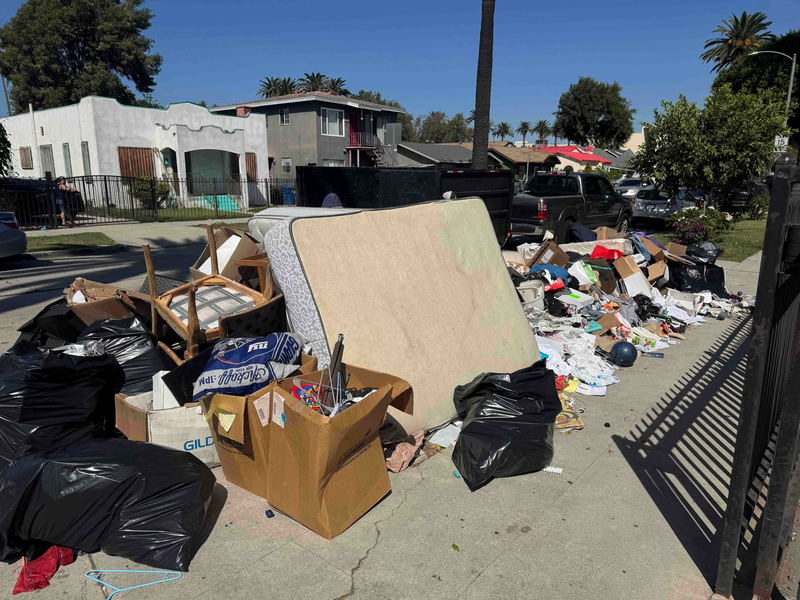
Two people need this page: the one staring at a pile that appeared overnight, and the one about to hand a sofa to a truck that will leave it three blocks away.
Free quote, no obligation · one flat number before we start · you can also text that number
Published · last checked · written by the crew at Los Angeles Junk Removal & Hauling
Under California Penal Code 374.3 a first conviction for illegal dumping carries a mandatory fine of $250 to $1,000. Dumping a cubic yard or more is a misdemeanor fined $1,000 to $3,000 on a first conviction. Los Angeles adds its own administrative fines under Municipal Code 66.25. Report a pile through MyLA311.
Those are the numbers most people came for. The one that matters more is subdivision (b) of the city ordinance: anyone whose identifying information is found in solid waste on a street is responsible for it. The envelope under the mattress counts for more than whose truck carried it. Reporting a pile is free; so is the bulky pickup that would have prevented it.
Four layers of law apply at once: the California Penal Code, the Health and Safety Code, the Los Angeles Municipal Code, and a city hauling ordinance with a five-figure penalty behind it. Different fines, different agencies, different burdens of proof. Everything below is quoted from the statute or the city page that sets it, and where a figure is not published this page says so rather than filling the gap.
Penal Code 374.3(a) makes it unlawful to “dump or cause to be dumped waste matter” on a public or private road, on private property without the owner's consent, or in a public park. Subdivision (b) names rocks, concrete, asphalt and dirt. Subdivision (c) makes it an infraction and adds the clause people miss: “Each day that waste placed, deposited, or dumped in violation of subdivision (a) or (b) remains is a separate violation.”
The fines in subdivision (e) are mandatory, not discretionary, and they escalate by conviction. Used tires double them. Subdivision (h) is where a household job turns criminal: dumping in “commercial quantities” is a misdemeanor, defined as waste from a trade or business or “an amount equal to or in excess of one cubic yard.” A three-seat sofa is more than a cubic yard, and that subdivision's household exemption only covers waste dumped at your own residence.
Two neighbors matter too. Penal Code 374.7 makes dumping into a river, creek, channel or reservoir, or within 150 feet of the high water mark, a misdemeanor. Health and Safety Code 117555 makes dumping solid waste on a street, alley or public property a straight misdemeanor with no volume threshold at all.
| 374.3, mandatory fines | $250 to $1,000 on a first conviction, $500 to $1,500 on a second, $750 to $3,000 on a third or later. Doubled for used tires. |
|---|---|
| 374.3(h), commercial quantities | Misdemeanor. Up to 6 months in county jail plus a mandatory $1,000 to $3,000, then $3,000 to $6,000, then $6,000 to $10,000. Triggered by waste from a trade or business, or one cubic yard or more. |
| 374.3(h)(2), business over 10 full-time staff | $1,000 to $5,000, then $3,000 to $10,000, then $6,000 to $20,000, and the licensing body posts the conviction publicly. |
| 374.3(c), (f), (g) | Every day it remains is a separate violation. The court may order removal or its cost, and 12 hours of picking up waste matter. |
| 374.7, waterways | Misdemeanor. $250 to $1,000, then $500 to $1,500, then $750 to $3,000. |
| 374.8, hazardous substances | Up to a year in county jail, or 16 months, 2 or 3 years, or a fine of $50 to $10,000, or both. |
| Health and Safety Code 117555 | Misdemeanor for dumping solid waste on a street, alley or public property. No volume threshold. |
Sources: California Penal Code 374.3, 374.7, 374.8 and Health and Safety Code 117555, read September 11, 2026.
Municipal Code 66.25 is the local prohibition and it is broader than people assume: “No person shall deposit or cause to be deposited any solid waste of any kind whatsoever upon or in any street, or upon any premises in this City, or in the Los Angeles River.” A vacant lot and an alley behind a building are both covered.
Subdivision (c) gives the city two routes: charge it criminally under Municipal Code 11.00, or issue an administrative citation at fines written into the ordinance. The City Attorney confirmed those figures to the City Council on January 27, 2026, and named the difference that decides which route gets used: administrative fines are collected by the city, criminal fines go to the court. The same report states that all illegal dumping violations in the Municipal Code are misdemeanors, apart from a short list of wash-water and commercial-kitchen infractions.
Subdivision (d) is the part that costs real money. Where a deposit damages public property or breaks a state or federal rule it is deemed a public nuisance, and whoever deposited it, or caused it to be deposited, owes the city its correction costs plus 40 percent of the work as administration, minimum $100.
| LAMC 66.25(c), administrative citation | $500 first violation, $750 second, $1,000 third and each after. |
|---|---|
| LAMC 11.00(m), criminal catchall | $250 for an infraction; $1,000, six months in jail, or both, for a misdemeanor. |
| LAMC 11.2.04(b), default ACE schedule | $250, then $500, then $1,000, where an ordinance names no figure. |
| LAMC 66.25(d), cost recovery | Cleanup cost plus 40 percent administration, minimum $100, as a personal obligation. |
| LAMC 64.70.02 | Separate ban on discharging pollutants or hazardous substances into the storm drain system. |
| LAMC 61.07 | LA Sanitation and Street Services officers may enforce state dumping law, not only the city code. |
Sources: Los Angeles Municipal Code Sec. 66.25, as amended by Ordinance No. 186,366, effective 10/31/19, and the Los Angeles City Attorney report on Council File 25-0203, January 27, 2026.
Rather not deal with any of it? Tell us what is there and we will price it.
Free upfront quote, no obligation. If your city will haul it free instead, we will tell you that first.
5.0 from 67 reviews on GoogleMon–Sat, open 24 hours


Our own crews on Los Angeles County jobs. Side yards, narrow walkways and the back of the property is where most of the work actually happens.
You paid a man in a pickup forty dollars to take a couch. He took it. Three days later it is in an alley with your junk mail in the cushions, and the citation comes to you.
There is a written basis for that. Municipal Code 66.25 subdivision (b): “Any person whose identifying information is found in or who is otherwise responsible for the deposit of solid waste of any kind whatsoever, upon or in any street, shall be responsible for depositing it on the public right-of-way.” Two tests, either one sufficient. The state statutes reach the same way through their verbs: Penal Code 374.3 covers dumping “or causing to be dumped”, and Health and Safety Code 117555 covers a person who “causes to be placed, deposited, or dumped” solid waste on a street.
That language does not decide your case. Whether a homeowner who hired in good faith is prosecuted turns on evidence and prosecutorial discretion, and no city or county page we could find promises either outcome. The honest version: the law plainly reaches the person who caused the dumping, and the practical trigger is something in the pile with a name on it. Investigators work backward from a prescription label, a shipping box, a utility bill, a delivery sticker still glued to a dresser. Strip the labels before anything leaves the house. If a load of yours does land on a street, 66.25(d) makes the cleanup cost a personal obligation on top of any fine.
From Penal Code 374.3 and LAMC 66.25.
Cameras. The City Attorney's January 2026 report states that many, if not most, of the illegal dumping cases the Criminal Branch prosecutes rest on evidence obtained through video surveillance, because officers can rarely catch dumping in real time, and it asks the Council to fund more cameras at hot spots. Cameras are real, and they are the main evidentiary route. How many is another question: the last count the city published is in the Controller's 2021 audit, 19 cameras across 470 square miles and roughly 6,500 miles of roadway. No updated figure has been published since, so we will not quote one.
Rewards. The Office of the City Clerk publishes a claim process for a reward for information resulting in the identification, apprehension and conviction or final adjudication of a person committing graffiti vandalism or illegal dumping. Payment is contingent on that conviction, and the LAPD reports to the City Council with a recommendation. The page publishes no dollar amount, so we will not invent one. Neither CleanLA nor County Public Works publishes a reward program at all.
Target against reality. LA Sanitation publishes a 48-hour response target for reported dumping sites. The Controller measured an average of five days, in a period when service requests had gone from about 457 a month in 2016 to about 2,500 a month in 2020. That audit is five years old and the program has been reorganized since, but it is the most recent independent measurement the city has published.
Sources: Los Angeles City Attorney, Council File 25-0203; City Controller, “Piling Up” (2021); Office of the City Clerk, reward claim.
LA Sanitation tracks every cleanup request through MyLA311 and says resident service requests are the primary force driving its daily cleanup routes. Crews run two shifts, 6:00am to 2:30pm and 3:00pm to 11:30pm. It does not abate dumping on private property, which is the owner's job, nor on freeway corridors and ramps, which are Caltrans, nor railroad corridors.
Street, sidewalk, alley or parkway is LA Sanitation. Private lot is the owner. Freeway shoulder or ramp is Caltrans. Filing against the wrong agency is the usual reason a pile sits for weeks.
Online at myla311.lacity.gov, open 24 hours, in the MyLA311 app, by dialing 311 or (213) 473-3231 in call center hours, or on LA Sanitation's 24-hour line 1-800-773-2489. TDD users call 7-1-1.
Nearest address or cross streets, which side of the street, and what is there. A mattress, four bags of trash and a television are three different trucks. County Public Works asks for the same two things.
A photo from the sidewalk records the pile and the date. Do not open bags or pull out mail. If paperwork is visible without touching anything, note it: under 66.25(b) that is what assigns responsibility.
It is the record the crew is dispatched against and the only way to follow up.
LA Sanitation's target is 48 hours. In unincorporated county areas allow two business days before calling (888) 253-2652 with the case number.
| City of LA, online | myla311.lacity.gov, 24 hours a day |
|---|---|
| City of LA, app | MyLA311 for Android and iPhone |
| City of LA, phone | 311, or (213) 473-3231. Call center Monday to Friday 7:00am to 7:00pm, weekends and holidays 8:00am to 5:00pm. |
| City of LA, 24-hour line | LA Sanitation Customer Care Center, 1-800-773-2489 |
| City of LA, response target | 48 hours to clear a reported site |
Sources: LASAN, Cleanup of Illegal Dumping, LASAN Illegal Dumping Clean-Up, MyLA311, LA County CleanLA and the City Controller’s 2021 audit.
311 does not reach the other eighty-seven cities in this county. In an unincorporated community the route is County Public Works; in an incorporated city it is that city's public works or code enforcement line. The state penalties apply either way. The county adds one tool the city does not: in August 2005 the Board of Supervisors adopted an ordinance, now Chapter 13.80 of the County Code, letting the Sheriff seize and forfeit a vehicle used to dump illegally.
| Who to call | County Public Works, (888) 253-2652, or dumping@pw.lacounty.gov |
|---|---|
| Online | The incident report form on pw.lacounty.gov, or The Works app |
| What the county cites | Penal Code 374.3 and Health and Safety Code 117555 |
| Vehicle forfeiture | County Code Chapter 13.80, adopted August 2005 |
| Antelope Valley | A Trash Responsibility Ordinance requires weekly disposal; self-hauling needs a free yearly permit from Public Health. Landfill vouchers on (661) 726-3600. |
| Illicit discharge to storm drains | (800) 675-4357, 24 hours |
Sources: LA County Public Works, CleanLA Illegal Dumping and Antelope Valley Illegal Dumping Task Force.
A legitimate hauler has nothing to hide about the back half of the job. Ask four things: the business name, a number that answers when you call it back, proof of insurance, and which facility this load is going to. Anyone who will not answer the fourth has answered it.
There is a hard rule behind that in the City of Los Angeles. Any private company collecting solid waste or construction and demolition debris inside city limits must hold an AB 939 Compliance Permit from LA Sanitation, pay a compliance fee of 10 percent of gross receipts once it moves 1,000 tons or more in a year, file quarterly tonnage reports, and take all mixed C&D to a City-certified processing facility. LA Sanitation states the penalty for a load that goes elsewhere: up to $5,000 per load, under Ordinance 181519, approved March 5, 2010. You can check the claim, because LA Sanitation publishes the current permitted hauler list and the certified processor list, and Building and Safety makes contractors name their permitted hauler on a building permit. The rest of the checks are in how to check a hauler is legitimate.
The free route deserves saying first, because it prevents all of this. City of LA bulky-item collection is unlimited, free, and needs one business day's notice through MyLA311 or 1-800-773-2489. Setting a couch out without that booking is not a shortcut to the same thing: it is a deposit of solid waste on a street under 66.25, and it is over a cubic yard. Our city-by-city guide covers what each surrounding city offers; when none of it fits, our pricing page explains how we quote.
| Permit required | AB 939 Compliance Permit from LA Sanitation, for any private company collecting solid waste or C&D debris in the city |
|---|---|
| Where mixed C&D must go | A City-certified mixed C&D processing facility, nowhere else |
| Penalty per load that goes elsewhere | Up to $5,000 |
| The ordinance | Ordinance 181519, Council File 09-3029, approved March 5, 2010 |
| How to check | LA Sanitation publishes the permitted hauler list and the certified processor list on its permit page |
| Ask before the truck leaves | Business name, a callback number that answers, proof of insurance, and the receiving facility |
Sources: LASAN Waste Hauler Compliance Program, Apply for a Commercial Waste Hauler Permit and C&D Recycling Program.
Every rule, fee, limit and deadline on this page is from the body that sets it. Checked on the date above; if a city changes its program we change the page.
Same crew, one visit, one number agreed before anything is lifted.
Couches, sectionals, mattresses in the same trip, beds, desks and wardrobes carried down rather than dragged.
Drywall, lumber, tile and concrete, hauled to a certified C&D processor.
The whole garage in one visit. We sort, donate what is usable and sweep the slab.
Booked and cleared the same day, most days, across LA County.
The rest of the LA disposal manual.
Thirteen Los Angeles-area programs in one table: how many free pickups a year, how many items, who to call and what each one refuses.
Seven checks that take ten minutes, and why the fine for illegally dumped junk follows the property it came from.
Free curbside pickup, free drop-off sites, the state recycling fee you already paid, and the fine for leaving it in an alley.
The follow-up questions people ask after this one.
Under California Penal Code 374.3 a first conviction carries a mandatory fine of $250 to $1,000, a second $500 to $1,500, a third $750 to $3,000. Dumping a commercial quantity, meaning one cubic yard or more or any waste from a business, is a misdemeanor with fines up to $10,000 and six months in county jail. The city can instead issue a $500, $750 or $1,000 administrative citation under Municipal Code 66.25.
File a service request at myla311.lacity.gov, open 24 hours, in the MyLA311 app, by dialing 311 or (213) 473-3231, or on LA Sanitation's 24-hour line 1-800-773-2489. Give the address or cross streets and list what is in the pile. LA Sanitation publishes a 48-hour response target.
Municipal Code 66.25(b) makes any person whose identifying information is found in solid waste deposited on a street responsible for it, and both Penal Code 374.3 and Health and Safety Code 117555 reach a person who causes waste to be dumped, not only whoever unloads it. Prosecution depends on the evidence, but the law plainly reaches the person who generated the waste.
Yes, unless a collection is booked. Municipal Code 66.25 prohibits depositing solid waste on any street, and a three-seat couch exceeds the one cubic yard that makes a dump a commercial quantity under Penal Code 374.3(h). LA Sanitation's bulky-item pickup is free and unlimited and needs one business day's notice.
The Office of the City Clerk publishes a claim process for a reward for information leading to the identification, apprehension and conviction or final adjudication of someone who dumps illegally, contingent on that conviction, with the LAPD reporting to the City Council. The page publishes no amount, and Los Angeles County publishes no reward program for its unincorporated areas.
In unincorporated Los Angeles County call County Public Works on (888) 253-2652, email dumping@pw.lacounty.gov or use The Works app, and allow two business days before following up. In an incorporated city such as Glendale, Burbank or Long Beach, use that city's public works or code enforcement line.
Word for word from Google. Nothing tidied.
Working with Hunter and this company was great. Gave us a quick quote over the phone after sending photos and was able to help us the SAME day. Removal was fast and easy. We definitely recommend going with this company.
Read all 67 on GoogleSee us on YelpReviews, and how to check any LA hauler
Send a photo, get a flat number back. Free, no obligation, no pressure and no call-out fee — and if your city will haul it free instead, we will tell you that too. Most requests are answered within the hour during working hours.