Mon–Sat open 24 hours · Sun 1–10pmFully insuredFamily-run, LA-based
team@lajunkhauling.com
Call us today(323) 230-0777
Home/Services/Mattress removal

Mattress removal and disposal
recycled, not dumped.

Mattresses, box springs, foundations and futons collected from any floor across greater LA, and put through California's recycling program wherever the unit is clean and dry.

Free quote, no obligation · one flat number before we start · you can also text that number

In short

In Los Angeles a mattress is removed by one of three parties: your city’s curbside bulky-item crew, a free state-funded drop-off site, or a private hauler who carries it out of the room. Clean, dry units are dismantled for steel, foam and wood. Wet, moldy or infested ones are landfilled.

A mattress is the most awkward single object in a normal home: too heavy to carry alone, too big for a car, banned from most dumpsters, and expensive to get wrong. It is also one of the few things in California with a dedicated, state-run recycling system behind it — which most people are paying for and never use.

So this page is in two halves. First the free routes, with the phone numbers and the caps, because in most of Los Angeles County one of them will work. Then the parts nobody writes about honestly: what a recycler actually does with the unit, what happens when it is wet or infested, and why a king mattress sometimes cannot physically leave the room it was assembled in.

Your four options

Four ways to get a mattress out of your house

In short Three of the four cost you nothing. Each of the three buys that with something else: a wait for your trash day, a cap on how many units you may bring, or a vehicle the mattress fits in. The fourth is a crew, and the only thing it sells is the lift.
The four ways a mattress leaves a Los Angeles home, compared
RouteWaitCost to youWho lifts itCatch
Your city’s bulky-item pickup Your next regular trash day in the City of Los Angeles, booked at least one business day ahead. Elsewhere it runs from 24 hours in Inglewood to about two weeks in Pasadena. Free in most of LA County. Burbank applies a per-item special handling fee to a mattress or box spring, and Beverly Hills charges when the unit goes from the parkway rather than the alley. You, as far as the curb. No city crew in this county comes inside, up a stair or into a garage. Caps. Long Beach allows twelve special collections a year, Beverly Hills two items a request, Torrance one pickup a year. In the City of Los Angeles a building of five units or more is off the free route entirely.
A free state-funded drop-off site None. Most sites keep weekday business hours; the Long Beach Public Works yard on West Chester Place is open to city residents around the clock. Free. California’s mattress recycling fee was already collected at the register when the mattress was sold, which is what pays the site to take it back. You, twice. Into the vehicle and out of it again. Several yards are unstaffed and say so in writing, so bring whoever is holding the other end. You need a vehicle it fits in, and almost every site runs a per-visit cap, typically four or five units.
Retailer take-back on delivery The day the new mattress arrives. The state program’s retailer guidance allows up to thirty days to collect the old one. Free. A California retailer must offer to take your old mattress at no additional cost when it delivers a new one. The delivery crew, from wherever they are putting the new one. This is the only free route that reaches past the curb. It only exists if you are buying a replacement, and you have to ask at the point of order rather than on the doorstep. A contaminated unit can be refused.
Book a crew Usually the same day. We run Monday to Saturday around the clock and Sunday 1pm to 10pm. Quoted on the spot, by volume. We do, out of the room it is in — second-floor walk-up, spiral stair, converted garage, storage unit. It is the one route on this table you pay for. If the mattress can reach the curb, you are a City of Los Angeles single-family customer and you can wait for trash day, do that instead.

Rows one to three are yours for free and we would rather you used them. Row four exists for the week you are actually having: the bed is on the second floor, the tenant is out on Saturday, the unit got wet, or the collection date is eleven days away and the mattress is in the hallway now. If that is you, text a photo to 323-230-0777 or get a free upfront quote and you will have a flat number before anyone drives.

Sources: LASAN bulky-item pickup, Mattress Recycling Council California, Bye Bye Mattress California FAQ, Los Angeles County Public Works, City of Burbank. Full city-by-city detail in our LA County mattress guide.

The free routes

You have already paid for the recycling

In short Every new mattress, futon and foundation sold in California carries a mattress recycling fee, which rose to $18.00 per unit on April 1, 2026. It funds a nonprofit program under CalRecycle oversight that runs more than 240 permanent drop-off sites statewide, around 100 collection events a year, and free retailer take-back on delivery. Dropping a mattress off costs you nothing.

LASAN curbside. City of Los Angeles residents can put mattresses and box springs out for free bulky-item pickup, requested a business day ahead via the service request form, the MyLA311 app or 1-800-773-2489. Curbside only, on your normal trash day. LASAN asks for an itemized list when you book so the yard sends a correctly sized truck, and its own example is worth copying: a mattress and a box spring are two items, not one.

Retailer take-back. If a new mattress is being delivered, the retailer is required to take the old one away free. Ask at the point of order, not on the doorstep. Los Angeles County Public Works reads the requirement as reaching online sellers too, and the program’s own retailer guidance allows a retailer to refuse a unit that is contaminated and poses a risk to its people, products or equipment.

Permanent drop-offs. LA County has close to twenty no-cost collection centers. Verified local sites: Nu-Way Roll Off and Monrovia Mattress Drop, 145 W Duarte Rd, Monrovia, Mon–Fri 9–2, ten-unit maximum; R5 Recycling, 739 N Georgia Ave, Azusa, Mon–Fri 7–3, five units per resident.

LASAN’s monthly drop-off Saturdays. If you would rather not wait for a trash day, the city opens five of its own yards one Saturday a month from 8:00am to 4:30pm: East Valley on Pendelton Street in Sun Valley, West Valley on Vanalden Avenue in Northridge, Harbor on North Gaffey Street in San Pedro, West LA on Stoner Avenue, and Central LA on East Washington Boulevard. The published 2026 Saturdays run from January 10 to December 12. It is first come, and you load and unload yourself.

City programs outside LA. Torrance gives one free pickup per address per year, up to twenty items, and recycles mattresses. Burbank collects at the curb but applies a per-item special handling fee to mattresses and box springs. Glendale takes them within its four free annual appointments. Pasadena caps at roughly three cubic yards and nothing heavier than two people can lift.

One caveat that catches people out at a collection event rather than a permanent site: the county’s own event rules say mattresses and box springs will not be accepted from commercial business haulers. These routes are built for residents moving their own unit, not for a contractor clearing a building.

Sources: Mattress Recycling Council California, CalRecycle mattress product management, Los Angeles County Public Works, Bye Bye Mattress greater Los Angeles, Bye Bye Mattress California FAQ, LASAN bulky-item pickup, City of Burbank.

On the job
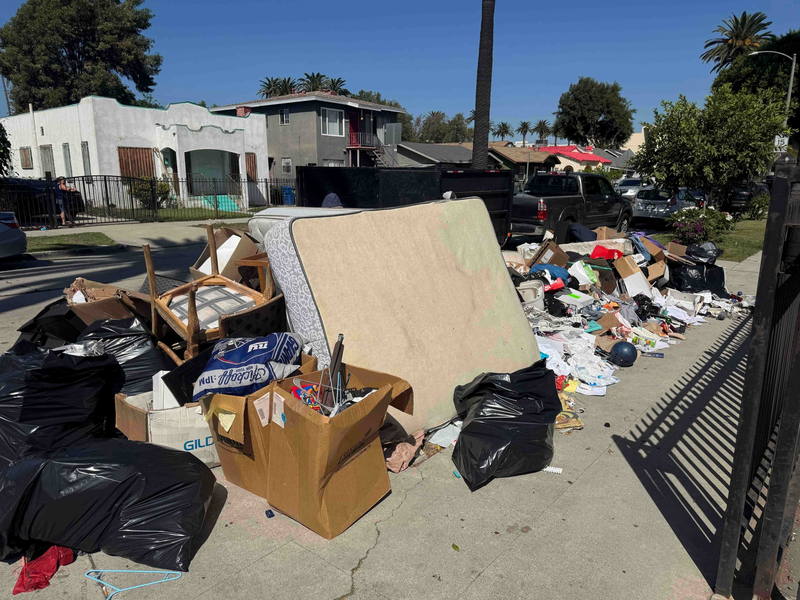
A large curbside pile on a Los Angeles County street: a stained mattress on its side, dining chairs, collapsed cartons, black bags and loose trash spread across the sidewalk in front of the houses
The kind of curbside pile we clear in one visit
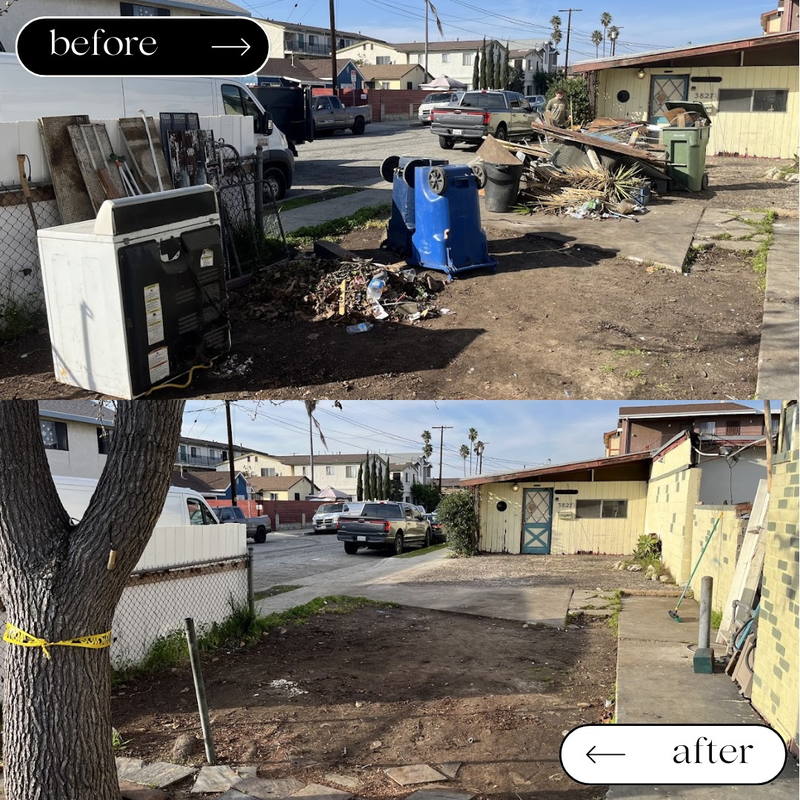
Before and after of a Los Angeles County front yard: a dumped washer and dryer, overflowing bins, cut palm fronds and scattered trash, then the same yard raked flat and completely clear
Before and after — a dumped front yard cleared
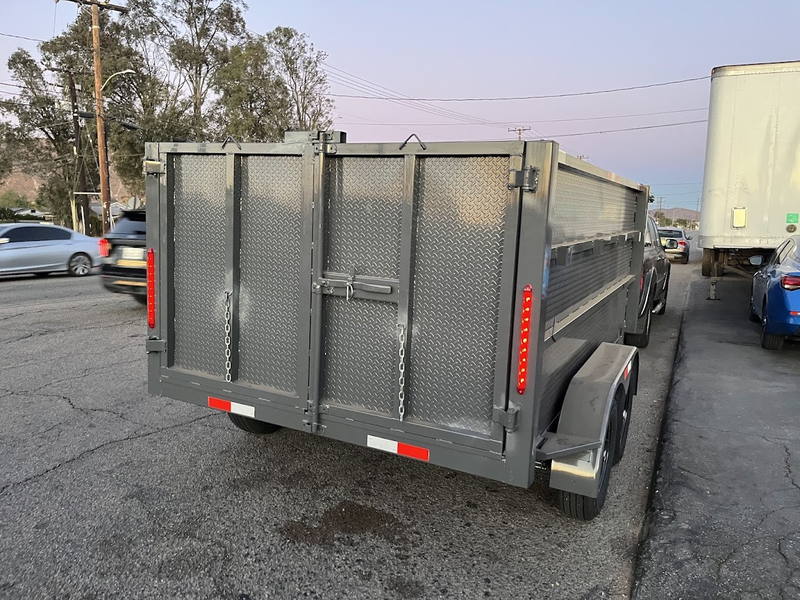
Our gray steel dump trailer with diamond-plate tailgate parked curbside on a Los Angeles County street, empty and ready for the next load
The trailer we bring to your curb

Our own crews on Los Angeles County jobs. Side yards, narrow walkways and the back of the property is where most of the work actually happens.

When you call us

The free routes have four gaps

Stairs

Every free program is curbside or drop-off. Nobody comes up to a second-floor apartment for a king and a box spring. That is the single most common reason people call.

Timing

Curbside runs on your trash day. Drop-offs run weekday daytime with unit caps. Neither works when a tenant leaves Saturday and a new one arrives Sunday.

Volume

Ten-unit caps at a drop-off and item caps on city pickups make a building turnover impossible to run for free. We take the lot in one visit.

The rest of the room

A mattress rarely leaves alone. Bed frame, dresser, nightstands, a rug and three bags. One truck, one price — see furniture removal.

On the day

Mattress pickup usually happens the same day you call

In short Text or send a photo of the unit, say which floor it is on, and you get a flat number back before anyone drives. A crew arrives in the window, carries the mattress and the foundation out of the bedroom, sweeps the space it came from, and the unit goes to a recycler the same day unless it is wet, moldy or infested.

Four things decide how a mattress pickup actually runs, and all four are worth saying when you book rather than when we arrive. The floor. Ground floor with a driveway is the easy version; a third-floor walk-up over tuck-under parking in North Hollywood is a different job and a different number. The stair or the elevator. A king and a one-piece box spring will not turn some landings in this city, and a building that requires a reserved freight elevator and a certificate of insurance needs that booked ahead. What else is going. A mattress almost never leaves alone: the frame, the headboard, the nightstands and three bags usually go in the same load, which prices better together than as two visits. The condition. Say it plainly if the unit is wet or you suspect bed bugs. It changes nothing about whether we take it and everything about how it is wrapped and where it goes.

We do not ask you to drag a mattress to the parkway and we do not need you to be home for the whole window. What we do need is access: a gate code, a unit number, a parking spot the truck can legally hold for twenty minutes. Storage facilities are a common one — most close their gates well before we stop working, so the booking has to land inside the facility’s hours rather than ours.

If none of this applies to you, the honest answer is that mattress pickup is already free where you live. Start with free mattress pickup in Los Angeles, which lists which city collects one at no charge, the caps and the phone numbers, and come back here only if the stairs, the deadline or the condition of the unit rules that out.

Where it actually goes

Mattress disposal is a sorting job, not a trip to the dump

In short A mattress that reaches a recycler is pulled apart by material. The steel coils are shredded or compressed and sold as scrap, the polyurethane foam is shredded and blended into carpet padding, and a box spring’s pine frame becomes mulch, fuel pellets or biomass fuel. The Mattress Recycling Council puts the recoverable share at up to 75 percent of a mattress, which is another way of saying a quarter of it still has nowhere to go.
What a mattress is made of, where each layer goes, and what sends it to landfill instead
LayerWhat a recycler does with itWhat it becomesWhen it is landfilled instead
Innerspring coils and border rod Cut out of the unit, then shredded or compressed to a scrap buyer’s specification. Pocketed coils have to be freed from their polypropylene sleeves first. Scrap ferrous steel Essentially never. Steel is the one layer with a reliable buyer, and it is why a mattress has any recycling economics at all.
Polyurethane foam Separated, shredded and blended with post-industrial scrap foam. Carpet padding When it has been wet. A padding plant will not take soaked or moldy foam, and the water does not have to be visible for the smell to disqualify it.
Memory foam and latex Sorted out by hand, then routed depending on the buyer. Natural, synthetic and blended latex cannot be told apart by eye. Padding where a plant accepts it, otherwise nothing Often. Some padding manufacturers treat memory foam as a contaminant in a blend, and some scrap buyers refuse latex outright on fire risk.
Wood frame of a foundation or box spring Broken down off the springs and chipped. Mulch, fuel pellets or biomass fuel When the timber is water-damaged, or so full of staples that sorting it costs more than the chip is worth.
Cotton, felt and shoddy padding Pulled off in sheets and graded by how clean it is. Industrial filters, insulation and oil-absorbent products Whenever it is visibly soiled. This is the layer that most often ends the whole unit’s recycling, because it sits directly under the cover.
Quilted cover and ticking Cut off the unit and baled if anyone is buying. Low-grade fiber Routinely. Fabric has the thinnest market of anything in the stream, and most of it is disposed of even on a unit that otherwise recycles well.
The whole unit, when it is wet, moldy or infested Nothing. It is bagged on site, kept clear of the rest of the load and taken straight to disposal. Nothing Always. California’s program needs a unit clean and dry, so a contaminated mattress leaves the free route the moment it gets wet.

Sources: Mattress Recycling Council, component-by-component teardown, Mattress Recycling Council California, CalRecycle mattress product management, Bye Bye Mattress, accepted and unaccepted in California.

Almost every hauler in Los Angeles says the word “recycled” and leaves it there. It is worth knowing what the word buys, because the economics of each layer explain why condition matters so much, and why a soaked mattress costs more to get rid of than a dry one.

Steel is the part with a real market

An innerspring mattress is held together by high-carbon steel. Older units use Bonnell coils — the hourglass-shaped continuous layer — and newer ones use pocketed coils, individual springs each sleeved in polypropylene fabric. Both end up as scrap ferrous steel, and the Mattress Recycling Council is blunt about the condition attached to that: the high value is only achieved once the metal has been shredded or compressed to the buyer’s specification, and with pocketed coils the steel first has to be separated from the fabric sleeve. A foundation’s springs are lower-carbon and softer, and have to come off the wood before they are worth anything. None of that happens in the back of a truck. It happens at a facility with a shredder, which is why a mattress has to be delivered somewhere specific rather than simply taken away.

Foam becomes carpet padding, if it is clean

Polyurethane is the most common mattress foam, and clean polyurethane is genuinely wanted: carpet padding manufacturers blend post-consumer mattress foam with post-industrial scrap foam. Memory foam is more awkward. Some padding manufacturers treat it as a contaminant in a blend, while some pads are made from nothing else. Latex is the hardest of the three, because natural, synthetic and blended latex cannot be told apart by eye and some scrap buyers refuse it outright as a fire risk at higher temperatures. The word “clean” is doing all the work in that paragraph. Foam that has been wet is not foam a padding plant wants.

The fibers are the honest problem

Between the coils and the comfort layers sits shoddy felt, a dense barrier made of shredded post-industrial fabric that has already been recycled once. Its short mixed fibers limit what it can be recycled into a second time. The resilient fiber layers — coconut fiber, polyester, wool, horsehair — arrive in volumes too small to accumulate and market, and the Council records them as typically landfilled. Gin mote cotton has a narrow use blended into insulation. Quilt panels are shredded into carpet padding when they are presentable, and the Council notes plainly that visibly contaminated quilt is commonly landfilled. That is the honest shape of the 75 percent figure: the metal and the foam carry it, and the textiles drag it down.

The box spring is a different object entirely

A foundation is mostly soft wood, typically Canadian pine, stapled to a steel grid and wrapped in fabric. Separated from the metal it becomes landscape mulch, fuel pellets, biomass fuel or reconstructed shipping pallets — but some of those markets will not tolerate nails, staples or fabric left in the chip. The non-woven bottom fabric has a market too, if the recycler knows which polymer it is. This is why we keep mattresses and foundations as a separate stream on the truck rather than crushing them in with furniture: once a foundation has been snapped in half and mixed with a dresser, nobody downstream can usefully sort it.

The numbers, as the state reports them

CalRecycle’s 2025 program highlights give the scale and the honest ceiling in the same breath. 1.6 million mattresses were collected in California in 2025 and 14.3 million since the program started in 2016. 62 million pounds of mattress material were diverted. Of the units collected in 2025, 67.3 percent were renovated, recycled, or sent to biomass conversion — which means roughly a third were not. There were 247 drop-off sites in California and 98.7 percent of residents had a site within fifteen miles of home. Nationally the Council counts more than 50,000 mattresses discarded in the United States every day.

We are not a recycler and we do not pretend to be one. What we do is get the unit to a facility that is, in a condition that facility can still use, and tell you when yours is past that point.

Sources: Mattress Recycling Council, component-by-component teardown, Bye Bye Mattress FAQ, CalRecycle mattress product management, the Bye Bye Mattress facility locator.

The calls nobody wants to make

Bed bugs, mold, and the units nobody will take

In short A mattress that is severely damaged, heavily soiled, moldy, excessively wet or infested is outside the normal no-cost drop-off route: Bye Bye Mattress tells you to contact the site first, because acceptance varies by location and fees may apply. We bag and seal the unit in the room it is in, carry it out sealed, and take it straight to disposal rather than to a recycler.

This is the part of the job people apologize for on the phone. There is nothing to apologize for. Bed bugs in Los Angeles are a building problem, not a hygiene problem, and mold on a box spring usually means a slab leak or a window somebody left open in February. What matters is that you say so when you book, because the handling changes completely.

What the free routes do with a contaminated unit

The state program is explicit. Where a mattress or box spring is severely damaged, heavily soiled, moldy, excessively wet or frozen, or infested with bedbugs or other organisms, Bye Bye Mattress asks you to contact your intended drop-off location for instructions, warns that no-cost drop-off of units in that condition varies by site, and says fees may apply. The retailer route closes too: California lets a retailer refuse to take back a unit that is contaminated and poses a risk to personnel, new products or equipment. And a city curbside crew is not going to argue about it on the parkway — a visibly soaked or infested mattress gets left, and then it is an illegal dumping problem attached to your address rather than a collection you booked.

What we actually do differently

Three things. We bring the bag to the bedroom instead of carrying the mattress to the bag, so the unit is sealed before it moves. We do not drag it down a shared hallway or stand it in a lobby or an elevator while we fetch the next piece, because that is precisely how one unit becomes four. And we route it to disposal rather than to a recycler, in its own stream, with nothing else from the house riding against it. That last part is why we ask rather than guess: a sealed infested unit mixed into a recycling load is a problem for the facility and for every other customer on that truck.

Before you throw the bed out at all

The EPA’s position is worth hearing before you spend anything. Its do-it-yourself guidance says not to discard furniture if the bed bugs can be safely eliminated from it, and recommends sealed protective covers for mattresses and box springs — with a cover that seals, the bugs are trapped inside and die. If you do decide to discard it, the EPA asks you to destroy it so nobody is tempted to take it home, and suggests marking the unit with spray paint so it is unmistakable. In Los Angeles that last step is not theater. Mattresses genuinely get picked up off parkways by people who do not know what they are taking.

The EPA also notes where they actually live: around the piping, seams and tags of the mattress and box spring, and in cracks in the bed frame and headboard. A bed bug is about the width of a credit card, so if a crack will hold a card it will hold a bug. The practical consequence is that replacing the mattress and keeping the frame often solves nothing, which is why we take the frame with it more often than not.

If you rent

Tell the landlord in writing. California Civil Code section 1954.603 requires every landlord of residential rental property to give tenants written information about bed bugs and a procedure for reporting a suspected infestation — built into new leases from July 1, 2017 and sent to existing tenants by January 1, 2018. The EPA’s own advice is the same: if an expert confirms bed bugs and you live in an apartment, notify the landlord, because the neighboring units need inspecting. A mattress leaving the building is the last step of that process, not the first.

Sources: Bye Bye Mattress FAQ, Bye Bye Mattress California FAQ, US EPA, do-it-yourself bed bug control, US EPA, how to find bed bugs, Berkeley Rent Board on California Civil Code 1954.603.

Access

Getting it out of the room

In short A king mattress is about 76 inches wide, a California king about 72 inches wide and 84 long. Nothing that size turns a tight stair landing flat. What gets a large mattress out of an LA apartment is folding it on its edge, taking the bed frame apart first, and knowing before we arrive whether the box spring is one piece or two.

Half the surprises on a mattress job are geometry, and all of them are avoidable with one question answered on the phone. The Better Sleep Council’s own sizing guide tells new buyers to measure the corridors, doors and stairwells a mattress has to pass through before they buy it. Almost nobody does, which is why the removal is harder than the delivery was.

The numbers that decide it

A twin is roughly 38 by 75 inches and a twin XL 38 by 80. A full is about 53 by 75, a queen 60 by 80. A king is about 76 by 80 — roughly two twin XLs pushed together — and a California king about 72 by 84, four inches narrower and four longer than a standard king. Those last two are the ones that generate the phone call. A standard interior doorway in an older LA apartment is narrower than a king mattress is wide, which is fine, because a mattress goes through a door on its edge. The problem is the turn immediately after it.

Why the box spring is harder than the mattress

A mattress bends. A box spring does not. It is a rigid wood-and-steel box, and a one-piece queen or king foundation is the single most common item that physically will not leave a bedroom it was carried into before a hallway was reframed or a stair rail was added. Split box springs — two half-width pieces under one mattress — exist precisely to solve this, and if yours is split you have no problem at all. If it is one piece and the route out is tight, it comes apart: fabric cut back, staples out, frame separated, carried out in sections. We would rather do that than put a corner through your drywall, and it is not an extra charge.

Compressed mattresses do not go back in the box

Foam mattresses now arrive rolled and vacuum-packed in a carton two people can carry up a stair. That is a one-way trip. Once a foam core has expanded it will not compress back to anything like its shipping size without industrial equipment, so the box it came in is no help and the mattress has to leave the building at full size like any other. People genuinely plan around the box, and it is worth saying out loud that the plan does not work.

Buildings, elevators and docks

In a Downtown or Koreatown tower the constraint is rarely the mattress. It is the service elevator, the dock, and the hours the building allows either to be used. Most require a reservation, many pad the elevator themselves, and some restrict moves to weekday business hours, which is exactly when a tenant is at work. Tell us the building rules when you book and we will work inside them; we carry a certificate of insurance and most managements want one named and on file before a crew arrives. Where there is no elevator — a Hollywood or Echo Park walk-up, a hillside house with a long flight up from the street — the job is simply two people and more time, and the quote reflects the carry, not a surcharge invented at the door.

Storage units, garages and back houses

Mattresses collect in the places nobody looks. A storage unit after a move stalls, a garage where the old bed went when the new one arrived, a back house used as overflow. Interior storage units with elevator access and narrow corridors take longer than a drive-up roll-up, and most facilities shut their gates earlier than we stop working, so timing matters more than usual. You do not have to be present if the facility will admit us on your written authorization. If what we find is a whole room rather than a bed, it becomes a cleanout and gets quoted as one before anything moves.

Mattress dimensions: Better Sleep Council mattress sizes, the consumer education arm of the International Sleep Products Association.

Landlords and property managers

Apartment turnovers, and the five-unit line

In short In the City of Los Angeles the free bulky-item route is for buildings of one to four units. At five units and above the address is served by a recycLA franchise hauler instead, and bulky collection is billed through the Multi-family Bulky Item Fee on the LADWP bill rather than being free at the point of use.

This is the detail that decides whether a move-out mattress is a free phone call or a line on an operating statement, and it is the thing most often got wrong by both tenants and new owners.

Where the line actually sits

LASAN serves single-family customers, which it defines as homes of one to four units. Anything larger is a recycLA account, and the program’s own definitions page quotes the state regulation it follows: a multifamily residential dwelling of fewer than five units is not a commercial business for these purposes. So a duplex or a fourplex calls 1-800-773-2489 like a house. A twelve-unit building does not. The City divides itself into recycLA service zones served by named haulers — Athens Services, CalMet Services, NASA Services, Republic Services, Universal Waste Systems and Waste Management — and which one you get depends on the zone, not on choice.

What the Multi-family Bulky Item Fee buys

LASAN describes the Multi-family Bulky Item Fee as paying for an on-call service that collects couches and other furniture, mattresses, doors, carpet, toilets, electrical waste and appliances from recycLA-served addresses. It is charged to ratepayers who receive hauling from a recycLA service provider and do not pay trash fees directly to LASAN, and it appears on the LADWP bill. An ordinance adjusting the fee was approved by the City Council in October 2025 and implemented in November 2025; LASAN says the adjustment was necessary to keep offering unlimited, on-demand bulky pickup. Financial assistance exists: LASAN publishes a potential 31.25 percent discount for low-income customers and a possible full exemption for Lifeline customers, applied automatically to households already enrolled.

Why managers call us anyway

Because a turnover is not a bulky-item request. A unit handed back on the 30th with a mattress, a box spring, a bed frame, a sofa and nine bags is a truck, and it has to be empty before a cleaner, a painter and a new tenant arrive in sequence. We schedule around that, including nights and Sundays, take every stream in one visit, send a certificate of insurance ahead, and invoice the entity rather than the person who opened the door. Several beds across several units price better as one collection than as five separate calls. At portfolio scale it runs as commercial junk removal.

And the part a landlord should hear first

If the building is four units or fewer and the mattress can reach the curb, book the city and keep your money. We will say that on the phone, every time. The free route is written up city by city, with the caps and the numbers, at free mattress pickup in Los Angeles.

Sources: LASAN recycLA, LASAN Multi-family Bulky Item Fee, LASAN bulky-item pickup.

Do not do this

Illegal dumping is the expensive option

Mattresses are the most-dumped bulky item in Los Angeles and among the easiest to trace, because they are dumped from vehicles in daylight on streets that increasingly have cameras. Fines run to four figures. Given that the city will take it free from the curb and the state has already collected a recycling fee on it, the alley is objectively the worst available choice. If cost is the problem, call and we will point you at the nearest free option.

And before you pay anyone, including us: in most of Los Angeles County your own city will collect a mattress at the curb for nothing. We wrote the whole thing up, city by city with the caps and the phone numbers, at free mattress pickup in Los Angeles.

If what you actually want is the self-haul answer, we keep a sourced county-wide list of where to dump a mattress in LA County — every free state-funded drop-off site, every city's bulky-item program and what each one caps — and it is worth reading before you book anyone, including us.

The short version

What holds true every time

Seven things that hold across Los Angeles
  1. Mattresses and box springs are accepted free at the curb by LA Sanitation in the City of Los Angeles, booked at least one business day before your regular trash day.
  2. California charges a mattress recycling fee on every new mattress, futon and foundation sold, which is why dropping an old one at a state-funded site costs nothing.
  3. The Mattress Recycling Council puts the recoverable share at up to 75 percent of a mattress: the steel coils go to scrap, the polyurethane foam is shredded into carpet padding, and the wood foundation becomes mulch or biomass fuel.
  4. A mattress that is heavily soiled, moldy, excessively wet or infested with bed bugs falls outside the free no-cost drop-off route and is landfilled instead of recycled.
  5. Every free mattress route in Los Angeles County is curbside or drop-off, so no city crew will come inside or carry a mattress down stairs.
  6. In the City of Los Angeles free bulky-item pickup covers buildings of one to four units; at five units and above bulky collection is billed through the Multi-family Bulky Item Fee.
  7. A king mattress is about 76 inches wide and a California king about 72 inches wide by 84 long, which is why a one-piece box spring is usually harder to remove than the mattress.

Caps, lead times and handling fees are set city by city, so the local rules are written one at a time: Santa Monica, Long Beach, Hollywood, Glendale, Burbank, Pasadena, Culver City and North Hollywood. If you want the free self-haul route instead, the state locator is the list that stays current: the Bye Bye Mattress facility locator.

Across the city

Mattress pickup near you

We run mattress collections through Koreatown and Hollywood walk-ups, student housing near Westwood, short-let turnovers in Venice and Marina del Rey, and family homes across Pasadena and Glendale. Full list on the areas we serve page.

Next step

Get a free upfront quote, today

Call or text (323) 230-0777, or send photos to team@lajunkhauling.com. Flat number, no obligation, and an honest answer if the city can do it for free.

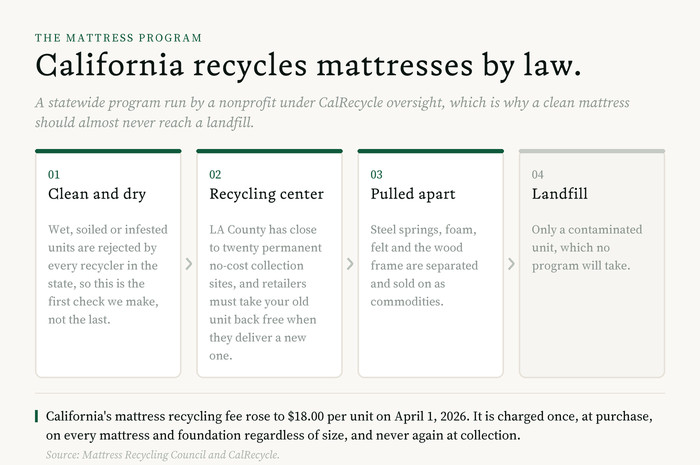
The mattress program
Diagram of California's statewide mattress recycling route: a clean dry unit goes to one of Los Angeles County's no-cost collection sites and is pulled apart into steel, foam, felt and timber, with landfill only for a contaminated mattress
California's statewide mattress recycling route, end to end.

That fee is paid once, at the shop, on every mattress sold in California. It is not a charge we add and not one the recycler collects. See how our pricing works.

Mattress removal, answered

Including the free routes, because you have already paid for them.

Where can I throw away a mattress for free?

Three free routes exist in Los Angeles County right now. Your city’s bulky-item collection takes a mattress off the curb at no charge in most of the county, and in the City of Los Angeles it is unlimited. California’s recycling program also funds drop-off sites you can drive to for nothing, and any retailer delivering a new mattress must offer to take the old one. Which one applies depends on your city, and every city’s rule is in our LA County mattress guide. If none of the three fit — it is upstairs, you have no vehicle, or you need it gone before the next trash day — text a photo to 323-230-0777 and we will quote the lift.

Where can I dump a mattress?

At a drop-off site funded by California’s mattress recycling program, which costs nothing because the fee was collected when the mattress was sold. Verified local examples are the Nu-Way Monrovia Mattress Drop at 145 W Duarte Rd, Monrovia, weekdays 9am to 2pm, and R5 Recycling at 739 N Georgia Ave, Azusa, weekdays 7am to 3pm. Caps and hours differ site by site, so check the current list in our LA County mattress guide before you drive.

Where to throw away a mattress?

Nowhere that involves your own trash. A mattress does not fit a black bin, most dumpster rental agreements in Los Angeles exclude it, and leaving it beside the bins is illegal dumping. The three places that will actually take one are your city’s bulky-item crew, a program drop-off yard, and a mattress retailer taking the old unit back on delivery — all listed city by city in our LA County mattress guide. When none of the three will take yours, or none of them will come upstairs, we will. Get a free quote. If it will not fit in your car, that is the one thing a drop-off cannot solve. We collect from the room instead — see mattress removal.

Where to dump a mattress?

If you can drive it, a yard is faster than a scheduled pickup. Long Beach runs a mattress drop-off open around the clock on West Chester Place for its own residents, and LA Sanitation opens five city yards one Saturday a month from 8:00am to 4:30pm with no appointment. Addresses, hours and who each site will take from are in our LA County mattress guide. Both of those need a vehicle and someone to lift the other end. If you have neither, send us a photo and we will come to the room it is in.

Where can I get rid of a mattress?

If a new mattress is on its way, the easiest answer is the delivery truck. California requires a retailer to offer to take your old mattress at no additional cost when it delivers a replacement, and it is the only free route that reaches past the curb. Ask at the point of order rather than on the doorstep. If you are not replacing it, the curbside and drop-off routes for your city are in our LA County mattress guide. If no new mattress is coming and the old one is upstairs, that is exactly the call we take all day. Call or text 323-230-0777.

Where to dispose a mattress?

Start with what kind of building you live in, because in Los Angeles that decides which program you get. Homes of one to four units are on LA Sanitation’s free curbside route. At five units and above the address is a recycLA account and bulky collection is billed through the Multi-family Bulky Item Fee instead. The rule for each city, and the apartment version of it, is in our LA County mattress guide. Buildings of five units and up are where most of our mattress work comes from, turnover by turnover — see mattress removal for how we run them.

Where can you throw away a mattress?

Not in household trash, not in a blue bin, and not in most rented dumpsters. The legal routes are a scheduled city bulky-item pickup, a state-funded drop-off site, retailer take-back, or a hauler. Leaving one out with no booked collection is illegal dumping under California Penal Code 374.3, which treats every day it stays there as a separate violation. The booked routes by city are in our LA County mattress guide. If you are about to leave one out because nothing else is working, call us first. A quote costs nothing and a dumping citation does not.

How much does it cost to dump a mattress?

At a drop-off site inside California’s program, nothing — the recycling fee was already paid at the register. At a landfill or transfer station you pay, usually a per-unit mattress charge on top of the tonnage, which makes it the most expensive way to get rid of one. Our own collection is quoted on the spot, by volume — see what mattress removal costs for how the market prices it. Where the free sites are is in our LA County mattress guide. Ask us what your load is before you drive to a landfill; the free route may still be open to you and we will say so.

How do I dispose of a mattress in Los Angeles?

Four routes. LASAN takes mattresses and box springs free at the curb through its bulky-item pickup if you are a City of LA resident. California runs a statewide recycling program that funds no-cost drop-off sites — LA County has close to twenty permanent ones. Any retailer delivering a new mattress must take the old one back free. Or we collect it, from any floor, usually the same day.

Is mattress recycling free in California?

Dropping one off is. The program is paid for by a mattress recycling fee charged at the point of sale on every new mattress, futon and foundation, which rose to $18.00 per unit on April 1, 2026. It is charged regardless of size and is not subject to sales tax. That fee is why the drop-off sites cost you nothing when you arrive.

Where can I drop off a mattress for free near Los Angeles?

Verified LA-area sites include Nu-Way Roll Off and the Monrovia Mattress Drop at 145 W Duarte Rd, Monrovia, Monday to Friday 9am–2pm with a ten-unit maximum, and R5 Recycling at 739 N Georgia Ave, Azusa, Monday to Friday 7am–3pm, five units for residents. Check the ByeByeMattress locator for the current list before you drive — sites and hours change.

Do you take box springs and futons too?

Yes. The state program covers mattresses, box springs, foundations and futons. Bunk bases, adjustable bed frames and headboards come with them and go out as furniture.

What if the mattress is wet, moldy or has bed bugs?

Say so when you book. A contaminated unit cannot be recycled — the program needs them clean and dry — so it is bagged, isolated and taken straight to disposal rather than mixed with the rest of the load. That is a handling question, not a judgement, and hiding it just spreads the problem.

Can you take it from an upstairs apartment?

Yes, and that is most of these calls. A king mattress plus a box spring down a narrow LA staircase is a two-person job with a real risk of damaging the wall. Free curbside programs will not do it; we will.

How much does mattress removal cost?

It is a small-volume job, quoted flat before we arrive. Multiple mattresses from a rental turnover or a hotel refit price better as one collection. See how our pricing works, and read our guide to mattress disposal in LA County for the free routes first.

Do you do whole buildings?

Regularly. Apartment turnovers, student housing at semester end, hotel and short-let refits. That runs as commercial junk removal, scheduled after hours where a building needs it, with a certificate of insurance sent ahead.

Do you remove the bed frame too?

Yes, and in practice we almost always do. Frame, headboard, footboard, side rails, slats and any under-bed drawers come out in the same visit. They travel as furniture rather than through the mattress program, because California’s program covers the mattress and the foundation, not the thing they sit on. Metal frames go to scrap, wood frames get broken down, and the rest of the room can ride along — see furniture removal.

Do you take futons and sofa beds?

Both, though they end up in different streams. A futon mattress that separates from its frame is the one exception California makes, so it rides with the mattresses; the frame itself is furniture. A sofa bed is not in the state program at all — Bye Bye Mattress names sofa beds and futon frames among the items it does not accept — so it leaves as furniture, with the steel fold-out mechanism usually cut free first to get it through the door.

What happens to the mattress after you take it?

A clean, dry unit goes to a recycler and is taken apart by material. The coils are shredded or compressed for scrap steel, the polyurethane foam is shredded and blended into carpet padding, and a foundation’s pine frame becomes mulch, fuel pellets or biomass fuel. The Mattress Recycling Council puts the recoverable share at up to 75 percent of a mattress. The remainder — loose fibers, shoddy felt, visibly soiled quilt — has no market yet and is landfilled.

Can you remove a mattress the same day?

Usually. We run crews around the clock Monday to Saturday and 1pm to 10pm on Sunday, and a single mattress is a small-volume job that slots into an existing route. Call or text rather than email if today matters. Same-day junk removal covers how the scheduling works.

Do you take just one mattress, or is there a minimum?

One is fine and there is no item minimum. But be honest with yourself before you book: if you are in the City of Los Angeles, the mattress can reach the curb and you can wait for your next trash day, LASAN will take that one unit for nothing. Paying anyone for a single mattress only makes sense when stairs, a deadline or the condition of the unit rules the free route out. Start with free mattress pickup in Los Angeles.

Do you take mattresses out of a storage unit?

Yes, and it is a regular call after a unit goes unpaid or a move stalls halfway. Bring us the gate code and the unit number, and say what the access is: an interior unit with elevator-only access and narrow corridors takes longer than a drive-up roll-up door, and most facilities close their gates well before we stop working. You do not have to be there if the office will let us in on your written authorization.
The proof

What our customers say

5.0from 70 reviews on Google

Word for word from Google. Nothing tidied.

  • 6 months ago

    We needed a last min mattress removal and called these guys up and hunter came by to pick up the mattress and haul it away for a fair price and had great communication. Very friendly and quick. Callem up for any junk removal they got you 👍the rest is on Google

    Jose G MunozLocal Guide · 16 reviews · 6 photosLast-minute mattress removal
  • Fair pricing 11
  • Personable staff 10
  • Polite 5
  • Punctual staff 4

Mattress removal
city by city

Local rules, access and drop-off points differ street by street. These pages cover what changes.

Check the free route
before you call us

Sourced guides to what Los Angeles will take for nothing, who to call and what the rules actually say.

All guides in the Los Angeles disposal manual

Request a quote

Send a photo, get a flat number back. Free, no obligation, no pressure and no call-out fee — and if your city will haul it free instead, we will tell you that too. Most requests are answered within the hour during working hours.

Or call or text (323) 230-0777 — Mon–Sat around the clock, Sunday 1–10pm.

Call (323) 230-0777Text a photo