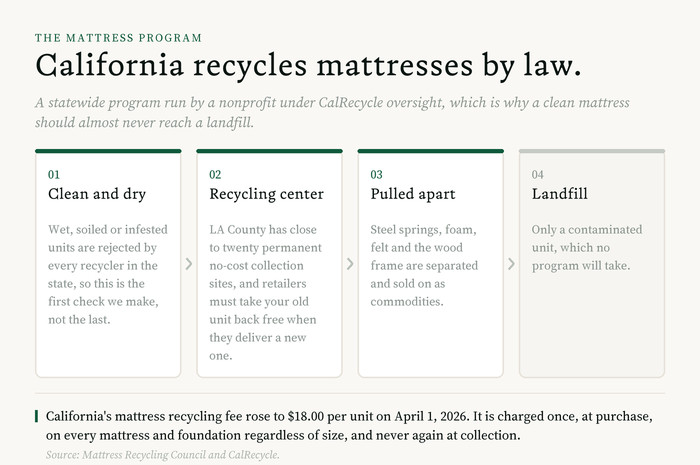
California does not leave mattresses to the market. The state runs a mattress stewardship program that CalRecycle oversees and the Mattress Recycling Council operates, funded by a recycling fee that retailers and other sellers must collect on every mattress, futon and foundation sold for use in California. That fee rose from $16.00 to $18.00 per unit for units sold on or after April 1, 2026. It is charged per unit regardless of size or type, it is not subject to sales tax, it must appear as a separate line item on the receipt whether the sale was in a store or online, and the full amount is remitted to the Council. Hotels, colleges, nursing homes and other commercial volume buyers pay it too. The money has already been collected, which is why qualifying used units are then accepted at participating drop-off points at no additional cost.
The state publishes what that buys. CalRecycle's 2025 program highlights record 1.6 million mattresses collected in 2025 and 14.3 million since the program began in 2016, 67.3 percent of collected units renovated, recycled or sent to biomass conversion, 62 million pounds of mattress materials diverted, 247 mattress drop-off sites across California, and 98.7 percent of California residents living within fifteen miles of program access. Inside a dismantled unit, the steel, foam, fabric and wood are separated and sold on to make new products, which is why a bed that is carried to the right gate is worth more than a bed that is crushed into a mixed load.
The coverage line is exact and it is worth knowing before you plan a bedroom. Accepted in California are mattresses and foundations used and discarded by California consumers, both individuals and businesses, and the program states that the condition of the unit and the date of purchase do not matter. A mattress may be all foam or a mix of foam, springs and other materials. A box spring or foundation counts, whether stationary or adjustable. California is the only one of the four program states where a futon mattress that separates from its frame or base is treated as a mattress. Not accepted are sofa beds, futon frames and bases, bed frames, car beds, collapsible roll-away beds, mattress pads, mattress toppers, pillows, loose bedding such as blankets, comforters, quilts and sheets, cushions from chairs or couches, sleeping bags, juvenile products including crib and bassinet mattresses, air mattresses and water beds with no upholstery material, and units stripped of their padding. So a sleeper sofa is a sofa, a topper is not a mattress, and a crib mattress is outside the program in California even though Connecticut counts it.
There is a second free route people forget until the delivery van has gone. California law requires a retailer to offer to take back your old mattress at no additional cost when it delivers a new one, including on an online purchase, though the retailer has up to thirty days to arrange that collection and the shipping carrier will not take it at the same time. The one refusal the law allows is for contamination: a retailer may decline a unit that poses a risk to personnel, new products or equipment, and the recycling fee is not refunded when that happens. If a bed has been through an infestation, the California Department of Public Health's guidance is specific. Have a pest control operator service furniture and mattresses before disposal, wrap the treated items in plastic before they leave the infested room so bed bugs and eggs cannot fall off in transit, and clearly label infested items BED BUG INFESTED before disposal or before placing them at the curb. Where a treated mattress or box spring is staying in the property, the guidance is to encase it in a commercially available plastic mattress cover at least 0.8 millimeters thick with a zipper. We bag and seal on that basis as standard, and we tell you before we start if a unit needs treating first.