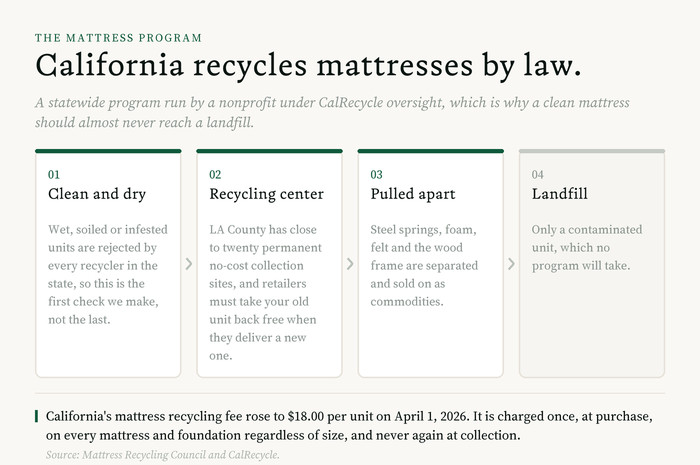
Every mattress and foundation sold in California carries a recycling charge collected at the till, and that charge is what funds the recovery system a Glendale bed ends up in. The Mattress Recycling Council runs the program under CalRecycle oversight, and the California mattress recycling fee rose from $16.00 to $18.00 per unit for units sold on or after April 1, 2026. The Council states that the $18.00 fee applies per unit regardless of size or type, covering mattresses, futons and foundations alike, that it is not subject to sales tax, and that it must appear as a separate line item on the receipt whether the sale happens in a store or online. If you have bought a bed in this state in the last decade, you have paid into this. The program exists so that the unit you are replacing does not have to be buried.
What the program covers is narrower than the phrase mattress recycling suggests, and the boundary decides what we can route and what we cannot. Bye Bye Mattress accepts mattresses and foundations discarded by California consumers, including box springs, and in California specifically a futon mattress that separates from the futon's frame or base counts as a mattress. It does not accept bed frames, futon frames or bases, sofa beds, mattress pads, mattress toppers, pillows, loose bedding such as blankets, comforters, quilts and sheets, cushions from chairs or couches or patio furniture, sleeping bags, collapsible roll-away beds, car beds, juvenile products including crib and bassinet mattresses, mattresses already stripped of their padding components, or air beds and water beds that contain no upholstery material. So the sleeper sofa in the spare room is a sofa, the topper on top of the bed is not a mattress, and the crib mattress in the nursery is outside the program in this state even though it is inside it in Connecticut.
Condition, on the other hand, is not a barrier here, and this is worth correcting because the internet is full of the opposite claim. In California and Oregon the program states that all mattresses and box springs can be dropped off at a participating location regardless of their condition or when they were purchased. The damaged, heavily soiled, moldy, excessively wet or infested caveat that circulates online belongs to the Connecticut and Rhode Island programs, not this one. What is true everywhere is that individual sites set their own practical terms: unit limits may apply and an appointment may be required, so the site decides how many units it will take in a day, not the program.
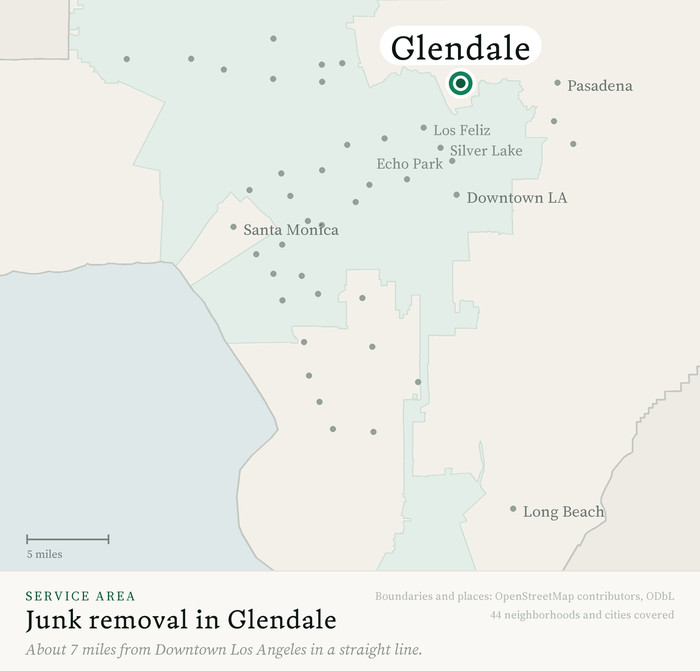
None of which helps a Glendale resident directly, because there is no participating site in Glendale. Search the Council's own facility finder against this city and the network does not have an entry inside the city boundary; the nearest listed no-cost residential drop-off is Goodwill at Fletcher Square, 3150 North San Fernando Road in Los Angeles, which is listed as free drop-off for residents, open 9:00 a.m. to 4:00 p.m. seven days a week, with a stated drop-off limit of two units. Two units is a mattress and a box spring. It is not a house with three bedrooms in it, and it is not a building turnover. Add the fact that the city's own recycling center refuses mattresses outright and the position is simple: a Glendale bed either goes out on a correctly booked and correctly wrapped curbside appointment, or it goes on a vehicle.
There is one more free route that almost nobody uses, and it is worth knowing before you buy. California law requires a retailer delivering a new mattress to offer to take your old one back at no additional cost. Delivery or set-up fees for the new product can still apply, the retailer has up to 30 days to collect the old unit, and the retailer may refuse to pick up a mattress that is contaminated and poses a risk to personnel, new products or equipment — a decision the retailer makes independently. The recycling fee is not refunded if they refuse. If your new bed is being delivered anyway, ask the retailer how their take-back works at the point of sale rather than after the truck has gone, because that conversation is the cheapest mattress removal available to anyone in this city.
The bed bug question comes up on roughly one Glendale mattress call in ten, and it deserves a straight answer rather than a shrug. Los Angeles County Public Health's pest bulletin describes exactly where the insects live on a bed: along the edge ribbing or beneath the buttons of a mattress, between the mattress and the box spring, in the folds of the dust ruffle, along the support frame and behind the headboard. They can endure prolonged starvation for 80 to 140 days without a host, and they arrive in second-hand furniture or in mattresses bought from thrift shops or private parties. The county is specific about multiple-family dwellings, which matters in a city with Glendale's apartment stock: infestations spread from one unit to another through wall voids, travelling along water pipes and electrical wires, and successful abatement requires a cooperative effort between management or property owners and an experienced pest management professional. The practical consequences for a removal are three. A suspect mattress is never a donation. It should be sealed before it leaves the room, not after. And the removal is not the treatment; if the unit is infested, the unit needs a professional as well as a truck, and we will say so rather than pretend a bed leaving the building solved it.
What is left is the material itself. A recycled mattress is dismantled and separated into steel, foam, fabric and wood, each of which has a manufacturing market, and that is why a bed is one of the better things in a junk load rather than one of the worse ones. Two categories never ride with it: electronics, which Glendale residents can drop free at the recycling center on Chevy Chase Drive, and anything chemical, which goes to the Household Hazardous Waste facility on Flower Street on a Wednesday or the second Saturday of the month. We separate all of that at your address and tell you where each part is going before the tailgate shuts.