Working with Hunter and this company was great. Gave us a quick quote over the phone after sending photos and was able to help us the SAME day. Removal was fast and easy. We definitely recommend going with this company.
Whole-property clearances across Glendale for executors, trustees, downsizing families and realtors preparing a listing — sorted room by room, separated into the streams the state and the city require, and quoted flat before anything moves.
Free quote, no obligation · one flat number before we start · you can also text that number

An estate cleanout in Glendale leaves one address as four separate legal streams: general contents on the curbside bulky list, electronics to the Glendale Recycling Center, refrigerant appliances to a Certified Appliance Recycler, and paint, chemicals and medication to the Fire Department facility on Flower Street. Sorting and routing all four is the job.
An estate cleanout in Glendale is four legally separate waste streams leaving one address at the same time. General contents — furniture, beds, household goods — can go out through the City of Glendale's curbside bulky item pickup, which works from a closed accepted-item list. Electronics cannot: California classifies e-waste as universal waste, and in Glendale it is taken to the Glendale Recycling Center at 540 W. Chevy Chase Drive instead. Refrigerators, freezers, air conditioners, washers and dryers hold refrigerant, oils, mercury switches and capacitors that state law says a Certified Appliance Recycler must remove before the shell is crushed or shredded. And paint, solvents, pool chemicals, propane cylinders, sharps and medication are household hazardous waste, which the bulky program refuses outright and which Glendale accepts only at the Fire Department's facility at 780 Flower Street on Wednesdays and the second Saturday of each month. Los Angeles Junk Removal & Hauling clears the property, sorts it into those streams and routes each one, on one flat price agreed before we load. The quote is free and carries no obligation.
The reason estate work in Glendale looks nothing like ordinary junk removal is arithmetic. A bulky appointment is designed around a handful of discrete objects set at a curb; a house is a hundred decisions a room, in a property where nobody has thrown anything away since the kitchen was last remodelled. Executors, trustees, siblings splitting a job over a weekend and listing agents with a photography date all arrive at the same wall: the free municipal route was never built for volume, and the parts of the load that are worth the most attention are precisely the parts it will not take.
So we run these in a fixed order — set aside, donate, recycle, dispose — and we run the sorting slowly and the clearing fast, because the expensive mistakes all happen in the first hour rather than the last. If you want the county-wide picture of how the service works, that is on estate cleanouts. If you are looking at one part of the property rather than all of it, most Glendale estates start with the garage and the furniture, and the whole city picture is on junk removal in Glendale.
Glendale's bulky item pickup is an item-based service, not a property-based one, and that single fact decides how much of an estate it can absorb. The city publishes an accepted-item list and states plainly that if something is not on it, it is not accepted. The list itself is generous enough for ordinary life — couch, chair, table, desk, bookshelf, filing cabinet, mattress and box spring, television, computer, microwave, stove, dishwasher, washer, dryer, refrigerator, small freezer, toilet, sink, bicycle, exercise equipment, floor lamps, screen door, window shades, ironing board, large children's toys — but it is a list of things, and an estate is a building.
The conditions attached to the accepted items are where whole-house jobs quietly fail. Mattresses and box springs are only collected if they are wrapped in plastic or a mattress bag, and the city says unwrapped ones will not be taken. Anything containing glass, including mirrors and glass-fronted cabinets, has to be shrink-wrapped or protected with cardboard first. A refrigerator needs its door removed or taped closed. Carpet has to be rolled, taped or tied, no more than five feet long and under two feet in diameter, which is one bedroom's worth per roll. Cast iron sinks are excluded, freezers are limited to small ones, and a framed picture over five feet is out unless the glass is removed. Multiply those preparation rules by the contents of a three-bedroom house and the free option becomes a weekend of work before the truck even arrives.
Then the exclusions, which is the real problem in an estate. The city refuses cardboard, bags of trash or recycling, construction materials, lumber, large amounts of glass, propane tanks and hazardous waste of any kind. A cleared house produces all of those: flattened boxes from packing, sacks of soft trash that fit no other category, the lumber from a collapsed shelving run, the barbecue cylinder in the side yard and a garage shelf of paint. Everything has to be fully removed from private property to be collected at all, so nothing can be staged in the driveway, and requests still need at least three working days' notice against your refuse day. If the property is an apartment or condominium in a building of five or more units, the city program does not apply and the building's franchise hauler handles bulky collection through the property manager, with up to four free appointments per calendar year shared across the whole building. Glendale's own advice on the reuse side is worth taking: the city points residents to earth911.com to find local donation and recycling options before anything is treated as waste.
Sources: City of Glendale bulky item pickup request form; Glendale Integrated Waste accepted-item list. Cited in full below.
| What the program is | Curbside bulky item pickup run by City of Glendale Integrated Waste for residential properties of one to four units |
|---|---|
| The governing rule | A closed list. Glendale states that if an item is not on the accepted list, it is not accepted |
| On the list | Couch, chair, table, desk, bookshelf, filing cabinet, mattress and box spring, television, computer, microwave, stove, dishwasher, washer, dryer, refrigerator, toilet, sink, bicycle, exercise equipment |
| Refused outright | Cardboard, bags of trash or recycling, construction materials, lumber, large amounts of glass, propane tanks, hazardous waste |
| Preparation that decides collection | Mattresses wrapped in plastic or a bag, all glass items wrapped or boarded, refrigerator doors removed or taped shut |
| Items with size limits | Carpet taped in a roll under five feet long and two feet across; freezers small only; no cast iron sinks; pictures under five feet with glass removed |
| Where it has to stand | At the curb after 6:00 p.m. the evening before, fully removed from private property |
| Notice required | At least three working days before your refuse collection day |
| Buildings of five or more units | Franchise hauler through the property manager, up to four free appointments per calendar year for the whole building |
| Never in a curbside cart | Electronic waste and household hazardous waste, both of which have their own Glendale drop-off point |
| Reuse route the city names | earth911.com, to find local donation and recycling before anything is set out as waste |
Sources: Glendale Integrated Waste, Bulky Item Pick Up accepted-item list (PDF); City of Glendale, Residential (1-4 Units) Bulky Item Pickup Request Form; Glendale Integrated Waste, Collection Services; Glendale Integrated Waste, Property Owners & Managers.
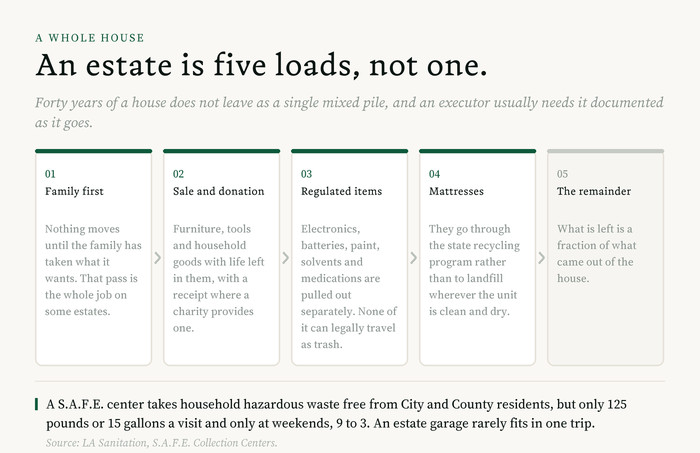
A Glendale estate cleanout is a sorting job before it is a hauling job, and the order it runs in is set aside, donate, recycle, dispose. Everything that looks personal, financial or legal comes out first and goes to one staged place for the family: paperwork, deeds, tax files, chequebooks, medical records, correspondence, photographs, albums, service medals, jewelry boxes, keys and anything locked. We do not make that call for anyone, we do not value contents, and we are not an estate sale company or an appraiser. If the family cannot be at the property, that stage gets photographed before it moves. Only once that pass is finished does anything get loaded.
The reason this takes as long as it does in Glendale is the housing stock. The city's largest historic district, Rossmoyne, is 503 homes laid out along curving streets from 1923 and largely built out by 1950. Ard Eevin Highlands covers 87 homes in the Cumberland Heights neighborhood, almost all of them built between the 1920s and the 1940s. The Niodrara Drive district is 32 single-family homes in Verdugo Woodlands representing fifty years of building, from 1912 to 1962. Cottage Grove, at the foot of Adams Hill, is fourteen Tudor Revival cottages on a single block. Houses of that vintage were designed with small closets and no storage, so the storage happened elsewhere: a detached garage down a long driveway, a floored attic reached by a hatch, a crawl space, a basement under a Spanish Colonial, a lean-to at the back of the lot. A three-bedroom Glendale house of this era routinely holds more volume behind the house than inside it, and on a hillside parcel it all has to be carried up or down a stair run to reach the truck. We size the vehicle to the street, shuttle rather than block a narrow one, and quote the whole property as one number rather than discovering loads on the day.
Old houses also hold things that stop the job if nobody plans for them. Bathroom cabinets in an estate almost always contain medication and sometimes sharps, and Glendale's hazardous waste facility takes non-controlled prescriptions, over-the-counter and pet medications and hypodermic needles in a puncture-proof container, but explicitly refuses chemotherapy waste and controlled substances in Schedules II to V, pointing residents to a DEA disposal site for those instead. Ammunition, bullets and casings are not accepted at the city facility either and are directed to designated law enforcement collection points, and fireworks and explosives are refused under any circumstances. Older smoke detectors containing Americium-241 are turned away as radioactive material. None of that is a reason to panic; it is a reason to tell us what is in the house when you call, so the routing is worked out in advance rather than at a gate.
The last constraint is the calendar, and in estate work somebody else always owns it. Probate and trust sales, lender deadlines, a listing photography date, a buyer's walkthrough, an out-of-state family with one shared week of leave: the clearance is almost never what sets the date. We work to it. Walkthroughs run on video, quotes are built from photographs, access is arranged with an agent, a manager or a locksmith, and written confirmation of what was removed goes out if a file needs it. What we will not do is guess a number on the phone and then find extra loads on the day, because on a whole-property job that is what wrecks a closing date.
Sources: City of Glendale, Rossmoyne Historic District; City of Glendale, Ard Eevin Highlands Historic District; City of Glendale, Niodrara Drive Historic District; City of Glendale, Cottage Grove Historic District; Glendale Fire Department, Household Hazardous Waste.
Estate cleanouts in Glendale. Tell us what is there and we will price it.
Free upfront quote, no obligation. One number, agreed before anything is lifted.
5.0 from 67 reviews on GoogleMon–Sat, open 24 hours


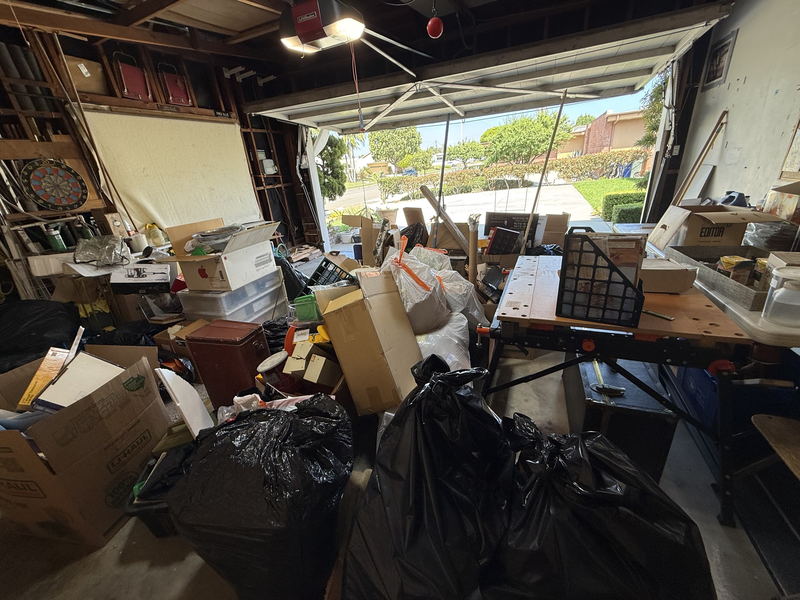
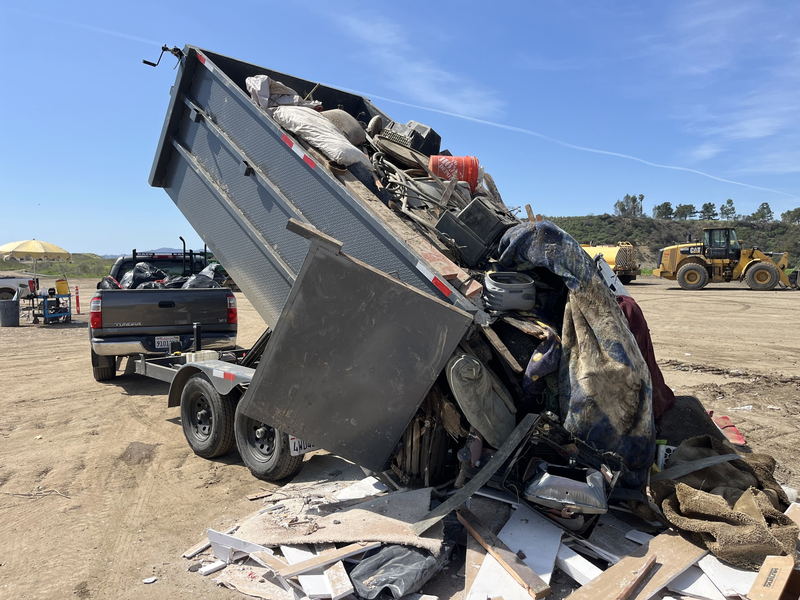
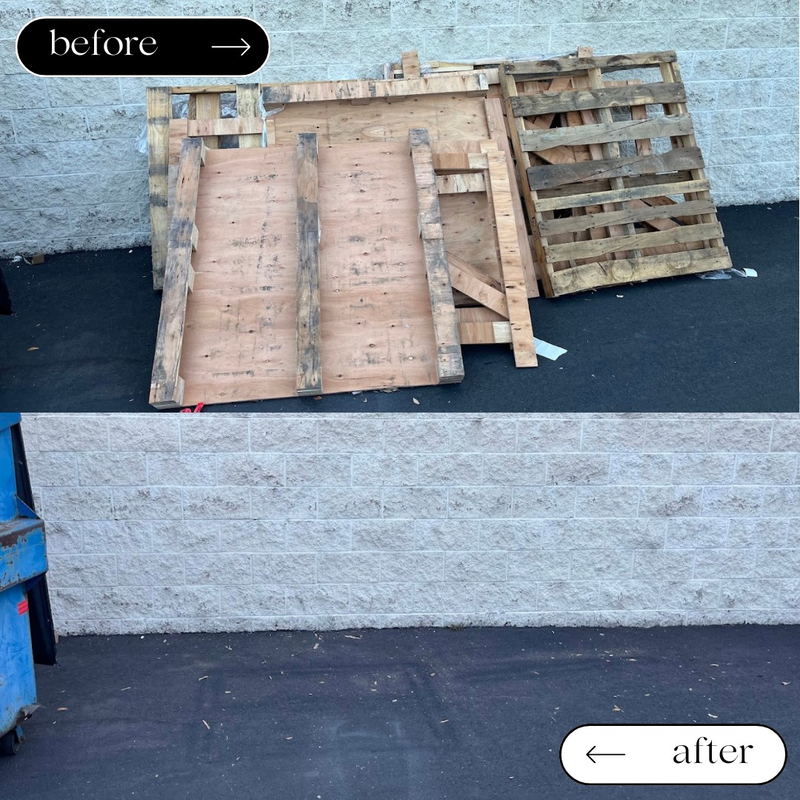
Our own crews on Los Angeles County jobs. The estate cleanouts we run in Glendale looks like this too: side yards, narrow walkways and the back of the property is where the work actually is.
Everything that comes out of a Glendale estate belongs to one of four streams, and California treats three of them as something other than trash. Getting that separation right on the driveway is the entire difference between a clearance that finishes and one that gets refused at a gate.
Stream one: general contents and donation. Estate furniture donates better than almost any other load we carry, because it is usually solid, undamaged and simply unwanted. Usable furniture, kitchenware, linens, books, tools and clothing are set aside for reuse before anything is tipped, which is the order the City of Glendale itself recommends when it points residents to earth911.com to find a local donation or recycling option. We will not print the name of a charity we have not confirmed is currently taking furniture in this city, because intake changes constantly and a refused van helps nobody. What cannot be reused is separated into scrap metal, textiles, mixed recycling and landfill, in that order.
Stream two: electronic waste. California's Department of Toxic Substances Control classifies e-waste as universal waste, which is a type of hazardous waste, because devices contain materials such as lead and mercury. Households lost their exemption from the universal waste rule's prohibition on putting electronic waste in household trash in 2006, so a tube television, a monitor, a tower, a printer, a VCR or a landline handset has had no legal path to a curbside cart for two decades. CalRecycle has widened that further: from 1 January 2026, Senate Bill 1215 brings covered battery-embedded products into the state's Covered Electronic Waste Recycling Program, which is exactly the category an estate produces in bulk — cordless tools, electric toothbrushes, e-readers, cameras, portable speakers. In Glendale the destination is the Glendale Recycling Center at 540 W. Chevy Chase Drive, open Monday to Friday from 7:30 a.m. to 4:45 p.m. and Saturday from 8:00 a.m. to 3:30 p.m., closed Sunday. It takes computers and office equipment, televisions and monitors, phones and small devices, audio and video equipment, household electronics and small appliances, and batteries, cords and chargers. Note the split that catches people: the Fire Department's hazardous waste facility does not take e-waste, and the Recycling Center does not take hazardous materials. They are two trips. See e-waste disposal.
Stream three: major appliances. Under California law a major appliance is a washing machine, clothes dryer, water heater, dehumidifier, oven, microwave, stove, refrigerator, freezer, air conditioner, trash compactor or residential furnace, and most of them contain what the state calls materials that require special handling. DTSC is unambiguous about the sequence: those materials must be removed by a Certified Appliance Recycler before an appliance is crushed, baled, shredded, sawed or sheared apart or disposed of, and whoever removes them becomes the generator of hazardous waste. Refrigerant in a refrigerator, freezer or air conditioning unit may only be taken out by a technician certified under section 82.161 of title 40 of the Code of Federal Regulations. Compressor oil, transmission oil and capacitor oil have to be drained and managed separately. Mercury tilt switches, pilot light sensors and flame switches turn up in older washers, dryers, chest freezers, furnaces, water heaters and ovens. Metal-encased capacitors in pre-1979 appliances may contain PCBs. In a 1930s Glendale house with a 1970s laundry in the garage, that is not a theoretical list. The Glendale Recycling Center does not accept large appliances at all, so refrigerators, washers and dryers leave the property either on a bulky appointment or with a hauler that routes them to a certified appliance recycler. See appliance removal.
Stream four: household hazardous waste. This is the shelf that stops most estates, and no general hauler may legally carry it, so we separate and stage it rather than load it. Glendale runs its own facility, the Fire Department's Environmental Management Center at 780 Flower Street, one of the first permanent indoor household hazardous waste facilities in Southern California and open since 1991, with more than 3,000 tons collected since. It opens every Wednesday and the second Saturday of each month, 9:00 a.m. to 3:00 p.m., closed on holidays and in extreme weather. It is residential drop-off only and asks for a driver's license or a utility bill: Glendale and La Cañada residents qualify with proof of residency, and La Crescenta and Montrose residents qualify on a Glendale Water and Power bill. Each visit is capped at 15 gallons of liquid or 125 pounds of solids, with the container counted in the weight, and containers are not returned except for oil, where a replacement is provided. You stay in the car and the crew unloads. It takes paint, thinners, shellac and wood preservatives, cleaners and aerosols, pool and spa chemicals including muriatic acid and chlorine tablets, pesticides and weed killers, motor oil, brake fluid, coolant and oil filters, propane tanks, fluorescent tubes and CFL and LED lamps, every kind of battery including car batteries, mercury thermometers and thermostats, caulk, adhesives and roof tar, medications and sharps — with compressed gas cylinders and wet, double-bagged asbestos handled case by case. If a Wednesday does not fit the schedule, the Los Angeles-Glendale S.A.F.E. Collection Center at 4600 Colorado Boulevard is minutes from south Glendale and opens Saturdays 9:00 a.m. to 3:00 p.m. only, free to City of Los Angeles and Los Angeles County residents for both hazardous waste and e-waste. Bring a state-issued photo ID: the center sits inside a water reclamation plant and the security gate checks it before entry. CalRecycle's own summary is the shortest version of all of this — it is illegal to put hazardous waste in the garbage, down a storm drain or on the ground, anywhere in California.

Sources: Glendale Fire Department, Household Hazardous Waste; Glendale Integrated Waste, Glendale Recycling Center; City of Glendale, Recycle Right! residential guide (PDF); LA Sanitation, Los Angeles-Glendale S.A.F.E. Center; LA Sanitation, S.A.F.E. Centers and Household Hazardous Waste; California DTSC, Electronic Hazardous Waste; California DTSC, Guidance on Major Appliances; CalRecycle, Electronic Waste Management; CalRecycle, Waste Banned from the Trash.

Same rule in Glendale as anywhere else in Los Angeles County. The local part is the program above, not the disposal law. Full detail on estate cleanouts.
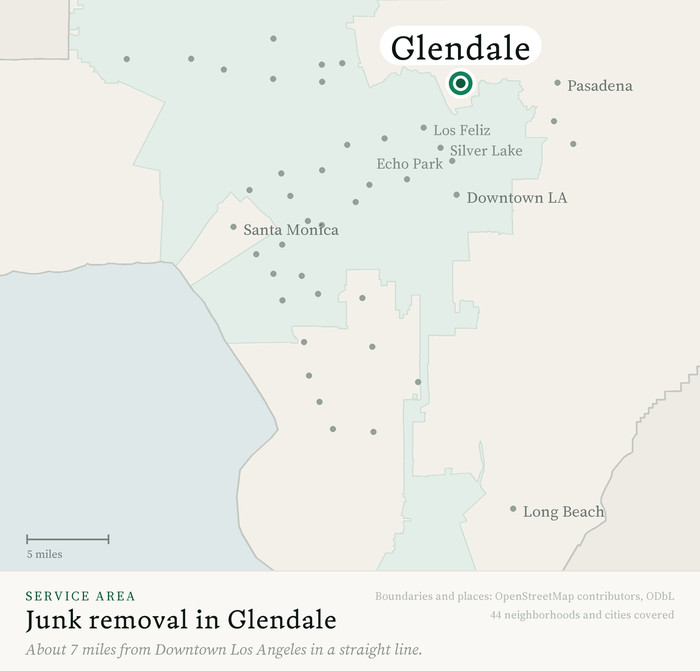
This page is estate cleanouts in Glendale specifically. The wider service is on estate cleanouts across Los Angeles, and everything we haul in this city is on junk removal in Glendale. Same crew, different job: furniture removal in Glendale, same-day junk removal in Glendale, commercial junk removal in Glendale. Pricing works the same way everywhere: how our pricing works, and the full map is on areas we serve.

We are already next door most days. The whole list is on areas we serve.
The six loads that come out of nearly every whole-property clearance in this city, each with its own destination.
Couches, sectionals, mattresses in the same trip, beds, desks and wardrobes carried down rather than dragged.
The whole garage in one visit. We sort, donate what is usable and sweep the slab.
Fridges, washers and AC units. Refrigerant units are handled as universal waste.
TVs, CRT monitors and computers. Banned from the trash in California.
Recycled through a state-funded program, not dumped. Box springs and futons too.
Brush, palm fronds, sod, soil and storm debris, priced by weight.
Asked by executors, trustees, families and listing agents clearing a whole property.
No, and not because of the volume alone. The city works from a closed accepted-item list, so anything not named on it is refused, and it will not take cardboard, bags of trash, construction materials, lumber, large amounts of glass, propane tanks or hazardous waste at all. Accepted items still have to be prepared — mattresses wrapped, glass wrapped or boarded, fridge doors removed or taped — and everything must be fully off private property at the curb. Use it for a few pieces you have time to prepare. For a house, it is not the mechanism.
To the Glendale Recycling Center at 540 W. Chevy Chase Drive, open Monday to Friday 7:30 a.m. to 4:45 p.m. and Saturday 8:00 a.m. to 3:30 p.m. It accepts computers and office equipment, televisions and monitors, phones and small devices, audio and video gear, small household electronics and batteries, cords and chargers. It cannot go in any curbside cart: California's DTSC classifies e-waste as universal waste, and households lost their exemption from that prohibition in 2006. From 1 January 2026 covered battery-embedded products such as cordless tools and e-readers are inside the state program too. See e-waste disposal.
They go to a certified appliance recycler rather than to scrap. California defines these as major appliances and requires that materials needing special handling — refrigerant, compressor and transmission oils, capacitors, mercury switches — are removed by a Certified Appliance Recycler before the shell is crushed, shredded or disposed of, and refrigerant may only be recovered by a federally certified technician. Note that the Glendale Recycling Center does not take large appliances, so they leave on a bulky appointment or with a hauler. See appliance removal.
Not on the truck — household hazardous waste is not something a general hauler may transport. What we do is separate it as we clear, stage it safely in one place, and tell you exactly where it goes. In Glendale that is the Fire Department's facility at 780 Flower Street, open Wednesdays and the second Saturday of each month, 9:00 a.m. to 3:00 p.m., residential drop-off only with a driver's license or utility bill, capped at 15 gallons of liquid or 125 pounds of solids per visit including the container. The Los Angeles-Glendale S.A.F.E. Center at 4600 Colorado Boulevard is the Saturday alternative and needs a state photo ID at the gate.
Remotely, and we do a lot of it. The walkthrough can be done on video or from a set of photographs, the whole property is quoted as one flat number rather than per load found on the day, and access can be arranged with a listing agent, a property manager, a neighbor or a locksmith. We can send written confirmation of what was removed for the file, and hand the property back swept and ready for photography or an inspection. Tell us the date that matters and we will say plainly whether it is achievable before you commit to anything.
Tell us and we will route them properly. Glendale's hazardous waste facility takes non-controlled prescription, over-the-counter and pet medication, and hypodermic needles in a puncture-proof container, and it will supply a sharps container. It does not take chemotherapy waste or controlled substances in Schedules II to V, and directs those to a DEA disposal site. Ammunition, bullets and casings are not accepted there and are directed to designated law enforcement collection points, fireworks and explosives are refused outright, and older smoke detectors containing Americium-241 are turned away as radioactive. We separate and stage, and we do not guess.
Word for word from Google. Nothing tidied.
Working with Hunter and this company was great. Gave us a quick quote over the phone after sending photos and was able to help us the SAME day. Removal was fast and easy. We definitely recommend going with this company.
Read all 67 on GoogleSee us on YelpReviews, and how to check any LA hauler
Collection rules, transfer stations and permit counters change at the city line, so each of these is written for that city rather than for Glendale. A job that straddles two of them is still one visit and one number.
Everything we haul in the cities next door: Los Feliz, Burbank, Silver Lake. The whole list is on areas we serve.
Send a photo, get a flat number back. Free, no obligation, no pressure and no call-out fee — and if your city will haul it free instead, we will tell you that too. Most requests are answered within the hour during working hours.