Hunter is truly dedicated on providing the most excellent of removal of unwanted junk from your home or office. Always on time, very efficient at his job in a timely manner. I would recommend him for any junk removal you may have.
Office move-outs, retail fixture strips, restaurant equipment clears and cabinet tear-outs across Glendale — certificate of insurance to building management first, dock and freight elevator worked around, one flat number quoted free before we start.
Free quote, no obligation · one flat number before we start · you can also text that number

Glendale's free bulky pickup serves homes of one to four units only, so a business address is not eligible, and the zone franchise hauler covers bins rather than an office move-out or a fixture strip. Commercial junk removal fills that gap, with insurance paperwork filed with your building beforehand and one flat price.
A Glendale business address is not eligible for the city's free bulky item pickup. The City of Glendale collects for residential homes and 2-4 unit properties; every business, and every apartment or condo building of five units or more, is served instead by the franchise hauler for its zone, arranged through the property manager. That covers the bins, not a tenant improvement, an office move-out, a fixture strip or a cabinet tear-out. Separately, a permitted non-residential renovation in Glendale is a covered project under Glendale Municipal Code Chapter 8.58, which requires a construction waste management plan before the permit is issued, 65 percent diversion to a certified mixed debris recycling facility, and original facility tags afterwards. None of that is the City of Los Angeles ordinance, because Glendale is an independent city. Los Angeles Junk Removal & Hauling clears the commercial load, issues a certificate of insurance to your building first, and quotes one flat number before anything moves.
Almost every commercial junk removal enquiry in Glendale starts with the same discovery: the free route the tenant assumed existed was never open to them. Glendale's municipal collection is drawn tightly around small residential properties, and the moment an address is a shop, a suite, a restaurant or a building of five units and up, it leaves the city's program and joins a private franchise arrangement that the tenant usually does not control and often cannot even see. The bin is the manager's contract. The bulky appointment is the manager's to book. And neither of them was ever sized for the two hundred linear feet of casework coming off a wall.
The second discovery is the paperwork. A tenant improvement in Glendale is not governed by the rules people read about downtown; the city runs its own diversion program out of Building and Safety, and it attaches to non-residential alterations regardless of what the job cost. That means the strip-out and the hauling are part of a permit file with a deposit riding on it. This page covers who is allowed to serve a Glendale business address, what the ordinance asks a permitted job to prove, and the practical side — docks, freight elevators, insurance certificates and after-hours windows — that decides whether a clear-out finishes in one visit. The county-wide version of the service is on commercial junk removal, and everything we haul in this city is on junk removal in Glendale.
Glendale draws the line by property type, not by what is in the pile. Glendale Integrated Waste states it plainly: the city provides collection services for residential homes and 2-4 unit properties, while its franchise haulers provide collection for apartments and condos of five or more units and for businesses. Since 1 December 2021 that private side has been organized into four franchise zones with one hauler assigned to each, and tenants are told to contact their property manager or their designated hauler to arrange a bulky item pickup. State law and city regulation also require every commercial and multi-family property of five units or more to subscribe to trash, recycling and organics service unless the city grants a waiver. So the routine waste question in a Glendale office has an answer — it is simply an answer that belongs to the building, and it is a weekly-volume answer.
What the franchise does not swallow is more interesting for a fit-out. Glendale Municipal Code section 8.56.170(B) says the franchisee's exclusive right to provide collection services does not include solid waste removed from a commercial business by a self-hauler, construction and demolition waste, solid waste collected by the city, or temporary bin and temporary roll-off collection. Section 8.56.180(C) then restricts temporary bin and roll-off service in a franchise zone to companies that hold a written franchise agreement with the city, and non-franchise haulers are permitted in Glendale only on a temporary basis for construction and demolition work, under the permit rules at sections 8.56.080 through 8.56.160, with applications running on an annual cycle. Section 8.56.100 also exempts scrap metal dealers, junk dealers and household cleanup firms that incidentally transport solid waste in the ordinary course of their primary business from holding a solid waste services permit. The short version for a tenant: your ongoing bin contract is the building's, and a one-off project clear-out is a different transaction with different rules.
That is the gap this page exists for. A cabinet tear-out in a Brand Boulevard suite, a gondola-and-slatwall strip in a Galleria unit, a restaurant equipment clear on Central Avenue, a cubicle farm coming out of an office floor, or a whole clean-out at lease end — none of it fits a weekly bin, none of it can be booked as a free city pickup, and ordering a roll-off means finding curb or garage space for a steel box in a district where there usually is not any, then guarding it, then filling it yourself. A crew that arrives, carries, loads, sorts and leaves the same day removes the container from the problem entirely. Ask the property manager what the building's arrangement is before you book anything — and if the manager's hauler can do it inside your date, we will tell you to use them.
Source: Glendale Municipal Code chapter 8.56 and Glendale Integrated Waste. Cited in full below.
| City collection covers | Residential homes and 2-4 unit properties only |
|---|---|
| Businesses and 5+ units | Served by the franchise hauler for the zone, arranged through the property manager |
| Franchise system | Four zones, one assigned hauler each, in place since 1 December 2021 |
| Mandatory subscription | Commercial and 5+ unit properties must subscribe to trash, recycling and organics unless waived |
| Outside the franchise's exclusive right | Self-hauled waste, construction and demolition waste, city-collected waste, temporary bin and roll-off service (GMC 8.56.170(B)) |
| Temporary bins and roll-offs | Only from a company holding a written Glendale franchise agreement (GMC 8.56.180(C)) |
| Non-franchise haulers | Temporary basis only, for construction and demolition projects, under GMC 8.56.080-8.56.160 |
| Permit exemption | Not required of scrap metal dealers, junk dealers and household cleanup firms that incidentally transport solid waste (GMC 8.56.100) |
| Who to ask first | Your property manager, then the franchise hauler for your zone |
| City contact | Glendale Integrated Waste on (818) 548-3916 or recycle@glendaleca.gov |
Sources: Glendale Integrated Waste, Collection Services; Glendale Integrated Waste, Haulers; Glendale Municipal Code Chapter 8.56, Solid Waste Disposal (§§ 8.56.080, 8.56.100, 8.56.160–8.56.190).
Glendale's commercial work sits in three bands, and each one hands you a different access problem. The Downtown Specific Plan area is the first: the zoning code describes it as generally bounded to the north by Glenoaks Boulevard, to the west by Central and Columbus Avenues, to the east along Maryland and Glendale Avenues, and to the south by Elk Avenue. Inside it sits the Town Center specific plan area — the Americana at Brand, whose owner the city's own Planning Commission reports identify with addresses on Americana Way and Caruso Avenue — generally bounded by Brand Boulevard on the east, Colorado Street on the south, Central Avenue on the west and the Glendale Galleria, north of Harvard Street, on the north. That is retail and office at high density with structured parking under it, which in practice means booked dock time, a garage height limit and a freight elevator that other trades also want. The second band is the office spine along Brand and Central, where suites turn over floor by floor. The third is the San Fernando Road corridor in south Glendale, where the city's industrial and industrial/commercial mixed use zones run either side of the rail line and the Tropico blocks around San Fernando Road and South Central Avenue carry industrial/commercial-residential mixed use designations — ground-level roll-up doors, yard space, and heavier material.
Paperwork travels ahead of the truck in the first two bands. We carry insurance and we can have a certificate of insurance issued to your building before the job is scheduled: send the exact legal entities your risk team needs named as additional insured and any specific wording they require, and if the building runs a vendor compliance portal, send the invitation and we upload into it. We do not publish coverage figures on a web page, because the document your risk manager actually reads is the certificate itself, not a marketing claim. Ask and you get the certificate.
Then the window. Glendale buildings ration vendor access rather than banning it: docks are reserved in slots, freight elevators are padded and booked, garage clearances are low enough that a box truck matters, and retail centers will not have a crew walking casework across a public concourse at lunchtime. We are open around the clock Monday to Saturday and 1pm to 10pm on Sunday, so a pre-opening morning slot, an evening strip in a shop unit or a weekend office floor is a normal shift rather than a favor. Give us the slot, the elevator dimensions, the garage clearance and the route from the suite door to the dock, and the quote we gave you is the quote that holds.
The material itself decides the crew. A cabinet tear-out is uppers, lowers, countertops and toe-kick, and casework fixed to a wall comes off in pieces rather than as furniture — the moment it touches drywall, flooring or ceiling grid it stops being a furniture job and becomes debris, which is what the next section is about. A retail strip is gondola runs, slatwall, counters, display cases, signage and back-of-house racking. A restaurant clear is prep tables, shelving, walk-in panels, hoods and equipment that is heavy, greasy and awkward on an elevator; we remove equipment that has already been disconnected, and gas, electrical, plumbing and refrigerant work belongs to the licensed trades, not to a hauling crew. An office decommission is workstations, cubicle systems, task chairs, filing, conference furniture and a server closet. On records and anything confidential, our rule is simple: we do not open boxes or sort paper for you. Tell us what is retained and what leaves, keep material under a retention obligation with a document destruction specialist, and we will clear the rest and confirm in writing what left which suite.
Sources: Glendale Municipal Code §§ 30.10.010, 30.10.030 and 30.10.040, zones, Town Center specific plan and Downtown specific plan boundaries; City of Glendale Planning Commission report, Americana at Brand and the Town Center district of the Downtown Specific Plan (PDF); CEQAnet, Tropico Project, San Fernando Road at South Central Avenue, industrial/commercial-residential mixed use.

Commercial junk removal in Glendale. Tell us what is there and we will price it.
Free upfront quote, no obligation. One number, agreed before anything is lifted.
5.0 from 67 reviews on GoogleMon–Sat, open 24 hours


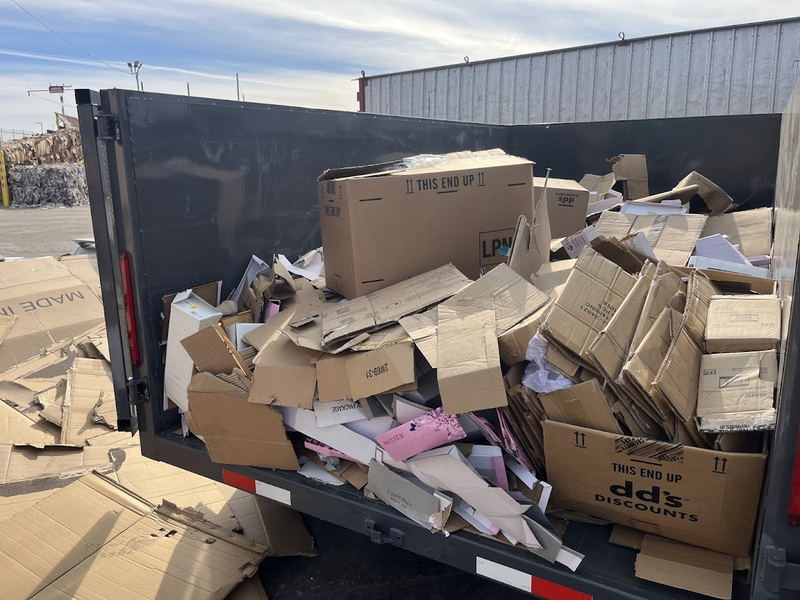
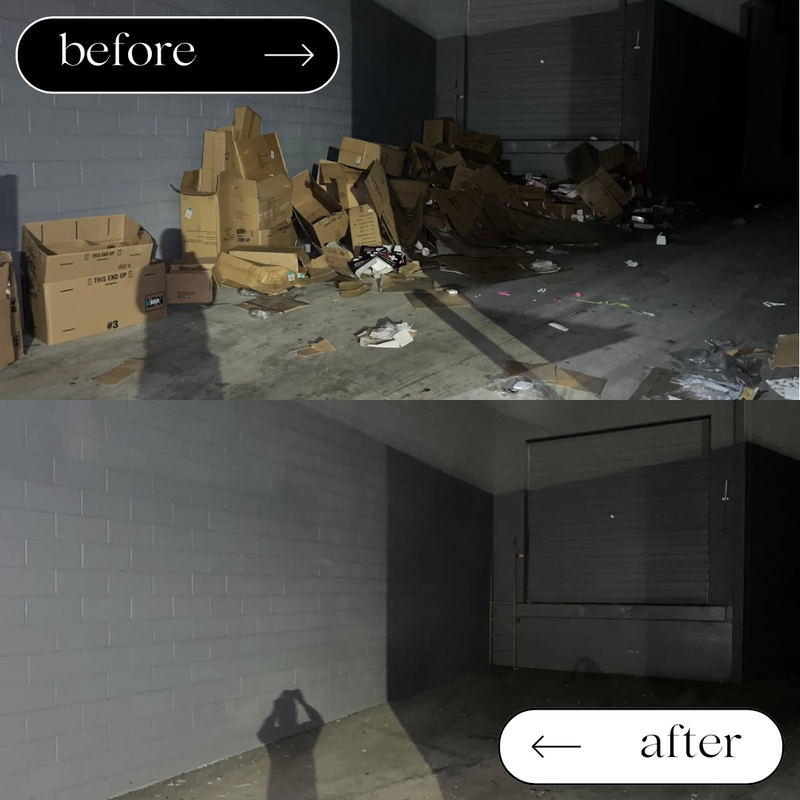
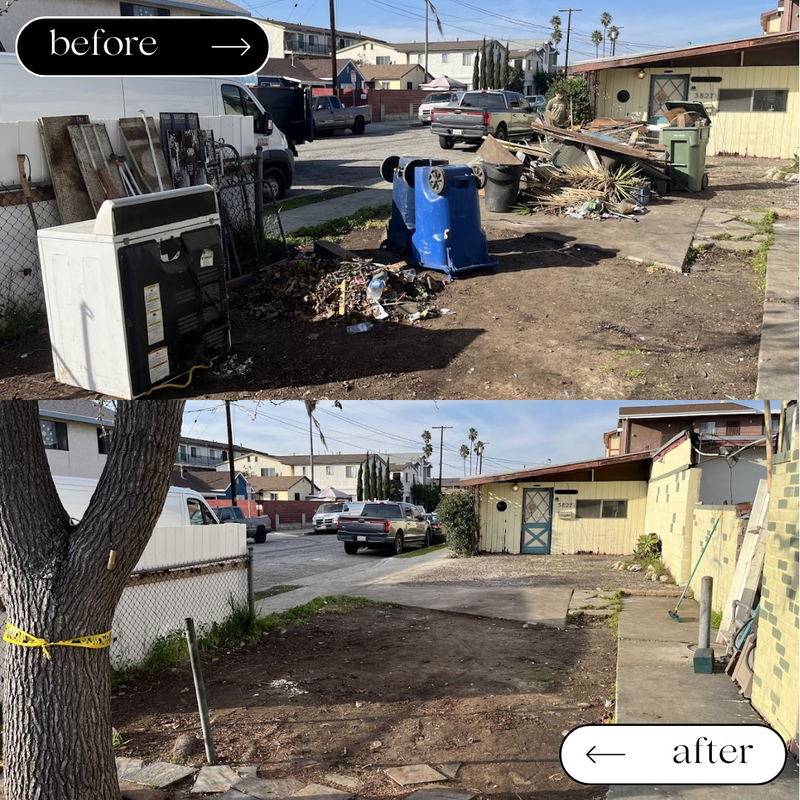
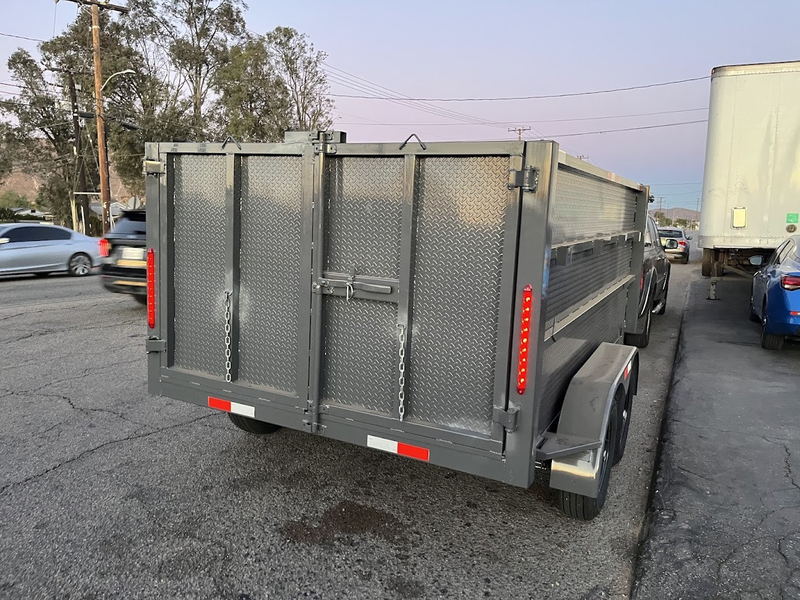
Our own crews on Los Angeles County jobs. The commercial junk removal we run in Glendale looks like this too: side yards, narrow walkways and the back of the property is where the work actually is.
In Glendale, a non-residential addition, renovation or alteration of an existing non-residential building is a covered project under the city's Construction and Demolition Debris Diversion Program regardless of the proposed construction value. That is Glendale Municipal Code Chapter 8.58, administered by the city's building official, and its definition of renovation expressly includes tenant improvements to an existing facility or structure. Newly constructed buildings and residential work that increases conditioned area, volume or size are covered too, and city-sponsored projects of 5,000 square feet or more. This is Glendale's own ordinance, not the City of Los Angeles program; Glendale is an independent city and quoting LA City rules at a Glendale plan check helps nobody.
The sequence matters more than the percentage. Before the permit is issued, the applicant submits a construction waste management plan to the building official, and no permit is issued until that plan is approved. The plan has to show how the project will divert 65 percent or more of its estimated debris, name the certified mixed debris recycling facilities and the haulers that will carry the material, say whether waste is source-separated or single stream, and document the CALGreen section 5.408 requirements for non-residential work. A diversion security deposit goes in with the plan; the building official may waive it only where the deposit would come to two hundred dollars or less. All project debris must go to a certified mixed debris recycling facility — defined in the ordinance as a facility certified by the city of Los Angeles to divert 65 percent or more without using material as alternative daily cover — unless the building official grants an exemption. Then, no later than 60 days after project completion, the diversion worksheet goes in with original tags from the certified facility, and the ordinance is specific that photocopies are not acceptable and that receipts must carry the project address, the dates and the actual weights and volumes for each load. No certificate of occupancy is issued for construction on land where a demolition occurred until that worksheet is approved, refunds are denied outright where the documentation is missing or late, and an applicant who is refused can appeal to the building and fire board of appeals within 15 calendar days.
Two clauses catch office and retail jobs in particular. The plan for a non-residential addition or alteration of 1,000 square feet or more must describe and document the proper handling of universal waste, and the diversion worksheet must include receipts reflecting proper disposal of universal waste from the covered project. Universal waste is where the electronics live: DTSC treats unwanted covered electronic devices as universal waste in California, which is why monitors, servers, desk phones, printers and lamps cannot be dropped in a building bin, and why a fit-out that skips them arrives at closeout with a hole in its paperwork. Land clearing is stricter again — the plan must state how the project achieves 100 percent reuse or recycling of trees, stumps, rocks, vegetation and soils. Because the permit is in the applicant's name, the tags a hauler brings back are the applicant's evidence, and a load that goes somewhere uncertified is the applicant's deposit.
So we route a Glendale commercial load in streams rather than as one pile. Usable desks, chairs, conference tables and shelving go to donation before anything is tipped, because a functioning workstation is worth more to a charity than to a landfill. Metal, including racking, gondola frames and stainless from a kitchen, goes to a scrap recycler. Electronics leave as e-waste. Mixed debris from casework, drywall, ceiling grid, flooring and demolition goes to a certified mixed debris processor and the facility tags come back to you for the file. What we cannot legally carry on a general hauling truck is the hazardous fraction — paint, solvents and thinners, motor and cooking oils, cleaning and pool chemicals, aerosols, fluorescent tubes and mercury-containing lamps, sealed lead-acid and automotive batteries, propane cylinders, and any sharps or medical waste. Commercial quantities of those are regulated waste that needs a licensed transporter, and Glendale's household facility on Flower Street is for residents rather than businesses. We identify that fraction at the walkthrough and tell you who takes it, which is a great deal cheaper than finding out at closeout. See construction debris removal and e-waste disposal.
Sources: Glendale Municipal Code Chapter 8.58, Construction and Demolition Debris Diversion Program; City of Glendale, Construction & Demolition Debris Recycling Ordinance; California DTSC, Covered Electronic Devices.

Same rule in Glendale as anywhere else in Los Angeles County. The local part is the program above, not the disposal law. Full detail on commercial junk removal.
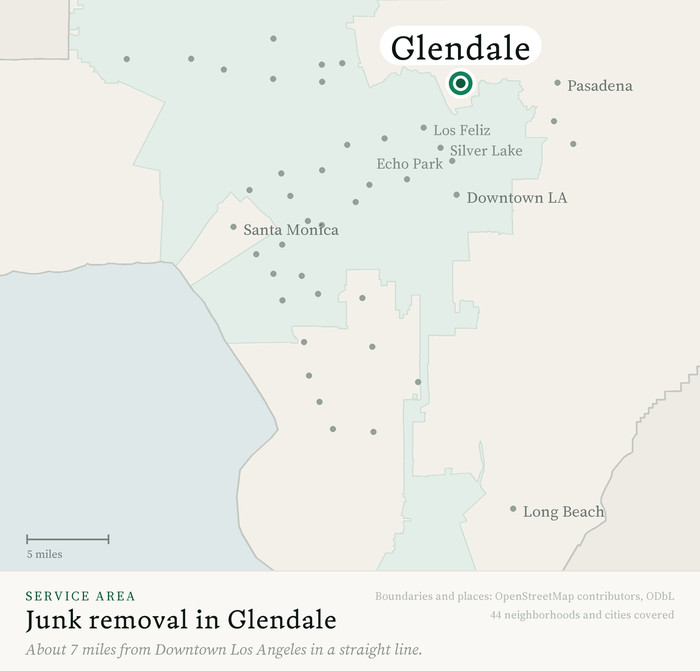
This page is commercial junk removal in Glendale specifically. The wider service is on commercial junk removal across Los Angeles, and everything we haul in this city is on junk removal in Glendale. Same crew, different job: furniture removal in Glendale, same-day junk removal in Glendale, estate cleanouts in Glendale. Pricing works the same way everywhere: how our pricing works, and the full map is on areas we serve.

We are already next door most days. The whole list is on areas we serve.
Fit-out debris, office electronics, desks and casework, yard structures, deadline work and whole-property clear-outs.
Drywall, lumber, tile and concrete, hauled to a certified C&D processor.
TVs, CRT monitors and computers. Banned from the trash in California.
Couches, sectionals, mattresses in the same trip, beds, desks and wardrobes carried down rather than dragged.
Sheds, playhouses and patio covers dismantled in sequence, slab optional.
Booked and cleared the same day, most days, across LA County.
A full property cleared with care, on probate or move-out timelines.
Asked by tenants, property managers, contractors and shop owners working inside somebody else's rules.
No. Glendale Integrated Waste provides collection for residential homes and 2-4 unit properties; businesses, and apartment or condo buildings of five units or more, are served by the franchise hauler assigned to their zone and arrange collection through the property manager. That covers routine service. A fit-out strip, an office move-out or a fixture removal is a project haul, and that is what we do — quoted flat and free before we start.
Yes. Uppers, lowers, countertops, toe-kick, reception joinery, back-of-house casework and shop fittings. Anything fixed to the structure comes off in sections rather than as furniture, and once the tear-out touches drywall, flooring or ceiling grid the load becomes construction and demolition debris, which in Glendale must be documented under Municipal Code Chapter 8.58 and taken to a certified mixed debris recycling facility. We bring the facility tags back for your permit file. See construction debris removal.
Yes. We carry insurance and we can have a certificate issued before the job is scheduled — send the exact legal entity names your risk team needs listed as additional insured, plus any wording they require, and send the invitation if your building uses a vendor compliance portal. We do not quote coverage figures on a web page; you get the certificate itself.
Yes, and it is the part most quotes get wrong. Glendale runs its own Construction and Demolition Debris Diversion Program under Municipal Code Chapter 8.58, not the City of Los Angeles ordinance. A non-residential alteration is a covered project regardless of construction value, the construction waste management plan has to be approved before the permit is issued, 65 percent of estimated debris must be diverted through a certified mixed debris recycling facility, and original facility tags — not photocopies — are due within 60 days of project completion, with the diversion security deposit riding on them.
Yes. We are open around the clock Monday to Saturday and 1pm to 10pm on Sunday, so an early-morning dock reservation, an evening shop strip or a weekend office floor is a normal booking. Tell us the slot time, the freight elevator dimensions, the garage clearance and the route to the dock, and we plan the crew and vehicle around them rather than turning up and improvising.
They split into separate streams. Electronics leave as e-waste, because California treats unwanted covered electronic devices as universal waste and they cannot go in a building bin — and on a permitted Glendale project the diversion worksheet has to include receipts showing proper universal waste disposal. Usable desks, chairs and shelving go to donation first. Metal goes to a scrap recycler. Only the genuine remainder is disposed of. See e-waste disposal and furniture removal.
Word for word from Google. Nothing tidied.
Hunter is truly dedicated on providing the most excellent of removal of unwanted junk from your home or office. Always on time, very efficient at his job in a timely manner. I would recommend him for any junk removal you may have.
Read all 67 on GoogleSee us on YelpReviews, and how to check any LA hauler
Collection rules, transfer stations and permit counters change at the city line, so each of these is written for that city rather than for Glendale. A job that straddles two of them is still one visit and one number.
Everything we haul in the cities next door: Los Feliz, Burbank, Silver Lake. The whole list is on areas we serve.
Send a photo, get a flat number back. Free, no obligation, no pressure and no call-out fee — and if your city will haul it free instead, we will tell you that too. Most requests are answered within the hour during working hours.