Mon–Sat open 24 hours · Sun 1–10pmFully insuredFamily-run, LA-based
team@lajunkhauling.com
Call us today(323) 230-0777
Home/Services/Commercial junk removal/Hollywood

Commercial junk removal in Hollywood
Your franchise hauler covers the bins. It does not cover a cleanout.

Offices, retail units, restaurants, studios and production spaces cleared in Hollywood. We work around your recycLA service, not against it.

Free quote, no obligation · one flat number before we start · you can also text that number

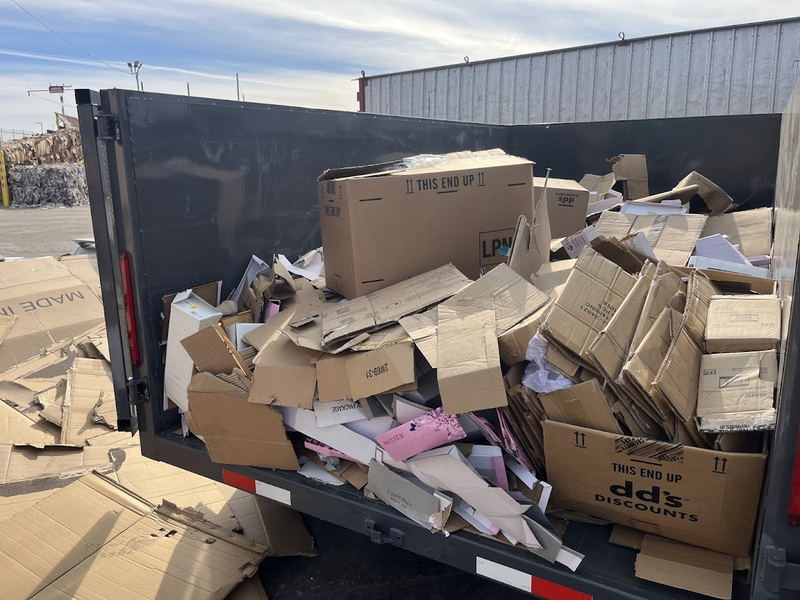
The bed of our dump trailer filled to the rail with flattened cardboard cartons and packing waste from a retail clear-out, parked at a Los Angeles County recycling facility
A commercial load staged for collection on a Los Angeles County job. Tenant improvement debris travels as its own compliant load.
In short

recycLA assigns every Hollywood business to a single franchised hauler for bins and scheduled collections across eleven citywide zones, but that contract does not cover one-off clearances such as a lease ending or a shop refit. Those go private, with mixed construction debris kept separate for a permitted hauler.

Commercial junk removal in Hollywood has to be understood alongside recycLA, the City of Los Angeles exclusive franchise system for commercial, industrial and multi-family waste. Since 2017 every business and every residential building of five or more units in the city has been served for ongoing waste and recycling collection by one contracted provider assigned to its zone, across eleven citywide zones and roughly 66,385 customers. That system covers your bins and your scheduled collections. What it is not built for is the one-off event: a tenancy ending, a store fitting out, a production wrapping, an office halving its footprint, a restaurant replacing its dining room. Those produce a volume and a mix — furniture, fixtures, electronics, packaging and often construction debris — that does not fit a bin schedule, and in the City of Los Angeles mixed construction and demolition debris additionally has to be carried by a hauler holding a LASAN private waste hauler permit to a City-certified processing facility. Los Angeles Junk Removal & Hauling handles the one-off clearance, keeps the regulated fractions separate, works around your building's loading rules, and quotes free upfront.

Every business in Hollywood already has a waste hauler, whether it chose one or not. That is the point of recycLA. What almost no business has is a plan for the week the tenancy ends, the fit-out starts, or the storeroom that has been accumulating since 2015 finally has to be emptied.

This page is about that gap: what the franchise covers, what it does not, and how a clearance gets done in a neighborhood where the loading arrangements were designed in 1931. What we clear across the area generally is on junk removal in Hollywood, and the county-wide service is on commercial junk removal.

The franchise, and what sits outside it

recycLA is a collection contract.
A cleanout is a different animal.

The Zero Waste LA ordinance established an exclusive, competitive franchise system for the collection, transportation and processing of commercial and multi-family solid waste in the City of Los Angeles. In operation as recycLA since 2017, it divides the city into eleven zones, assigns each zone to a contracted service provider, and covers businesses along with residential buildings of five or more units — in the order of 66,385 customers. Providers operate clean-fuel fleets and are held to diversion requirements under their contracts. New eight-year contracts from the most recent procurement are set to begin in February 2027.

What that means for a Hollywood business is simple and worth stating plainly: your ongoing waste and recycling collection is not something you shop for. It comes with your address. The rate structure is standardized citywide, and the program has been publicly criticized for the scale of its ancillary charges — customers were collectively billed around $60 million in access, distance and related fees on black bins in a single recent year, and the current procurement proposes eliminating fees for container access, distance, weight and fullness. Whatever your view of that, it is the system your building sits inside.

Here is the gap. A franchise collection contract is built around a repeating service: a bin of a given size, emptied on a schedule. It is not built around a hundred cubic yards appearing in one afternoon because a tenancy ended. Businesses discover this at exactly the wrong moment, usually during a move-out with a landlord's deadline attached. The practical answer is a one-off clearance carried out around the franchise service rather than in place of it, which is what we do.

The second gap is regulatory. A lot of commercial clearance is not really waste collection at all, it is demolition. Strip out a counter, a partition, a shopfront, a set of shelves fixed to the wall, and you have mixed construction and demolition debris. In the City of Los Angeles that must be collected and transported by a hauler holding a LASAN private waste hauler permit and delivered to a City-certified processing facility, and permitted haulers hold an AB 939 compliance permit and file tonnage reports. LADBS also asks building permit applicants to name their permitted hauler or show a self-haul permit. That is a chain of custody, and it is the reason a tenant improvement load and a furniture load do not travel together.

11 zonesthe citywide franchise zones recycLA divides Los Angeles into
66,385the approximate number of commercial and multi-family customers recycLA serves
Since 2017how long the exclusive franchise has covered commercial waste in the city

Sources: LA Sanitation recycLA and reporting on the franchise RFP. Both cited in full below.

What recycLA isthe City of Los Angeles exclusive franchise for collection, transportation and processing of commercial and multi-family solid waste
Who it coversbusinesses and residential buildings of five or more units
Zoneseleven citywide franchise zones, each assigned to a contracted service provider
Scaleapproximately 66,385 commercial and multi-family customers
In operation since2017
Next contract termnew eight-year contracts scheduled to begin in February 2027
Ancillary chargescustomers were collectively billed around $60 million in access and distance fees on black bins in a recent year; the current procurement proposes eliminating access, distance, weight and fullness fees
What it does not covera one-off clearance: the volume and mix produced by a move-out, a fit-out or a wrap
C&D debrismixed construction and demolition debris must be hauled by a permitted private hauler to a City-certified processing facility
Hauler permittingprivate waste haulers must hold a LASAN private waste hauler permit and an AB 939 compliance permit
Building permitsLADBS asks permit applicants to name their permitted hauler or show a self-haul permit

Sources: LA Sanitation, recycLA Program · Waste Dive, LASAN recycLA franchise RFP, zones, providers and customer counts · Zero Waste LA exclusive franchise ordinance summary · LA Sanitation, Construction & Demolition Waste Recycling Program · LA Sanitation, Waste Hauler Compliance Program

Loading a 1931 building

Second floors, single stairs
and a boulevard you cannot stop on.

Hollywood's commercial stock is largely interwar, and it was built for a delivery pattern that no longer exists. The typical arrangement along Hollywood, Sunset, Vine, Highland and Western is a ground-floor retail or restaurant unit with one or two floors above it reached by a single stair, no service elevator, and a rear service door onto a shared yard or a narrow alley if you are lucky. A second-floor office clearance in a building like that is a stair job, and the stair is usually the original: steep, turning, with a handrail that cannot be removed.

The boulevards themselves are the second constraint. Posted no-stopping hours cover the busiest parts of the day on the main commercial corridors, which is exactly when a business would prefer the work to happen. Bus lanes, loading zones with time limits, and valet stands outside restaurants further reduce the usable frontage. The practical consequence is that a lot of Hollywood commercial clearance is scheduled early, late or overnight, and we are set up for that: Monday to Saturday we are open around the clock.

Third, the shared-building problem. Many Hollywood commercial tenancies sit inside buildings with residential above or a mix of small tenancies alongside, which means noise limits, a building manager, agreed hours and often a certificate of insurance. A production company clearing a post suite at eleven at night is a different negotiation from a retailer clearing a stockroom at eight in the morning, and both are doable with notice.

Fourth, the trash enclosure. A commercial enclosure is sized and permitted for the bins the franchise provides. It is not an overflow area, and filling it with a fit-out's worth of fixtures does not transfer the problem to the franchise hauler. It creates a violation and an unhappy neighbor. If you have a clearance coming, the material needs to leave the site directly rather than be staged in the enclosure.

Fifth, timing around production and events. Street closures for filming and for events are a genuine feature of the neighborhood rather than an exception, and they can close the exact frontage a job depends on. We check the window we are quoting. If the address is a restaurant or a kitchen with appliances involved, see appliance removal.

Tell us the tenancy, the floor and the loading arrangement. We quote commercial work free upfront.

Free upfront quote, no obligation. One number, agreed before anything is lifted.

5.0 from 67 reviews on GoogleMon–Sat, open 24 hours

On the job
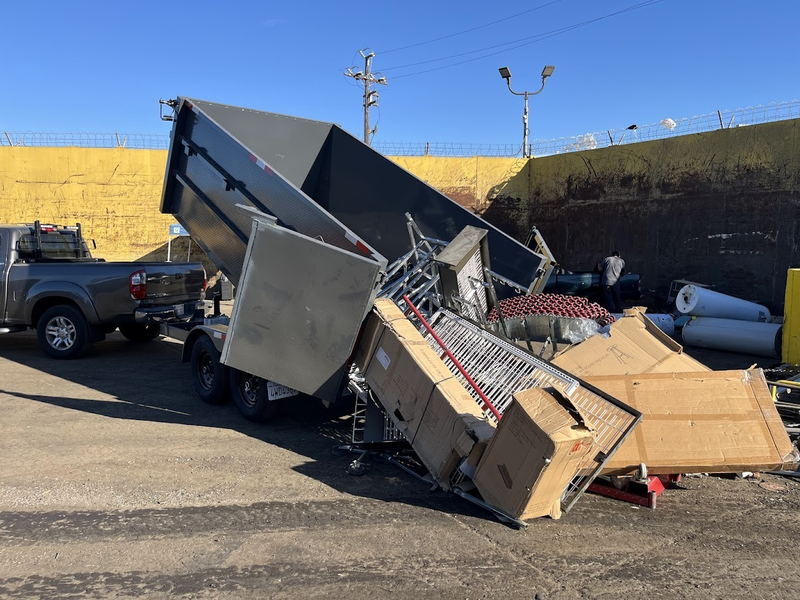
Our dump trailer raised and tipping a commercial load of flat-pack cartons and steel shelving out onto the floor of a Los Angeles County recycling yard
Tipping a commercial load at the recycling yard · Hollywood
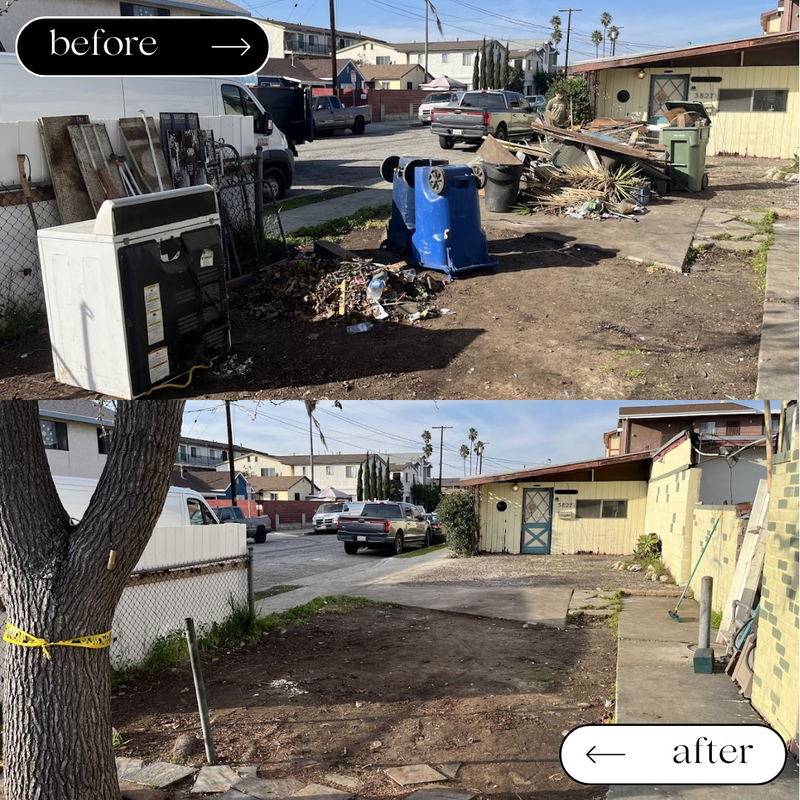
Before and after of a Los Angeles County front yard: a dumped washer and dryer, overflowing bins, cut palm fronds and scattered trash, then the same yard raked flat and completely clear
Before and after — a dumped front yard cleared · Hollywood
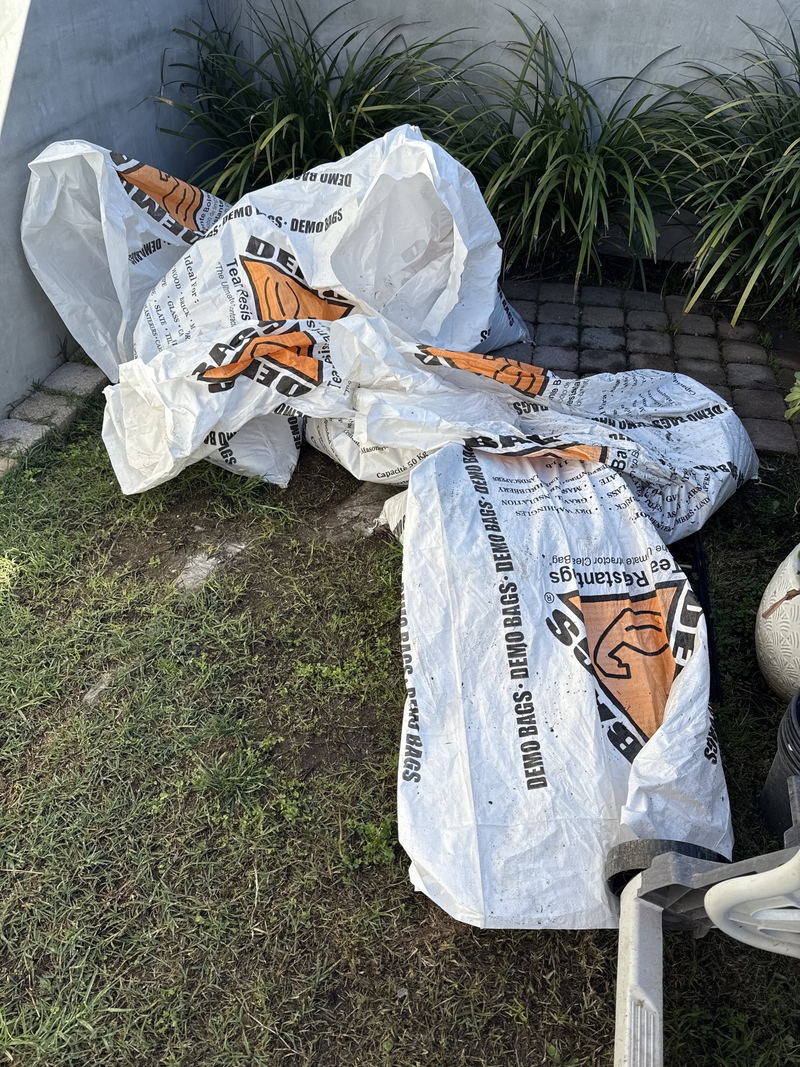
Heavy-duty white demolition bags packed full of renovation waste lying on the lawn and paved patio of a Los Angeles County property, staged for a hand carry to the trailer
Bagged renovation waste staged on the lawn · Hollywood

Our own crews on Los Angeles County jobs. The commercial junk removal we run in Hollywood looks like this too: side yards, narrow walkways and the back of the property is where the work actually is.

Where commercial material goes

Six streams
out of one tenancy.

A commercial clearance separates further than a household one because the material is more uniform and therefore easier to route. Stream one is reuse. Office furniture, shelving, restaurant equipment, display fixtures and lighting frequently have a second life with another business or a charity, and the value of that decision is highest when it is made before anything is stacked. Stream two is paper and cardboard, which in a retail or office clearance is often the largest single fraction by volume and the easiest to recover cleanly.

Stream three is metal: shelving, racking, steel furniture frames, fixtures, ducting. Stream four is electronics, and a commercial clearance produces a great deal of it. California's universal waste rules ban computers, monitors, televisions, printers, fluorescent lamps, batteries, mercury switches and microwaves from the trash, and that has been the case since the household exemption ended on February 9, 2006. An office clearance without a separate e-waste stream is not a compliant clearance.

Stream five is the hazardous fraction, which businesses often forget they have: fluorescent tubes from a ceiling grid, ballasts, cleaning chemicals, aerosols, and in a restaurant, fryer oil and refrigerant-bearing equipment. S.A.F.E. centers handle business material through a paid Very Small Quantity Generator program by appointment rather than over the counter, which is a different route from the free residential one and needs planning rather than a Saturday morning.

Stream six is construction and demolition debris, and it is kept entirely separate for legal reasons. Partition, counter, floor covering, tile, shopfront and fixed joinery are C&D. In the City of Los Angeles that has to be carried by a permitted hauler to a City-certified processing facility, and LASAN's waste hauler compliance program is the mechanism behind it. Keeping that load separate is the difference between a clearance that survives scrutiny and one that does not.

Sources: Californians Against Waste, background on universal waste and DTSC regulations · LA Sanitation, S.A.F.E. Collection Centers and Household Hazardous Waste · LA Sanitation, Construction & Demolition Waste Recycling Program

The rule behind it
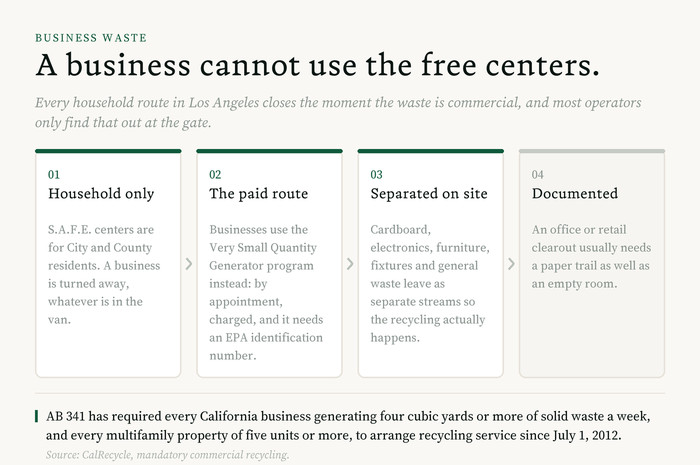
Diagram of why Los Angeles business waste cannot use the free household centers: S.A.F.E. centers are residents only, businesses use the paid Very Small Quantity Generator program with an EPA identification number
Every household route closes when the waste is commercial

Same rule in Hollywood as anywhere else in Los Angeles County. The local part is the program above, not the disposal law. Full detail on commercial junk removal.

Worth knowing

Hollywood commercial
in six lines.

Commercial facts
  1. recycLA is the City of Los Angeles exclusive franchise for commercial, industrial and multi-family waste, in operation since 2017 across eleven citywide zones.
  2. It serves roughly 66,385 customers, including every residential building of five or more units in the city.
  3. The franchise is a scheduled collection contract; it is not built for the one-off volume of a move-out, a fit-out or a wrap.
  4. New eight-year franchise contracts from the latest procurement are scheduled to begin in February 2027.
  5. Mixed construction and demolition debris in the City of Los Angeles must be carried by a hauler holding a LASAN private waste hauler permit to a City-certified processing facility.
  6. Business hazardous material goes through the paid Very Small Quantity Generator program by appointment, not through the free weekend S.A.F.E. counter.

This page is commercial junk removal in Hollywood specifically. The wider service is on commercial junk removal across Los Angeles, and everything we haul in this city is on junk removal in Hollywood. Same crew, different job: Furniture removal in Hollywood, Mattress removal in Hollywood, Same-day junk removal in Hollywood. Pricing works the same way everywhere: how our pricing works, and the full map is on areas we serve.

Service area
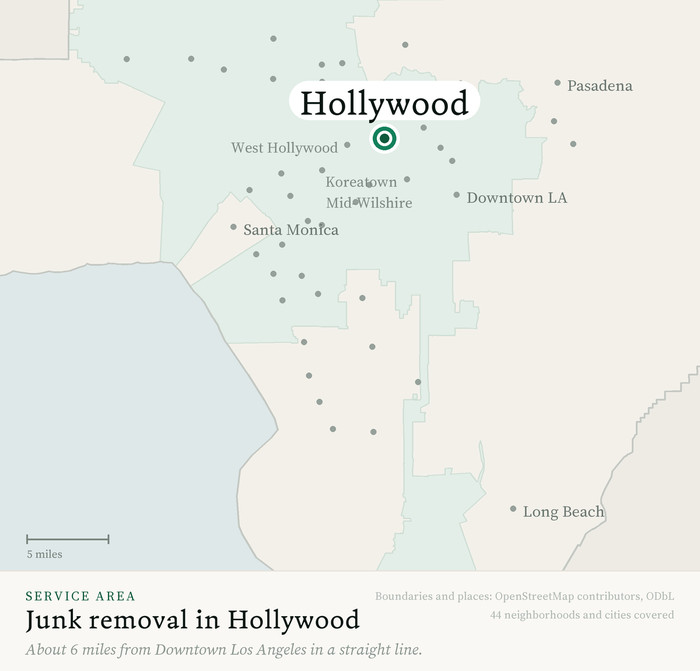
Map of our greater Los Angeles junk removal service area with Hollywood marked, about 6 miles from Downtown Los Angeles, drawn from OpenStreetMap boundary data
Hollywood in the greater Los Angeles service area. Boundaries and places from OpenStreetMap contributors, ODbL.

We are already next door most days. The whole list is on areas we serve.

Other things we clear in Hollywood

Same crew, same trucks, same free upfront quote.

Hollywood commercial
questions

recycLA, tenant improvement debris, loading rules and out-of-hours work.

We already have a waste hauler through the city. Why would we need you?

Because those are two different services. recycLA assigns your building a franchised provider for scheduled collection, and that provider empties the bins your business generates week to week. A clearance is not that. A tenancy ending or a fit-out starting produces in one afternoon what your bins handle in a quarter, in a mix the bins are not set up for. We do the one-off work around your franchise service rather than in place of it, which keeps your ongoing account exactly as it is.

Can you work outside business hours?

Yes, and in Hollywood it is often the only sensible option. The main commercial corridors post no-stopping hours through the busiest part of the day, so early morning, evening and overnight are frequently the windows where a truck can legally stand at your door. We are open Monday to Saturday around the clock and Sunday from 1 to 10 p.m. Tell us the building's permitted working hours and any noise restriction and we will schedule inside them.

Our fit-out is producing demolition debris. Can that go with the rest?

No, and this is the part worth getting right. In the City of Los Angeles, mixed construction and demolition debris has to be collected and transported by a hauler holding a LASAN private waste hauler permit and delivered to a City-certified processing facility. LADBS also asks permit applicants to name their permitted hauler or show a self-haul permit. So partition, counter, tile, flooring and fixed joinery travel as their own compliant load, separate from furniture and general waste. We quote both parts together.

What happens to our old office furniture and equipment?

It is sorted on site into reuse, metal, paper and cardboard, electronics and residual. Office furniture, shelving, display fixtures and restaurant equipment often have a second life with another business or a charity, and that decision is made before anything is stacked. Electronics come out as a separate stream because California's universal waste rules ban computers, monitors, printers, fluorescent lamps and batteries from the trash. We will tell you what went where.

We are clearing a second-floor suite with no elevator. Is that a problem?

It is normal here. A great deal of Hollywood's commercial stock is interwar, with one or two floors above a ground-floor unit reached by a single original stair and no service elevator. What we need to know is the stair, the door widths and where the truck can stand, because that determines crew size and duration rather than whether the job is possible. Tell us at the quote stage and you get a realistic number and a realistic window rather than an optimistic one.

Can we put the fit-out material in the building's trash enclosure in the meantime?

Please do not, and it is worth explaining why. The enclosure is sized and permitted for the bins the franchise provides. Filling it with fixtures and partition material does not hand the problem to the franchised hauler; it creates a violation for the building and a blockage for every other tenant using it. Material from a clearance should leave the site directly. If timing is the issue, tell us and we will schedule the removal to match the strip-out rather than after it.

The proof

What our customers say

5.0from 67 reviews on Google

Word for word from Google. Nothing tidied.

  • 3 months ago

    Hunter is truly dedicated on providing the most excellent of removal of unwanted junk from your home or office. Always on time, very efficient at his job in a timely manner. I would recommend him for any junk removal you may have.

    James Russell3 reviewsHome and office junk removal
  • Fair pricing 11
  • Personable staff 10
  • Polite 5
  • Punctual staff 4
One city over

Commercial junk removal near Hollywood

Collection rules, transfer stations and permit counters change at the city line, so each of these is written for that city rather than for Hollywood. A job that straddles two of them is still one visit and one number.

Everything we haul in the cities next door: West Hollywood, Los Feliz, Koreatown. The whole list is on areas we serve.

Request a quote

Send a photo, get a flat number back. Free, no obligation, no pressure and no call-out fee — and if your city will haul it free instead, we will tell you that too. Most requests are answered within the hour during working hours.

Or call or text (323) 230-0777 — Mon–Sat around the clock, Sunday 1–10pm.

Call (323) 230-0777Text a photo