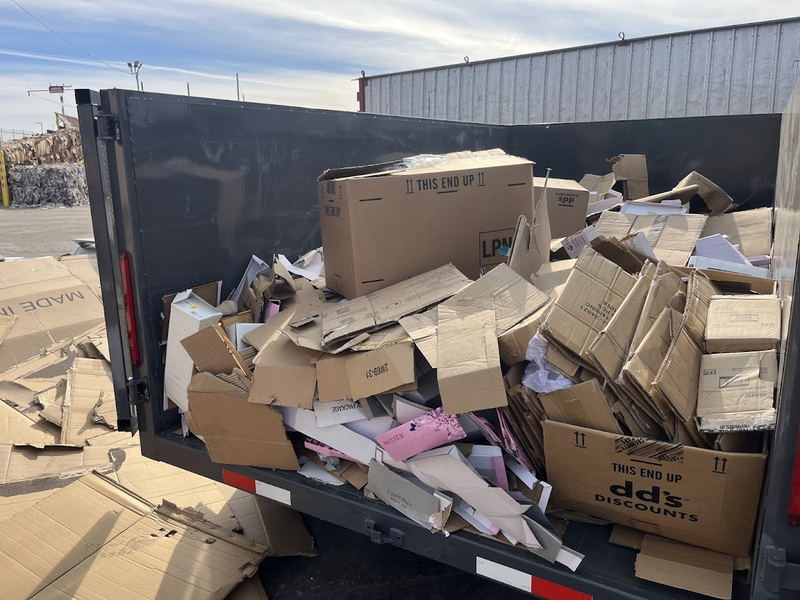
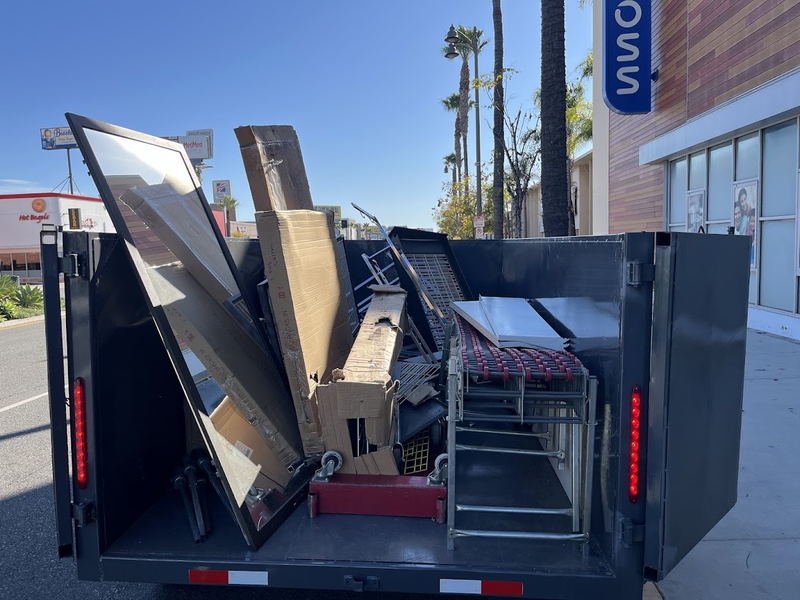
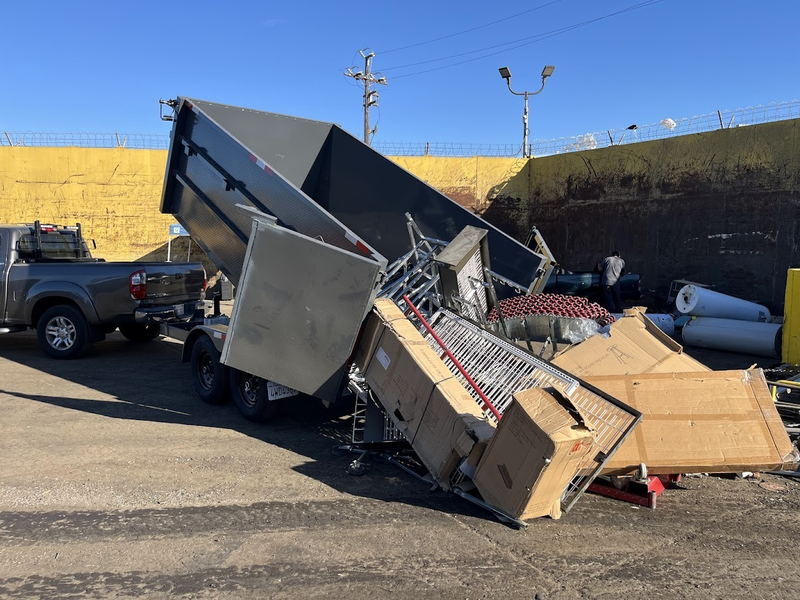
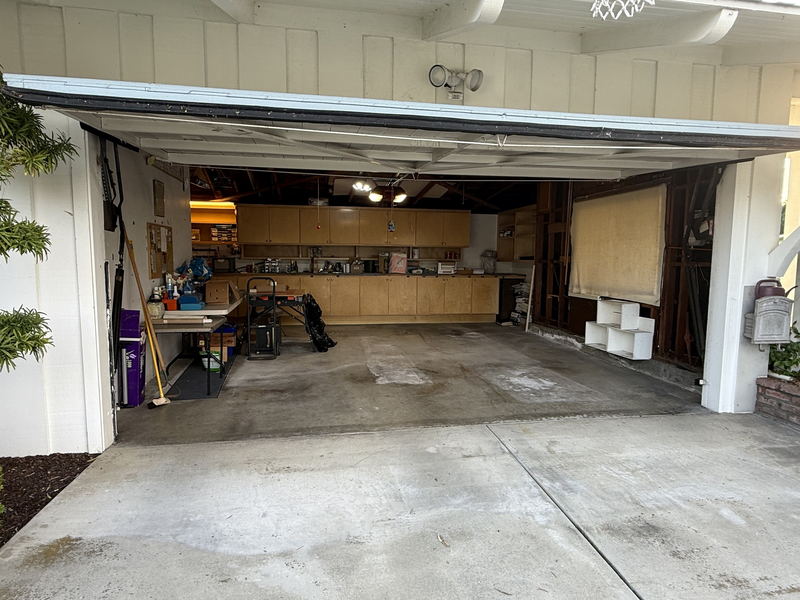
Hunter is truly dedicated on providing the most excellent of removal of unwanted junk from your home or office. Always on time, very efficient at his job in a timely manner. I would recommend him for any junk removal you may have.
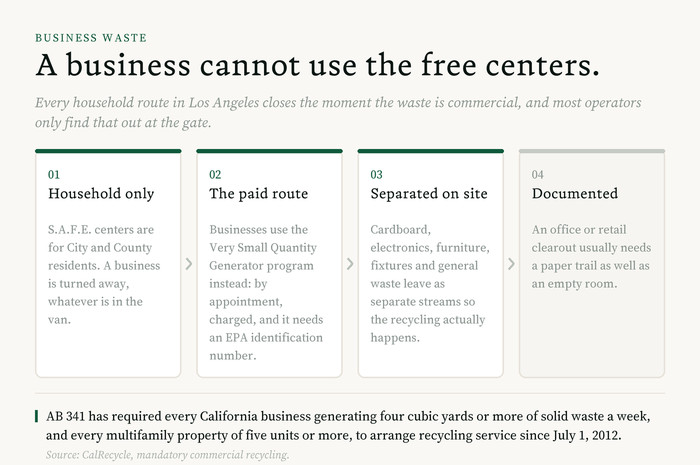
A business in Culver City has no free bulky allowance and no access to the county's household hazardous waste centers. Every route a resident can use is closed to a commercial tenant, which changes how a clearance has to be planned.
Free quote, no obligation · one flat number before we start · you can also text that number

Culver City's residential bulky item program excludes commercial waste outright, and county S.A.F.E. centers take household material only, leaving businesses the paid Very Small Quantity Generator route by appointment. A commercial clearance here is always a private haul, worked around building hours and quoted free before anything moves.
Commercial waste is explicitly excluded from Culver City's residential bulky item program, and commercial customers have no free allowance under it at all. The county's S.A.F.E. Collection Centers are equally closed to business waste: they exist for household hazardous waste, and a business must instead use the paid Very Small Quantity Generator program, by appointment, with an EPA identification number, and only if it generates no more than 27 gallons or 220 pounds of hazardous waste a month. So a commercial clearance in Culver City is always a private haul, with no free fallback behind it. Los Angeles Junk Removal & Hauling clears offices, studios, retail units and warehouses across the city, works out of hours where a building requires it, and quotes free and up front before anything is moved.
The mistake commercial tenants make in Culver City is assuming the rules that apply to their home apply to their unit. They do not, and the gap is wider here than most people expect. A resident has a free municipal pickup, a free household hazardous waste route at the weekend and a state-funded mattress program. A business has none of those three. Every stream a business produces has to be arranged and paid for privately, and several of them are governed by state law rather than by preference.
That is not a reason to panic, it is a reason to plan. A lease-end clearance with three weeks of notice is a straightforward job. The same clearance with three days of notice, a shared loading area and a landlord who wants the unit swept and the fixtures out is a different one entirely. This page sets out what the rules actually are, what the Culver City building stock does to access, and how a clearance is sequenced. The residential side of the city is on junk removal in Culver City, and the wider service is on commercial junk removal across Los Angeles.
Start with the city. Culver City's bulky item program lists commercial waste among the materials it will not accept, and states that the fee for commercial customers is set by the city's adopted refuse rates. There is no free allowance to draw on. Whatever a business puts out is a paid arrangement, and putting commercial waste out on a residential curbside pickup is not an option the program permits.
Next, hazardous waste. The S.A.F.E. Collection Centers — Solvents, Automotive, Flammables, Electronics — are free to City of Los Angeles and Los Angeles County residents, and Culver City residents qualify. Business waste does not. Those programs are for household hazardous waste and are not intended for business-generated material. A small business instead uses the Very Small Quantity Generator program, which is by appointment and charged. To qualify as a Very Small Quantity Generator a business must generate no more than 27 gallons or 220 pounds of hazardous waste per month, or 2.2 pounds of extremely hazardous waste, and it must hold an EPA identification number to take part.
Then state law, which most tenants have simply never been walked through. Under California's mandatory commercial recycling law, a business generating four cubic yards or more of commercial solid waste per week, and any multifamily residential property of five units or more, must arrange recycling services — by self-hauling, by subscribing to a hauler, by arranging collection of recyclables, or by using mixed waste processing that achieves comparable diversion. Those requirements took effect on 1 July 2012, and since 1 July 2020 covered businesses have also had to provide organics and recycling containers at the front of the premises for material bought and consumed on site.
Organics sit on top of that. Under SB 1383, jurisdictions must provide organic waste collection to all residents and businesses and recycle that organic waste, against statewide targets of 75 per cent less organic waste sent to landfill and 20 per cent of unsold edible food redirected to food recovery organizations, and some food service businesses are required to donate surplus edible food rather than dispose of it. For an office that is a coffee-and-lunch question; for a production kitchen or a food unit it is an operational one.
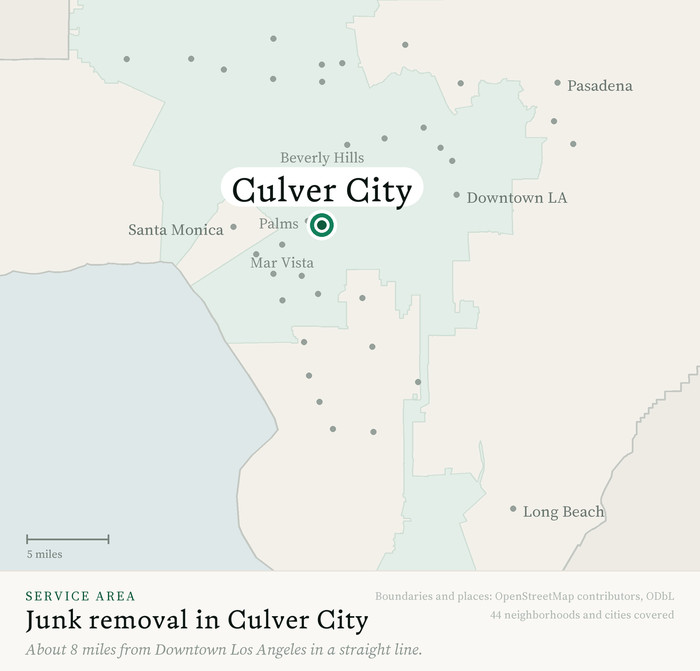
One rule that does not apply here is worth naming, because it is the single most common error in advice written about Culver City. The City of Los Angeles construction and demolition ordinance, which requires mixed construction debris to go to a City-certified processor via a permitted hauler, is a City of Los Angeles rule. Culver City is a separate incorporated city and is not covered by it. If your unit is in the Hayden Tract, that ordinance is not what governs your strip-out. If your unit is on the other side of the boundary in Palms or Mar Vista, it is. We check which side of the line an address sits on before quoting a fit-out clearance, because the answer changes the paperwork.
Sources: CalRecycle; LA Sanitation; City of Culver City. All cited in full below.
| Culver City bulky pickup | Commercial waste is on the unacceptable list. No free allowance for commercial customers |
|---|---|
| Commercial fee basis | The city's adopted refuse rates |
| S.A.F.E. centers | Household hazardous waste only, free to LA County residents. Not for business-generated waste |
| Business hazardous route | Very Small Quantity Generator program, by appointment, charged |
| VSQG threshold | No more than 27 gallons or 220 pounds of hazardous waste a month, or 2.2 pounds extremely hazardous |
| VSQG paperwork | An EPA identification number is required to take part |
| Mandatory commercial recycling | Applies at 4 cubic yards or more of commercial solid waste a week, and to multifamily properties of 5 units or more |
| In force since | 1 July 2012, with front-of-premises recycling and organics containers required from 1 July 2020 |
| Organics, SB 1383 | Statewide targets of 75% less organic waste landfilled and 20% of unsold edible food recovered |
| LA City C&D ordinance | A City of Los Angeles rule. It does not apply at a Culver City address |
Sources: City of Culver City, Bulky Items; LA Sanitation, Washington Boulevard S.A.F.E. Center and the Very Small Quantity Generator program; CalRecycle, Mandatory Commercial Recycling (AB 341); CalRecycle, SB 1383 Short-Lived Climate Pollutants: Organic Waste Reductions.
The eastern end of Culver City around National Boulevard and Hayden Avenue is the Hayden Tract: a former heavy-manufacturing and warehouse district beside Ballona Creek, roughly bounded by National, West Jefferson and Ince boulevards, Lucerne Avenue and Higuera and Schaefer streets, rebuilt over four decades by Eric Owen Moss Architects and the developer Samitaur Constructs into more than thirty reworked buildings occupied largely by film, media, advertising and tech firms. It is a genuinely unusual place to clear a tenancy out of, and it is worth saying why.
These are conversions. A building designed as a warehouse and reworked into creative office space very often has one roller door, no dedicated loading dock, a goods route that runs through the same doors people use, and internal levels connected by open stair rather than a freight elevator. Sculptural interiors that photograph beautifully are hostile to a six-foot desk. Add on-street parking that is shared with every other tenant on the block, and the practical constraint on a clearance is almost never the volume of the load. It is how many trips it takes to get a truck loaded and how long the door can be held open.
The rest of the commercial stock has its own patterns. Downtown Culver City around Culver Boulevard is ground-floor retail and restaurant units with pedestrian frontage, where a daytime clearance is disruptive and out-of-hours working is usually the only sensible answer. The Jefferson and Higuera corridors carry light industrial and studio-adjacent units with better vehicle access but tighter yard space. Fox Hills has the mall-adjacent commercial blocks and larger managed properties where a facilities team, not the tenant, controls the loading window and the service elevator.
So the questions we ask a Culver City business are about control rather than contents. Who books the loading bay or the elevator, and how far ahead. Is out-of-hours or weekend working permitted, and is there a noise or delivery restriction on the street. Is there a roller door, and what is the drop from it. Does the landlord require the unit swept, the fixtures removed, or the tenant improvements reinstated. Is there an IT room, and has anything in it been signed off for disposal. Answer those and the job plans itself. Where volume and access drive the number, the structure is the same as everywhere else: quoted free and up front, by the space the load occupies rather than by the hour, with labor, transport and disposal inside the number. It is set out on how our pricing works.
If a lease is ending on a fixed date and the clearance has to finish inside the day, that is same-day junk removal in Culver City. If it is the contents of a storage unit or a back-of-house store rather than an office floor, it looks more like a garage cleanout in Culver City.
Clearing an office, studio or unit in Culver City? Tell us the access and the deadline and we will quote it free.
Free upfront quote, no obligation. One number, agreed before anything is lifted.
5.0 from 67 reviews on GoogleMon–Sat, open 24 hours


Our own crews on Los Angeles County jobs. The commercial junk removal we run in Culver City looks like this too: side yards, narrow walkways and the back of the property is where the work actually is.
The reason a commercial clearance takes planning is that an office is not one material. A single floor produces desks and task chairs, steel filing and shelving, IT equipment, batteries and lamps, paper, packaging, and whatever is left in the kitchen. Each has a different lawful destination and one of them has a legal deadline attached.
Furniture first. Commercial desking, task seating, storage and meeting furniture is the most reusable category in the whole job, because it is standardised, durable and usually in far better condition than domestic furniture of the same age. It also has the shortest window: it is reusable while it is dismantled carefully and stacked, and it is scrap the moment it is thrown into a truck. We separate it before loading for exactly that reason. Steel carcasses, frames and shelving that cannot be reused go to a metals recycler, where they hold value.
Electronics are the stream with the law behind it. Electronics are universal waste in California; the state exemption ended on 9 February 2006, and since then computers, monitors, televisions, printers, microwaves, household batteries, fluorescent lamps and mercury devices have been banned from ordinary trash, with cathode-ray tubes named specifically. An office fit-out strip produces all of those at once: a rack of dead machines, a cabinet of monitors, a bin of drained UPS batteries, a ceiling grid of fluorescent tubes. None of it goes on the general load, and none of it can go to a S.A.F.E. center on a business account. It is handled as a business waste stream, which is precisely the thing the residential rules do not cover.
Then the fraction that is not waste at all. Anything holding data has to be dealt with before disposal, not after. Anything still under lease or finance is not yours to dispose of. Anything the landlord considers a fixture is part of the reinstatement conversation rather than the clearance. We flag those on the walk-through instead of discovering them on the truck, because the expensive mistakes in a commercial clearance are almost always things that should not have left the building.
Finally, the paper and organics streams that the state now expects a covered business to be separating anyway. If the mandatory commercial recycling threshold applies to your operation, a clearance is a good moment to get the separation right rather than a good moment to abandon it, and a hauler that mixes everything into one load is making your compliance position worse, not simpler.

Sources: Californians Against Waste, background on universal waste and DTSC regulations; CalRecycle, Mandatory Commercial Recycling (AB 341); CalRecycle, SB 1383 Short-Lived Climate Pollutants: Organic Waste Reductions; LA Sanitation, Washington Boulevard S.A.F.E. Center and the Very Small Quantity Generator program.

Same rule in Culver City as anywhere else in Los Angeles County. The local part is the program above, not the disposal law. Full detail on commercial junk removal.
This page is commercial junk removal in Culver City specifically. The wider service is on commercial junk removal across Los Angeles, and everything we haul in this city is on junk removal in Culver City. Same crew, different job: same-day junk removal in Culver City, furniture removal in Culver City, garage cleanouts in Culver City. Pricing works the same way everywhere: how our pricing works, and the full map is on areas we serve.

We are already next door most days. The whole list is on areas we serve.
A tenancy clearance is several waste streams at once. One quote covers them, and we tell you which ones the law treats differently.
Couches, sectionals, mattresses in the same trip, beds, desks and wardrobes carried down rather than dragged.
TVs, CRT monitors and computers. Banned from the trash in California.
Drywall, lumber, tile and concrete, hauled to a certified C&D processor.
Fridges, washers and AC units. Refrigerant units are handled as universal waste.
The whole garage in one visit. We sort, donate what is usable and sweep the slab.
Booked and cleared the same day, most days, across LA County.
Mostly about what a business is allowed to use, and what the landlord will actually ask for.
No. Commercial waste is listed among the materials the program will not accept, and commercial customers have no free allowance; the fee for a commercial customer is set by the city's adopted refuse rates. This is the single biggest difference between clearing your home and clearing your unit in Culver City. There is no free fallback behind a business clearance, which is why it is worth planning rather than improvising.
Not on a business account. The S.A.F.E. Collection Centers exist for household hazardous waste and are free to Los Angeles County residents; they are not intended for business-generated waste. A small business uses the Very Small Quantity Generator program instead, which is by appointment and charged, applies only to businesses generating no more than 27 gallons or 220 pounds of hazardous waste a month, or 2.2 pounds of extremely hazardous waste, and requires an EPA identification number to take part.
No. That ordinance is a City of Los Angeles rule requiring mixed construction and demolition debris to be taken by a permitted hauler to a City-certified processing facility, and Culver City is a separate incorporated city that is not covered by it. It is the most common error in advice written about this city. Note the boundary matters, though: an address in Palms or Mar Vista a few streets away is City of Los Angeles and is covered. We check the address before we quote a strip-out.
Under California's mandatory commercial recycling law, a business generating four cubic yards or more of commercial solid waste per week, and any multifamily property of five units or more, must arrange recycling services — self-hauling, subscribing to a hauler, arranging collection of recyclables, or using mixed waste processing with comparable diversion. That has been in force since 1 July 2012, and since 1 July 2020 covered businesses must also provide recycling and organics containers at the front of the premises. Organics sit under SB 1383, with statewide targets of 75 per cent less organic waste landfilled and 20 per cent of unsold edible food recovered.
Yes, and in a lot of Culver City buildings it is the only workable answer. The Hayden Tract is a converted warehouse district, so a tenancy often has one roller door, no dedicated loading dock, and a goods route that runs through the doors people use. Ground-floor retail on Culver Boulevard has pedestrian frontage where a daytime clearance is disruptive. Tell us who controls the loading window and whether there is a noise or delivery restriction on the street, and we plan the job around it.
It is quoted free and up front with no obligation, and the number is agreed before anything is moved. Pricing is by the volume the load occupies in the truck rather than by the hour, with labor, transport and disposal inside the number. On a commercial job the things that actually move it are access and timing rather than volume: dock availability, elevator booking, out-of-hours working, and how many streams have to be separated. The structure is on how our pricing works.
Word for word from Google. Nothing tidied.
Hunter is truly dedicated on providing the most excellent of removal of unwanted junk from your home or office. Always on time, very efficient at his job in a timely manner. I would recommend him for any junk removal you may have.
Read all 67 on GoogleSee us on YelpReviews, and how to check any LA hauler
Collection rules, transfer stations and permit counters change at the city line, so each of these is written for that city rather than for Culver City. A job that straddles two of them is still one visit and one number.
Everything we haul in the cities next door: Palms, Mid-City, West Los Angeles. The whole list is on areas we serve.
Send a photo, get a flat number back. Free, no obligation, no pressure and no call-out fee — and if your city will haul it free instead, we will tell you that too. Most requests are answered within the hour during working hours.