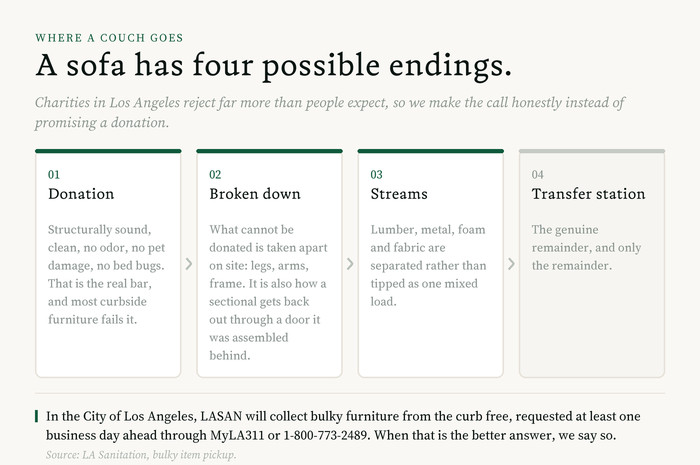
Whether a piece of furniture can be donated is decided by four things, and only one of them is about the furniture. Condition, obviously: no structural break, no soaking, no mold, no infestation. Cleanliness, which in practice means upholstery without heavy staining, because a reuse organization cannot deep-clean at scale and will not take a gamble on a fabric sofa it has to store. Completeness, because a bed frame missing its slats and hardware is scrap metal and lumber, not a bed. And handling, which is the one nobody thinks about until it is too late.
Handling is why we sort on the driveway. Once a wardrobe has gone into the truck first and a granite-topped console has gone in on top of it, both are waste. So the reusable pieces come out of the house wrapped or blanketed, get set aside rather than loaded, and go on last. It costs a few minutes per item and it is the entire difference between a donation and a landfill ticket. It is also why we ask on the phone whether anything in the load is worth keeping intact, rather than assuming.
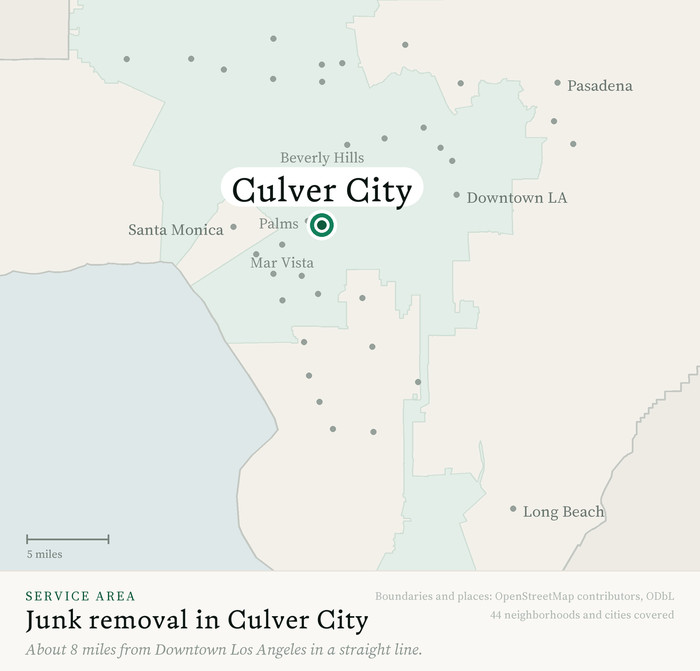
Culver City's building stock then decides how hard that is. The single-family streets in Sunkist Park, Studio Village and the McManus and Lindberg Park blocks are mostly post-war one-story houses with a straightforward path out through a hallway and a driveway, which is the easy version. Culver Crest and Blair Hills sit on the hill: split levels, external stair runs, tight switchback driveways where a truck parks at the bottom and everything is carried up or down. Fox Hills is largely condos and managed buildings, which means an elevator, a reserved loading window and a building manager who controls both. Downtown Culver City and the Washington and Venice corridors are a mix of walk-ups and newer apartment stock, where the constraint is usually the stairwell turn rather than the weight.
What we ask about a Culver City address is therefore quite specific: is there an elevator, and who books it; is the parking a red curb or a permit block; how many stair runs and how many turns; is there a side gate wide enough for a sofa or does everything go through the front. Those answers change the crew and the time, which is what changes the quote. Nothing about it is mysterious, and we would rather ask five questions on the phone than send two people to a job that needs three. Pricing is by the volume the load occupies in the truck rather than by the hour, with labor, transport and disposal inside one agreed number: how our pricing works.
If the job is really the whole contents of a property rather than a few pieces, it is closer to a garage cleanout in Culver City or a full clearance, and if it has to be finished today, that is same-day junk removal in Culver City.