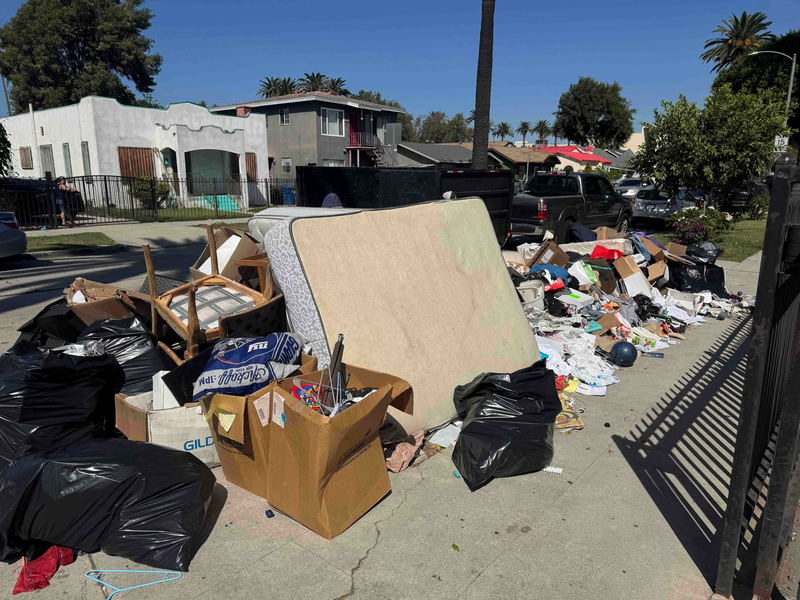
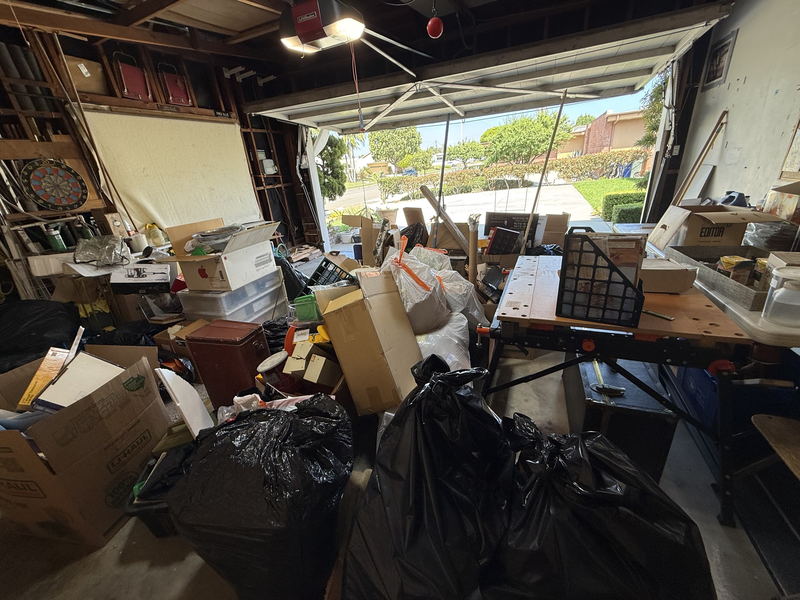
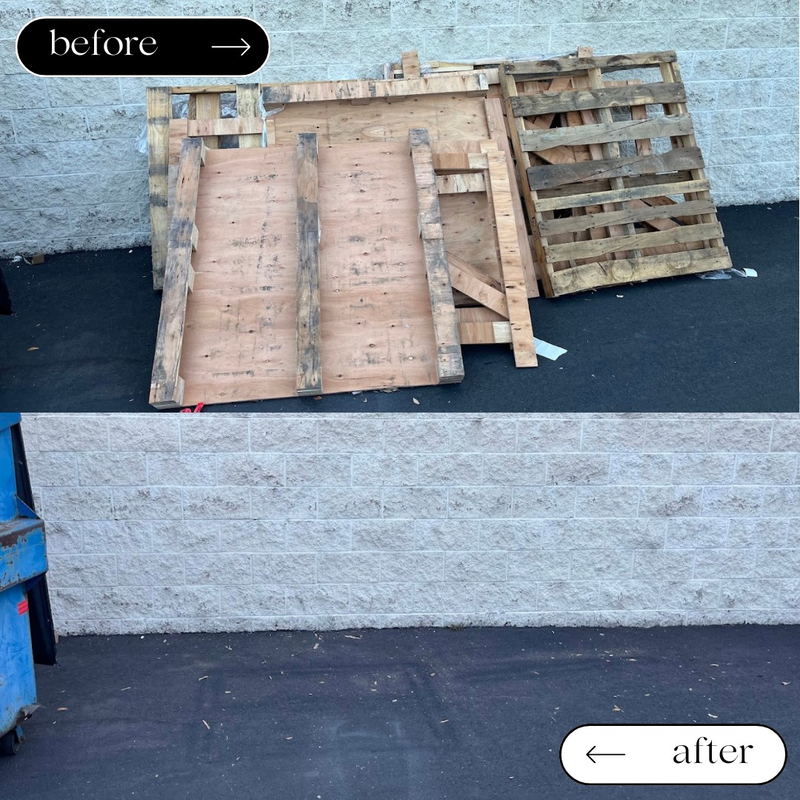
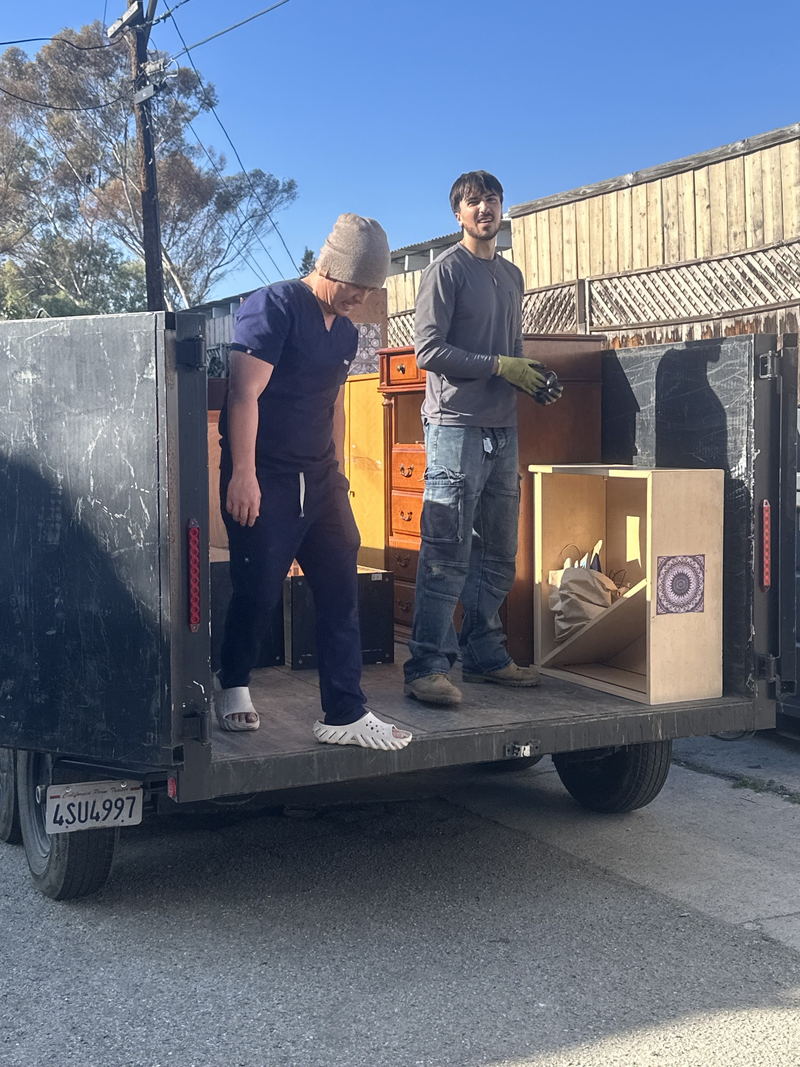
Working with Hunter and this company was great. Gave us a quick quote over the phone after sending photos and was able to help us the SAME day. Removal was fast and easy. We definitely recommend going with this company.
Probate, downsizing, family clearances and pre-sale clears across Pasadena, handled room by room, with donation and recycling separated from waste and a free upfront quote before anything moves.
Free quote, no obligation · one flat number before we start · you can also text that number

Pasadena's free bulky pickup excludes estate-type residential properties of 20,000 square feet or more, along with commercial units and buildings of five or more units, so a full house clearance here has no municipal route. Whole properties get cleared room by room, sorting donation, resale, recycling and regulated waste, quoted free upfront.
Pasadena's free bulky item program is built for ordinary households, and it steps back precisely where an estate clearance begins. The city does not collect from commercial units, from estate-type residential properties of 20,000 square feet or more, or from multi-family buildings of five or more units, and even for a qualifying single-family address the allowance is two free pickups a year, capped at roughly three cubic yards, nothing heavier than two people can lift, placed on the parkway because staff cannot enter private property. Pasadena also has no permanent household hazardous waste facility, so the chemical fraction of a long-lived house has to travel to a S.A.F.E. center or wait for a county roundup. Los Angeles Junk Removal & Hauling clears whole properties room by room, sorts donation, resale, recycling and regulated waste as it goes, and quotes the entire job free upfront.
An estate clearance in Pasadena usually arrives with someone else's deadline attached: a probate timetable, an escrow, a listing shoot, relatives flying home on Sunday. And it usually arrives at a house that has been in one family for a very long time, which in this city means large rooms, deep closets, a detached garage, a basement or a service porch, and eighty years of things nobody has had a reason to move.
This page is about how that job actually runs here: what the city will not do, how the sorting works, what has to be routed separately, and the local wrinkles — large-property exclusions, landmark rules, no hazardous waste facility — that decide the schedule. The wider local picture is on junk removal in Pasadena, and our county-wide service is on estate cleanouts.
For an ordinary Pasadena household the free program is straightforward: two bulky item pickups per calendar year for city refuse customers, requested about two weeks ahead on (626) 744-7311 or the Citizen Service Center app with an itemized list, collected 7 a.m. to 4 p.m. Monday to Friday. On an estate job the arithmetic falls apart immediately. Two pickups at roughly three cubic yards each is about six cubic yards a year, and the contents of a family house is a multiple of that. The weight rule — nothing heavier than two people can lift — excludes exactly the items an old house is full of: the upright piano, the safe, the workshop bench, the cast iron bath in the basement.
Then there are the exclusions that catch Pasadena's larger houses. The city does not collect from commercial units, from estate-type residential units of 20,000 square feet or more, or from multi-family buildings of five or more units. That is not a technicality here: Pasadena has genuine large-lot estate properties, and the moment a property crosses that line the municipal bulky service is simply not part of the plan.
The parkway rule shapes the rest. Items are collected from the strip between the sidewalk and the street, and city staff cannot enter private property. On a large Pasadena lot the distance from the back of the house to the parkway can be a hundred feet or more, past a side gate, down a single-width drive. Add the timing rule — out by 7 a.m. on collection day, no more than 24 hours early, with a Code Enforcement citation possible for early set-out — and staging a house clearance on a parkway is not a workable plan.
One more Pasadena-specific factor belongs in an estate conversation, because it changes timelines rather than trucks. Properties in the city's designated landmark districts are subject to design review: demolition, or an exterior change visible from the street, requires a certificate of appropriateness before a building permit can be issued, and the city's own guidance puts that process at roughly two months. Clearing the contents of a house is not a permit matter. Removing part of the structure is. If a family is planning to clear and then alter before a sale, those are two different clocks and it is worth knowing that before the listing date is set.
Sources: City of Pasadena; LA Sanitation S.A.F.E. centers. Cited in full below.
| Free allowance | Two bulky item pickups per calendar year, city refuse customers only |
|---|---|
| Volume per pickup | About three cubic yards, roughly a 4 x 5 x 4 foot bin |
| Weight test | Nothing heavier than two people can lift |
| Where items go | Parkway only; city staff cannot enter private property |
| Timing | Out by 7 a.m. on collection day and no more than 24 hours early |
| Early set-out | Can attract a Code Enforcement citation |
| Large properties | Estate-type residences of 20,000 sq ft or more are not collected from |
| Multi-family | Buildings of five or more units are outside the program |
| Commercial | Commercial units are not served by the residential bulky program |
| Refrigerators and AC units | Not accepted at all |
| Landmark districts | Demolition or street-visible exterior change needs a certificate of appropriateness first |
Sources: City of Pasadena, Bulky Item Pick-Up.
We start with a walk-through and agree the categories before anything is touched: definitely staying, definitely going, needs a family decision, and not yet looked at. Then we work room by room rather than category by category, because a half-sorted house is unusable and a finished room is a place to put things. Anything set aside for the family is boxed and kept in one designated room so it cannot be swept into a load by mistake.
Pasadena houses have specific places where estate work slows down. Basements and cellars, which most of Los Angeles does not have, and which in this city are usually full and reached by a narrow stair. Detached garages at the end of a long rear drive, holding decades of tools, paint and garden equipment. Service porches. Deep built-in cabinetry in the Craftsman stock, which hides more than it looks like it should. Attics with pull-down ladders rather than stairs. And on the hillside properties, terraced gardens with sheds, greenhouses and equipment stores that are a carry in their own right.
The access constraints are the same ones that shape every Pasadena job, scaled up. A long single-width driveway means a shuttle rather than a direct load. Hillside streets mean a smaller vehicle and more trips. Large-lot properties often have gates, gravel and landscaping that a loaded truck should not be driven over. We plan the route with you at the quote and stick to it.
What families most often want to know is what happens to the contents, and the answer is that we tell you rather than decide for you. Pasadena's older houses hold genuinely valuable material — period furniture, art, books, tools, instruments, documents — and anything with obvious resale value is set aside and shown to you before it goes anywhere. If an executor or an agent is out of state, we photograph as we go and provide a written account of what was cleared and where it went. For the garage half of the job see garage cleanouts in Pasadena, and for the refrigerator the city will not take see appliance removal in Pasadena.
Whole house, one wing or a single room — tell us the timeline and we will quote it free.
Free upfront quote, no obligation. One number, agreed before anything is lifted.
5.0 from 67 reviews on GoogleMon–Sat, open 24 hours


Our own crews on Los Angeles County jobs. The estate cleanouts we run in Pasadena looks like this too: side yards, narrow walkways and the back of the property is where the work actually is.
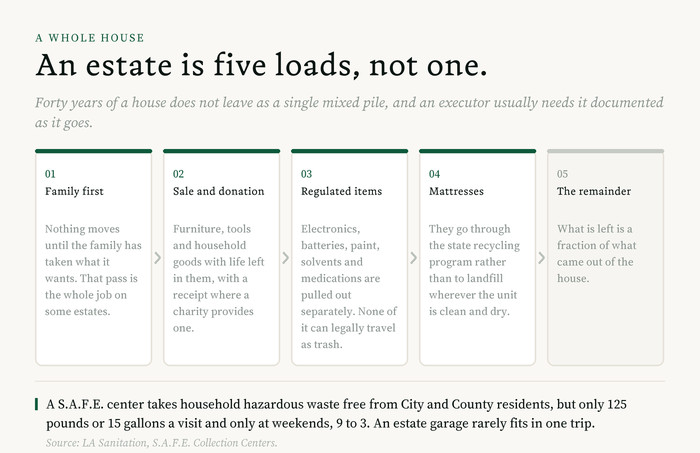
Five categories, and the quality of the clearance is decided by how honestly they are separated. Donation first: clean, sound furniture, household goods, clothing, books, kitchen equipment, tools, garden equipment. Resale second, which is a conversation rather than our decision. Recycling third: metal, clean wood, paper and card, glass. Regulated waste fourth. Genuine disposal fifth, and it should be the smallest of the five.
Regulated waste is where an old Pasadena house carries real risk, because it accumulates quietly. Electronics are always more numerous than the family expects — televisions, a desktop, monitors, a printer, a microwave, cordless tool batteries — and in California they are universal waste, banned from household trash since the state's exemption ended on 9 February 2006. Then fluorescent tubes and compact bulbs, mercury thermostats in older heating systems, smoke detectors, half-used paint from every decorating job since the sixties, automotive fluids and used oil in the garage, pesticides and weed killer in the potting shed, pool chemicals, aerosols, propane cylinders, and medications and sharps.
All of that has to travel, because Pasadena has no permanent household hazardous waste facility of its own. The free routes for a Pasadena resident are the City of Los Angeles S.A.F.E. collection centers, which are open to Los Angeles County residents as well, and the county's periodic roundup events — the most recent county roundup in Pasadena was held on 14 February 2026 at 360 North Arroyo Boulevard, and those come around roughly every couple of years rather than weekly. The nearest permanent S.A.F.E. center is LA-Glendale at 4600 Colorado Boulevard: Saturday only, 9 a.m. to 3 p.m., inside a water reclamation plant, with a state photo ID required at the security gate. The state transport limit of 125 pounds or 15 gallons per visit applies, which is why a well-stocked garage on an estate job is often more than one run. Architectural paint has its own free take-back through PaintCare, funded by a recovery fee paid at purchase.
Mattresses go into California's stewardship program, already funded by the fee paid at the till, so beds are rarely the expensive part of a clearance. And if the clearance turns into pre-sale work — carpets up, a kitchen out, a bathroom stripped — the material becomes construction and demolition debris, which in Pasadena sits under the city's own diversion requirements as well as the statewide CALGreen standard, and needs documented destinations rather than the nearest gate. We will tell you which part of your job has crossed that line before we move any of it.

Sources: LA Sanitation, S.A.F.E. Collection Centers and Household Hazardous Waste; Los Angeles County Public Works, household hazardous waste and E-waste roundups; Californians Against Waste, background on universal waste and DTSC regulations; PaintCare, California program and recovery fees; CalRecycle, Mattress Recycling Program; CalRecycle, construction and demolition model ordinance guidance.

Same rule in Pasadena as anywhere else in Los Angeles County. The local part is the program above, not the disposal law. Full detail on estate cleanouts.
This page is estate cleanouts in Pasadena specifically. The wider service is on estate cleanouts across Los Angeles, and everything we haul in this city is on junk removal in Pasadena. Same crew, different job: Appliance removal in Pasadena, Furniture removal in Pasadena, Garage cleanouts in Pasadena, Same-day junk removal in Pasadena. Pricing works the same way everywhere: how our pricing works, and the full map is on areas we serve.

We are already next door most days. The whole list is on areas we serve.
Room by room, sorted as we go, one quoted number agreed before we start.
The whole garage in one visit. We sort, donate what is usable and sweep the slab.
Couches, sectionals, mattresses in the same trip, beds, desks and wardrobes carried down rather than dragged.
Fridges, washers and AC units. Refrigerant units are handled as universal waste.
Recycled through a state-funded program, not dumped. Box springs and futons too.
TVs, CRT monitors and computers. Banned from the trash in California.
Drywall, lumber, tile and concrete, hauled to a certified C&D processor.
Timelines, exclusions, valuables and the chemicals that have to travel.
Only for a small part of it, and not at all if the property is an estate-type residence of 20,000 square feet or more, a building of five or more units, or a commercial address — the city does not collect from any of those. For a qualifying single-family address you get two pickups a year at about three cubic yards each, parkway only, nothing heavier than two people can lift. That is a fraction of a house, so most families use it for the tail end rather than the job.
A long-held Pasadena house is usually several days, and the constraint is the sorting rather than the hauling. Basements, detached garages, attics and deep built-in cabinetry all hold more than a walk-through suggests. We give you a realistic number of days at the quote rather than an optimistic one, and if there is a hard date — escrow, a listing shoot, a family flight — tell us at the start so we plan backwards from it.
We stop and show you. Old Pasadena houses hold real material: period furniture, art, books, instruments, tools, documents, jewelry. Anything with obvious value is set aside rather than loaded, and we ask at the walk-through whether there are specific things to look for, because papers and small valuables turn up inside furniture far more often than people expect.
They are handled, but they are specialist lifts rather than ordinary items, and they are exactly what the city's two-person-lift rule excludes from the free service. Tell us at quote stage so the right crew and equipment arrive, especially if the piece is in a basement or at the top of a hillside drive. We would rather plan it than discover it.
It has to travel, because Pasadena has no permanent household hazardous waste facility. The free options are the S.A.F.E. collection centers, which serve county residents too, and the county's periodic roundups. The nearest S.A.F.E. center is LA-Glendale on Colorado Boulevard, Saturdays only, 9 a.m. to 3 p.m., with a photo ID needed at the gate, and there is a 125 pound or 15 gallon limit per visit. On a full garage that often means more than one run, and we count it while quoting.
Yes, in two ways. Structural work in a landmark district needs a certificate of appropriateness before a building permit if it involves demolition or a street-visible exterior change, and the city puts that at roughly two months — worth knowing before a listing date is set. And the moment carpets, cabinetry or tiling start coming out, the material becomes construction debris with documented-destination requirements rather than ordinary bulky waste. We will separate and handle that part properly.
Word for word from Google. Nothing tidied.
Working with Hunter and this company was great. Gave us a quick quote over the phone after sending photos and was able to help us the SAME day. Removal was fast and easy. We definitely recommend going with this company.
Read all 67 on GoogleSee us on YelpReviews, and how to check any LA hauler
Collection rules, transfer stations and permit counters change at the city line, so each of these is written for that city rather than for Pasadena. A job that straddles two of them is still one visit and one number.
Everything we haul in the cities next door: South Pasadena, Alhambra, Echo Park. The whole list is on areas we serve.
Send a photo, get a flat number back. Free, no obligation, no pressure and no call-out fee — and if your city will haul it free instead, we will tell you that too. Most requests are answered within the hour during working hours.