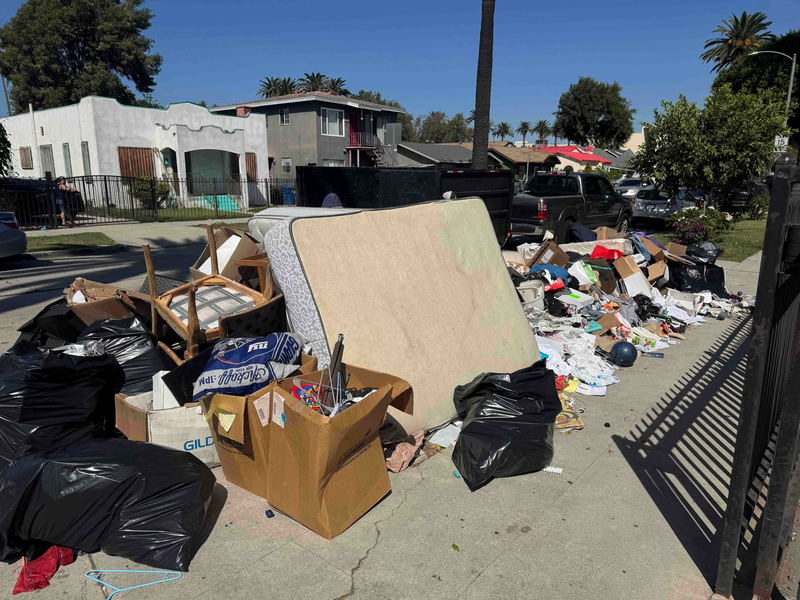
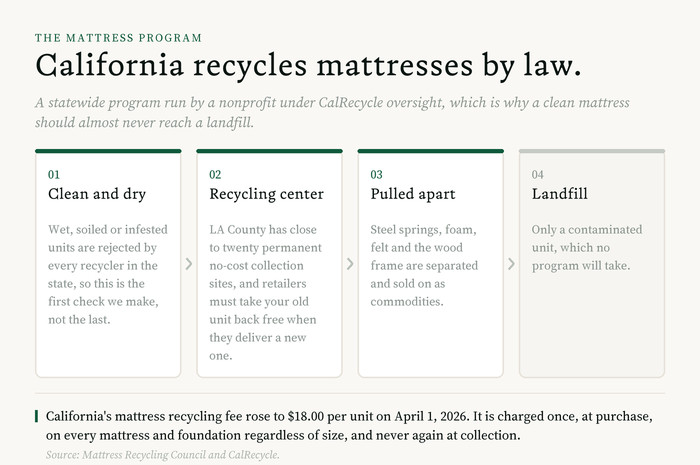
A mattress is one of the few things in a junk load with a dedicated statewide recovery system behind it, and Pasadena residents have already funded theirs. California's program is run by the Mattress Recycling Council under CalRecycle oversight and paid for by a fee collected at the point of sale. That fee rose from $16.00 to $18.00 per unit for units sold on or after April 1, 2026, applies per unit regardless of size or type across mattresses, futons and foundations, is not subject to sales tax, and has to appear as a separate line item on the receipt. Units collected under the program are dismantled so that the steel, foam, fabric and wood can be separated and sold into manufacturing, which is why a bed ought to be one of the cheapest things in a load rather than one of the dearest.
The program's definitions are worth knowing before you plan a bedroom clearance, because they do not match the everyday meaning of the words. A mattress may be all foam or a mixture of foam, springs and other materials. A foundation, which most people call a box spring, is a platform or base that supports the mattress, is covered in fabric, and either stays fixed or adjusts. In California, and only in California among the four state programs, a futon mattress that separates from its frame or base counts as a mattress. Outside that boundary sit bed frames, futon frames and bases, sofa beds, mattress toppers and pads, pillows, loose bedding, sleeping bags, cushions, roll-away beds, car beds, juvenile products including crib and bassinet mattresses, mattresses already stripped of their padding, and air beds or water beds with no upholstery material in them. A sleeper sofa contains a mattress and is still, for these purposes, a sofa.
Two practical points follow from that for a Pasadena job. The first is that a typical bedroom produces a mixed load rather than a single-category one: two program units, one bed frame that is not a program unit, a topper and a set of pillows that are not either, and quite often a headboard. Sorting that at your address rather than at a gate is what keeps the disposed fraction small. The second is that condition is not the obstacle people expect. In California the program accepts mattresses and box springs regardless of their condition or when they were purchased; the soiled, wet and infested caveats that circulate online apply to the Connecticut and Rhode Island programs. Individual sites still set their own terms, though, and the program is explicit that unit limits may apply and an appointment may be required.
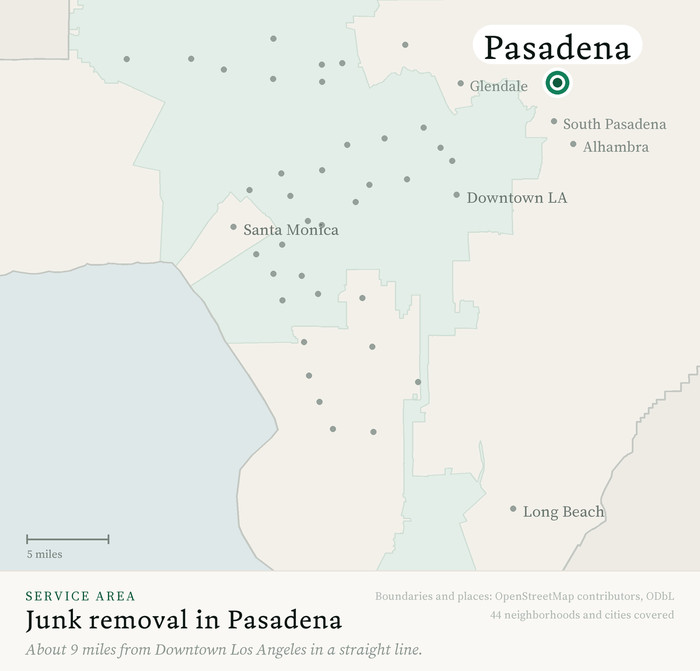
Which brings up the awkward local fact. There is no participating drop-off location in Pasadena. The Council's own facility finder lists nothing inside the city, and the nearest no-cost sites are in the next towns east: Nu-Way Roll Off Service at 145 West Duarte Road in Monrovia, listed as free drop-off for residents and businesses with a ten-unit maximum, open Monday to Friday from 9:00 a.m. to 2:00 p.m., and R5 Recycling at 739 North Georgia Avenue in Azusa, listed as free drop-off for residents and businesses with a five-unit maximum for residents and an incentive payment for qualifying drop-offs, open Monday to Friday from 7:00 a.m. to 3:00 p.m. Both are perfectly usable if you own a pickup and a free weekday morning. Neither is a plan for a household with a queen set, a car and a job.
The route almost nobody uses is the retailer. California law requires a retailer delivering a new mattress to offer to take back your old one at no additional cost. The retailer has up to 30 days to do it, delivery or set-up fees for the new product can still apply, and the retailer is allowed to refuse a unit that is contaminated and poses a risk to personnel, new products or equipment, a judgment they make on their own. The recycling fee is not refunded if they decline. If they do decline, the program's own advice is to contact your public works department or waste hauler, which in this city means 626-744-7311 and, on a mattress they have refused as contaminated, a conversation that will not end with a free parkway collection. Ask about take-back when you order, not when the delivery crew is on the doorstep.
On bed bugs, we work to what Los Angeles County Public Health publishes rather than to folklore. The county's pest bulletin puts the harborage sites on the bed itself: along the edge ribbing and beneath the buttons of the mattress, between the mattress and the box spring, in the folds of the dust ruffle, along the support frame and behind the headboard, with the rest of the room — baseboards, the carpet edge at the wall junction, night stand drawers, upholstered furniture, wall hangings — in play as well. The insects survive 80 to 140 days without feeding and commonly arrive in second-hand furniture or in mattresses bought from thrift shops or private parties, which is the single best argument against taking a free bed off a Pasadena curb. Treatment is a job for an experienced pest management professional, and the county notes that liquid household pesticides should not be applied to the mattress. Our part is narrow and we keep it narrow: tell us in advance, we seal the unit in the room before it moves, we do not offer it for donation, and we do not claim that removing it has treated anything.
The rest of a bedroom clearance sorts the way any other load does. Sound bed frames, headboards and furniture go to reuse where the condition genuinely justifies it. Metal frames and bases go to scrap. Textiles that fall outside the mattress program are handled as textiles. And the two categories the city's own bulky route refuses — e-waste and household hazardous materials — are separated at your address and routed properly rather than buried inside a mixed load, because Pasadena's program will not take them and neither will a landfill gate without consequences.