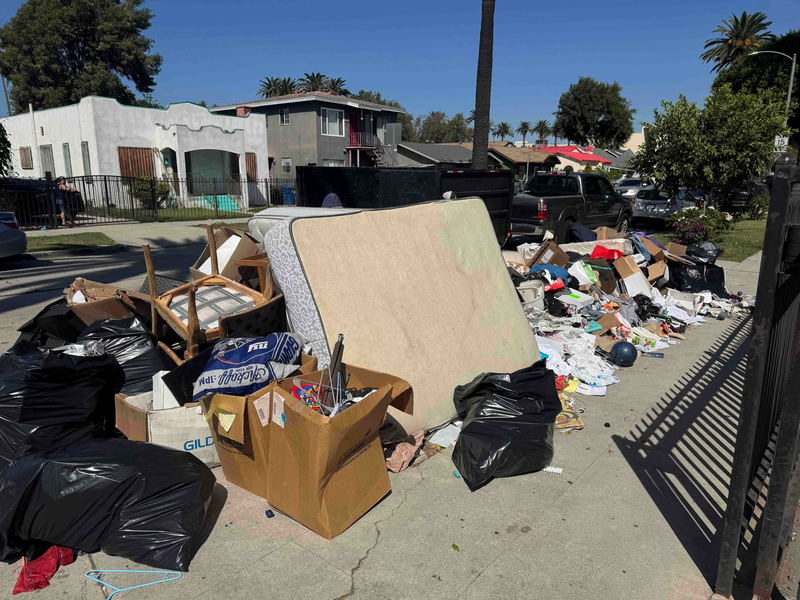
Take the legal point first, because it is the one nobody reads until it is too late. California Penal Code section 374.3 makes it unlawful to dump or cause to be dumped waste matter upon a public or private highway or road including any portion of its right-of-way, or on private property without the owner's consent, or in a public park or other public property not designated for the purpose. A violation is an infraction, and the statute states that each day the waste remains is a separate violation. On conviction the fine is mandatory: not less than $250 and not more than $1,000 for a first conviction, $500 to $1,500 for a second, and $750 to $3,000 for a third or subsequent one. The court may additionally require the person to remove the waste or pay the cost of removal, and may require them to pick up waste matter for not less than twelve hours. Where dumping is in commercial quantities, which the section defines as waste generated in the course of a trade, business, profession or occupation or an amount equal to or in excess of one cubic yard, it becomes a misdemeanor punishable by up to six months in county jail plus mandatory fines starting at $1,000 and rising to $10,000 on a third or subsequent conviction, with higher ranges again for a business owner employing more than ten full-time staff. That subdivision expressly does not apply to household waste at a person's own residence, but a stack of mattresses cleared out of an apartment building by a hired hand is not that.
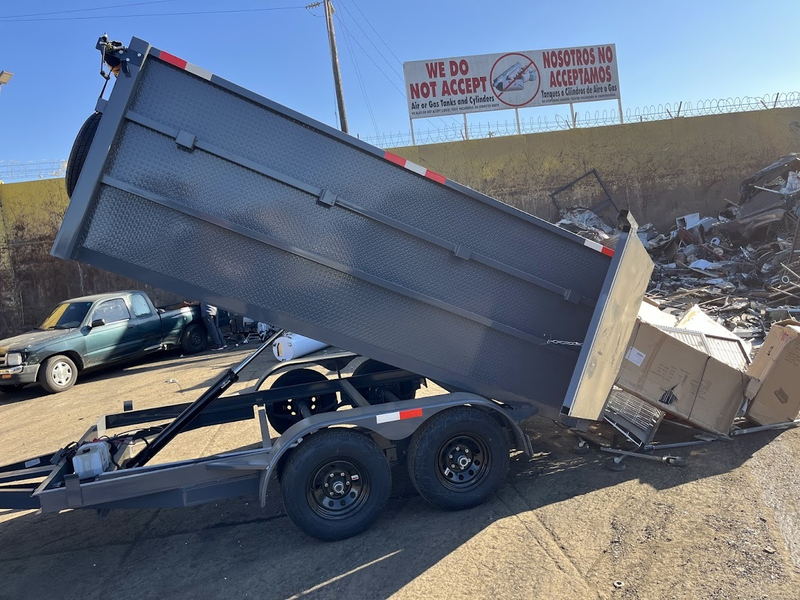
The practical version is simpler. Use a booked collection, use a drop-off, or use a hauler who will tell you which gate the load is going to. LA Sanitation opens five bulky item drop-off sites across the city one Saturday a month, 8:00 a.m. to 4:30 p.m., the closest to North Hollywood being the East Valley site at 11050 Pendleton Street in Sun Valley, and the Mattress Recycling Council's directory lists participating no-cost drop-off locations in the area, including Goodwill Fletcher Square at 3150 N. San Fernando Road in Los Angeles, which is listed as free for residents with a two unit maximum and open 9 a.m. to 4 p.m. every day.
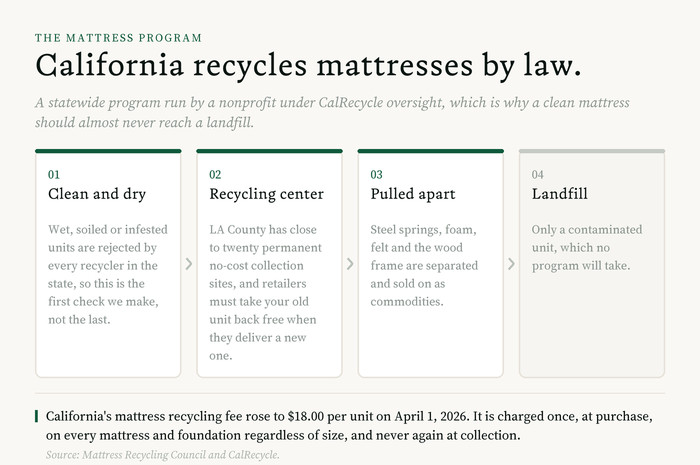
What happens at the end of that route is the reason the law is worth obeying. California's mattress stewardship program, overseen by CalRecycle and operated by the Mattress Recycling Council, is funded by a recycling fee collected on every mattress, futon and foundation sold for use in the state, which increased from $16.00 to $18.00 per unit for units sold on or after April 1, 2026. The fee is charged per unit regardless of size or type, is not subject to sales tax, appears as a separate line item on the receipt and is remitted in full to the Council. In exchange, units are dismantled and their steel, foam, fabric and wood separated for new products. CalRecycle's 2025 figures record 1.6 million units collected that year, 67.3 percent of them renovated, recycled or sent to biomass conversion, and 62 million pounds of materials diverted. The program's own material notes that part of the fee goes toward helping communities address illegal dumping, which is a neat closing of the circle in a neighborhood where mattresses are among the most commonly dumped items.
Two boundaries finish the picture. The program covers mattresses and foundations, including box springs and separable futon mattresses, discarded by California consumers, with condition and purchase date explicitly not mattering in this state; it does not cover sofa beds, futon frames or bases, bed frames, roll-away and car beds, mattress pads and toppers, pillows, loose bedding, cushions, sleeping bags, crib and bassinet mattresses, uncushioned air mattresses and water beds, or units stripped of padding. And where bed bugs are involved, California Department of Public Health guidance is to have a pest control operator service mattresses and furniture before disposal, wrap treated items in plastic before they leave the room so bugs and eggs do not fall off in transit, label them clearly as BED BUG INFESTED before disposal or curbside placement, and encase any treated unit that stays in the property in a zippered plastic cover at least 0.8 millimeters thick. In a building with shared stairs and a shared laundry, that sequence is not optional politeness; it is the difference between one unit's problem and the whole block's.