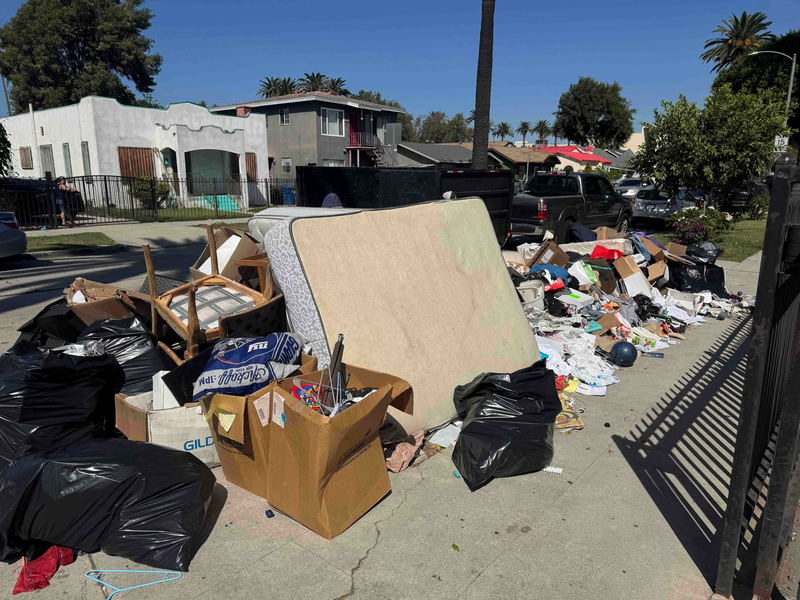
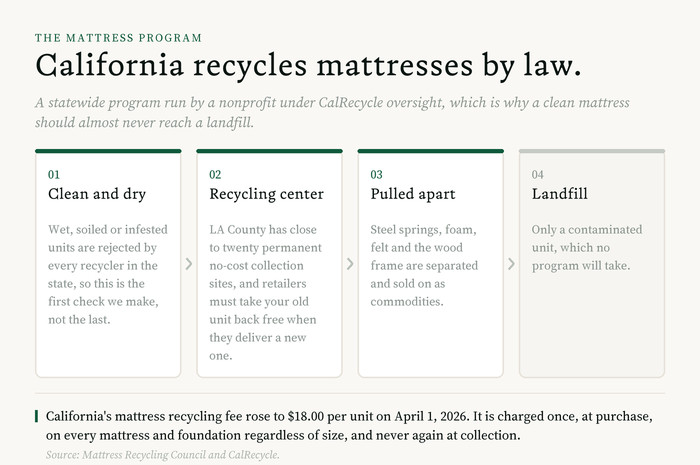
The program's boundary is drawn by product, not by condition. Mattresses and foundations used and discarded by California consumers qualify for no-cost drop-off, and MRC states explicitly that the condition of the unit and the date of purchase do not matter. A mattress can be all foam or a mixture of foam, springs and other materials. A box spring, also called a foundation, is the platform or base that supports the mattress, is covered by fabric, and either stays put or adjusts. A futon mattress qualifies here too, on the condition that it comes away from the futon's frame or base.
What does not qualify is a longer list than most people expect, and it is worth reading before you plan a clearance around it. Bed frames. Futon frames and bases. Sofa beds. Collapsible roll-away beds and car beds. Mattress pads and mattress toppers. Pillows, loose bedding such as blankets, comforters, quilts and sheets, and cushions from chairs, couches or patio furniture. Sleeping bags. Air mattresses and water beds that contain no upholstery material. Juvenile products including crib and bassinet mattresses, carriages, baskets, dressing tables, strollers, playpens, infant carriers, lounge pads and crib bumpers. Mattresses stripped of their padding components — partial units. And out-of-state units, where the discarder is not a California consumer or the mattress was not used in California. Individual sites may still take some of those things on their own account, outside MRC's program, which is not the same thing as the program covering them.
The oversight behind all of this is real and current rather than decorative. CalRecycle requires MRC to file a stewardship plan, annual reports and annual budgets, and publishes what happens to them. MRC submitted its 2025 annual report on July 1, 2026; CalRecycle notified MRC on July 31, 2026 that the report was found incomplete and must be resubmitted by September 29, 2026. MRC submitted a revised Used Mattress Recovery and Recycling Plan on July 13, 2026, which CalRecycle's director must approve, conditionally approve or disapprove by October 12, 2026, and its 2027 program budget on July 1, 2026, with a decision due by September 29, 2026. Anyone can read those filings; the program is accountable in public.
What we do with that is straightforward. A sound, dry, uncontaminated mattress and its foundation go into the recycling stream whole, because whole is what the program is built to process. A bed frame, a topper, a sofa bed or a crib mattress is handled as ordinary bulky waste, sorted for reuse or recycling on its own merits. A unit that is genuinely contaminated — the sort a retailer is entitled to refuse — is bagged and handled separately so it does not contaminate anything else in the load. You are told which of those you have while we are still standing in the room.