Mon–Sat open 24 hours · Sun 1–10pmFully insuredFamily-run, LA-based
team@lajunkhauling.com
Call us today(323) 230-0777
Home/Services/Construction debris removal/Burbank

Construction debris removal in Burbank
Your deposit comes back on receipts, not on good intentions.

Remodel, demolition and strip-out debris removed from Burbank projects, with the weight tickets and recycling receipts the Building Division asks for.

Free quote, no obligation · one flat number before we start · you can also text that number

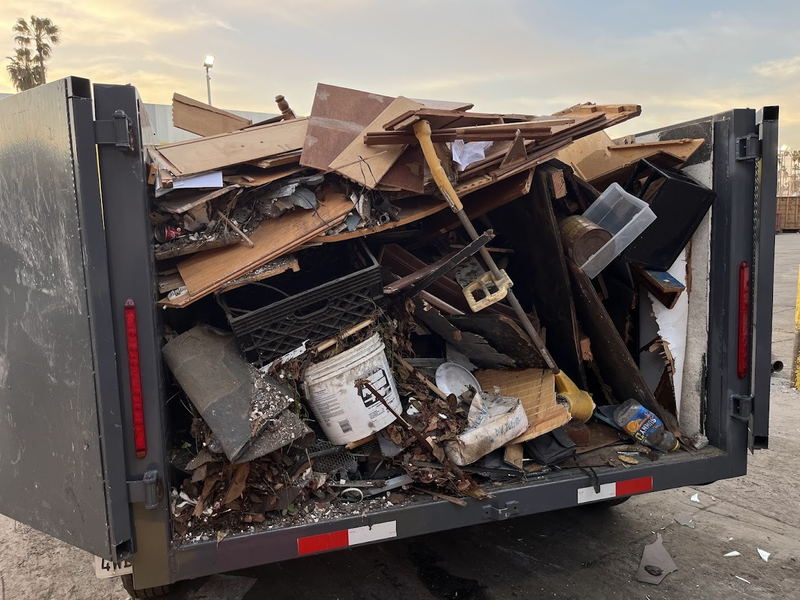
Our dump trailer loaded with mixed construction debris at dusk: cut timber, baseboard, a paint bucket, crates and broken fixtures stacked above the tailgate on a Los Angeles County job
Strip-out debris staged for loading on a Los Angeles County job. Receipts are what turn a deposit back into money.
In short

Covered Burbank construction and demolition projects must divert at least 65 percent of their debris, and the city holds a deposit of up to $1,000 residential and $5,000 nonresidential until recycling receipts are filed within 90 days of permit final. Hauling and the paperwork come together, quoted free.

Burbank has had its own construction and demolition waste ordinance since Ordinance No. 3652 took effect on November 20, 2004, amended effective July 1, 2007 and mandatory for applicable projects. Covered projects must divert at least 65 percent of construction and demolition debris through recycling, reuse, salvage or deconstruction. The coverage thresholds are specific: nonresidential additions of 1,000 square feet or more; alterations, remodels and tenant improvements with a permit valuation of $200,000 or more; and residential additions and alterations that increase the building's conditioned area, volume or size. The money side is what makes documentation matter. A non-refundable administrative fee is paid at permit issuance, plus a refundable deposit calculated per ton and capped at $1,000 for residential and $5,000 for nonresidential projects, refunded on presentation of recycling receipts to the Building Division within 90 days of permit final. Separately, Burbank's curbside bulky program prohibits construction material outright, so none of this debris can go out with household waste. Los Angeles Junk Removal & Hauling hauls the debris and gives you the tickets. The quote is free upfront.

Construction debris in Burbank is an accounting problem wrapped around a hauling problem. The hauling part is simple: a strip-out produces plaster, tile, timber, metal, cabinetry and floor covering, and none of it can go in a household bin or at the curb. The accounting part is where money is actually won or lost, because Burbank holds a refundable deposit against your permit and hands it back only when you produce receipts.

So this page is about paperwork as much as trucks. What we clear across the city is on junk removal in Burbank, and the county-wide service is on construction debris removal.

Burbank's own C&D ordinance

Divert 65 percent.
Then prove it within 90 days.

Burbank's construction waste ordinance was added to the municipal code by Ordinance No. 3652, effective November 20, 2004, as a companion to the city's Green Building and Sustainable Architecture Program. It was amended effective July 1, 2007 and is now mandatory for applicable projects rather than voluntary. The requirement is that covered demolition and construction projects divert at least 65 percent of the construction and demolition debris generated, through recycling, reuse, salvage or deconstruction.

Which projects are covered is where most people guess wrong. The reference manual sets out nonresidential additions of 1,000 square feet or more; alterations, remodels and tenant improvements with a permit valuation of $200,000 or more; and residential additions and alterations that increase the building's conditioned area, volume or size. A kitchen refit in a house that does not enlarge the conditioned area sits outside the threshold; a second-story addition does not. It is worth checking with the Building Division at permit stage rather than assuming, because the deposit is taken at issuance either way.

The financial mechanism has two parts. First, a non-refundable administrative fee paid at the time of permit issuance. Second, a refundable performance deposit calculated on a per-ton basis with a minimum, capped at $1,000 for residential projects and $5,000 for nonresidential projects. That deposit is returned when recycling receipts are presented to the Building Division within 90 days of permit final. Miss the window or lose the tickets and the deposit is simply gone, which is an expensive way to learn that a hauler's paperwork is part of the service rather than an extra.

Underneath the city layer sits the state layer. The 65 percent figure is not arbitrary: it matches the construction waste management requirement in the California Green Building Standards Code, which is why the same number appears in ordinances across the region. And separately from all of it, Burbank's household bulky collection prohibits construction material by name — bricks and cinder blocks, concrete, ceramic tile, sand, dirt and rocks, fencing, pallets, roofing materials, railroad ties, duct and sheet metal, plaster, sheetrock, floor coverings, carpet, marble and countertops. So there is no informal route. The city does offer a two-yard temporary dumpster for rent with a maximum weight of 1,000 pounds, which is useful for a small job and quickly inadequate for a real one.

65%the diversion Burbank's ordinance requires from covered construction and demolition projects
90 daysthe window to present recycling receipts to the Building Division after permit final
$1,000 / $5,000the deposit caps for residential and nonresidential projects

Source: City of Burbank Construction and Demolition Debris Diversion Reference Manual. Cited in full below.

OrdinanceBurbank Ordinance No. 3652, effective November 20, 2004, amended effective July 1, 2007
Statusmandatory for applicable projects, administered through the Building Division
Diversion requirementat least 65 percent of construction and demolition debris, through recycling, reuse, salvage or deconstruction
Nonresidential thresholdadditions of 1,000 square feet or more
Alteration thresholdalterations, remodels and tenant improvements with a permit valuation of $200,000 or more
Residential thresholdadditions and alterations that increase the building's conditioned area, volume or size
Administrative feenon-refundable, paid at the time of permit issuance
Performance depositrefundable, calculated per ton, capped at $1,000 residential and $5,000 nonresidential
Refund conditionrecycling receipts presented to the Building Division within 90 days of permit final
State layerthe 65 percent figure aligns with the construction waste requirement in the California Green Building Standards Code
Household bulkyconstruction material is prohibited outright from Burbank's curbside bulky collection
City dumpster optiona two-yard temporary dumpster is available to rent with a 1,000 pound maximum weight
City landfillBurbank Landfill Site No. 3, 1600 Lockheed View Drive, Burbank 91504, operated by the City of Burbank Department of Public Works

Sources: City of Burbank Building Division, Construction and Demolition Debris Diversion Reference Manual · City of Burbank Public Works, Bulky Item Pick-Up · CalRecycle, construction and demolition model ordinance guidance · CalRecycle SWIS record 19-AA-0040, Burbank Landfill Site No. 3

Working a Burbank site

Small lots, live streets
and a neighbor who works nights.

Most Burbank residential construction happens on a standard lot in a dense grid, which means the working area is a driveway and a stretch of curb. There is rarely room for both a dumpster and a contractor's vehicles, which is precisely why on-call removal beats a container on a lot of these jobs: the debris leaves as it is generated rather than occupying the only place anyone can park for three weeks.

The Media District and the studio-adjacent commercial blocks add a scheduling layer. A great many people in this city work production hours, which means neighbors sleeping during the day and noise sensitivity that does not follow the usual pattern. Tenant improvement work in commercial buildings there commonly comes with permitted working hours, a loading dock with a booking, a service elevator with a weight limit and a property manager who wants a certificate of insurance before anyone starts.

The hillside blocks above Glenoaks change the vehicle rather than the method. Steep driveways that a loaded truck should not reverse down, narrow streets with no turning circle, and houses entered up a flight of steps mean a smaller truck making more trips, and a carry that is genuinely part of the cost.

The Rancho district is its own case again: deep lots, outbuildings, stable structures, and designated horse trails alongside several roadways. Demolition of an outbuilding there has a long carry to any point a vehicle can reach, and the presence of horses makes parking and engine noise a real consideration rather than a nicety.

Then the material itself. Plaster and sheetrock are heavy and dusty, tile and countertop are dense and sharp, roofing is heavy and awkward, and timber with fixings still in it is the most common cause of a punctured tire on a job site. We separate as we load rather than at a gate, because a mixed load is what pushes a project below its diversion percentage and costs you a deposit. If the job also involves an old kitchen's appliances, see appliance removal in Burbank.

Tell us the project and whether a deposit is riding on it. Receipts come as standard.

Free upfront quote, no obligation. One number, agreed before anything is lifted.

5.0 from 67 reviews on GoogleMon–Sat, open 24 hours

On the job
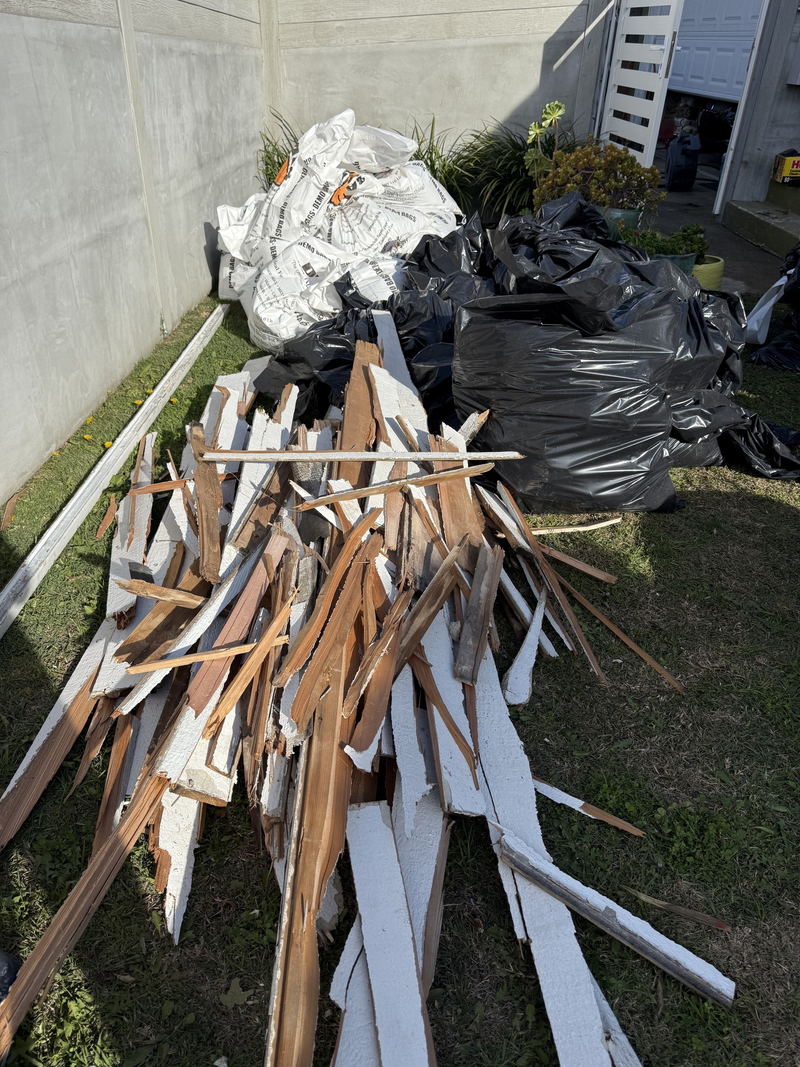
Broken fence boards, splintered lumber and strips of stucco piled on the grass of a Los Angeles County back yard, next to filled white demolition bags and black contractor bags waiting to be carried out
A back-yard demolition pile bagged and stacked ready to load · Burbank
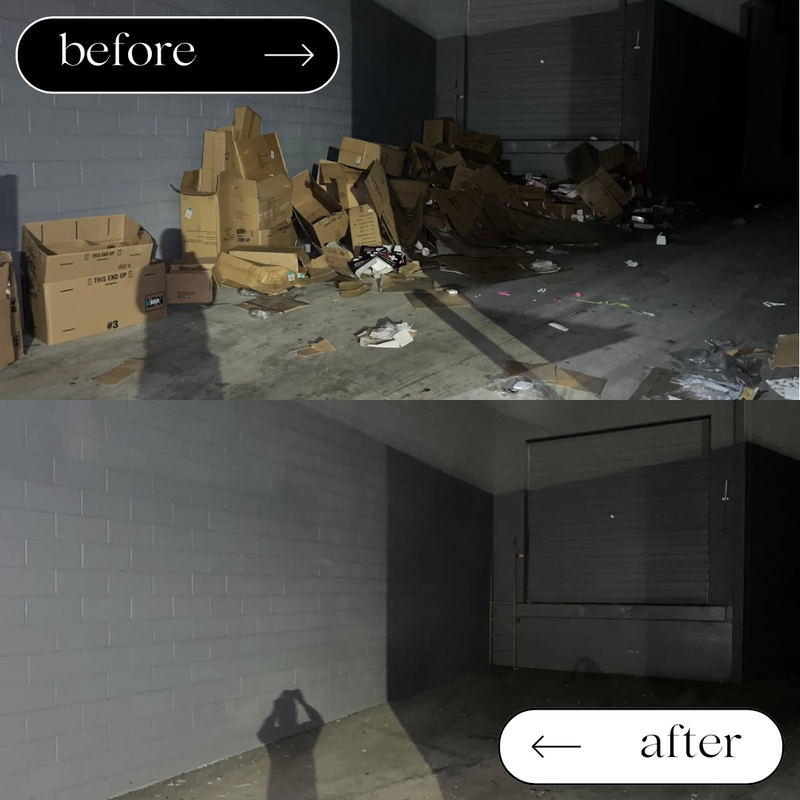
Before and after of a Los Angeles County commercial unit: the floor buried in collapsed cardboard cartons and loose litter, then the same unit completely empty with the roller door clear and the concrete swept
Before and after — a commercial unit cleared and swept · Burbank
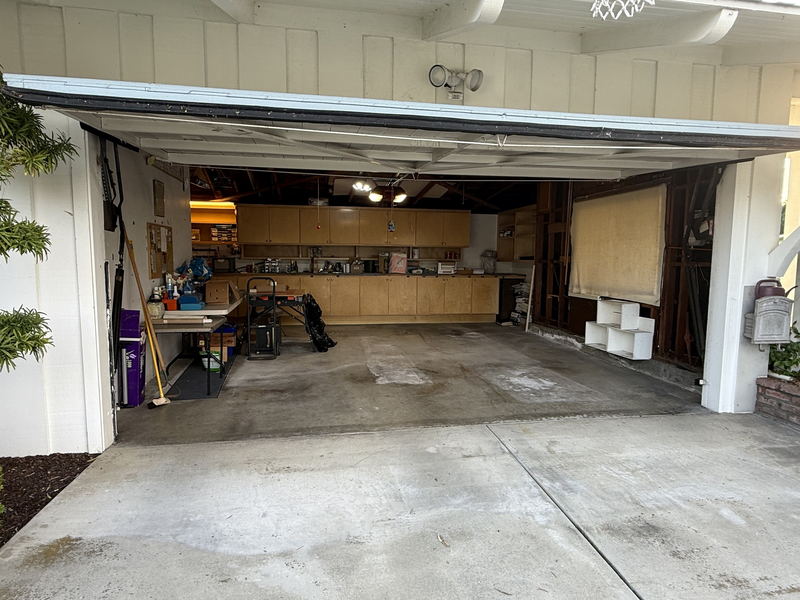
A two-car Los Angeles County garage after a full clear-out, the slab swept empty with only the workbench and wall cabinets left in place and the door open to the driveway
A garage handed back swept and usable · Burbank

Our own crews on Los Angeles County jobs. The construction debris removal we run in Burbank looks like this too: side yards, narrow walkways and the back of the property is where the work actually is.

Where the debris goes

Separated on site
because mixed loads divert worst.

Diversion percentage is decided by how the load is made up, not by where it is taken. A load that arrives as clean timber, clean metal, clean inert and a small residual fraction diverts far better than the same material arrived as one mixed pile, which is why separation at the property is the single biggest lever on hitting Burbank's 65 percent and getting your deposit back.

Stream one is metal: duct, sheet metal, rebar, copper pipe, aluminum window frames, appliance carcasses. It has the clearest value and the highest recovery rate of anything on a site. Stream two is clean timber: studs, joists, sheathing and framing offcuts, chipped or recovered so long as it is free of fixings and of painted or treated material.

Stream three is inert: concrete, brick, block, tile, marble and countertop. Heavy, dense, and highly recoverable as crushed aggregate when it is kept clean. Stream four is gypsum, which is sheetrock and plaster, and it needs to be separate because gypsum contaminates other streams and has its own recovery route.

Stream five is everything that is not construction material but comes out during construction: old appliances, which are metal and, if sealed, refrigerant-bearing; fluorescent tubes and ballasts from a ceiling grid, which are universal waste banned from California trash since the household exemption ended on February 9, 2006; and paint, solvent and adhesive left over from the job, which is household hazardous waste that Burbank's own Recycle Center will not accept and which goes to the Randall Street S.A.F.E. Center in Sun Valley at the weekend, within the 125 pound or 15 gallon per-visit limit. PaintCare provides a second free route for architectural coatings, funded by a recovery fee already paid at purchase.

And stream six is the residual, which should be the smallest part of the load. Whatever is left goes to disposal, and Burbank operates its own permitted facility for that: Burbank Landfill Site No. 3 at 1600 Lockheed View Drive, run by the City of Burbank Department of Public Works under CalRecycle SWIS record 19-AA-0040, with the Los Angeles County Department of Public Health as local enforcement agency. Weight tickets from wherever a load goes are what turn your deposit back into money, so we keep them and hand them over.

Sources: CalRecycle SWIS record 19-AA-0040, Burbank Landfill Site No. 3 · Californians Against Waste, background on universal waste and DTSC regulations · PaintCare, California program and recovery fees · City of Burbank Public Works, Household Hazardous Waste Collection

The rule behind it
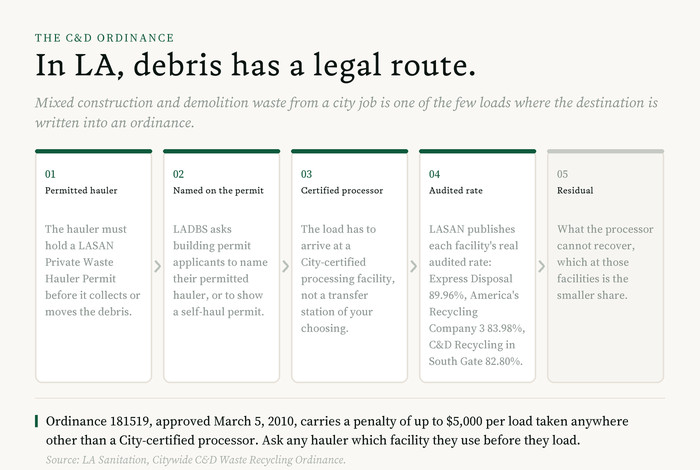
Diagram of the Los Angeles construction and demolition ordinance route: a LASAN-permitted hauler named on the building permit takes mixed debris to a City-certified processor with a published audited recycling rate
The route the C&D ordinance actually requires

Same rule in Burbank as anywhere else in Los Angeles County. The local part is the program above, not the disposal law. Full detail on construction debris removal.

Worth knowing

Burbank debris
in six lines.

Construction facts
  1. Burbank Ordinance No. 3652 took effect November 20, 2004, was amended effective July 1, 2007, and is mandatory for applicable projects.
  2. Covered projects must divert at least 65 percent of construction and demolition debris through recycling, reuse, salvage or deconstruction.
  3. Coverage thresholds are nonresidential additions of 1,000 square feet or more, alterations and tenant improvements valued at $200,000 or more, and residential work that increases conditioned area, volume or size.
  4. A non-refundable administrative fee is paid at permit issuance, plus a refundable per-ton deposit capped at $1,000 residential and $5,000 nonresidential.
  5. The deposit is refunded only on presentation of recycling receipts to the Building Division within 90 days of permit final.
  6. Burbank's curbside bulky collection prohibits construction material outright, so there is no informal route for this debris.

This page is construction debris removal in Burbank specifically. The wider service is on construction debris removal across Los Angeles, and everything we haul in this city is on junk removal in Burbank. Same crew, different job: Furniture removal in Burbank, Appliance removal in Burbank, Garage cleanouts in Burbank. Pricing works the same way everywhere: how our pricing works, and the full map is on areas we serve.

Service area
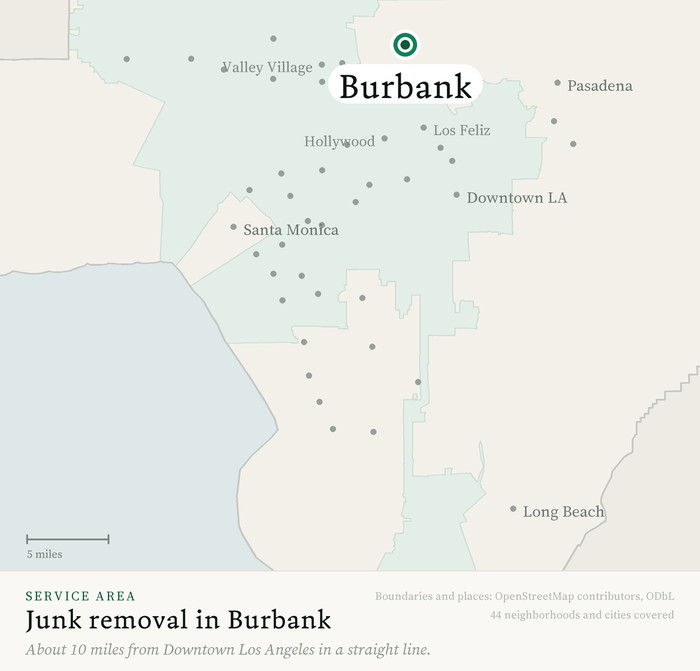
Map of our greater Los Angeles junk removal service area with Burbank marked, about 10 miles from Downtown Los Angeles, drawn from OpenStreetMap boundary data
Burbank in the greater Los Angeles service area. Boundaries and places from OpenStreetMap contributors, ODbL.

We are already next door most days. The whole list is on areas we serve.

Other things we clear in Burbank

Same crew, same trucks, same free upfront quote.

Burbank construction
questions

The ordinance, the deposit, the receipts and what can travel together.

Does Burbank really hold a deposit on my remodel?

On covered projects, yes. Burbank's construction and demolition program takes a non-refundable administrative fee at permit issuance plus a refundable deposit calculated per ton, capped at $1,000 for residential and $5,000 for nonresidential projects. You get the deposit back by presenting recycling receipts to the Building Division within 90 days of permit final. Miss that window and the money is gone, which is why the paperwork from your hauler matters as much as the truck.

Which projects are actually covered?

The published thresholds are nonresidential additions of 1,000 square feet or more; alterations, remodels and tenant improvements with a permit valuation of $200,000 or more; and residential additions and alterations that increase the building's conditioned area, volume or size. A refit that does not enlarge the conditioned area of a house generally sits outside it; a second-story addition does not. Confirm with the Building Division at permit stage rather than assuming, because the fee is taken at issuance.

Can I put the debris out with my household bulky pickup?

No. Burbank's bulky prohibited list names construction materials specifically: bricks and cinder blocks, concrete, ceramic tile, sand, dirt and rocks, fencing, pallets, roofing materials, railroad ties, duct and sheet metal, plaster, sheetrock, floor coverings, carpet, marble and countertops. The city does rent a two-yard temporary dumpster with a 1,000 pound maximum, which suits a very small job. Anything real needs proper removal with tickets attached.

Do you provide the receipts?

Yes, as standard rather than on request. We keep the weight tickets and the recycling receipts from every load and hand them to you, because on a Burbank project those documents are what convert your deposit back into money. We also separate on site rather than at a gate, which is the thing that actually moves your diversion percentage: a load arriving as clean metal, clean timber and clean inert diverts far better than the same material arriving as one mixed pile.

Is a dumpster or on-call removal better on a Burbank lot?

It depends entirely on the lot, and we will give you an honest answer rather than the one that suits us. On a standard Burbank residential lot there is usually room for a dumpster or for the trades' vehicles, not both, and a container sitting for three weeks takes the only place anyone can park. On-call removal takes the debris as it is generated. On a long demolition with continuous output a container can be the better tool. Tell us the project shape and we will say which.

What about the paint and the old fluorescent tubes from the job?

Those come out separately, and in Burbank they cannot go to the city's own facility. The Burbank Recycle Center Drop Zone does not accept paint or chemicals, and the city's motor oil collection has ended. So leftover paint, solvent and adhesive, plus tubes and ballasts beyond the Drop Zone's ten-tube annual limit, go to the Randall Street S.A.F.E. Center in Sun Valley at the weekend, within 125 pounds or 15 gallons per visit. Architectural paint also has PaintCare, which is free because the fee was paid at purchase.

The proof

What our customers say

5.0from 67 reviews on Google

Word for word from Google. Nothing tidied.

  • 3 months ago

    Hunter is truly dedicated on providing the most excellent of removal of unwanted junk from your home or office. Always on time, very efficient at his job in a timely manner. I would recommend him for any junk removal you may have.

    James Russell3 reviewsHome and office junk removal
  • Fair pricing 11
  • Personable staff 10
  • Polite 5
  • Punctual staff 4
One city over

Construction debris removal near Burbank

Collection rules, transfer stations and permit counters change at the city line, so each of these is written for that city rather than for Burbank. A job that straddles two of them is still one visit and one number.

Everything we haul in the cities next door: Los Feliz, Valley Village, Hollywood. The whole list is on areas we serve.

Request a quote

Send a photo, get a flat number back. Free, no obligation, no pressure and no call-out fee — and if your city will haul it free instead, we will tell you that too. Most requests are answered within the hour during working hours.

Or call or text (323) 230-0777 — Mon–Sat around the clock, Sunday 1–10pm.

Call (323) 230-0777Text a photo