Mon–Sat open 24 hours · Sun 1–10pmFully insuredFamily-run, LA-based
team@lajunkhauling.com
Call us today(323) 230-0777
Home/Services/Construction debris removal/Glendale

Construction debris removal in Glendale
The city is holding a deposit until it sees the tags.

Drywall, plaster, lumber, tile, concrete, roofing, cabinetry, windows and mixed remodel debris removed from Glendale properties and routed to a certified mixed debris recycling facility, with the receipts you need for your permit file.

Free quote, no obligation · one flat number before we start · you can also text that number

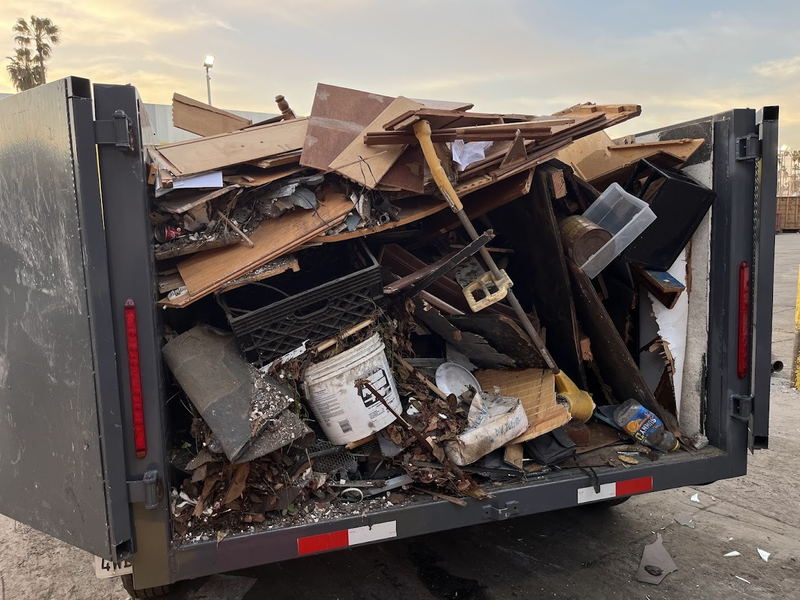
Our dump trailer loaded with mixed construction debris at dusk: cut timber, baseboard, a paint bucket, crates and broken fixtures stacked above the tailgate on a Los Angeles County job
Strip-out debris stacked and staged on a Los Angeles County job. Separating it at the property is what makes the paperwork work later.
In short

Glendale runs its own construction and demolition ordinance. A covered project must divert 65 percent of its debris, take it to a mixed debris facility certified by the City of Los Angeles, and lodge a diversion security deposit that Building and Safety releases only against original weighed tags. We haul and document.

Glendale is its own city with its own construction and demolition program, and the part that catches people is financial rather than logistical. Under Glendale Municipal Code Chapter 8.58, diversion is written in as a condition of approval on the permit itself. A covered project has to file a construction waste management plan with the building official before a permit is issued, pay a published administrative processing fee of $50 per application, and lodge a diversion security deposit calculated from project valuation — 6% for demolition, 2% for construction or an addition to a single family home — capped by the city at $30,000. The deposit comes back only when the project documents 65% or greater diversion using original tags from a certified mixed debris recycling facility, filed within six months of the certificate of occupancy. Los Angeles Junk Removal & Hauling clears the debris, separates it at the property and hands back the weighed paperwork that closes the file.

Most construction debris pages talk about trucks. In Glendale the truck is the easy half. The hard half is that the city has taken money from you at permit stage and written the release conditions in advance, and every load that leaves the site either builds that file or quietly damages it. A load that goes to the wrong gate is not just a disposal decision, it is a missing tag six months later.

So this page is about where Glendale debris is allowed to go, what the city wants back, and what the hillside half of the city does to the carry before any of that matters. The full local picture is on junk removal in Glendale, and how we handle strip-outs across the county is on construction debris removal.

Glendale's own ordinance

A plan before the permit,
original tags before the refund.

Start with what counts as a covered project, because the net is wider than most people assume. Glendale's ordinance reaches any newly constructed building; any residential addition, renovation or alteration that increases the building's conditioned area, volume or size; any non-residential addition, renovation or alteration of an existing non-residential building regardless of the proposed construction value; and city-sponsored construction, demolition or renovation projects of 5,000 square feet or greater. Note the third one carefully. On the commercial side there is no dollar threshold at all, so a small tenant improvement on Brand Boulevard sits under the same rules as a ground-up building.

Once a project is covered, the sequence is fixed. The applicant completes and submits a construction waste management plan to the building official before a permit is issued, and the code is explicit that no permit will be issued until that plan is approved. The plan has to show the project's total estimated debris by volume and weight, the minimum diversion required, which specific materials will get the project to 65% or better, whether waste will be source-separated on site or mixed for single stream collection, and which certified mixed debris recycling facilities, source-separated recyclers and haulers will actually handle the material. That last line is the one that concerns us directly: your hauler is named in the plan before anybody lifts anything.

The deposit is what gives the paperwork teeth. Glendale takes a diversion security deposit with the plan, payable by cash, check, credit card or bond, calculated at 6% of project valuation for demolition and 2% of project valuation for construction or an addition on a single family home, with a published maximum of $30,000. The building official may waive it where the calculated deposit would be $200 or less. If the building official later determines noncompliance, the code says plainly that the deposit is forfeited.

Release runs the other way and on a clock. At project completion the applicant submits a waste reduction and recycling plan compliance report with ORIGINAL facility tags — the city capitalizes that word itself — within six months of the certificate of occupancy, and the city asks applicants to allow four to six weeks for refund processing. The ordinance adds that receipts must come from certified mixed debris recycling facilities, must show actual weights and volumes for each load accepted, and must carry the project address and the dates. Photocopies are not accepted. A refund is denied where the documentation is missing or late.

Two extra requirements are easy to miss and both cost deposits. Non-residential additions or alterations of 1,000 square feet or more, and building alterations with a permit valuation of $200,000 or more, must recycle universal waste — batteries, cathode ray tubes, electronic devices, mercury-containing equipment and lamps — and document it in the plan. And on anything involving land clearing, the applicant must reuse or recycle 100% of trees, stumps, rocks and assorted vegetation, with an original facility receipt to prove it. On a Glendale hillside lot, that second rule turns a bit of brush and a couple of removed oleanders into a separately documented load.

Then there is who is allowed to carry it. Glendale runs four franchise zones with four designated franchise haulers for ongoing collection, but construction and demolition waste is specifically carved out of a franchisee's exclusive right under the municipal code. Non-franchise haulers may operate in the city on a temporary basis for construction and demolition projects, and the city requires them to apply for an annual permit before July 1 each year, submit quarterly payments and meet the city's reporting and service standards. Only haulers with an active permit may operate, and the city publishes the list.

65%of a covered project's estimated debris must be diverted and documented under Glendale Municipal Code Chapter 8.58
$30,000the published cap on Glendale's diversion security deposit, set at 6% of project valuation for demolition
6 monthsthe city's window after the certificate of occupancy to file the compliance report with original facility tags

Sources: City of Glendale, Construction & Demolition Debris Recycling Ordinance; Glendale Municipal Code Chapter 8.58. Both cited in full below.

The ordinanceGlendale Municipal Code Chapter 8.58, Construction and Demolition Debris Diversion Program
Covered projectsAny new building; a residential addition, renovation or alteration that increases conditioned area, volume or size; any non-residential addition, renovation or alteration regardless of construction value; city projects of 5,000 sq ft or more
Diversion required65% or greater of total estimated project debris, diverted and documented
Where debris may goA certified mixed debris recycling facility, or reuse. Glendale defines that as a facility certified by the City of Los Angeles to divert 65% or more without using material as alternative daily cover
Permit gateNo permit is issued until the building official approves the construction waste management plan
Plan fee$50 per application, published by the city as the Construction Waste Management Plan Administrative Processing Fee
Diversion security deposit6% of project valuation for demolition; 2% for construction or an addition on a single family home; maximum $30,000; waived if it would be $200 or less
Getting it backCompliance report plus ORIGINAL facility tags showing the project address, within six months of the certificate of occupancy
Refund timingThe city asks applicants to allow 4 to 6 weeks for refund processing
Land clearing100% of trees, stumps, rocks and assorted vegetation must be reused or recycled, evidenced by an original facility receipt
Who may haul C&DNon-franchise haulers work in Glendale on a temporary basis for construction and demolition only, under an annual city permit applied for before July 1

Sources: City of Glendale, Construction & Demolition Debris Recycling Ordinance; Glendale Municipal Code Chapter 8.58, Construction and Demolition Debris Diversion Program; Glendale Municipal Code Chapter 8.56, solid waste services permits and franchises; Glendale Integrated Waste, franchise and permitted haulers.

Why Glendale debris is a carry problem

The load leaves the house
long before it leaves the city.

Glendale is two cities stacked on each other. There is the flat grid around Brand, Central and the freeway corridors, which behaves like anywhere else, and there is the hillside half, which does not. The Verdugo Mountains rise straight off the north and northwest edge above Verdugo Woodlands and Whiting Woods, and the San Rafael Hills climb on the east side behind Chevy Chase Canyon. A remodel up there is not a harder job because of the volume. It is a harder job because of the first eighty yards.

The city's own zoning tells you what you are walking into. Glendale's hillside land sits in the ROS and R1R zones, where development is regulated against average current slope, primary buildings are held to two stories or 32 feet, an additional story is only permitted where the building sits on ground with an average current slope of 40% or steeper, and at least 40% of the site must stay ungraded open space on lots above 30% slope. Translated into a working day: houses on those lots are tall, narrow, cut into the hill, and surrounded by ground nobody has flattened. The garage is often at street level with the living space below it, or the reverse, and the route from the room being stripped to the street involves exterior stairs, a retaining wall and a turn.

The private drive is the next constraint. Hillside lots in Glendale are routinely served by a single-width drive with a crown, a dip at the street and a gradient a loaded cart does not like. A three-axle truck that can reverse into a flat driveway on Kenneth Road cannot always get back out of a hillside drive above Chevy Chase, and finding that out with a full body is expensive for everyone. We size the vehicle from the description you give on the phone, and on the tightest addresses the answer is a smaller truck making more trips, or a shuttle to a legal position on the street. Debris does not have to move in one piece, and nothing about the city's diversion paperwork cares how many trips it took.

Then the material itself fights the route. Drywall sheets are awkward rather than heavy and they do not corner. Plaster and lath comes off in large sheets that break into dust and nails. Cast iron tub sections, old galvanized pipe, slate and tile all concentrate weight into pieces that are dangerous on a stair. Concrete and broken slab is the worst of all for a hillside carry because it is dense, sharp and unstackable. The right answer is usually small containers moved often rather than heroic loads moved rarely, and the crew size is set by the carry, not by the pile.

Finally there is a Glendale-specific dead end worth knowing about before you load a pickup truck. The city's own Glendale Recycling Center on West Chevy Chase Drive is a genuinely useful public drop-off for paper, metal, plastics, glass and a wide range of electronics, but its published not-accepted list includes construction debris, wood and lumber, pane glass and mirrors, and PVC pipes. There is no municipal counter in Glendale where you hand over a remodel. Everything has to go to a certified facility, which means it is leaving the city, which is exactly why the route and the paperwork are the same conversation. If the job is really a garage full of stored material rather than structure, that is estate cleanouts in Glendale territory, and if a business unit is being stripped it is commercial junk removal in Glendale.

Sources: Glendale Municipal Code Chapter 30.11, residential districts including the ROS and R1R hillside zones; Glendale Integrated Waste, Glendale Recycling Center accepted and not accepted items.

Remodel, demolition or a hillside strip-out in Glendale. Tell us what is coming out and we will quote it free.

Free upfront quote, no obligation. One number, agreed before anything is lifted.

5.0 from 67 reviews on GoogleMon–Sat, open 24 hours

On the job
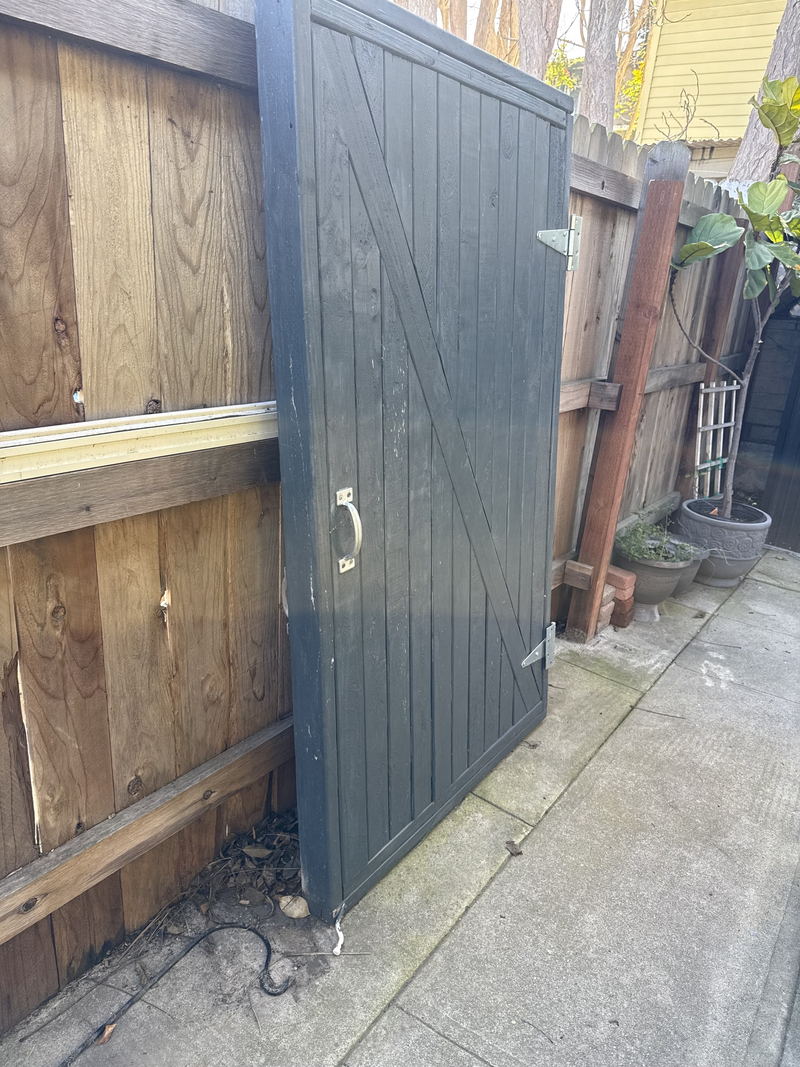
A heavy timber garden gate lifted off its hinges and leaned against a failing board fence along a narrow Los Angeles County side path, ready to be carried out
An old gate and fence panels pulled for removal · Glendale
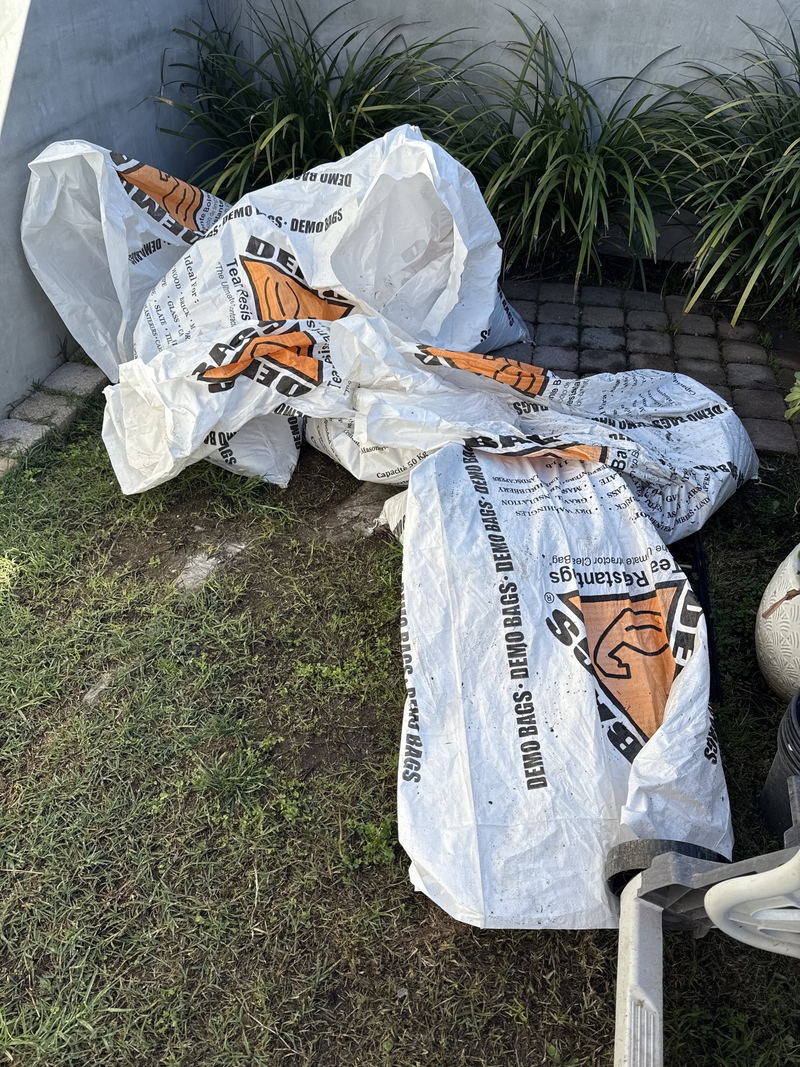
Heavy-duty white demolition bags packed full of renovation waste lying on the lawn and paved patio of a Los Angeles County property, staged for a hand carry to the trailer
Bagged renovation waste staged on the lawn · Glendale
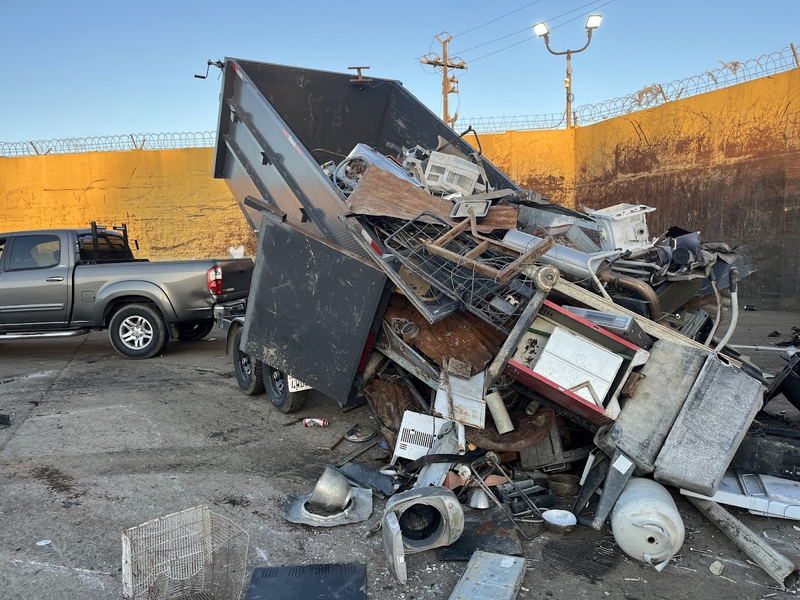
Our dump trailer tipping a load of scrap appliances at a Los Angeles County metal yard: stoves, air-conditioning units, a water heater and mixed steel sliding out onto the floor
Appliances and scrap metal going to the metal yard · Glendale

Our own crews on Los Angeles County jobs. The construction debris removal we run in Glendale looks like this too: side yards, narrow walkways and the back of the property is where the work actually is.

Where Glendale debris actually goes

Certified by another city,
which is the point.

Here is the detail that explains Glendale's whole system. The ordinance defines a certified mixed debris recycling facility as a facility that has been certified by the City of Los Angeles to divert 65% or more of construction and demolition debris from landfills without using material as alternative daily cover. Glendale did not build a parallel certification program. It borrowed the neighbor's, and then made using it the condition of getting your deposit back. So a Glendale strip-out is measured against a Los Angeles list, and the alternative daily cover exclusion means tonnage spread over a landfill face does not count as diversion no matter how it is reported.

The code allows one escape and it is narrow: a certified mixed debris recycling facility must be used for diversion credit unless the building official has granted an exemption to use an alternative recycling facility. That is a decision made in advance at a counter, not a decision made by a driver at four in the afternoon.

Underneath the city rule sits the state floor, and it is the same 65%. CALGreen requires locally permitted new residential and non-residential construction, demolition and certain addition and alteration projects to recycle or salvage for reuse a minimum of 65% of the nonhazardous construction and demolition debris generated, in sections 4.408, 5.408, 301.1.1 and 301.3. CalRecycle developed its model C&D diversion ordinance under Senate Bill 1374 for voluntary local adoption and encourages jurisdictions to coordinate with neighbors so contractors working across city lines do not face conflicting requirements. Glendale's chapter is written to run alongside CALGreen, and states that where the two conflict the more restrictive Title 24 requirement controls.

What that means on the ground is sorting. The ordinance asks, to the maximum extent feasible, that project debris be separated on site where separation increases diversion, and it names the categories: salvageable materials such as fixtures and appliances, dimensional lumber, wallboard, concrete and corrugated cardboard. It also requires demolition diversion to be tracked and measured separately from construction and renovation diversion on projects that involve both. We work to that structure at the property because it is cheaper than fixing it afterwards. Clean wood goes one way. Concrete, asphalt, brick and inert rubble go another and are among the easiest materials to recycle at high rates. Scrap metal comes off separately because a separated metal load has a real destination and a mixed load has the worst one available. Gypsum wallboard is separated where the volume justifies it. Cardboard and packaging never belong in a mixed debris load at all.

Then there is the material that is not C&D debris and never becomes it. Glendale's own definition excludes hazardous waste from the start. Three categories come up on nearly every pre-1980 Glendale job and all three have a regulator rather than a hauler attached. Asbestos-containing material is first: South Coast AQMD Rule 1403 requires a documented survey for the presence of asbestos before any demolition, with no exceptions, and before renovation except on single-unit residential structures where less than 100 square feet of intact material is removed, and the survey must be done by a Cal/OSHA-certified inspector or an employee holding a current AHERA Building Inspector certificate. Notification to South Coast AQMD through its online system is required before work starts on all demolitions and on renovations that impact asbestos-containing material above that 100 square foot threshold. Removal itself is a registered trade: Cal/OSHA requires contractor registration to remove material with asbestos content above 0.1% covering 100 square feet or more of surface area. If your Glendale job has asbestos in it, the correct next call is a licensed abatement contractor, not a hauler, and we will say so on site rather than load it.

Lead is second. Cal/OSHA's lead in construction standard covers demolition or salvage of structures where lead or lead-containing materials are present, and it treats manual demolition of structures where lead-containing coatings or paint are present as a trigger task, meaning the employer must assume exposure above the permissible limit until monitoring proves otherwise. That is an abatement and worker-protection question that belongs to a qualified contractor before debris removal starts.

Treated wood is third, and it is the one that shows up on Glendale hillside properties most often, because retaining timber, deck framing, posts and fencing on a sloped lot are frequently pressure treated. DTSC's alternative management standards under Assembly Bill 332, codified in Health and Safety Code section 25230, govern how treated wood waste is stored, labeled, shipped and disposed of. It cannot be burned and it cannot be commingled with other wood waste. Generators and handlers who exceed 10,000 pounds of treated wood waste in a calendar year must obtain an identification number and file a handler notification with DTSC within 30 days, and DTSC states that failing to do so is a violation of the state's hazardous waste control laws. One useful distinction: DTSC is clear that natural wood which is simply painted or finished with lacquer, shellac, polyurethane or varnish is not treated wood. Painted trim is a lead question. A pressure-treated deck post is a treated wood question. They are not the same problem and they do not travel together.

Sources: Glendale Municipal Code Chapter 8.58, Construction and Demolition Debris Diversion Program; City of Glendale, Construction & Demolition Debris Recycling Ordinance; CalRecycle, Construction and Demolition Diversion Informational Guide and model ordinance; CalRecycle, Construction and Demolition Debris Recycling; South Coast AQMD, Rule 1403 compliance advisory for renovations and demolitions; Cal/OSHA Asbestos and Carcinogen Unit, contractor registration and consultant certification; California Code of Regulations Title 8 Section 1532.1, Lead in construction; California DTSC, Treated Wood Waste; California DTSC, requirements for generators of treated wood waste.

The rule behind it
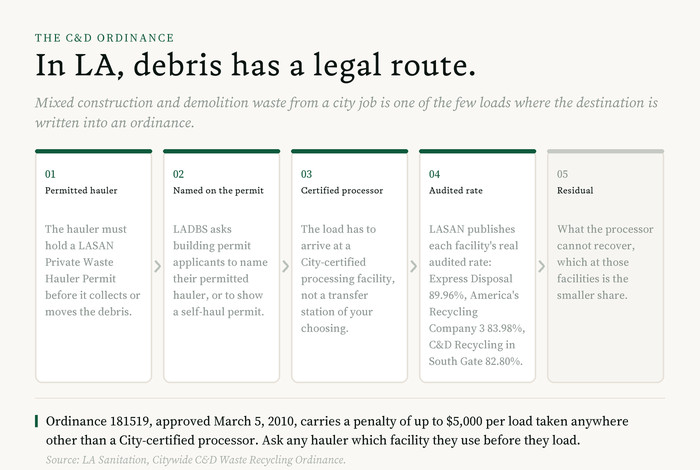
Diagram of the Los Angeles construction and demolition ordinance route: a LASAN-permitted hauler named on the building permit takes mixed debris to a City-certified processor with a published audited recycling rate
The route the C&D ordinance actually requires

Same rule in Glendale as anywhere else in Los Angeles County. The local part is the program above, not the disposal law. Full detail on construction debris removal.

Worth knowing

Glendale construction debris
in six lines.

Glendale C&D facts
  1. Glendale Municipal Code Chapter 8.58 requires covered projects to divert and document 65% or greater of total estimated project debris.
  2. No Glendale permit is issued for a covered project until the building official has approved the construction waste management plan.
  3. Glendale's diversion security deposit is calculated at 6% of project valuation for demolition and 2% for construction or a single family addition, capped at $30,000.
  4. The deposit is released only against original facility tags showing the project address, filed within six months of the certificate of occupancy.
  5. Glendale requires C&D debris to go to a facility certified by the City of Los Angeles to divert 65% or more without using material as alternative daily cover.
  6. The Glendale Recycling Center does not accept construction debris, wood and lumber, pane glass or PVC pipe, so there is no municipal drop-off for a remodel.

This page is construction debris removal in Glendale specifically. The wider service is on construction debris removal across Los Angeles, and everything we haul in this city is on junk removal in Glendale. Same crew, different job: Commercial junk removal in Glendale, Estate cleanouts in Glendale, Furniture removal in Glendale, Same-day junk removal in Glendale. Pricing works the same way everywhere: how our pricing works, and the full map is on areas we serve.

Service area
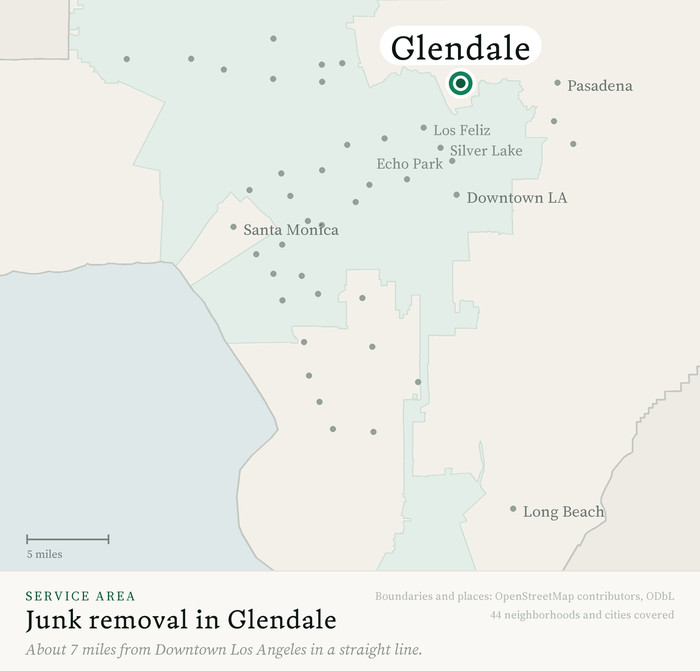
Map of our greater Los Angeles junk removal service area with Glendale marked, about 7 miles from Downtown Los Angeles, drawn from OpenStreetMap boundary data
Glendale in the greater Los Angeles service area. Boundaries and places from OpenStreetMap contributors, ODbL.

We are already next door most days. The whole list is on areas we serve.

What usually goes
with a strip-out

Separated at the property, routed by material, quoted as one number before anything moves.

Glendale construction
debris questions

The deposit, the tags, the hillside carry and what we are not allowed to touch.

Does my Glendale remodel need a construction waste management plan?

If it is a covered project, yes, and it has to be approved before the permit is issued. Glendale's ordinance covers any newly constructed building, any residential addition, renovation or alteration that increases the building's conditioned area, volume or size, and any non-residential addition, renovation or alteration of an existing non-residential building regardless of the proposed construction value. City-sponsored projects of 5,000 square feet or more are covered too. Check with the Building and Safety Division before you assume a small job is outside it, because the commercial category has no dollar threshold.

How do I get the diversion security deposit back?

By documenting 65% or greater diversion and filing the compliance report with ORIGINAL facility tags within six months of the certificate of occupancy. The city asks for receipts from certified mixed debris recycling facilities showing actual weights and volumes for each load, carrying the project address and the dates. Photocopies are not accepted. Glendale asks applicants to allow four to six weeks for the refund to process. We hand you the weighed tags for every load we take, which is the part of this that we control.

Where is our debris allowed to go?

To a certified mixed debris recycling facility, or to reuse. Glendale defines a certified facility as one certified by the City of Los Angeles to divert 65% or more of construction and demolition debris without counting material used as alternative daily cover. A different facility can only be used for diversion credit if the building official has granted an exemption in advance. That is why the destination is decided before the truck leaves, not at the gate.

Can you get debris out of a hillside property above Chevy Chase or Verdugo Woodlands?

Yes, and it is normal work here. Those lots sit in the city's ROS and R1R hillside zones, where slope drives everything: tall narrow houses cut into the hill, exterior stairs, retaining walls and a single-width private drive with a gradient. We size the truck to the drive rather than sending the biggest one and discovering the problem at the top, and on the tightest addresses we shuttle to a legal position on the street. Tell us on the phone how far a vehicle can actually get.

There is old pipe lagging and painted woodwork coming out. Can you take it?

Not if it is asbestos or lead abatement waste, and we will tell you that plainly. South Coast AQMD Rule 1403 requires a documented asbestos survey before any demolition and before most renovations, and Cal/OSHA requires contractor registration to remove asbestos material above 0.1% content covering 100 square feet or more. Cal/OSHA's lead in construction standard covers manual demolition where lead-containing coatings are present. The right answer for both is a licensed abatement contractor first, and us afterwards for the clean debris.

What does construction debris removal cost in Glendale?

We price by the volume the load actually takes up in the truck, with labor, transport and disposal included, quoted upfront and confirmed on site before anything is lifted. The quote is free and there is no obligation. What genuinely moves a Glendale number is the carry and the material: a flat driveway with dimensional lumber is quick, a hillside strip-out with broken concrete coming down exterior stairs is not, and we say which one you have while we are quoting rather than afterwards.

The proof

What our customers say

5.0from 67 reviews on Google

Word for word from Google. Nothing tidied.

  • 3 months ago

    Hunter is truly dedicated on providing the most excellent of removal of unwanted junk from your home or office. Always on time, very efficient at his job in a timely manner. I would recommend him for any junk removal you may have.

    James Russell3 reviewsHome and office junk removal
  • Fair pricing 11
  • Personable staff 10
  • Polite 5
  • Punctual staff 4
One city over

Construction debris removal near Glendale

Collection rules, transfer stations and permit counters change at the city line, so each of these is written for that city rather than for Glendale. A job that straddles two of them is still one visit and one number.

Everything we haul in the cities next door: Los Feliz, Silver Lake, Echo Park. The whole list is on areas we serve.

Request a quote

Send a photo, get a flat number back. Free, no obligation, no pressure and no call-out fee — and if your city will haul it free instead, we will tell you that too. Most requests are answered within the hour during working hours.

Or call or text (323) 230-0777 — Mon–Sat around the clock, Sunday 1–10pm.

Call (323) 230-0777Text a photo