Mon–Sat open 24 hours · Sun 1–10pmFully insuredFamily-run, LA-based
team@lajunkhauling.com
Call us today(323) 230-0777
Home/Services/Construction debris removal/Pasadena

Construction debris removal in Pasadena
Approved first. Then hauled. In that order.

Plaster and lath, painted timber, cabinetry, tile, roofing, concrete and mixed remodel debris cleared from Pasadena properties, with weight tickets that go straight into your Green Halo file.

Free quote, no obligation · one flat number before we start · you can also text that number

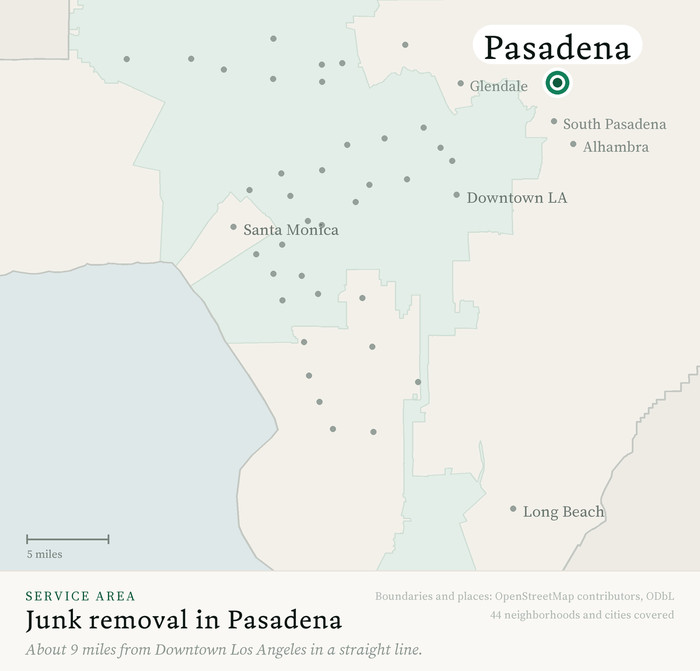
Our dump trailer loaded with mixed construction debris at dusk: cut timber, baseboard, a paint bucket, crates and broken fixtures stacked above the tailgate on a Los Angeles County job
A cleared interior on a Los Angeles County job. On a covered project the weight tickets matter as much as the empty room.
In short

In Pasadena the paperwork is the critical path, not the truck. Under Municipal Code Chapter 8.62 the construction and demolition application has to be approved before any debris is hauled, and covered projects must divert at least 75 percent. We work to an approved Green Halo plan and hand back weight tickets.

Pasadena is the strictest jurisdiction we work in on construction debris, and the reason is sequencing rather than severity. Under the Construction and Demolition Waste Management Ordinance, Pasadena Municipal Code Chapter 8.62, effective 1 April 2014, certain projects must divert at least 75% of their waste through recycling, salvage or deconstruction. Pasadena's own published wording is that the construction and demolition application must be approved prior to hauling any C&D debris, with the performance security deposit at risk of forfeiture where that application is never put in for approval or where any provision of the ordinance goes unmet. Compliance runs through Green Halo, where the project is submitted for approval before the permit is issued and the compliance report is approved before final inspection and the certificate of occupancy. Los Angeles Junk Removal & Hauling works to the approved plan, uses the facilities named on it, and returns weight tickets you can upload.

A Pasadena contractor rarely calls us because the debris is heavy. They call because a deadline collided with an approval, and somebody has realized that the load in the driveway is not allowed to move yet. That is a genuinely unusual rule. Most cities audit diversion after the fact. Pasadena gates it at the front, and again at the end, and puts a refundable deposit between the two gates.

This page explains both gates, what the city counts as a covered project, what the deposit is calculated from, and what Pasadena's pre-war housing stock does to the carry once the paperwork is sorted. The wider local picture is on junk removal in Pasadena, and the county-wide service is on construction debris removal.

Two approvals, one deposit

The application is the critical path,
not the truck.

Take the covered project list first, because Pasadena's is broader than most and one line in it catches an enormous amount of ordinary residential work. The city applies C&D approval to all new structures; to non-residential additions of either 1,000 square feet or more of gross floor area or tenant improvements of $200,000 or more; to all residential additions; to all demolitions; to all city public works projects awarded by competitive bidding; and — this is the line — to all residential alterations and remodels with no increase in the building's conditioned area, volume or size where the value of the permitted work is $20,000 or more. A kitchen taken back to studs in a bungalow, adding no floor area whatsoever, is a covered project.

Now the sequence. After a permit is filed, the applicant receives an email from Green Halo, the waste tracking system the city uses, and creates an account. The project information section is filled in with estimated quantities of what will be recycled, reused and disposed. The applicant selects a hauling method, then identifies and selects one or more facilities from the city's Authorized Facilities List. Then the project is submitted for approval in Green Halo, and the city states that this approval is required prior to permit issuance. That is gate one, and it is where the rule about not hauling before approval bites: at that point in the job nothing has been approved, so nothing should be leaving.

During the project, weight tickets are uploaded to Green Halo as loads happen rather than gathered up at the end. At completion the applicant selects submit for final, and the compliance report is reviewed. The city states that this approval is required before the final building inspection and certificate of occupancy. That is gate two. The compliance report has to confirm that at least 75% of the debris generated was recycled or reused. The city is direct about the standard of evidence: a form or letter stating that all waste hauled in Pasadena is subject to 75% diversion is not sufficient, and weight tickets are necessary.

The money sits between the gates. Pasadena's refundable C&D deposit is the greater of $1,000 or 3% of the valuation of the project, not to exceed $30,000, for building permits; and the greater of $1,000 or $1 per square foot, not to exceed $30,000, for demolition permits. There is also a separate non-refundable administrative review fee for each project, set by the city's General Fee Schedule. Getting the deposit back is not automatic even when a project is compliant: the applicant has to submit a Request for Refund Form, and the city says deposits will be forfeited if it does not receive one. A project found non-compliant gets 14 days to submit additional documents for review or risks forfeiting the deposit.

Universal waste has its own line. Pasadena requires universal waste to be properly managed on all commercial construction projects and tenant improvements over 1,000 square feet under CALGreen section 301.3, naming mercury thermostats, batteries, compact fluorescent bulbs, fluorescent tubes and ballasts. Disposal has to be documented and submitted to the city through Green Halo, and the recycling receipts retained.

Behind all of that sits Pasadena's hauling system, which is not open. The city grants non-exclusive solid waste collection franchises under Pasadena Municipal Code Chapter 8.61, and the published master agreement obliges every franchisee to meet a minimum recycling diversion rate of 75% for construction and demolition debris, measured both monthly and annually, and 60% for other solid waste. Where a franchisee uses a third party to help hit those numbers, that third party tonnage may not exceed 25% of the total tonnage reported in any one calendar month. Missing the C&D number triggers liquidated damages on a sliding scale: $10 per ton of recycling shortfall tonnage where the monthly rate lands between 40% and 75%, $20 per ton between 30% and 40%, $30 per ton between 20% and 30%, and $40 per ton below 20%. Continued failure is a material breach and grounds for termination. Pasadena counts what leaves it, and the contract says what happens when the count is wrong.

75%the diversion Pasadena requires from covered construction and demolition projects under PMC Chapter 8.62
Before haulingthe city's own wording: the C&D application must be approved prior to hauling any debris
14 dayswhat a non-compliant project gets to supply further documents before the C&D deposit is at risk

Sources: City of Pasadena, Construction and Demolition Waste Management Requirements and Public Works C&D Debris Recycling. Both cited in full below.

The ordinancePasadena Municipal Code Chapter 8.62, Construction and Demolition Waste Management Ordinance, effective 1 April 2014
Diversion requiredAt least 75% of project waste, through recycling, salvage or deconstruction
The timing ruleThe construction and demolition application must be approved prior to hauling any C&D debris
Tracking systemGreen Halo. Project information, estimated quantities, hauling method and facilities selected from the city's Authorized Facilities List
Approval gate oneSubmitting the project for approval in Green Halo is required prior to permit issuance
Approval gate twoThe compliance report must be approved before the final building inspection and certificate of occupancy
Covered projectsAll new structures; all residential additions; all demolitions; non-residential additions of 1,000 sq ft or more or tenant improvements of $200,000 or more; residential alterations and remodels with no increase in size where the permitted work is valued at $20,000 or more; city public works projects
Deposit, building permitsThe greater of $1,000 or 3% of project valuation, not to exceed $30,000
Deposit, demolition permitsThe greater of $1,000 or $1 per square foot, not to exceed $30,000
RefundA Request for Refund Form must be submitted or the deposit is forfeited. Non-compliant projects get 14 days to supply further documents
Who may haulPMC Chapter 8.61 non-exclusive franchise. The master agreement sets 75% C&D diversion monthly and annually, with liquidated damages of $10 to $40 per ton of shortfall tonnage

Sources: City of Pasadena, Construction and Demolition Waste Management Requirements; City of Pasadena Department of Public Works, Construction and Demolition Debris Recycling; City of Pasadena, Master Solid Waste Franchise Agreement under Pasadena Municipal Code Chapter 8.61.

What a Pasadena remodel actually produces

Plaster, lath and painted timber
down a drive built for a Model T.

Pasadena's residential core is early twentieth century and that dictates the debris. The Bungalow Heaven Historic District, listed on the National Register in April 2008, is the best-known concentration of it, but the same construction runs through the older east and northwest neighborhoods for blocks in every direction. What comes out of those houses is not the drywall-and-engineered-lumber mix a 1990s tract remodel produces. It is wood lath and lime plaster, square-edge redwood framing, shiplap sheathing, single-glazed wood sash, cast iron waste pipe, galvanized supply, porcelain fixtures, linoleum over fir flooring, and painted trim with a lot of history on it.

Each of those behaves differently in a load. Plaster and lath is the defining one: it comes off in slabs, it turns to fine dust the moment it hits the ground, and it hides hundreds of small nails. It is dense, it is dirty, and it is the material most likely to blow a volume estimate because a ceiling that looks like nothing fills a container. Old growth framing is heavier than modern dimensional lumber of the same nominal size. Cast iron pipe sections are a two-person lift in short lengths. None of that is exotic, but it changes the number of trips and the crew, and on a covered project it changes the weight tickets, which is the part the city reads.

Then the route. The classic Pasadena residential lot has a long single-width driveway running down the side of the house past a side gate to a detached garage at the rear. The distance from a back bedroom to a legally parked truck is often well over a hundred feet, past a gate that is narrower than the drive, with a step or two in the middle. That drive will not let a full-size vehicle turn, and on many blocks it will not let one pass a parked car either. We plan the staging point first and work backwards from it, because the alternative is a crew discovering at eight in the morning that the container cannot be positioned where the debris is.

The hillside north and west of the center adds gradient on top. The streets climbing toward the mountains and the roads through the San Rafael hills on the west side have tight turns, narrow lanes and limited legal parking, and the private drives on them are frequently steeper than a loaded cart tolerates. As on any steep site the right vehicle is often a smaller one making more runs. Multifamily is the third pattern, mostly along the freeway corridors and in the older courtyard blocks, where a unit remodel becomes a building question: service entrance, protection through shared space, a manager who wants a certificate of insurance on file, and a window that does not collide with another tenant.

One practical note that is specific to a covered project rather than to the building. Because approval has to exist before debris is hauled, the staging decision matters more here than anywhere else. Material that would normally leave the same afternoon may have to sit for a day or two, which means it has to sit somewhere safe, dry, out of the public right of way and not blocking your own access. We plan that with you rather than around you. If the job is really a whole property rather than a strip-out, see estate cleanouts in Pasadena, and for the chemical end of a garage see garage cleanouts in Pasadena.

Working to an approved Pasadena C&D plan? Tell us the facilities on it and we will quote the haul free.

Free upfront quote, no obligation. One number, agreed before anything is lifted.

5.0 from 67 reviews on GoogleMon–Sat, open 24 hours

On the job
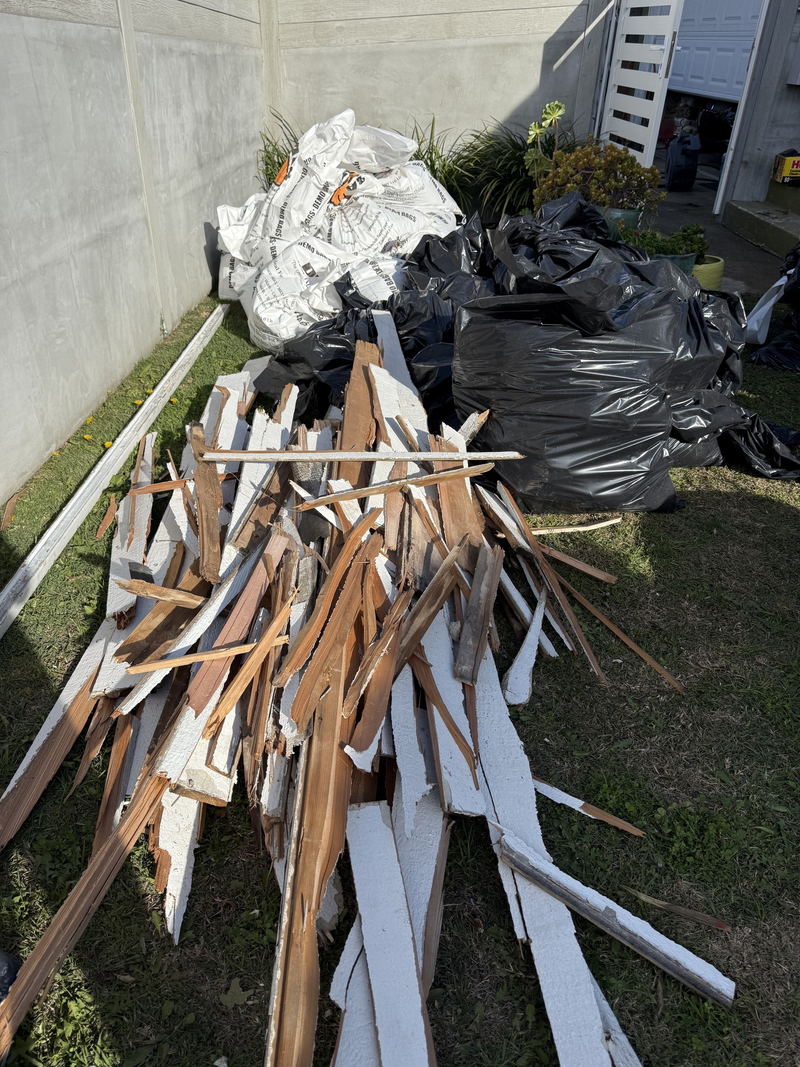
Broken fence boards, splintered lumber and strips of stucco piled on the grass of a Los Angeles County back yard, next to filled white demolition bags and black contractor bags waiting to be carried out
A back-yard demolition pile bagged and stacked ready to load · Pasadena
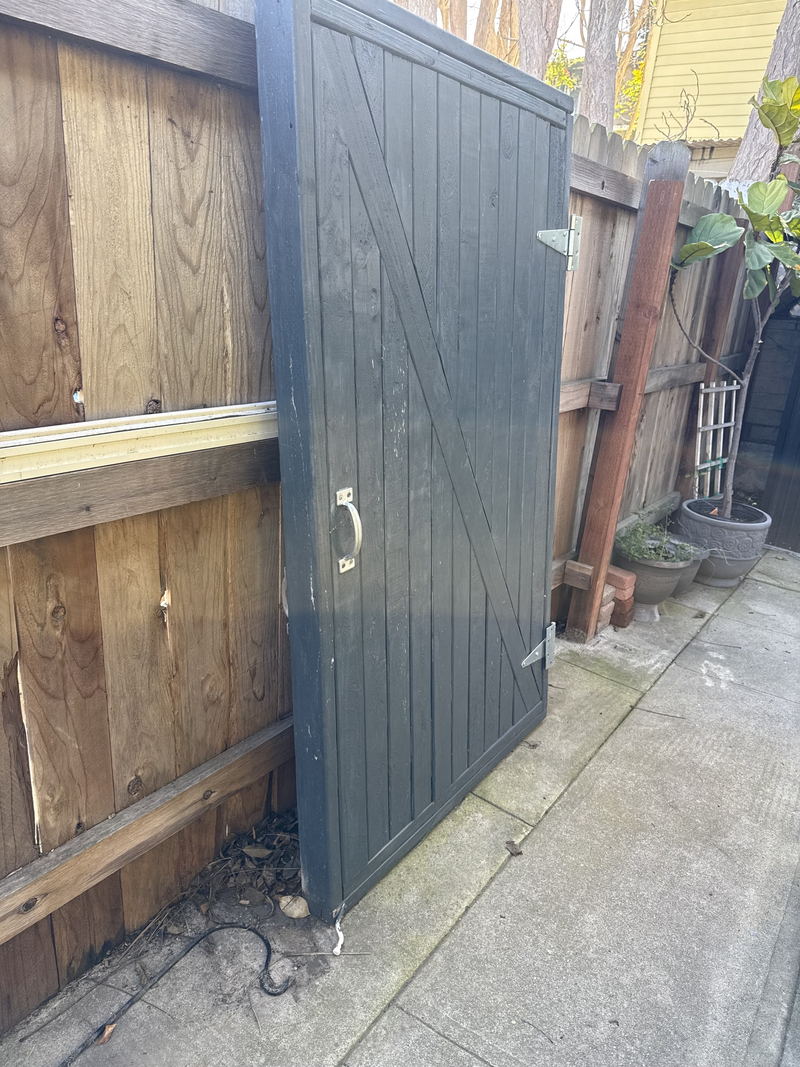
A heavy timber garden gate lifted off its hinges and leaned against a failing board fence along a narrow Los Angeles County side path, ready to be carried out
An old gate and fence panels pulled for removal · Pasadena
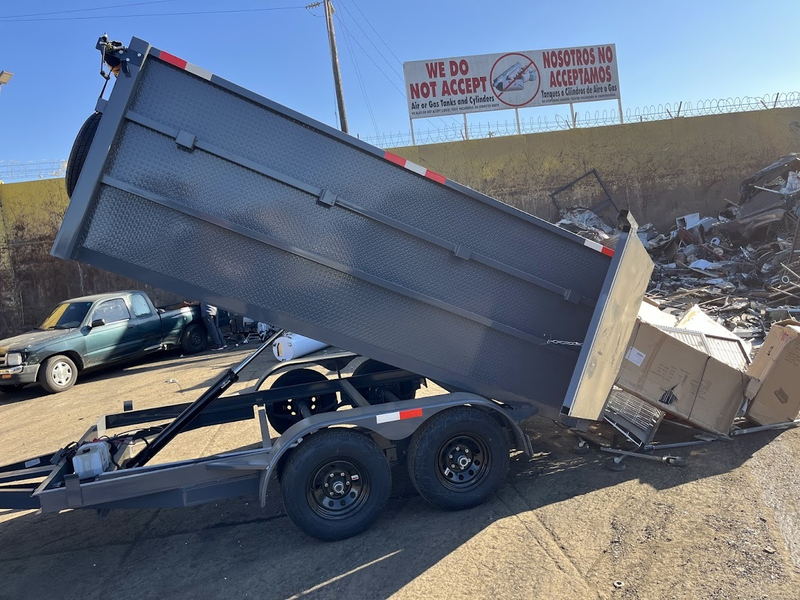
Our empty dump trailer tipped up beside a scrap pile at a Los Angeles County transfer station, under the yard sign refusing air and gas cylinders
Emptied out at the transfer station · Pasadena

Our own crews on Los Angeles County jobs. The construction debris removal we run in Pasadena looks like this too: side yards, narrow walkways and the back of the property is where the work actually is.

Where the material goes

Authorized facilities,
and the four things that are not debris.

On a covered Pasadena project the destination is not a preference, it is an entry in your file. The facilities are selected from the city's Authorized Facilities List inside Green Halo at the planning stage, and the weight tickets uploaded during the job have to come from those facilities. The city publishes the list as a service rather than an endorsement and expects applicants to satisfy themselves about any operator they use. Practically, that means the conversation about where a load is going happens at the same time as the conversation about the plan, and a hauler who cannot tell you which gate a load is destined for is a problem waiting to surface at the refund stage.

What gets separated is the ordinary C&D breakdown, and separating it well is how a job reaches 75% rather than scraping at it. Concrete, brick, asphalt and inert rubble recycle at very high rates and should never travel mixed with light waste. Clean dimensional lumber, unpainted and free of fixings, has its own route. Scrap metal — cast iron, copper, galvanized, aluminum window frames, steel studs, rebar — goes to a metal recycler rather than through a mixed line, because the recovery rate is higher and the metal is worth something. Gypsum wallboard separates where there is enough of it. Cardboard and packaging are recyclable and simply should not be in a debris container. Salvage is the quiet winner on Pasadena jobs specifically: period doors, hardware, clawfoot tubs, light fixtures, mantels and old growth timber are genuinely wanted, and salvage counts as diversion under an ordinance that names salvage and deconstruction alongside recycling.

The state floor under all of it is CALGreen, which requires locally permitted new construction, demolition and certain additions and alterations to recycle or salvage for reuse a minimum of 65% of nonhazardous construction and demolition debris, in sections 4.408, 5.408, 301.1.1 and 301.3. Pasadena sets its own bar 10 points above that. CalRecycle, which developed the state's model C&D diversion ordinance under Senate Bill 1374, notes that C&D can be a significant portion of a jurisdiction's waste stream and encourages jurisdictions to coordinate with neighboring cities so contractors are not caught between conflicting local rules. Anyone working across the Pasadena, Glendale and Los Angeles lines will recognize why that advice exists.

Now the four things that come out of a Craftsman-era Pasadena house and are not construction debris at all.

Asbestos is first and it is the one that most often changes a schedule. South Coast AQMD Rule 1403 requires a survey for the presence of asbestos-containing material to be conducted and documented before any demolition, with no exceptions, and before renovation except on single-unit residential structures where less than 100 square feet of intact material is removed or stripped. The survey has to be carried out by a Cal/OSHA-certified inspector or, where Cal/OSHA permits, a facility employee holding a current AHERA Building Inspector certificate, and the inspector has to observe and touch the material to judge friability. A survey is required even where a notification is not. South Coast AQMD must be notified through its online system before work starts on all demolitions and on renovations affecting more than 100 square feet of asbestos-containing material, and where material is damaged or disturbed a Procedure 5 clean-up plan must be submitted and approved in writing before abatement begins, regardless of project size. Removal is a registered activity: Cal/OSHA requires contractor registration for removing material with asbestos content above 0.1% covering 100 square feet or more. If a survey finds asbestos in your Pasadena job, the next call is a licensed abatement contractor, not a hauler. We will not carry it and we will tell you that before anyone starts swinging.

Lead paint is second, and in a house built between 1905 and 1930 with ninety years of repainting on it, it is a live question. Cal/OSHA's lead in construction standard applies to demolition or salvage of structures where lead or lead-containing materials are present, to removal or encapsulation of lead-containing materials, and to transportation, disposal, storage or containment of lead-containing material on site. It treats manual demolition of structures, manual scraping and heat gun work where lead-containing coatings or paint are present as trigger tasks, which means the employer must assume exposure above the permissible limit until an exposure assessment proves otherwise. Painted debris from a controlled abatement is that contractor's waste stream, handled under their controls. Ordinary painted trim from an unremarkable remodel is a different conversation, and the honest answer is that the survey, not the hauler, decides which one you have.

Treated wood is third, and it separates cleanly from the lead question if you know the definition. DTSC governs treated wood waste under the alternative management standards restored by Assembly Bill 332 and codified in Health and Safety Code section 25230. Treated wood cannot be burned and cannot be commingled with other wood waste, must be stored off the ground and covered, and handlers or generators exceeding 10,000 pounds in a calendar year must obtain an identification number and file a handler notification within 30 days, which DTSC states is enforceable as hazardous waste control law. The distinction that matters on an old Pasadena property: DTSC says natural wood that is merely painted or coated with lacquer, shellac, polyurethane or varnish does not qualify as treated wood. So painted interior trim is not treated wood waste. A pressure-treated sill plate, fence post or exterior deck member is.

Universal waste is fourth and it is the easiest to get wrong because it looks like fittings. On commercial projects and tenant improvements over 1,000 square feet Pasadena requires universal waste to be properly managed under CALGreen section 301.3 and documented through Green Halo, naming mercury thermostats, batteries, compact fluorescent bulbs, fluorescent tubes and ballasts. Old fluorescent tubes pulled from a suspended ceiling are not debris. We take them off the load and route them separately, and the receipt goes in the file with everything else.

Sources: City of Pasadena, Construction and Demolition Waste Management Requirements; City of Pasadena Department of Public Works, Construction and Demolition Debris Recycling; CalRecycle, Construction and Demolition Diversion Informational Guide and model ordinance; CalRecycle, Construction and Demolition Debris Recycling; South Coast AQMD, Rule 1403 compliance advisory for renovations and demolitions; Cal/OSHA Asbestos and Carcinogen Unit, contractor registration and consultant certification; California Code of Regulations Title 8 Section 1532.1, Lead in construction; California DTSC, Treated Wood Waste; California DTSC, requirements for generators of treated wood waste; California Office of Historic Preservation, listed resources in Los Angeles County.

The rule behind it
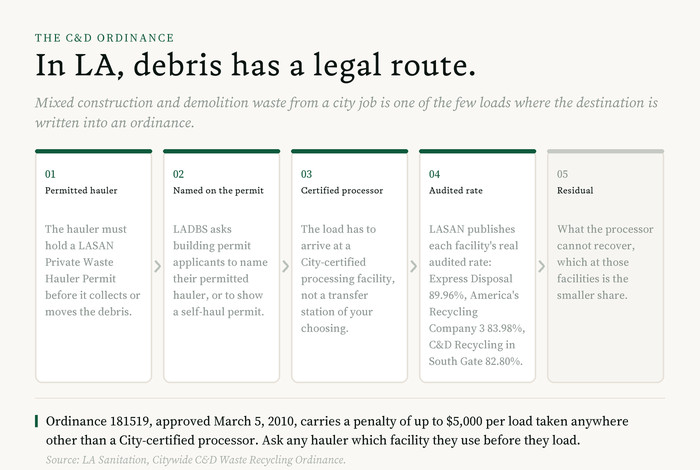
Diagram of the Los Angeles construction and demolition ordinance route: a LASAN-permitted hauler named on the building permit takes mixed debris to a City-certified processor with a published audited recycling rate
The route the C&D ordinance actually requires

Same rule in Pasadena as anywhere else in Los Angeles County. The local part is the program above, not the disposal law. Full detail on construction debris removal.

Worth knowing

Pasadena construction debris
in six lines.

Pasadena C&D facts
  1. Pasadena requires the construction and demolition application to be approved before any C&D debris is hauled.
  2. Covered projects in Pasadena must divert at least 75% of their waste through recycling, salvage or deconstruction under Municipal Code Chapter 8.62.
  3. A residential alteration or remodel that adds no floor area is still a covered project in Pasadena if the permitted work is valued at $20,000 or more.
  4. Pasadena's C&D deposit is the greater of $1,000 or 3% of valuation for building permits, and the greater of $1,000 or $1 per square foot for demolition permits, capped at $30,000.
  5. Compliance runs through Green Halo, where the project is approved before permit issuance and the compliance report is approved before final inspection and the certificate of occupancy.
  6. Pasadena's franchised haulers must hit a 75% C&D recycling diversion rate monthly and annually or pay liquidated damages of $10 to $40 per ton of shortfall tonnage.

This page is construction debris removal in Pasadena specifically. The wider service is on construction debris removal across Los Angeles, and everything we haul in this city is on junk removal in Pasadena. Same crew, different job: Appliance removal in Pasadena, Estate cleanouts in Pasadena, Furniture removal in Pasadena, Garage cleanouts in Pasadena, Same-day junk removal in Pasadena. Pricing works the same way everywhere: how our pricing works, and the full map is on areas we serve.

Service area
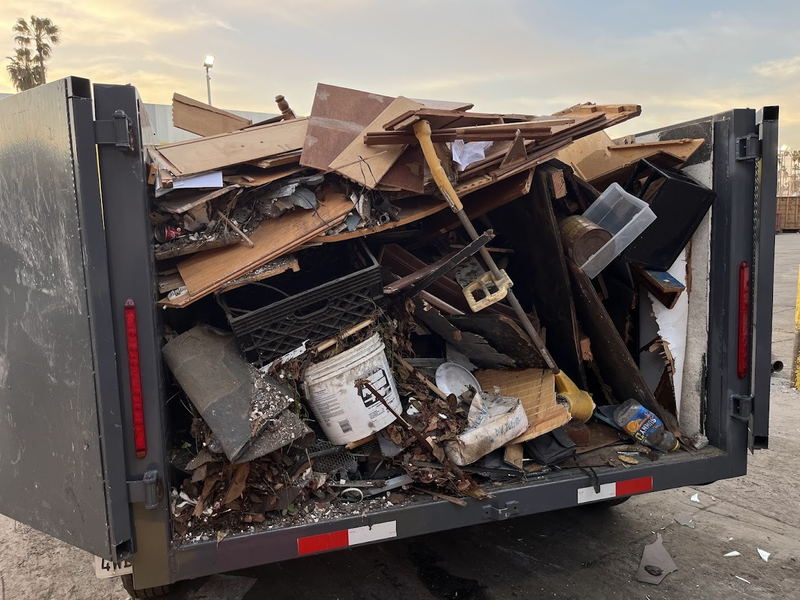
Map of our greater Los Angeles junk removal service area with Pasadena marked, about 9 miles from Downtown Los Angeles, drawn from OpenStreetMap boundary data
Pasadena in the greater Los Angeles service area. Boundaries and places from OpenStreetMap contributors, ODbL.

We are already next door most days. The whole list is on areas we serve.

What usually goes
with a Pasadena remodel

Sorted at the property, weighed at the gate, documented for the file.

Pasadena construction
debris questions

The approval, the deposit, Green Halo and what a 1915 house actually contains.

Can you haul my Pasadena remodel debris before the C&D application is approved?

No, and this is the single most important thing to know about working here. The city states that the construction and demolition application must be approved prior to hauling any C&D debris, and that failing to submit the application for approval or to comply with the ordinance may result in forfeiture of the performance security deposit. If your approval is in place, we work to the facilities named on it. If it is not, that comes first and we will say so rather than move the material and create a problem in your file.

My remodel is not adding any square footage. Am I still covered?

Probably yes. Pasadena applies C&D approval to all residential alterations and remodels with no increase in the building's conditioned area, volume or size where the value of the permitted work is $20,000 or more. It also covers all new structures, all residential additions, all demolitions, non-residential additions of 1,000 square feet or more, and tenant improvements of $200,000 or more. A kitchen or bathroom taken back to studs in a bungalow clears that threshold easily.

How much is the Pasadena C&D deposit and how do I get it back?

The city calculates it as the greater of $1,000 or 3% of project valuation for building permits, and the greater of $1,000 or $1 per square foot for demolition permits, in both cases capped at $30,000, plus a separate non-refundable administrative review fee from the General Fee Schedule. It is refunded once a compliance report confirming at least 75% diversion is approved, and you also have to submit a Request for Refund Form, because the city says deposits are forfeited if it never receives one.

What is Green Halo and do you upload the tickets?

Green Halo is the waste tracking system Pasadena uses for C&D compliance. You create an account after filing the permit, enter estimated quantities, choose a hauling method, pick facilities from the city's Authorized Facilities List and submit the project for approval before the permit is issued. Weight tickets are uploaded during the job, and at the end you submit for final. We give you the weighed ticket for every load we take so it can go straight into your account; the account itself stays in your name.

We have found old plaster, painted woodwork and some pipe lagging. What now?

Stop and get it surveyed. South Coast AQMD Rule 1403 requires a documented asbestos survey before any demolition and before most renovations, carried out by a Cal/OSHA-certified inspector, and notification before work starts. Cal/OSHA requires contractor registration to remove asbestos material above 0.1% content covering 100 square feet or more, and its lead in construction standard treats manual demolition where lead-containing paint is present as a trigger task. Both are jobs for a licensed abatement contractor, not a hauler. We take the clean debris afterwards.

What does construction debris removal cost in Pasadena?

We quote by the volume the load takes up in the truck, with labor, transport and disposal included, agreed upfront and confirmed on site before anything is lifted. The quote is free and there is no obligation. In Pasadena two things move the number honestly: the material, because plaster and lath and old growth framing are far denser than a modern tear-out, and the carry, because a long single-width rear drive is a hundred feet of walking per load. We point both out while quoting.

The proof

What our customers say

5.0from 67 reviews on Google

Word for word from Google. Nothing tidied.

  • 3 months ago

    Hunter is truly dedicated on providing the most excellent of removal of unwanted junk from your home or office. Always on time, very efficient at his job in a timely manner. I would recommend him for any junk removal you may have.

    James Russell3 reviewsHome and office junk removal
  • Fair pricing 11
  • Personable staff 10
  • Polite 5
  • Punctual staff 4
One city over

Construction debris removal near Pasadena

Collection rules, transfer stations and permit counters change at the city line, so each of these is written for that city rather than for Pasadena. A job that straddles two of them is still one visit and one number.

Everything we haul in the cities next door: South Pasadena, Alhambra, Echo Park. The whole list is on areas we serve.

Request a quote

Send a photo, get a flat number back. Free, no obligation, no pressure and no call-out fee — and if your city will haul it free instead, we will tell you that too. Most requests are answered within the hour during working hours.

Or call or text (323) 230-0777 — Mon–Sat around the clock, Sunday 1–10pm.

Call (323) 230-0777Text a photo