Hunter is truly dedicated on providing the most excellent of removal of unwanted junk from your home or office. Always on time, very efficient at his job in a timely manner. I would recommend him for any junk removal you may have.
Drywall, framing, tile, stucco, concrete, roofing, cabinetry and mixed construction debris removed from North Hollywood houses, apartment buildings and commercial units, and delivered to a City-certified processing facility.
Free quote, no obligation · one flat number before we start · you can also text that number

North Hollywood is part of the City of Los Angeles, so mixed construction and demolition debris generated here must be moved by a permitted hauler to a City-certified processing facility. The city's administrative penalties for taking a load elsewhere run from $1,000 to $5,000, and every load counts as a separate violation.
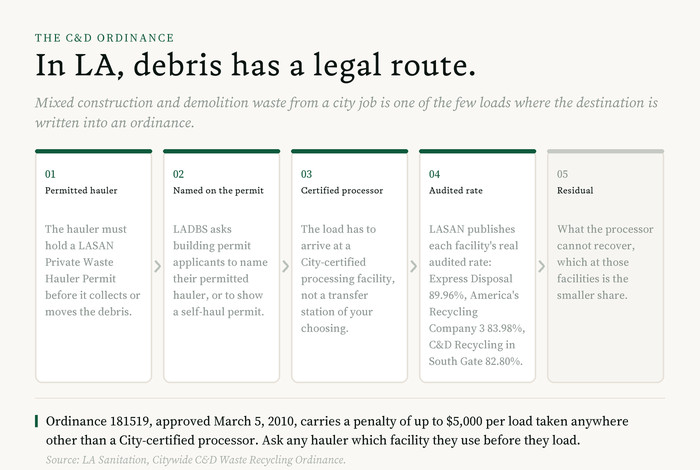
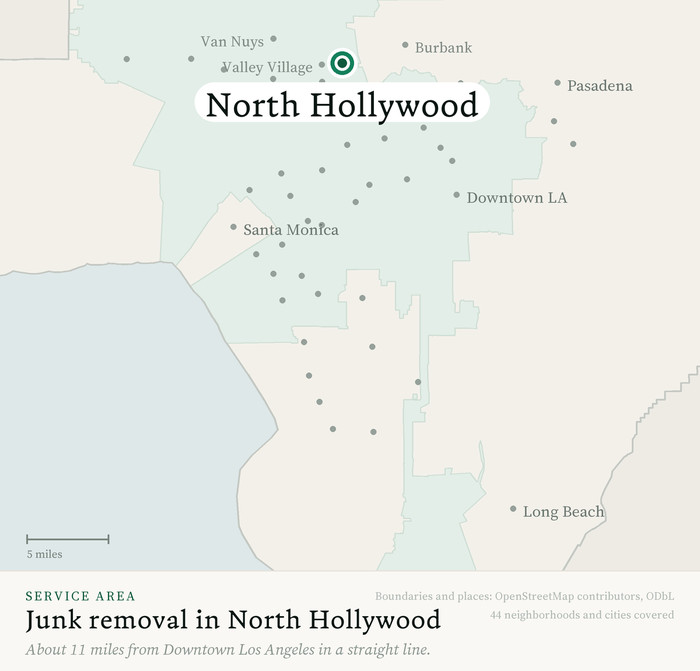
North Hollywood is not its own city. It is a neighborhood of the City of Los Angeles inside the North Hollywood – Valley Village Community Plan area, so its construction debris falls under the citywide construction and demolition waste recycling ordinance rather than any separate local program. The rule is short and expensive. Under Los Angeles Municipal Code Section 66.32.1, anyone collecting, removing or transporting construction and demolition waste generated in the city must hold an AB 939 Compliance Permit from the Bureau of Sanitation, and must deliver that waste to a Certified Construction and Demolition Waste Processing Facility. Section 66.32.3 attaches administrative penalties of $1,000 for a first violation, $2,000 for a second within six months, and $5,000 for a third and every one after, with each load delivered in violation counting as a separate violation. Los Angeles Junk Removal & Hauling routes NoHo debris to certified processors and documents it.
The question we get asked most often in North Hollywood is not what a load costs. It is whether a load can be taken at all this week, because the site is a 1950s apartment building being converted, there is nowhere to put a container, and the only vehicle access is a shared alley that three other buildings also use. That is the real NoHo problem: the law about where the material goes is rigid, and the space to work in is not there.
This page covers both halves. First the citywide rule, the certified processor list, the documentation a permitted hauler has to keep, and the exceptions that genuinely exist. Then the access reality of dense infill and alley-only sites. The wider local picture is on junk removal in North Hollywood, and the county-wide service is on construction debris removal.
The ordinance behind this is well documented. On 5 March 2010 the Los Angeles City Council approved Council File 09-3029, establishing a citywide construction and demolition waste recycling ordinance, and the municipal code sections were amended by Ordinance No. 181,519, effective 12 February 2011 and operative from 1 January 2011. LA Sanitation runs it through the Solid Resources Citywide Recycling Division, and describes the requirement plainly: all mixed C&D debris generated in the city must be transported by a permitted private waste hauler and processed at a City-certified facility.
Start with the permit. Section 66.32.1(a) requires persons who collect, remove or transport solid waste generated within the city, including construction and demolition waste, to obtain an AB 939 Compliance Permit from the Bureau of Sanitation in addition to every other permit they need. It also reaches the person arranging the work: anyone who arranges for the removal or transportation of C&D waste generated in the city and does not contract with a permittee to do it must hold the permit themselves. LA Sanitation sets the compliance fee at 10% of a permitted hauler's gross receipts and requires detailed quarterly tonnage and financial reports. If your hauler is not on the permitted list, the exposure does not stay with the hauler.
Then the destination. Section 66.32.1(b) says every permitted person who collects, removes or transports C&D waste within the city must deliver it to a Certified Construction and Demolition Waste Processing Facility. There is exactly one alternative written into the code, and it is narrow: a load may go elsewhere only if at least two certified facilities refuse to accept it and provide a rejection slip, and those rejection slips have to be kept for a minimum of three years. That is not a loophole anyone should plan around. It is a provision for material that genuinely cannot be processed.
Two real exceptions do exist and both are worth knowing. The certified-facility requirement does not apply to source-separated material generated from a project in the city and delivered to a recycling facility, or segregated for recycling on site. Clean separated metal going to a metal recycler, or clean concrete going to an inert facility, is treated differently from a mixed container. And a residence owner who generates C&D waste while personally performing construction or demolition at their own residence, and transports it in their own vehicle, is outside both the permit requirement and the facility requirement. A homeowner with a pickup truck is not the target of this ordinance. A contractor is.
Documentation is the part people underestimate. Section 66.32.1(c) requires permittees to submit reports to the Bureau of Sanitation on its forms covering all disposal and diversion amounts of material generated in the city, and to maintain documentation including invoices, weight tickets, rejection slips where issued, weight tickets from any non-certified destination where issued, and documents identifying the project location, the quantity of C&D waste, solid waste, source-separated material and co-mingled recyclables, and the destination of each load of material. All of it has to be kept for at least three years. There is even a marking rule: bins owned by haulers and used for C&D waste generated in the city must be clearly marked with the hauler's name and phone number. If an unmarked container turns up on your NoHo site, that is a signal.
The penalties are what make this different from an ordinance that simply encourages recycling. Section 66.32.3(b) sets administrative penalties for failing to deliver C&D waste to a certified facility at $1,000 for the first violation, $2,000 for a second occurring within six months of a first, $5,000 for a third occurring within six months of a second, and $5,000 for each violation after a $5,000 penalty has been imposed. The Bureau of Sanitation issues a Notice of Penalty Assessment, and delivery of each and every load in violation is a separate violation. LA Sanitation's own summary describes penalties of up to $5,000 for every load of C&D waste unlawfully processed. There is an appeal: a written request for a hearing before the Board within thirty days of the notice being mailed, after which the assessment is stayed pending the hearing. Miss the thirty days and it is final.
Finally, the permit desk closes the loop. LA Sanitation works with the Los Angeles Department of Building and Safety so that building permit applications require contractors either to identify their permitted private solid waste hauler or to provide their own private solid waste hauler permit for self-hauling. The hauler question is asked at LADBS before the job starts, not after.
Sources: Los Angeles Municipal Code Sections 66.32.1 and 66.32.3; LA Sanitation. All cited in full below.
| The ordinance | Citywide C&D Waste Recycling Ordinance, Council File 09-3029 approved 5 March 2010; LAMC amended by Ordinance No. 181,519, effective 12 February 2011 |
|---|---|
| The core rule | Mixed C&D waste generated in the city must be delivered to a Certified Construction and Demolition Waste Processing Facility |
| Who may haul it | A hauler must hold an AB 939 Compliance Permit from the Bureau of Sanitation before collecting, removing or transporting C&D waste |
| Hauler compliance fee | LA Sanitation sets it at 10% of a permitted hauler's gross receipts, with quarterly tonnage and financial reports |
| Penalty ladder | $1,000 first violation; $2,000 for a second within six months; $5,000 for a third within six months of a second; $5,000 for each one after |
| Counted per load | Delivery of each and every load in violation is a separate violation |
| The only alternative | A load may go elsewhere only where at least two certified facilities refuse it and issue rejection slips, kept for three years |
| Source separation | The certified-facility rule does not apply to source-separated material taken to a recycling facility or segregated for on-site recycling |
| Homeowner exception | A residence owner doing the work at their own home and hauling in their own vehicle is outside the permit and facility requirements |
| Records | Invoices, weight tickets, project location, quantities and the destination of every load, kept at least three years |
| At the permit counter | LADBS asks building permit applicants to name a permitted hauler or show their own self-haul permit |
Sources: Los Angeles Municipal Code Section 66.32.1, solid waste hauler permit requirements; Los Angeles Municipal Code Section 66.32.3, violations, penalties, and permit suspension and revocation; LA Sanitation, Construction and Demolition (C&D) Recycling Program and certified processor list; LA Sanitation, Waste Hauler Compliance Program; Los Angeles City Clerk, Ordinance No. 181519.
North Hollywood has been building upward and infilling for two decades, and the construction debris calls reflect it. Three site types account for almost everything. The first is the small lot redevelopment: an older single family house or duplex on a standard lot being gutted, added to, or taken down for something denser. The second is the multifamily conversion or rehab, usually a two-story 1950s or 1960s building with tuck-under parking, exterior stairs, no elevator and a single narrow driveway serving every bay. The third is commercial tenant work along the Lankershim and Magnolia frontages and in the Arts District blocks around them, where units sit shoulder to shoulder with no loading dock and service access runs down a shared alley behind the buildings.
What those three have in common is that there is no spare ground. On a suburban lot you stage debris on a driveway or a side yard and load in one pass. On a NoHo infill site the building footprint has eaten the lot, the setbacks are landscaping or paving, and the only flat surface is either the parking deck that tenants need or the alley that somebody else's trash bins are already using. That is a sequencing problem rather than a lifting problem, and the way through it is smaller stages more often: clear a room, carry it out, load it, come back. Debris left in a shared alley overnight is an obstruction, a fire access problem and an invitation for other people's material to join it by morning.
If the answer is to use the street, the city has a rule about that. Los Angeles Municipal Code Section 62.45 says no person shall deposit or maintain on any public street, sidewalk or parkway any protection fence, protection canopy, building material of any kind, debris from any building or building excavation, or any material or equipment used in connection with work on adjacent private property, without first filing a written application, receiving a permit and paying a fee. The permit fee for depositing and maintaining building material or debris is charged by the square foot occupied, subject to a minimum, and the Bureau of Engineering charges a separate processing fee for each permit it handles. The board may attach special conditions to safeguard the public and protect the street. In other words, a container standing in the roadway outside a NoHo remodel is a permitted occupation of the public way, not a parking decision.
The alley itself deserves respect. Alleys in this part of the Valley are narrow, two-way in practice, and serve as the service route for every building on the block. Standing a truck across one blocks a neighbor's only vehicle access, and on a block with restaurants or a market on the frontage it blocks their collection as well. We work alleys in short bursts with a spotter, keep a lane open, and where the alley is genuinely unusable we carry to a legal position on the street instead and accept the longer walk.
Parking is the last variable and it is worth a phone call. Large parts of the residential blocks around the Arts District are permit parked, and street cleaning days take a side of the road out entirely. Telling us the cross street and whether the block is permit parked changes the vehicle we send and the hour we send it, which is a far better outcome than a crew arriving and circling. For a unit turnover with no structural work in it, see furniture removal in North Hollywood, and for a commercial unit being handed back, see commercial junk removal in North Hollywood.
NoHo strip-out, unit turnover or conversion. Tell us the access and we will quote the haul free.
Free upfront quote, no obligation. One number, agreed before anything is lifted.
5.0 from 67 reviews on GoogleMon–Sat, open 24 hours


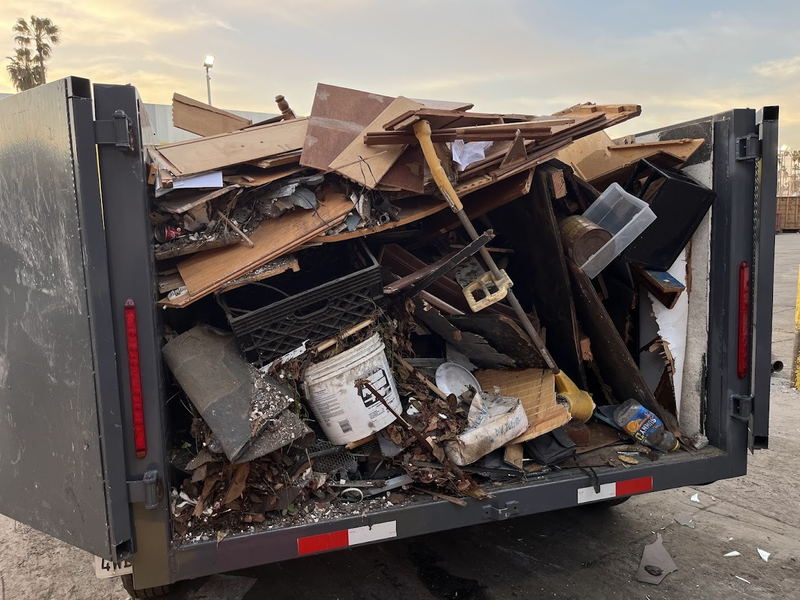
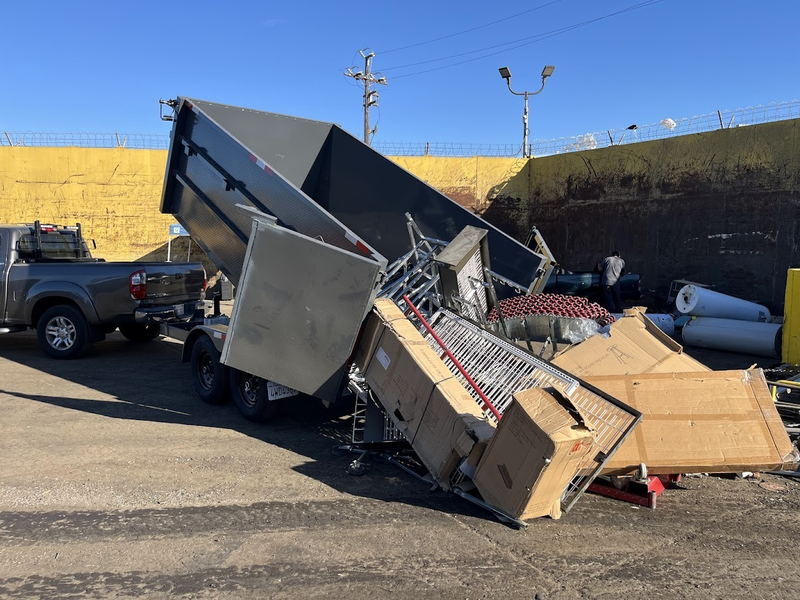
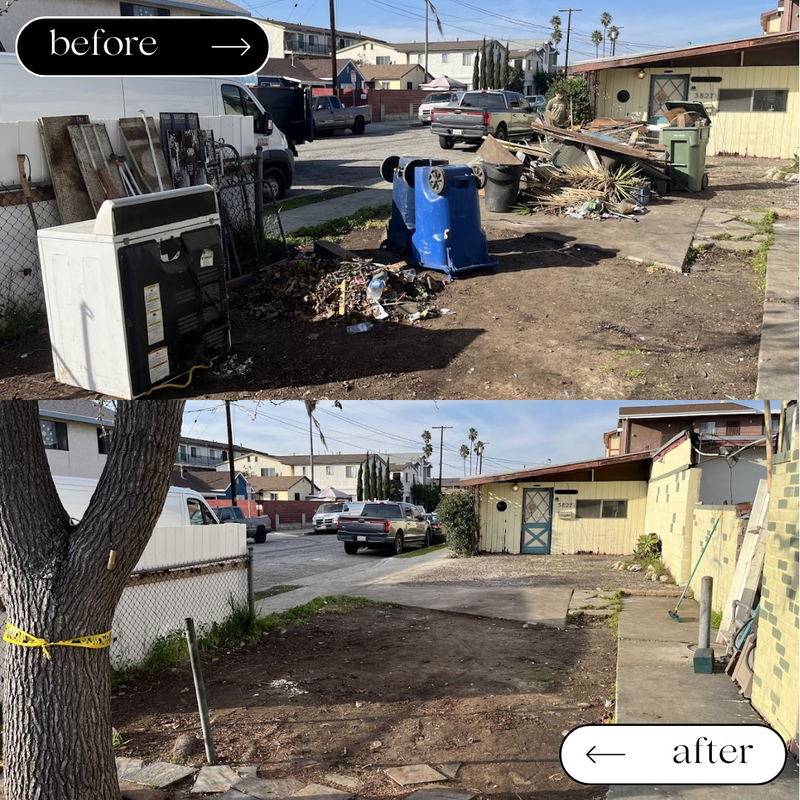
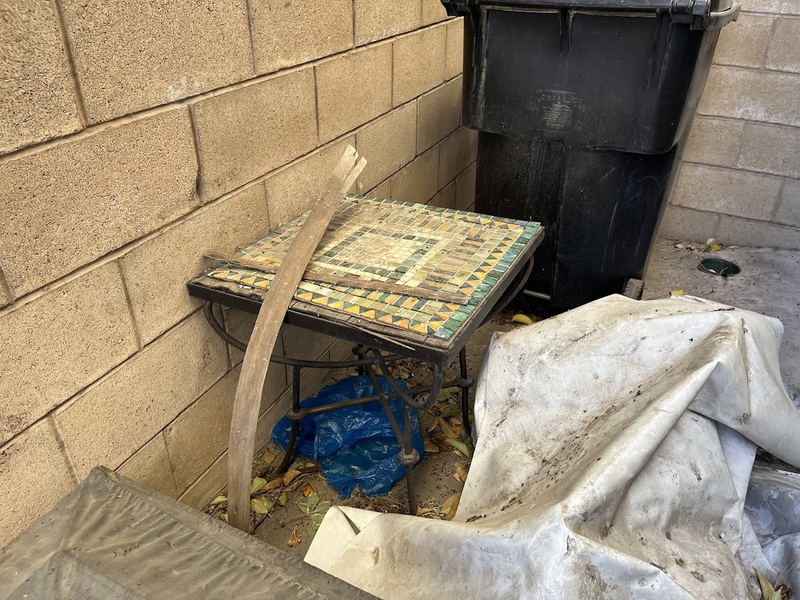
Our own crews on Los Angeles County jobs. The construction debris removal we run in North Hollywood looks like this too: side yards, narrow walkways and the back of the property is where the work actually is.
The certified processor list is not a vague category, it is a document. LA Sanitation publishes the approved processor list for the calendar year alongside an interactive map of City-certified C&D processors, and each entry carries the facility's mixed C&D waste recycling rate. On the 2026 list the published rates run from the low seventies into the high eighties, with Express Disposal on East Washington Boulevard at 89.96%, America's Recycling Company 3 on Glenoaks Boulevard in Sun Valley at 83.98% and American Reclamation on Doran Street at 80.75%. Several of the closest facilities to North Hollywood sit in the Sun Valley and Pacoima industrial belt a short run up the 170 and the 5, which is one of the few logistical advantages of working in this part of the Valley: the certified gates are genuinely nearby, so a compliant route is not a long-haul route.
LA Sanitation lists the C&D material categories it expects to see recycled: concrete, asphalt, brick, dirt and mixed inerts; wood waste; gypsum and wallboard; and scrap metal. Those four groups are the whole game on a typical NoHo job. Inerts are heavy and recycle at high rates, so they should never share a container with light mixed waste. Clean wood, free of paint, nails and fixings, has a route of its own. Wallboard separates where a job produces enough of it, which a gut remodel of an apartment building certainly does. Metal is the one worth pulling every time: steel studs, ductwork, copper pipe, aluminum window frames, rebar and appliance shells all have a better destination separated than mixed, and the code specifically exempts source-separated material delivered to a recycling facility from the certified-facility requirement.
The state floor beneath the city rule is CALGreen, which requires locally permitted new residential and non-residential construction, demolition and certain addition and alteration projects to recycle or salvage for reuse a minimum of 65% of the nonhazardous construction and demolition debris generated, in sections 4.408, 5.408, 301.1.1 and 301.3. CalRecycle developed the state's model C&D diversion ordinance under Senate Bill 1374 and publishes guidance for jurisdictions adopting one. Los Angeles layered a certified-facility mandate and a per-load penalty on top of that floor, which is why the city's rule behaves less like a recycling target and more like a chain of custody.
Then the material that is not construction debris and must not be in the container. On a North Hollywood site the two that surface most often are asbestos in pre-1980 buildings and lead in painted surfaces, and both have a regulator that outranks any hauler.
South Coast AQMD Rule 1403 requires a survey for the presence of asbestos-containing material to be conducted and documented prior to any demolition, with no exceptions, and prior to renovation except for single-unit residential structures where less than 100 square feet of intact material is removed. A two-story apartment building is not a single-unit residential structure, so that exception does not help a multifamily rehab. The survey must be performed by a Cal/OSHA-certified inspector or an employee holding a current AHERA Building Inspector certificate from a Cal/OSHA-approved course, must be documented in writing, must identify all asbestos-containing material that will be disturbed, and must state whether it is damaged or disturbed and whether it is friable. South Coast AQMD must be notified through its online system before work begins on all demolitions and on renovations impacting more than 100 square feet of asbestos-containing material, and where material is damaged or disturbed a Procedure 5 clean-up plan has to be approved in writing before abatement starts, whatever the size of the job. Cal/OSHA separately requires contractors and employers to be registered to remove material with an asbestos fiber content above 0.1% covering 100 square feet or more of surface area, and certifies the consultants and technicians who sample and oversee those projects. The correct response to suspected asbestos on a NoHo site is a licensed abatement contractor, not a debris hauler, and we say that on site rather than loading it.
Lead sits in the same category. Cal/OSHA's lead in construction standard covers demolition or salvage of structures where lead or lead-containing materials are present, removal or encapsulation of lead-containing materials, and the transportation, disposal, storage or containment of lead-containing material on the site, and it treats manual demolition where lead-containing coatings or paint are present as a trigger task requiring interim protection until an exposure assessment says otherwise. Abatement waste belongs to the abatement contractor's controlled stream.
Treated wood is the third. DTSC regulates treated wood waste under the alternative management standards restored by Assembly Bill 332 and codified in Health and Safety Code section 25230: it cannot be burned, cannot be commingled with other wood waste, has to be stored covered and off the ground, and anyone generating more than 10,000 pounds in a calendar year must obtain an identification number and file a handler notification with DTSC within 30 days. That threshold is reachable on a larger multifamily site where decks, stairs, landings and fencing are all coming out at once. Clean wood and treated wood are two different loads with two different destinations, and mixing them contaminates the clean one.
Everything left over is ordinary C&D, and it goes where the code says it goes. We tell you which certified facility a load is destined for before it leaves, and we hand back the ticket.

Sources: LA Sanitation, Construction and Demolition (C&D) Recycling Program and certified processor list; Los Angeles Municipal Code Section 66.32.1, solid waste hauler permit requirements; CalRecycle, Construction and Demolition Diversion Informational Guide and model ordinance; CalRecycle, Construction and Demolition Debris Recycling; South Coast AQMD, Rule 1403 compliance advisory for renovations and demolitions; Cal/OSHA Asbestos and Carcinogen Unit, contractor registration and consultant certification; California Code of Regulations Title 8 Section 1532.1, Lead in construction; California DTSC, Treated Wood Waste; California DTSC, requirements for generators of treated wood waste; Los Angeles City Planning, North Hollywood – Valley Village Community Plan area.

Same rule in North Hollywood as anywhere else in Los Angeles County. The local part is the program above, not the disposal law. Full detail on construction debris removal.
This page is construction debris removal in North Hollywood specifically. The wider service is on construction debris removal across Los Angeles, and everything we haul in this city is on junk removal in North Hollywood. Same crew, different job: Appliance removal in North Hollywood, Commercial junk removal in North Hollywood, Furniture removal in North Hollywood, Same-day junk removal in North Hollywood. Pricing works the same way everywhere: how our pricing works, and the full map is on areas we serve.

We are already next door most days. The whole list is on areas we serve.
One crew, one visit, one agreed number, and a ticket for every load that leaves.
COIs, after-hours dock slots and property-manager invoicing.
The whole garage in one visit. We sort, donate what is usable and sweep the slab.
Sheds, playhouses and patio covers dismantled in sequence, slab optional.
Brush, palm fronds, sod, soil and storm debris, priced by weight.
Fridges, washers and AC units. Refrigerant units are handled as universal waste.
Booked and cleared the same day, most days, across LA County.
The certified processor rule, the penalties, alley access and who is exempt.
To a Certified Construction and Demolition Waste Processing Facility. Los Angeles Municipal Code Section 66.32.1 requires every permitted person who collects, removes or transports C&D waste generated in the city to deliver it to a certified facility. The only alternative written into the code is if at least two certified facilities refuse the load and issue rejection slips, which must be kept for three years. LA Sanitation publishes the approved processor list and an interactive map of certified processors.
Municipal Code Section 66.32.3 sets administrative penalties of $1,000 for a first violation, $2,000 for a second within six months of the first, $5,000 for a third within six months of the second, and $5,000 for each violation after a $5,000 penalty has been imposed. Delivery of each and every load in violation counts as a separate violation, so on a busy site the numbers compound quickly. The Bureau of Sanitation issues a Notice of Penalty Assessment and there is a thirty day window to request a hearing before the Board.
Not in that specific situation. The code exempts a residence owner who generates construction and demolition waste while personally performing construction and demolition projects at their own residence and transports the waste in their own vehicle, both from the hauler permit requirement and from the certified facility requirement. As soon as you hire someone to take it, the person doing the hauling needs the permit and the load needs the certified gate. Most people call us precisely because they do not want to make twelve trips.
We work in stages rather than staging. On dense NoHo lots and alley-served buildings we clear and load in passes so nothing sits in the alley or across a neighbor's access, and where the street is the only option that is a permit question: Municipal Code Section 62.45 requires a written application and permit before building material or debris is deposited on a public street, sidewalk or parkway, with the fee charged by the square foot occupied. Tell us the cross street and whether the block is permit parked and we will plan the access before the truck leaves the yard.
No. South Coast AQMD Rule 1403 requires a documented asbestos survey before any demolition and before renovations affecting more than 100 square feet of material, and the single-unit residential exception does not apply to a multi-unit building. Removing material with an asbestos fiber content above 0.1% across 100 square feet or more of surface area is work Cal/OSHA registers contractors to perform, and the same agency's lead in construction standard presumes overexposure during manual demolition wherever lead-containing coatings are present. That work belongs to a licensed abatement contractor, not a hauler. We take the clean construction debris once abatement is finished.
We price by the volume the load occupies in the truck, with labor, transport and disposal included, quoted upfront and confirmed on site before anything moves. The quote is free and there is no obligation. In North Hollywood the honest variables are access and material: a site where a truck can stand next to the work loads quickly, an alley-only building with an exterior stair does not, and heavy inert material behaves differently from light mixed debris. We tell you which you have while quoting.
Word for word from Google. Nothing tidied.
Hunter is truly dedicated on providing the most excellent of removal of unwanted junk from your home or office. Always on time, very efficient at his job in a timely manner. I would recommend him for any junk removal you may have.
Read all 67 on GoogleSee us on YelpReviews, and how to check any LA hauler
Collection rules, transfer stations and permit counters change at the city line, so each of these is written for that city rather than for North Hollywood. A job that straddles two of them is still one visit and one number.
Everything we haul in the cities next door: Valley Village, Sherman Oaks, Van Nuys. The whole list is on areas we serve.
Send a photo, get a flat number back. Free, no obligation, no pressure and no call-out fee — and if your city will haul it free instead, we will tell you that too. Most requests are answered within the hour during working hours.