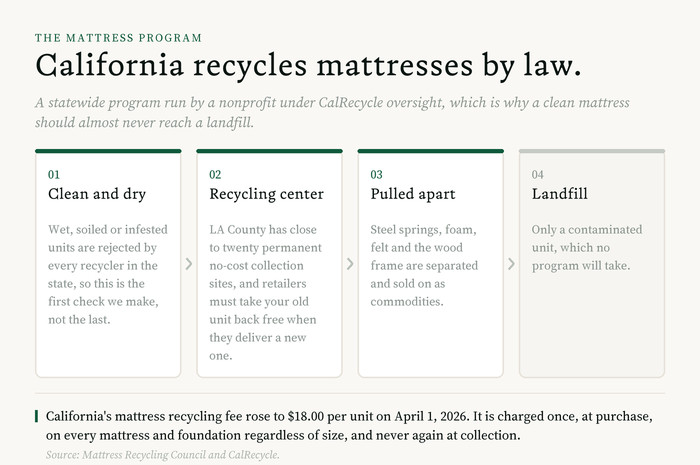
California's mattress stewardship program is run by the Mattress Recycling Council under CalRecycle oversight and funded by a recycling fee collected when a mattress is sold, not when it is thrown away. That fee moves from $16.00 to $18.00 per unit for sales on or after April 1, 2026, and it applies per unit to mattresses, futons and foundations sold for use in California regardless of size or type. In exchange, qualifying used mattresses and foundations are accepted at participating drop-off points at no additional cost, at more than 3,500 locations across the state. If you recycle a mattress yourself, you still paid the fee — so a bed should never be the item you pay a disposal gate by the ton for.
One detail of the California program is worth knowing because it is genuinely different from other states. In California, all mattresses and box springs can be dropped off at a participating location regardless of their condition or when they were purchased. The stricter condition rules that apply in Connecticut and Rhode Island — where a severely damaged, heavily soiled, moldy, excessively wet or infested unit has to be discussed with the drop-off location first — are not the California rule. A tired, stained mattress out of a rental is still a program mattress here.
What the program does not cover is a longer list than people expect, and it decides how we handle the rest of a bedroom. Accepted: mattresses of any construction, foundations and box springs, and futon mattresses that separate from the frame. Not accepted: bed frames, futon frames and bases, sofa beds, mattress pads and toppers, pillows, loose bedding, sleeping bags, cushions from furniture, air mattresses and water beds with no upholstery material, car beds, collapsible roll-away beds, juvenile products including crib and bassinet mattresses, mattresses stripped of their padding, and units that were not used in California. So a sleeper sofa is a sofa, a topper is not a mattress, and a crib mattress is its own conversation. All of those still leave on the same truck; they simply leave on a different route, and we tell you which is which while quoting.
Mechanically, a recycled mattress is dismantled and separated into steel, foam, fabric and wood. Long Beach sends the mattresses it collects to a Mattress Recycling Council facility where they are cut open and sorted by material type, about 75% of which is recyclable, and the components are repurposed into products such as carpet padding and construction materials. Statewide, CalRecycle reports 96.7% of collected mattresses went to beneficial reuse or processing in 2025. That is a better outcome than almost anything else on a moving day.
Bed bugs are the one case where the answer changes, and the right advice is not ours, it is the EPA's. If you throw out a mattress or furniture that has bed bugs in it, the EPA says you should slash or otherwise destroy it so that nobody else takes it and gets bed bugs. It also points out that throwing an infested mattress out is a poor way to control an infestation, because not all bed bugs live on the bed and a replacement is usually re-infested quickly. If that is your situation, tell us when you book. We wrap and handle those units so the problem does not travel through the building on the way out, and we would rather talk about it openly than pretend we did not notice.