Hunter is truly dedicated on providing the most excellent of removal of unwanted junk from your home or office. Always on time, very efficient at his job in a timely manner. I would recommend him for any junk removal you may have.
Drywall, lumber, tile, concrete, roofing, flooring, cabinetry and demolition waste cleared from Long Beach remodels, strip-outs and site clears. Free upfront quote before we start.
Free quote, no obligation · one flat number before we start · you can also text that number

Remodel debris is banned from every Long Beach cart, along with rocks, concrete and dirt, and it is not on the free Special Collection list either. Only permitted haulers may move solid waste inside the city, and CALGreen sets the diversion standard. Sorting happens at your property, each stream routed properly, quoted free.
In Long Beach, debris from construction, remodeling or demolition may never go in any city cart, and neither may rocks, concrete or dirt. It is also absent from the Special Collection eligible list, which covers furniture, appliances, electronics, tires and yard trimmings but not building material. That leaves a private haul, and the city restricts that too: only a limited number of private waste haulers are permitted to haul solid waste within the City of Long Beach, and the city publishes their non-exclusive franchise agreements under AB 2048. On top of the local rules, California projects are built to the CALGreen construction waste diversion standard, so where the material goes is part of the job rather than an afterthought. Los Angeles Junk Removal & Hauling separates the load at your property, routes each stream properly and quotes the whole thing upfront and free.
A remodel produces the one category of waste that every free route in this city refuses. The cart refuses it. The bulky collection does not list it. And the alley — where a lot of it ends up in practice — is the fastest way to turn a small disposal problem into an illegal dumping problem with your address attached to it.
This page is about what actually happens to building material in Long Beach: what the bans say, who is allowed to move it, how the material sorts, and why separating at the property beats separating at a gate. For the wider city picture see junk removal in Long Beach, and for how we handle debris county-wide see construction debris removal.
Long Beach publishes a short, blunt list of what can never go in any cart, and building material is on it. Household hazardous waste, rocks, concrete or dirt, hot ashes, debris from construction, remodeling or demolition, and heavy or oversized items that require a Special Collection pickup. That is the complete answer to the question people usually ask first, which is whether a bathroom strip-out can be fed into the black cart over three weeks. It cannot, and the rule exists because that material breaks collection vehicles and contaminates loads.
The obvious next thought is the free Special Collection, and it does not work either. The eligible list is furniture, appliances with doors removed or taped, computers and monitors, televisions, tires up to 16 inches with a maximum of five, tree branches and yard trimmings in 4 foot 40 pound bundles, and other oversized or bulky items. Building debris is not on it, and the practical limits give the same answer from another direction: no item over 72 by 48 inches, bundles under 48 inches and 40 pounds, bags under 25 pounds. A bag of broken tile hits the weight limit long before it looks full.
So the route is a private haul, and Long Beach regulates that route. The city states that a limited number of private waste haulers are permitted to haul solid waste within the city, publishes each one with its contract number, and posts their non-exclusive franchise agreements because AB 2048 requires jurisdictions to do so. One detail on that list is worth reading closely, because it shows how specific this gets: alongside one hauler the city notes hauling only, not an approved C&D recycling facility. Being permitted to move waste and being able to process construction debris are two different things.
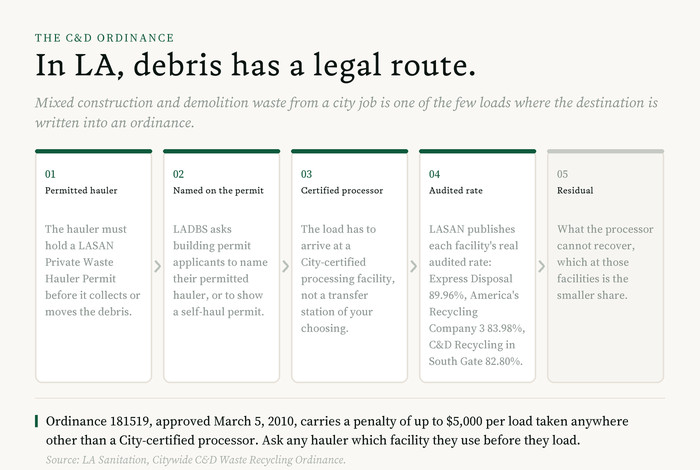
The state layer decides where it ought to end up. CalRecycle's guidance for local construction and demolition programs is built around the CALGreen construction waste diversion standard, which sets a 65 percent diversion requirement for covered projects, and it is that standard, rather than a curbside rule, that a permitted project in California is measured against. In practice that means your debris needs a destination that can document what it did with the material, which is a very different thing from the nearest gate.
Sources: City of Long Beach, Refuse Collection 101 and Private Waste Haulers; CalRecycle. Cited in full below.
| In a city cart | Never. Construction, remodeling and demolition debris is banned from every cart |
|---|---|
| Also banned from carts | Household hazardous waste, rocks, concrete or dirt, hot ashes |
| On the free bulky truck | Not listed. Special Collection covers furniture, appliances, electronics, tires and yard trimmings |
| Bulky size limits | No item over 72 x 48 inches; bundles under 48 inches and 40 lb; bags under 25 lb |
| Who may haul it | Only a limited number of city-permitted private waste haulers |
| Franchise transparency | AB 2048 requires all current hauler franchise agreements to be published by the city |
| Permitted is not processing | The city notes at least one permitted hauler as hauling only, not an approved C&D recycling facility |
| State diversion standard | CALGreen sets a 65% construction waste diversion requirement for covered projects |
| Yard material | Tree branches and yard trimmings are accepted in tied bundles up to 4 ft and 40 lb |
| Illegal dumping | The city runs a dedicated illegal dumping reporting route; alley fly-tipping is traceable |
Sources: City of Long Beach, Refuse Collection 101; City of Long Beach, Special Collection 101; City of Long Beach, Private Waste Haulers; CalRecycle, construction and demolition model ordinance guidance and the CALGreen diversion standard.
Construction debris is the only material where the truck fills by weight long before it fills by space. A pickup bed of broken tile, plaster or concrete is heavier than a whole apartment of furniture, and that changes how a job is planned: smaller loads, more trips, staged loading, and honesty on the quote about which of those we expect. If somebody quotes you a demolition clear the way they would quote a sofa, they have not thought about the scale.
The second reality is where the material can wait. In much of the older Long Beach grid the only staging area is the alley behind the property, and an alley is a shared right of way, not a private yard. Material left there is not just in the way, it is a reportable dumping issue, and the city runs a dedicated route for reporting it. We stage on your property where there is room, or we run tighter loads where there is not, and we do not leave a pile behind for a neighbor to inherit.
The third is access. Belmont Shore and the Peninsula have narrow streets, permit parking and, in Naples, frontages that a truck cannot reach at all. Downtown means a dock window and a service elevator. The industrial west side means forklift access and, usually, a much bigger volume. All three change the vehicle, not the price of the drywall. Tell us which one you are on the phone.
The fourth is what the debris is mixed with, and this is where most Long Beach remodel jobs go wrong. A bathroom strip-out is not just tile and plasterboard: it is an old cast iron tub that is metal recovery, a vanity that may be reusable, a cabinet full of half-used chemicals that is household hazardous waste, and a light fitting with a fluorescent tube in it that is universal waste. A kitchen adds appliances with sealed refrigeration circuits. Those things all leave in different directions, and the sorting happens at your address so nothing is discovered at a gate. If your job is really a kitchen or bathroom fitting job with appliances in it, see appliance removal in Long Beach, and for a commercial strip-out see commercial junk removal in Long Beach.
Tell us what the material is and roughly how much. We will quote the haul and the destination free.
Free upfront quote, no obligation. One number, agreed before anything is lifted.
5.0 from 67 reviews on GoogleMon–Sat, open 24 hours


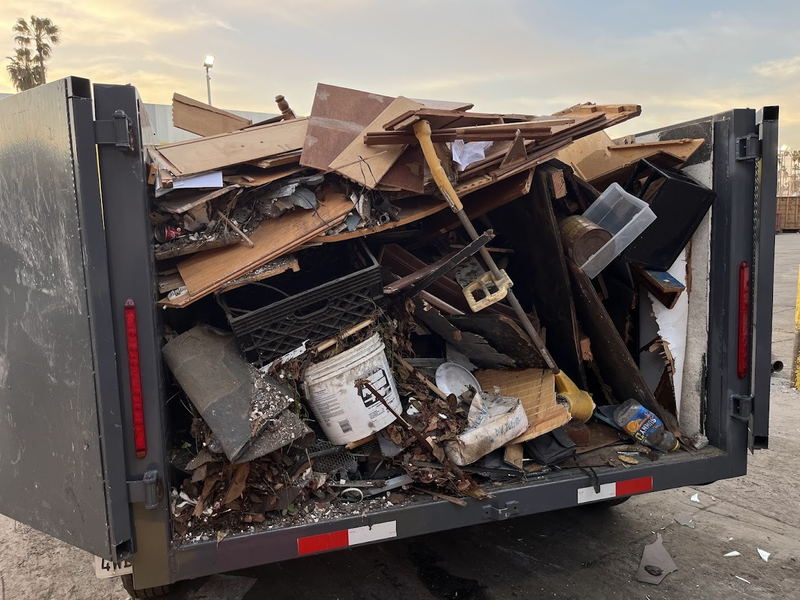
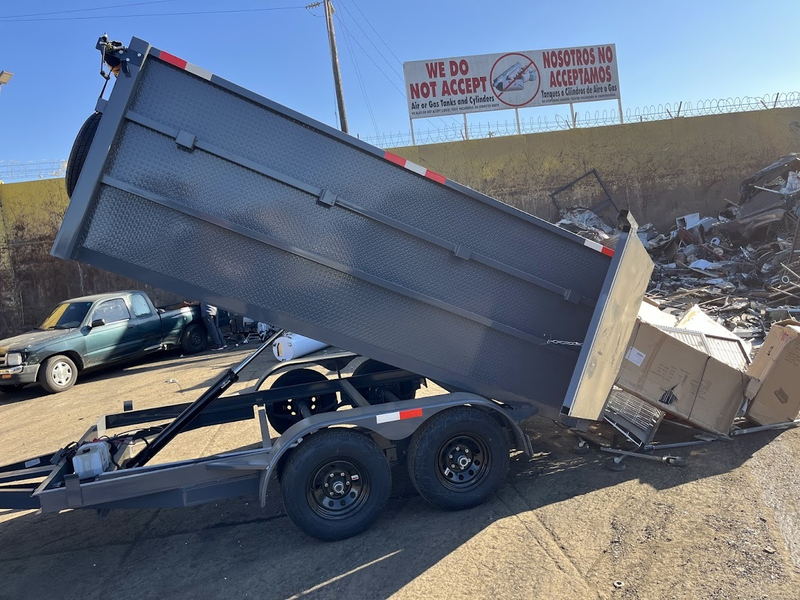
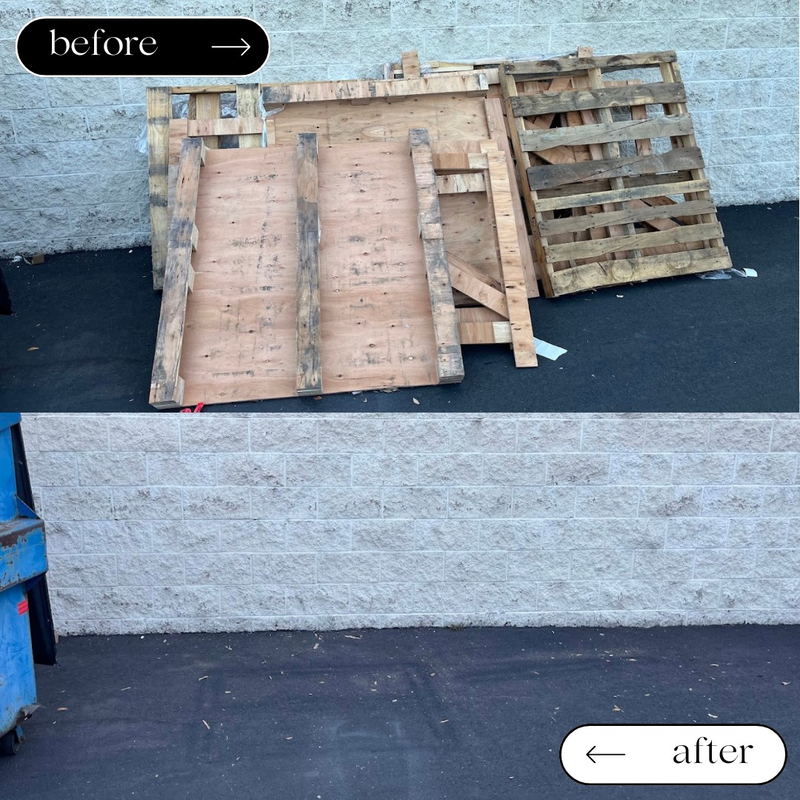
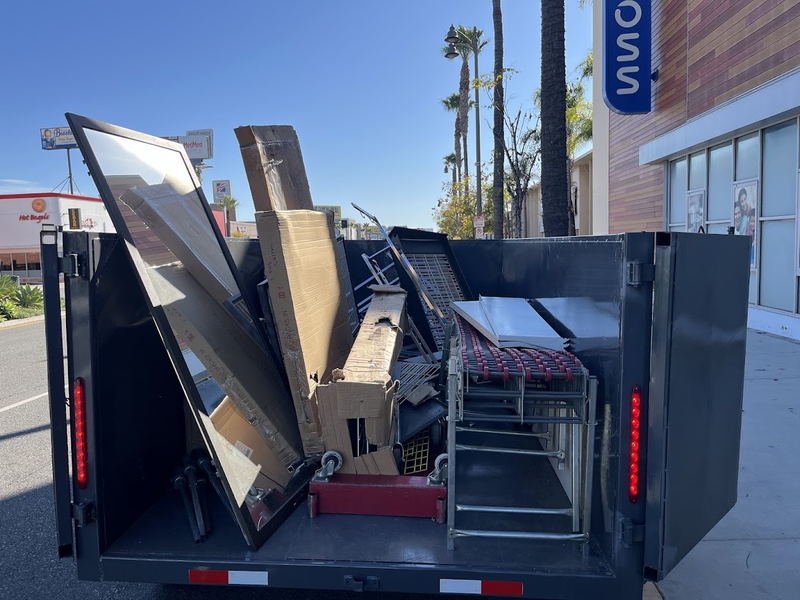
Our own crews on Los Angeles County jobs. The construction debris removal we run in Long Beach looks like this too: side yards, narrow walkways and the back of the property is where the work actually is.
Clean, separated construction material has genuinely better destinations than mixed debris, and the difference is decided in your driveway rather than at a scale. Clean lumber is one stream. Clean concrete, brick and tile are another, and inert material has its own routes. Metal — ducting, pipe, rebar, a cast iron tub, an old boiler, window frames — is scrap and should never be paying disposal rates by the ton. Cardboard and packaging from new fittings is recyclable. Drywall, insulation, carpet, treated timber and mixed fines are the genuinely difficult fraction, and that is the part that actually needs a processing facility.
Two categories inside a remodel are not construction debris at all, legally speaking, and they are the ones that create real exposure. The first is household hazardous waste: paint, thinners, solvents, adhesives, pool chemicals, used motor oil and filters, weed killer, antifreeze, cleaners. Long Beach states those may not be placed in your trash or recycling carts, and points residents at two free destinations, the EDCO Recycling & Transfer Environmental Collection Center at 2755 California Avenue in Signal Hill on scheduled days, and the Gaffey Street S.A.F.E. Center at 1400 North Gaffey Street in San Pedro, open Saturdays and Sundays 9 a.m. to 3 p.m. Both serve households. Paint has its own free statewide take-back through PaintCare, funded by a recovery fee already paid at purchase.
The second is universal waste. Fluorescent tubes and compact fluorescent lamps coming out of a ceiling, lamp ballasts, mercury thermostats being replaced by a smart control, batteries out of an old alarm panel, and any electronics on site are all universal waste under California rules, banned from the household trash since the state's exemption ended on 9 February 2006. They come off the job separately.
Two more practical notes. Asbestos and lead are not junk removal work: in a Long Beach house from the pre-war or immediate post-war stock, popcorn ceilings, old floor tile, tile mastic and pipe lagging are exactly where asbestos-containing material turns up, and the correct answer is testing and a licensed abatement contractor before any demolition, not a truck. And if the work is under a building permit, keep your disposal documentation — a project measured against the CALGreen diversion standard has to be able to show what happened to its waste, and receipts that simply say trash do not describe a diversion. We will tell you plainly which parts of your load are which, and what documentation we can provide, before we take any of it.

Sources: City of Long Beach, Household Hazardous Waste; City of Long Beach, Refuse Collection 101; Californians Against Waste, background on universal waste and DTSC regulations; PaintCare, California program and recovery fees; CalRecycle, construction and demolition model ordinance guidance and the CALGreen diversion standard.

Same rule in Long Beach as anywhere else in Los Angeles County. The local part is the program above, not the disposal law. Full detail on construction debris removal.
This page is construction debris removal in Long Beach specifically. The wider service is on construction debris removal across Los Angeles, and everything we haul in this city is on junk removal in Long Beach. Same crew, different job: Furniture removal in Long Beach, Appliance removal in Long Beach, Garage cleanouts in Long Beach, Mattress removal in Long Beach, Commercial junk removal in Long Beach, Same-day junk removal in Long Beach. Pricing works the same way everywhere: how our pricing works, and the full map is on areas we serve.

We are already next door most days. The whole list is on areas we serve.
Sorted at your address so each stream reaches the right destination.
COIs, after-hours dock slots and property-manager invoicing.
Fridges, washers and AC units. Refrigerant units are handled as universal waste.
Brush, palm fronds, sod, soil and storm debris, priced by weight.
The whole garage in one visit. We sort, donate what is usable and sweep the slab.
Couches, sectionals, mattresses in the same trip, beds, desks and wardrobes carried down rather than dragged.
Booked and cleared the same day, most days, across LA County.
What is banned, who is allowed to move it, and what a permitted job needs on paper.
No. The city's list of what can never go in any cart names debris from construction, remodeling or demolition explicitly, along with rocks, concrete and dirt. It is not a volume rule you can work around by spreading it over three weeks. The material also is not on the free Special Collection list, so the bulky truck is not an alternative either. A private haul is the route, and in Long Beach only permitted haulers may move solid waste.
Yes, though they behave differently from everything else on a job. Inert material is dense, so a load fills by weight long before it fills by space, and it usually means smaller staged loads rather than one big one. We will say that on the quote instead of discovering it on the day. Clean concrete separated from mixed debris also has better destinations than a mixed load does, which is why we sort it at your property.
Keep everything that describes what happened to your waste. California projects covered by CALGreen are measured against a 65 percent construction waste diversion standard, and a receipt that just says trash does not evidence diversion. Tell us at quote stage that the job is permitted and we will tell you exactly what we can provide for your records and what your contractor or the city will still need from you.
That is not junk removal work and we will not pretend otherwise. In older stock, popcorn ceilings, old vinyl floor tile, tile mastic and pipe lagging are the usual places asbestos-containing material shows up. The correct sequence is testing first, then a licensed abatement contractor, then us for what is left. If we see something suspect on a job we stop and tell you rather than load it.
Please do not. Alleys in Long Beach are shared rights of way, not private yards, and material left in one is a reportable dumping issue that the city has a dedicated route for. We stage on your property where there is room, or we run tighter, more frequent loads where there is not. If access is genuinely impossible we will work out a plan with you rather than leave a pile behind.
Yes. A post-construction clear is a normal part of the work: offcuts, packaging, protective sheeting, the last of the fixtures, and a sweep so the space is usable. Cardboard and packaging is recyclable and separates out, metal offcuts go to scrap, and anything chemical left by a trade gets pulled out and routed properly rather than buried in the load.
Word for word from Google. Nothing tidied.
Hunter is truly dedicated on providing the most excellent of removal of unwanted junk from your home or office. Always on time, very efficient at his job in a timely manner. I would recommend him for any junk removal you may have.
Read all 67 on GoogleSee us on YelpReviews, and how to check any LA hauler
Collection rules, transfer stations and permit counters change at the city line, so each of these is written for that city rather than for Long Beach. A job that straddles two of them is still one visit and one number.
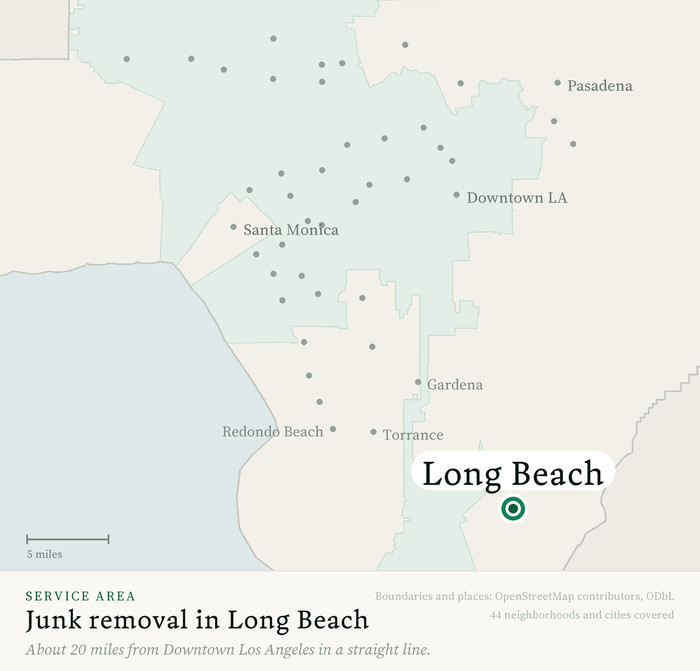
Everything we haul in the cities next door: Gardena, Torrance, Redondo Beach. The whole list is on areas we serve.
Send a photo, get a flat number back. Free, no obligation, no pressure and no call-out fee — and if your city will haul it free instead, we will tell you that too. Most requests are answered within the hour during working hours.