Hunter is truly dedicated on providing the most excellent of removal of unwanted junk from your home or office. Always on time, very efficient at his job in a timely manner. I would recommend him for any junk removal you may have.
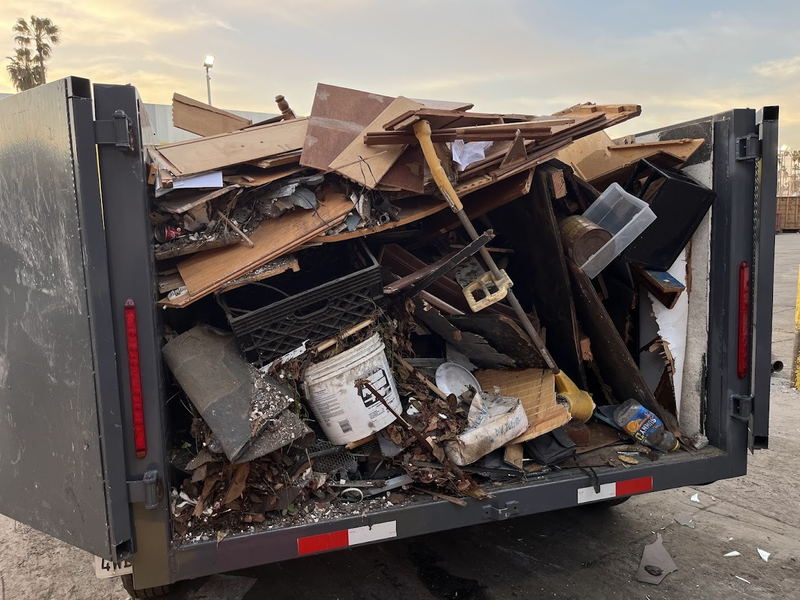
Drywall, lumber, tile, plaster, cabinetry, flooring and demolition debris removed from Beverly Hills remodels, loaded from inside the property line and hauled to a processor.
Free quote, no obligation · one flat number before we start · you can also text that number

Beverly Hills prohibits construction material on its bulky item pickup and operates its own in-house roll-off division instead. A dumpster standing in the street needs a public right-of-way permit and cannot be left overnight, so most remodel debris here is better loaded from private property and hauled the same day.
Two published rules shape every debris job in this city. The first is that the city's bulky item program will not touch it: construction and roofing materials, named on the prohibited list as concrete, cement, bricks, roof shingles, tiles and drywall, are excluded outright, and the city directs anyone with construction material to its roll-off division at 310-288-2806. The second is that putting a container on the street is itself a permitted activity. A Public Right-of-Way Permit is required for any activity that uses the public right-of-way, dumpsters are listed by name among the examples, and the city states that any authorized dumpsters, equipment or vehicles shall not be allowed to remain overnight except as authorized and permitted by street closures permits.
Loading and unloading construction materials on private property, by contrast, does not require a Public Right-of-Way Use permit. That is the whole case for hauling rather than renting on a Beverly Hills remodel: the material is carried out and loaded inside the property line, the truck leaves with it, and nothing stands on a residential street overnight waiting to be collected. Los Angeles Junk Removal & Hauling quotes that as one flat number before anything is lifted.
Remodeling is more or less continuous here, and most of it is not a ground-up rebuild. It is a kitchen, a set of bathrooms, a floor going up, cabinetry coming out, a pool deck being relaid. Those jobs generate real tonnage in short bursts, on properties where there is nowhere obvious to put it and neighbors who notice immediately.
They also happen under a permit, which means the paperwork side of the debris matters as much as the carry. What we haul across the rest of this city is on junk removal in Beverly Hills, and the county-wide service is on construction debris removal.
Most Los Angeles County cities leave containers to the market. Beverly Hills does not. The city's Commercial Services Division provides roll-off bin service for businesses and residents, described as typically used for construction, demolition, remodeling, large landscaping projects or other special large projects, reached at 310-288-2806 or rolloff@beverlyhills.org, with fees varying by bin size. The bulky item page sends construction material there explicitly. And on the Trousdale Estates construction page the city goes further, stating that it does not certify or permit roll-off trucks or containers, and that as the City operates its own in-house roll-off division it does not issue permits or certifications for external roll-off equipment.
On the diversion side the city is equally direct. Its commercial waste page states that California law requires at least 65% of construction and demolition debris to be diverted from landfills through recycling or reuse, and instructs contractors and residents to separate wood, metal, concrete, asphalt, cardboard and drywall for recycling and to use the city's roll-off service or another City-approved facility if self-hauling, to ensure diversion compliance. The statewide requirement behind that sits in CALGreen, which CalRecycle describes as requiring covered new construction, demolition and certain addition and alteration projects to recycle or salvage for reuse a minimum 65% of the nonhazardous construction and demolition debris generated, in sections 4.408 and 5.408.
Beverly Hills has its own ordinance authority on top of the state rule, and it is printed in the city's demolition permit guidelines. To ensure that the city meets the statutory obligations imposed by the California Integrated Waste Management Act, the Director of Building and Safety, in issuing permits for construction, renovation and demolition projects of a specified magnitude, is authorized to impose and to enforce requirements related to the salvaging, recycling and reuse of construction and demolition debris, with those requirements established by resolution of the city council. In practice that means the debris conditions that apply to your job are the ones written on your permit, and the honest answer is to read them — we cannot tell you from the outside what magnitude threshold or council resolution your particular permit was issued under, and we are not going to invent one.
The same guidelines carry the requirement that catches remodels hardest. All buildings are required to obtain a pre-demolition or a pre-remodeling investigation by a Cal/OSHA Certified Asbestos Consultant, who must submit a survey stating that asbestos is or is not present before the demolition permit is issued; where asbestos is found, a copy of the South Coast Air Quality Management District notification of demolition and asbestos removal form must be submitted, and a licensed abatement contractor with an Asbestos Abatement Permit does the removal. That is not a junk removal service and we do not pretend otherwise — but it is the reason a 1950s bathroom tear-out here starts with a consultant rather than a sledgehammer.
Sources: CalRecycle C&D Diversion Informational Guide, Beverly Hills Municipal Code section 5-1-205, and City of Beverly Hills Trousdale Estates Construction. All cited in full below.
| Bulky pick-up | construction and roofing materials are prohibited: concrete, cement, bricks, roof shingles, tiles and drywall |
|---|---|
| Where the city sends you | its own roll-off division, 310-288-2806 or rolloff@beverlyhills.org, with fees varying by bin size |
| Who runs containers | the city's Commercial Services Division provides roll-off bin service for businesses and residents |
| External roll-off equipment | for the Trousdale Estates the city states it does not certify or permit roll-off trucks or containers, as it operates its own in-house roll-off division |
| Diversion requirement | the city's commercial waste page states California law requires at least 65% of C&D debris to be diverted from landfills |
| What to separate | wood, metal, concrete, asphalt, cardboard and drywall, per the city's instruction to contractors and residents |
| Statewide rule | CALGreen sections 4.408 and 5.408 require a minimum 65% of nonhazardous C&D debris to be recycled or salvaged on covered projects |
| Local ordinance authority | the Director of Building and Safety may impose and enforce salvage, recycling and reuse requirements on permits of a specified magnitude, per the city's demolition permit guidelines |
| Before demolition or remodel | a pre-demolition or pre-remodeling asbestos investigation by a Cal/OSHA Certified Asbestos Consultant is required for all buildings |
| If asbestos is present | an SCAQMD notification form must be filed and a licensed abatement contractor must hold an Asbestos Abatement Permit |
| Dumpster on the street | requires a Public Right-of-Way Use permit and may not remain overnight except under a street closures permit |
Sources: City of Beverly Hills, Commercial Waste Disposal and roll-off service · City of Beverly Hills, Bulky Item Pick-up · City of Beverly Hills Community Development, Demolition Permit Guidelines (PDF) · City of Beverly Hills, Trousdale Estates Construction · CalRecycle, Construction and Demolition Diversion Informational Guide
Beverly Hills regulates what may drive on its streets in unusual detail, and a debris haul runs straight into it. Vehicles exceeding 6,000 pounds gross vehicle weight, or wider than 8 feet 6 inches, may only travel on streets designated for heavy vehicle usage, and a vehicle needing to deviate must travel the shortest possible distance over prohibited streets — unless the detour would add more than two miles, in which case it may take the most direct route. The city also states flatly that bottom dump and transfer truck type vehicles are not allowed in the City of Beverly Hills. Hauling fees on construction permits are published: a single trip permit is $16 per trip for up to ten trips, and a multi-trip permit is a $90 annual fee allowing unlimited hauling unless the permit says otherwise. No separate permit is required for construction-related hauling itself; the hauling of construction debris, material or equipment is regulated in conjunction with Building, Grading, Demolition or Public Right-of-Way Use permits.
North of Sunset the rules tighten again. Eighteen-wheel vehicles and cranes parked in the right-of-way require a traffic plan approved by the City Traffic Engineer, submitted four business days in advance, and 18-wheel vehicles destined north of Sunset Boulevard require police escorts with a minimum of 72 hours notice before the vehicle activity. Where the right-of-way is used, City-provided no-parking signs must be posted by the permittee and verified by the Beverly Hills Police Department at least 24 hours in advance of permitted work.
The Trousdale Estates has its own ordinance, adopted in 2015 as Ordinance 15-O-2683, applicable to any construction project requiring a City of Beverly Hills permit. Vehicles exceeding 26,000 pounds gross vehicle weight, or 10,000 pounds with three or more axles, must be inspected for a secondary braking system and carry a city-issued decal; no vehicle with a gross weight of 50,400 pounds or more may travel on any street in the area at all; the city must receive 24 hours notice before certified heavy vehicles travel to a jobsite; authorized hauling hours are 8:30 a.m. to 3:15 p.m.; and no more than two hauling or construction related vehicles associated with a single construction site may park on a public street.
Time of day is fixed citywide by the noise ordinance. Under Beverly Hills Municipal Code section 5-1-205 no person shall engage in construction, maintenance or repair work requiring a city permit between 6 p.m. and 8 a.m. on any day, or at any time on a Sunday or public holiday, without an after hours construction permit; within a residential zone or within 500 feet of one, Saturday work needs the same permit. No worker may even enter the site before 8 a.m., and a violation of that is an infraction. The right-of-way page adds that after-hours permits are issued only for construction projects located within commercial properties at least 500 feet from residential zones, and are not issued for residential projects at all. On a residential remodel here, in other words, the debris moves inside a working day or it does not move.
All of which is why we plan a Beverly Hills debris job as a sequence of loads rather than a container week: arrive inside the window, carry out on protected routes, load from the motor court or the driveway rather than the street, and leave. If the same project is producing furniture and household contents as well, that side is on estate cleanouts in Beverly Hills.

Construction debris removal in Beverly Hills. Send a photo of the pile and we will price the haul, not a rental week.
Free upfront quote, no obligation. One number, agreed before anything is lifted.
5.0 from 67 reviews on GoogleMon–Sat, open 24 hours


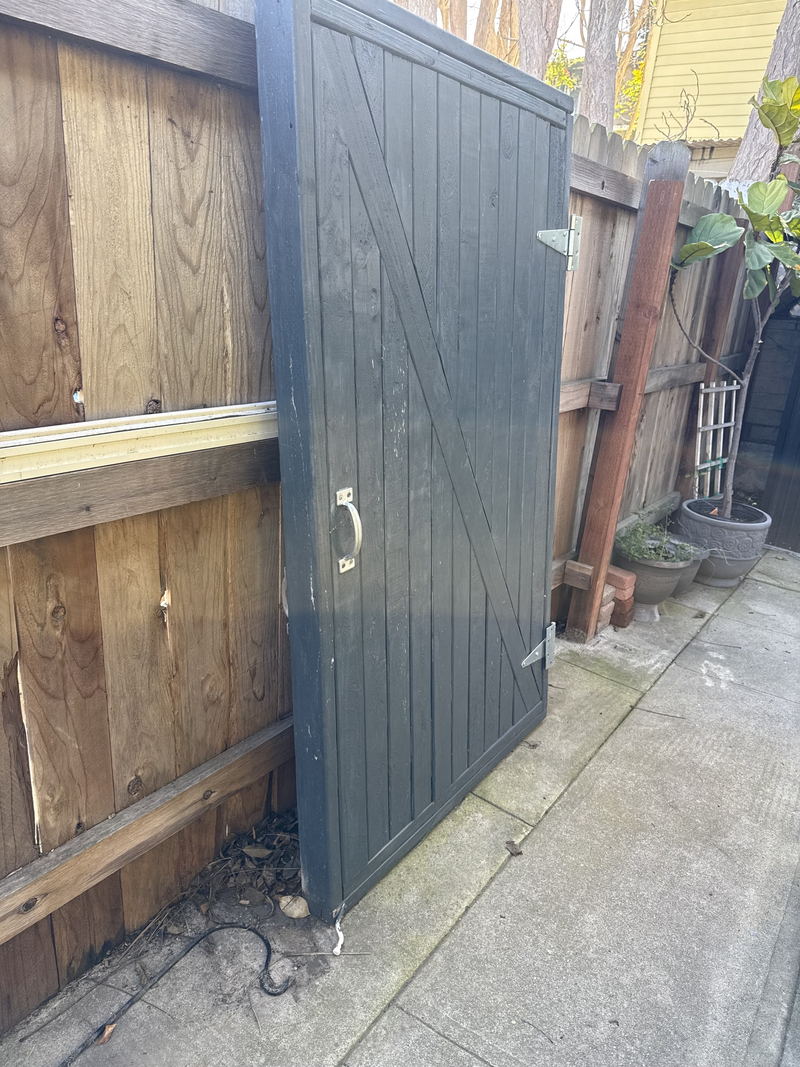
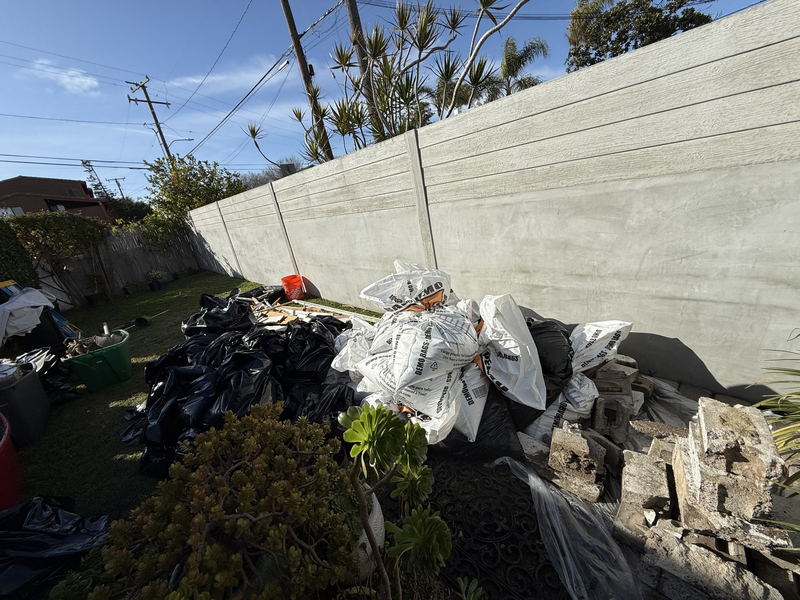
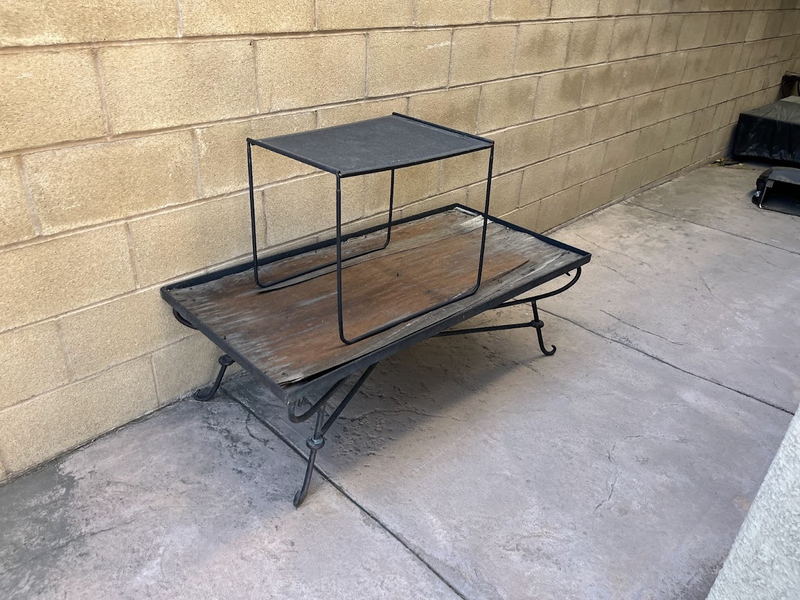
Our own crews on Los Angeles County jobs. The construction debris removal we run in Beverly Hills looks like this too: side yards, narrow walkways and the back of the property is where the work actually is.
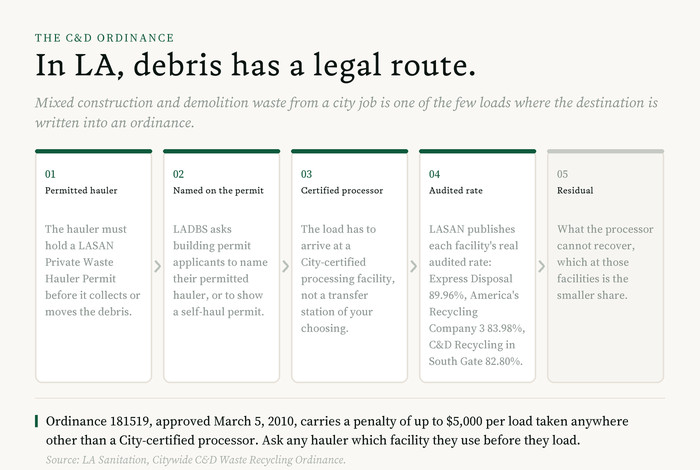
Construction and demolition debris is one of the largest single streams in California's waste picture, and CalRecycle treats it as its own material category precisely because so much of it is recoverable: concrete, asphalt, wood, metal, drywall, cardboard and mixed inerts all have processors that want them. The 65% CALGreen threshold is a documentation requirement as much as a physical one — the diversion has to be demonstrable, which means loads have to be identifiable when they arrive.
So the separation starts on the property. Clean wood, metal, cardboard and clean concrete or masonry are kept apart from mixed debris wherever the site allows it, because a clean single-material load is worth more at the gate and counts cleanly toward diversion. Mixed loads go to a processor that sorts them rather than to a landfill face. The city's own instruction to contractors and residents says the same thing in plainer terms: separate materials such as wood, metal, concrete, asphalt, cardboard and drywall for recycling, and use the city's roll-off service or another City-approved facility if self-hauling.
Some things that come out of a remodel are not C&D at all and cannot ride with it. Old paint, solvents, adhesives and thinners are household hazardous waste; the city states it is illegal to dispose of that type of material in the garbage, in storm drains or on the ground, and architectural paint has a funded take-back route through PaintCare, financed by a recovery fee added when paint is sold. Fluorescent tubes, ballasts, thermostats and smoke detectors are universal waste. Appliances pulled out of a kitchen have their own handling. And anything asbestos-containing is abatement work under a separate city permit and an SCAQMD notification, not debris hauling.
What we hand back at the end is a cleared site and a clear account of where each stream went. If your permit carries specific diversion conditions written by the Director of Building and Safety, tell us what they say and we will work to them.
Sources: CalRecycle, Construction and Demolition Debris · CalRecycle, Construction and Demolition Diversion Informational Guide · City of Beverly Hills, Commercial Waste Disposal and roll-off service · City of Beverly Hills, Universal and Hazardous Waste · PaintCare, California program and recovery fees

Same rule in Beverly Hills as anywhere else in Los Angeles County. The local part is the program above, not the disposal law. Full detail on construction debris removal.
This page is construction debris removal in Beverly Hills specifically. The wider service is on construction debris removal across Los Angeles, and everything we haul in this city is on junk removal in Beverly Hills. Same crew, different job: Estate cleanouts in Beverly Hills, Furniture removal in Beverly Hills. Pricing works the same way everywhere: how our pricing works, and the full map is on areas we serve.

We are already next door most days. The whole list is on areas we serve.
Same crew, same trucks, same free upfront quote.
The whole garage in one visit. We sort, donate what is usable and sweep the slab.
Couches, sectionals, mattresses in the same trip, beds, desks and wardrobes carried down rather than dragged.
Fridges, washers and AC units. Refrigerant units are handled as universal waste.
Brush, palm fronds, sod, soil and storm debris, priced by weight.
COIs, after-hours dock slots and property-manager invoicing.
Booked and cleared the same day, most days, across LA County.
Containers, permits, diversion paperwork and the hours you are allowed to work.
No. Construction and roofing materials are on the Beverly Hills prohibited list by name — concrete, cement, bricks, roof shingles, tiles and drywall — and the city directs anyone with construction material to its roll-off division at 310-288-2806 or rolloff@beverlyhills.org instead. Putting it out anyway means it sits on the parkway until somebody comes back for it, which on these streets is noticed fast.
Yes. A Public Right-of-Way Permit is required for any activity that uses the public right-of-way, and the city lists dumpsters among the examples along with cranes, ladders, barricades and the loading or unloading of construction materials. It also states that authorized dumpsters, equipment or vehicles shall not remain overnight except as authorized under street closure permits. Loading and unloading construction materials on private property does not require the permit, which is the practical argument for hauling loads out instead of leaving a container standing.
CALGreen sections 4.408 and 5.408 require covered new construction, demolition and certain addition and alteration projects to recycle or salvage for reuse a minimum 65% of the nonhazardous construction and demolition debris generated, and the City of Beverly Hills states the same 65% figure on its commercial waste page. Whether your specific project is covered, and what paperwork your permit requires, is written into the permit itself — Beverly Hills authorizes its Director of Building and Safety to impose and enforce salvage, recycling and reuse requirements on projects of a specified magnitude. Read your permit conditions, or ask the Permit Center; we will work to whatever they say.
A weekday between 8 a.m. and 6 p.m. Beverly Hills Municipal Code section 5-1-205 prohibits construction, maintenance or repair work requiring a city permit between 6 p.m. and 8 a.m. on any day, and at any time on a Sunday or public holiday, without an after hours construction permit; in or within 500 feet of a residential zone, Saturday work needs the same permit. Workers may not even enter the site before 8 a.m. The city's right-of-way page adds that after-hours permits are only issued for commercial projects at least 500 feet from residential zones. In the Trousdale Estates, authorized hauling hours are 8:30 a.m. to 3:15 p.m.
A great deal. Ordinance 15-O-2683, adopted in 2015, applies to any construction project requiring a City of Beverly Hills permit in that area. Vehicles over 26,000 pounds gross vehicle weight, or over 10,000 pounds with three or more axles, must be inspected for a secondary braking system and display a city-issued decal; the city must get 24 hours notice before a certified heavy vehicle travels to the jobsite; no vehicle of 50,400 pounds gross weight or more may travel on any street in the area; and no more than two hauling or construction related vehicles from one site may park on a public street. We size and route accordingly.
Those are two different answers. Leftover paint, solvents and similar materials are household hazardous waste — the city says it is illegal to put that type of material in the garbage, in storm drains or on the ground — and architectural paint has a funded take-back route through PaintCare. Asbestos is not ours at all: Beverly Hills requires a pre-demolition or pre-remodeling investigation by a Cal/OSHA Certified Asbestos Consultant for all buildings, an SCAQMD notification where asbestos is found, and removal by a licensed abatement contractor holding a city Asbestos Abatement Permit. We haul the debris after that work is signed off, not before.
Word for word from Google. Nothing tidied.
Hunter is truly dedicated on providing the most excellent of removal of unwanted junk from your home or office. Always on time, very efficient at his job in a timely manner. I would recommend him for any junk removal you may have.
Read all 67 on GoogleSee us on YelpReviews, and how to check any LA hauler
Collection rules, transfer stations and permit counters change at the city line, so each of these is written for that city rather than for Beverly Hills. A job that straddles two of them is still one visit and one number.
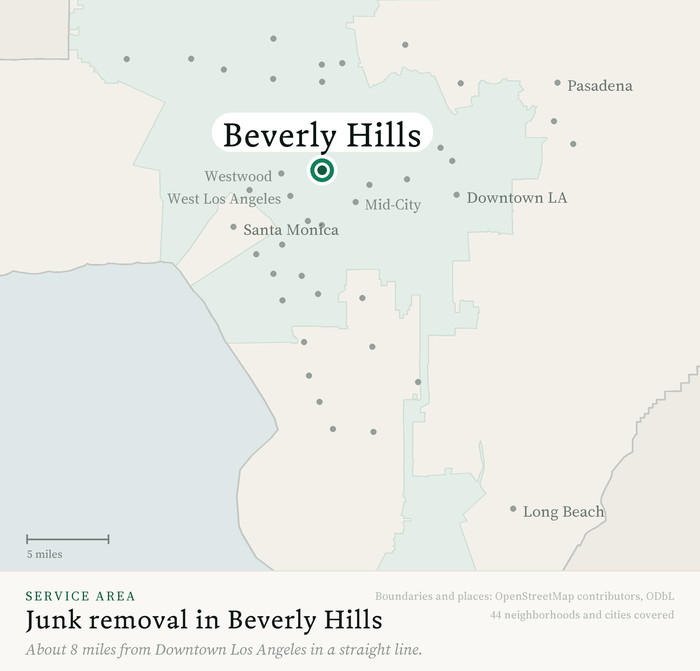
Everything we haul in the cities next door: West Hollywood, West Los Angeles, Westwood. The whole list is on areas we serve.
Send a photo, get a flat number back. Free, no obligation, no pressure and no call-out fee — and if your city will haul it free instead, we will tell you that too. Most requests are answered within the hour during working hours.