Mon–Sat open 24 hours · Sun 1–10pmFully insuredFamily-run, LA-based
team@lajunkhauling.com
Call us today(323) 230-0777
Home/Services/Construction debris removal/Culver City

Construction debris removal in Culver City
Its own ordinance, its own franchise, and five square miles with nowhere to put a pile.

Demolition debris, remodel waste, drywall, framing offcuts, tile, concrete, roofing and the mixed junk that comes out of a Culver City renovation, cleared by hand and hauled away on a free upfront quote.

Free quote, no obligation · one flat number before we start · you can also text that number

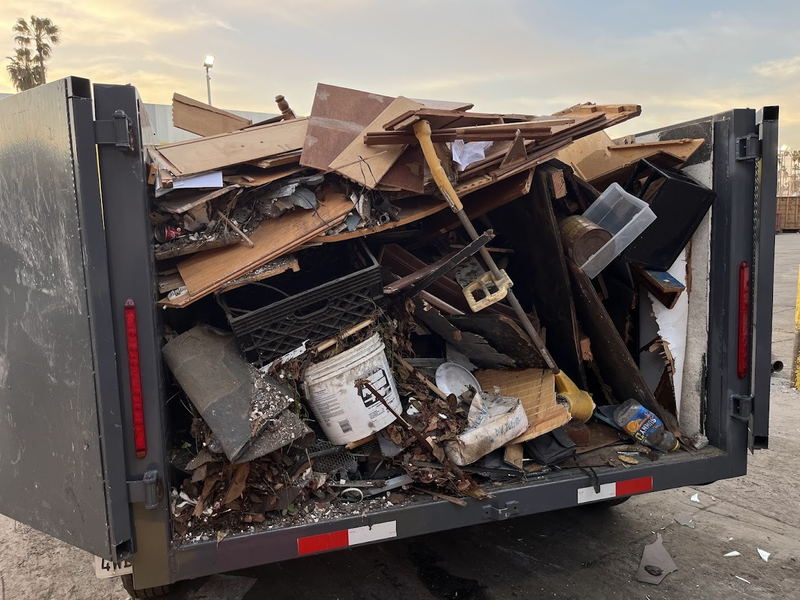
Our dump trailer loaded with mixed construction debris at dusk: cut timber, baseboard, a paint bucket, crates and broken fixtures stacked above the tailgate on a Los Angeles County job
A stacked side yard on a Los Angeles County job. On a small lot the debris pile is the problem long before the paperwork is.
In short

Culver City sets its own construction debris rules: projects must recycle at least 75% of construction debris, tracked in Green Halo, and the city's own dumpster permit states that containers come from its Environmental Programs and Operations Division because no other hauler may provide that service. We handle the labor and the load.

Culver City is not part of the City of Los Angeles and it does not use LA Sanitation, so none of LA's C&D rules apply here. The city runs its own program. Projects inside city limits are required to recycle at least 75% of construction debris under CalGreen and Culver City Municipal Code 15.02.1140, and every building and demolition permit holder tracks that through Green Halo, a system the city supplies at no cost, submitting a waste management plan first and then the weight tickets behind it. The second rule is the one that surprises contractors: the city's own dumpster permit application states that a dumpster must be rented from the Environmental Programs and Operations Division, and that no other hauler may provide that service in Culver City. So the container is the city's. What is left is the work — the tear-out, the carry, the separation and the load — and that is what we do.

Culver City incorporated in 1917 covering 1.2 square miles and grew to roughly 4.987 square miles through 42 annexations, which is why it feels less like a suburb and more like a dense island inside the Westside. Population at the 2020 census was 40,779. On lots that size, a kitchen strip-out or a bathroom gut produces a pile that has no legal place to sit: not the parkway, not the sidewalk, and not a metered space without a permit and posted signs.

That physical problem and the city's own paperwork are the same problem. This page sets out the 75% requirement, the Green Halo sequence, the container rule, what the street costs and what happens to each material stream afterwards. The wider local picture is on junk removal in Culver City, and how we handle debris across the county is on construction debris removal.

The city's own program

Seventy-five percent, logged in Green Halo
— and a container you do not get to choose.

Start with the number. The city states plainly that projects within Culver City must recycle at least 75% of construction debris, and points at two authorities for it: CalGreen and Culver City Municipal Code 15.02.1140. That figure sits ten points above the statewide CALGreen floor, so a contractor who arrives with a generic 65% waste management plan is already short.

The mechanism is Green Halo, which the city provides free to permit holders. The sequence matters more than the software. You open the project with its name, address, permit number, dates, value and square footage, you enter estimated quantities in the waste management plan, and — this is the part outsiders miss — you select "Exclusive Franchise Agreement" and then "Culver City Refuse and Recycling Services" as the service. You submit for approval and the city states a review turnaround of about three business days, excluding City Hall closure dates. Only after the project is approved do you begin adding tickets.

Ticket entry is per material, not per invoice. Each Single Ticket Entry Form wants the material type, the facility, the hauler, the ticket number, an image of the invoice, the date and the weight, and where one invoice covers several materials you append a suffix to the ticket number and file them separately. At the end you submit for final review, and if diversion has landed below 75% the city asks you to explain why rather than simply failing you. The city also recommends keeping a separate trash bin on site so that non-C&D household trash does not contaminate the C&D stream and drag the number down, which is exactly the mistake that turns a recoverable load into a landfill load.

Then the container rule. Culver City's dumpster, POD and moving truck permit application carries an instruction in bold print on the first line of the dumpster box: the dumpster must be rented from the Environmental Programs and Operations Division on (310) 253-6400, and no other hauler may provide service in Culver City. The rental fee is separate from the permit. The city's C&D page says the same thing in different words, describing the service as an exclusive franchised service with outside haulers not permitted to operate within city limits. Sizes run from 2 and 3 cubic yard bins, which must remain on the property, up to 8, 10 and 40 cubic yard roll-offs, with special 8 and 10 cubic yard lowboy units for dirt, concrete or asphalt. Delivery is typically one to three working days after a call to customer service, which runs 7 a.m. to 3 p.m. Monday to Friday.

If the container is going in the public right of way rather than on your own driveway, that is a separate permit from Mobility and Traffic Engineering and it costs money. The adopted comprehensive fee schedule for fiscal year 2024-25 lists encroachment into the public right of way at $200 per permit for a dumpster of 30 days' duration and $150 per permit for each additional 30 days, with a moving POD capped at three days at $150. Temporary no parking signs are $6 each for the first four and $4 for the fifth and subsequent, a minimum of two are always required, and they have to be posted at least 48 hours in advance. The signs are not enforceable until photographs of the installation reach parking enforcement, and if the truck arrives before enforcement is live you are simply parked behind somebody's car. The same fee schedule lists the monthly C&D Administration Fee at $267, adopted by City Council on 13 January 2025, alongside a C&D Deposit line set by city policy and a Hard to Handle Load Fee of $267.

75%the share of construction debris a Culver City project is required to recycle
No other haulerthe wording on the city's own dumpster permit application about container service inside city limits
~3 daysthe review turnaround the city states for a waste plan submitted through Green Halo

Sources: City of Culver City, Construction and Demolition; City of Culver City dumpster, POD and moving truck permit application. Both cited in full below.

Who writes the ruleCity of Culver City — its own ordinance, not LA Sanitation and not LA County
Diversion requiredAt least 75% of construction debris recycled, under CalGreen and Culver City Municipal Code 15.02.1140
Who it applies toAll building and demolition permit holders in the city
Tracking systemGreen Halo, provided by the city at no cost — plan first, weight tickets after approval
Service selection in the plan"Exclusive Franchise Agreement", then "Culver City Refuse and Recycling Services"
Review turnaroundAbout three business days, excluding City Hall closure dates
Ticket entryOne Single Ticket Entry Form per material type, with facility, hauler, ticket number, invoice image, date and weight
Containers2 and 3 cubic yard bins must stay on the property; 8, 10 and 40 cubic yard roll-offs; 8 and 10 cubic yard lowboys for dirt, concrete or asphalt
Who supplies the containerEnvironmental Programs and Operations Division on (310) 253-6400. The permit application states no other hauler may provide service in Culver City
Dumpster in the streetEncroachment permit, $200 per permit for 30 days and $150 per additional 30 days on the FY 2024-25 fee schedule
SignsMinimum two temporary no parking signs, posted at least 48 hours ahead and not enforceable until installation photos are received

Sources: City of Culver City, Construction and Demolition; City of Culver City, application for dumpster, POD or moving truck permit; City of Culver City, dumpster, POD and moving truck permit; City of Culver City, adopted comprehensive fee schedule, fiscal year 2024-25; CalRecycle, construction and demolition model ordinance guidance and the CALGreen 65% requirement.

Why the pile is the problem here

Small lots, working alleys
and a downtown where a container costs a parking space.

Culver City's official neighborhood map lists Blair Hills, Blanco/Culver Crest, Clarkdale, Culver/West, Downtown, Fox Hills, Jefferson, Lucerne/Higuera, McLaughlin, McManus, Park East, Park West, Studio Village, Sunkist Park and Washington Culver. That is fifteen distinct neighborhoods packed into under five square miles, and the packing is the whole story for debris work. The single-family belt through Sunkist Park, Studio Village, McManus and Clarkdale is small-lot stock with a driveway down one side and very little else. There is no back forty to stage material on. A bathroom gut fills the driveway, and once the driveway is full the homeowner has nowhere to park and the neighbors notice within the day.

Washington Culver and the older commercial frontage work off alleys, and alleys in a city this compact are shared infrastructure rather than private space. Restaurants stage deliveries there, buildings keep their enclosures there, and the fire lane has to stay open. We size the vehicle to the alley rather than the job, run shorter loads more often, and keep the tailgate area clear so we are not the reason a delivery truck is stuck behind us. Where the alley genuinely will not take a truck, the material comes out to the street by hand.

Blanco/Culver Crest and Blair Hills add gradient. These are hillside streets with limited turning space, driveways steeper than a loaded dolly wants, and retaining walls that leave no margin either side of a vehicle. Heavy material — tile, plaster, concrete, cast iron — is the category that decides how a hillside job runs, because weight on a slope is a different problem from bulk on a flat street. We split heavy from light at the property and run the heavy stream in smaller quantities rather than loading one truck past what the driveway can hold.

Fox Hills is the multifamily end of the city, where the question becomes a building question before it becomes a debris question. Is there a service entrance, is there an elevator with pads, does the management company want a certificate of insurance on file, and is there a window when a corridor can be used without blocking residents. We settle all of that before the crew arrives rather than discovering it at the loading dock.

Downtown is the tightest of all. Between the Culver Hotel, the Town Plaza and the studio frontage, curb space is metered and contested, and the city's fee schedule prices a parking space rental accordingly: $30 per day for a metered space downtown and $15 for a non-metered one, against $20 and $10 outside downtown, with a long-term rate 40% below the daily rate from the third month. A job that can be done in one clean visit by hand is worth more here than a container that sits for a week. If the clearance is more household than construction, garage cleanouts in Culver City and furniture removal in Culver City cover that side, and a shop or office fit-out is commercial junk removal in Culver City.

Sources: City of Culver City, neighborhoods map; City of Culver City, city fact sheet; City of Culver City, adopted comprehensive fee schedule, fiscal year 2024-25.

Tell us what the tear-out is and where the truck can stand. We quote it free before anything moves.

Free upfront quote, no obligation. One number, agreed before anything is lifted.

5.0 from 67 reviews on GoogleMon–Sat, open 24 hours

On the job
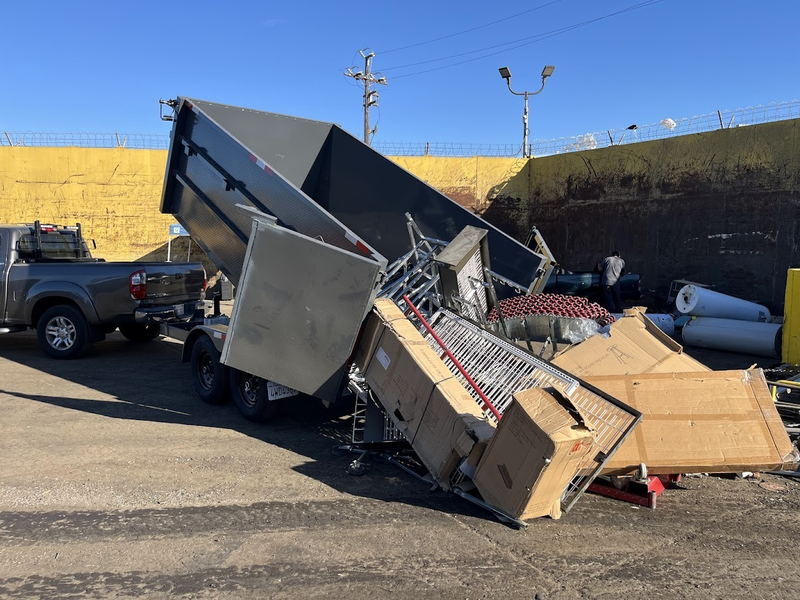
Our dump trailer raised and tipping a commercial load of flat-pack cartons and steel shelving out onto the floor of a Los Angeles County recycling yard
Tipping a commercial load at the recycling yard · Culver City
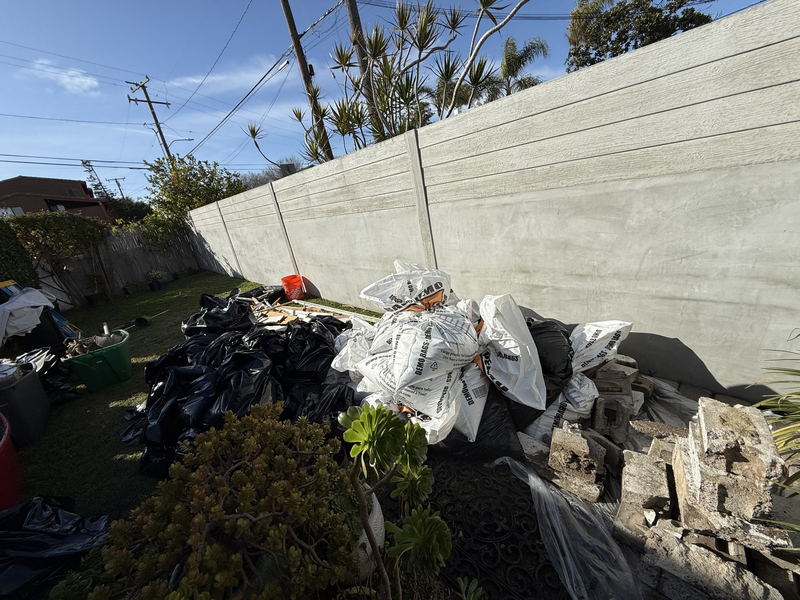
Bagged garden waste, filled white demolition bags and broken concrete rubble lined up along a poured concrete wall in a Los Angeles County back yard
Green waste and broken concrete, stacked and ready · Culver City
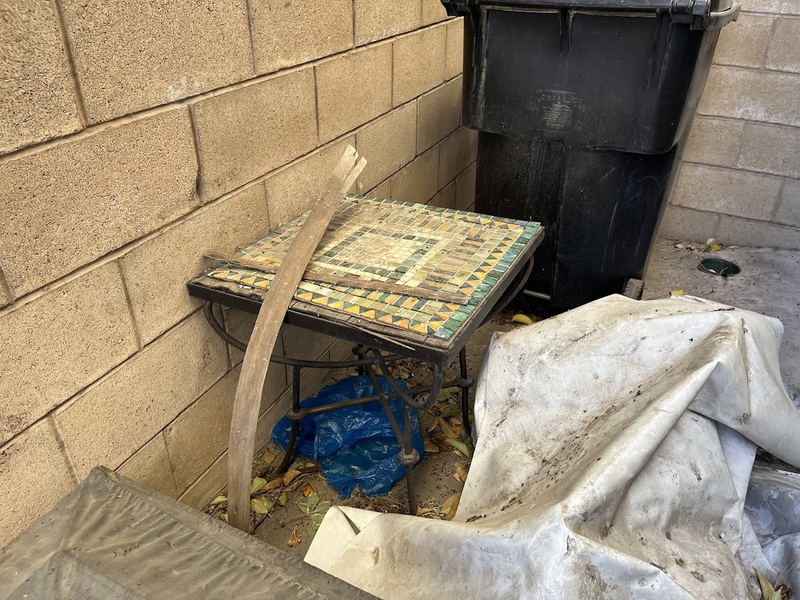
A mosaic-topped patio side table, a torn tarp and bagged waste tucked into the corner of a block-wall side yard beside a wheeled trash bin on a Los Angeles County pickup
The awkward corner nobody wants to clear out · Culver City

Our own crews on Los Angeles County jobs. The construction debris removal we run in Culver City looks like this too: side yards, narrow walkways and the back of the property is where the work actually is.

Where each stream goes

Separation is the number
— and three things are not debris at all.

Seventy-five percent is not achieved at the gate, it is achieved at the tailgate. Clean concrete, brick, sand, soil, ceramics and cured asphalt are inert material, and kept unmixed they are genuinely recyclable into base and aggregate. Stir half a yard of soil through a load of drywall and the whole load becomes something a processor has to pick apart by hand at a much lower recovery rate. Clean wood — untreated framing offcuts, sheathing, pallets — has its own outlet. Scrap metal has the best market of the lot: copper pipe, cast iron tub and soil stack, steel studs, aluminum window frames, the electrical panel and the ducting. Gypsum and wallboard are handled as their own stream. What is left over after all that is mixed C&D, which is the stream everybody defaults to and the one with the worst recovery rate, so the job is to make it as small as possible.

Everything above sits on a state floor. CALGreen requires locally permitted construction and demolition projects to recycle or salvage for reuse a minimum 65% of nonhazardous C&D debris, and CalRecycle's guidance is explicit that a jurisdiction implements CALGreen or its own local ordinance, policy or directive, whichever is more stringent. In Culver City the local number is 75%, so the local number is the one that governs.

Now the part where we stop. Three categories that come out of older Westside buildings are not construction debris and are not ours to carry, and the honest answer in every one of them is a licensed specialist rather than a hauler.

The first is asbestos-containing material. South Coast AQMD Rule 1403 requires that a facility or facility component be thoroughly surveyed for asbestos by an asbestos consultant before any demolition or renovation activity, with a single narrow exception for renovation of a residential single unit dwelling where less than 100 square feet of intact material is removed. Notification to South Coast AQMD is required electronically 10 working days ahead of a demolition or removal of more than 100 square feet of intact asbestos-containing material above 1% asbestos, and California Health and Safety Code Section 19827.5 prohibits a city from issuing a demolition permit until you give it a copy of that notification. Removal itself is restricted: only asbestos removal contractors listed on the Cal/OSHA asbestos registration may do it in California, except where Labor Code 6501.5 exempts them, and registration is required for work on 100 square feet or more of material containing more than 0.1% asbestos. Popcorn ceiling, floor tile and mastic, pipe lagging, roofing felt and old duct wrap are the usual suspects in pre-1980 stock. Test before it is disturbed.

The second is lead paint debris. Under the US EPA's Renovation, Repair and Painting Rule, anyone paid to perform work that disturbs painted surfaces in homes, childcare facilities and preschools built before 1978 must be a certified firm and must use lead-safe work practices. Sanded, scraped or torn-out painted woodwork from a pre-1978 Culver City house is a containment question, not a hauling question.

The third is treated wood waste. California's Health and Safety Code Article 11.2, added by AB 332 in 2021, sets alternative management standards for wood treated with a registered chemical preservative, and the prohibitions are blunt: treated wood waste managed under those standards may not be burned, scavenged, chipped for mulch, stored in contact with the ground, recycled other than by onsite reuse, or commingled with other waste before disposal once it has been segregated. It goes to a treated wood waste approved landfill, meaning a class I hazardous waste landfill or the composite-lined portion of a solid waste landfill unit. Old fence posts, sill plates, retaining timbers and deck framing are the usual source, and they do not belong in a clean wood pile.

Sources: CalRecycle, construction and demolition model ordinance guidance and the CALGreen 65% requirement; CalRecycle, construction and demolition debris recycling; South Coast AQMD, Rule 1403, asbestos emissions from demolition and renovation; South Coast AQMD, Rule 1403 frequently asked questions; Cal/OSHA, asbestos contractor registration and certification; US EPA, Lead Renovation, Repair and Painting Program; California Health and Safety Code, Article 11.2, treated wood waste (AB 332); City of Culver City, Construction and Demolition.

The rule behind it
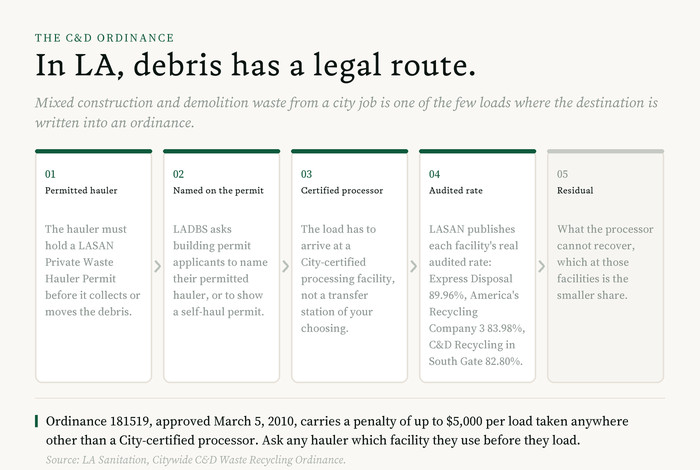
Diagram of the Los Angeles construction and demolition ordinance route: a LASAN-permitted hauler named on the building permit takes mixed debris to a City-certified processor with a published audited recycling rate
The route the C&D ordinance actually requires

Same rule in Culver City as anywhere else in Los Angeles County. The local part is the program above, not the disposal law. Full detail on construction debris removal.

Worth knowing

Culver City debris
in six lines.

Culver City C&D facts
  1. Projects in Culver City must recycle at least 75% of construction debris, under CalGreen and Culver City Municipal Code 15.02.1140.
  2. Culver City permit holders track diversion in Green Halo, submitting a waste management plan for approval before any weight tickets are added.
  3. The city's dumpster permit application states that a dumpster must be rented from the Environmental Programs and Operations Division and that no other hauler may provide that service in Culver City.
  4. The city states a review turnaround of about three business days on a Green Halo submission, excluding City Hall closure dates.
  5. A dumpster placed in the public right of way needs an encroachment permit, listed at $200 for 30 days on the city's fiscal year 2024-25 fee schedule.
  6. Temporary no parking signs in Culver City must be posted at least 48 hours ahead and are not enforceable until installation photographs reach parking enforcement.

This page is construction debris removal in Culver City specifically. The wider service is on construction debris removal across Los Angeles, and everything we haul in this city is on junk removal in Culver City. Same crew, different job: Commercial junk removal in Culver City, Furniture removal in Culver City, Garage cleanouts in Culver City, Same-day junk removal in Culver City. Pricing works the same way everywhere: how our pricing works, and the full map is on areas we serve.

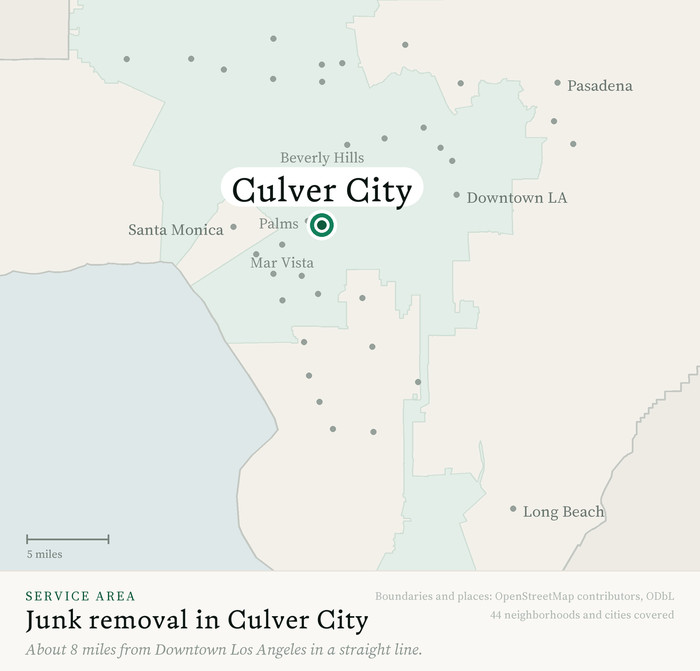
Service area
Map of our greater Los Angeles junk removal service area with Culver City marked, about 8 miles from Downtown Los Angeles, drawn from OpenStreetMap boundary data
Culver City in the greater Los Angeles service area. Boundaries and places from OpenStreetMap contributors, ODbL.

We are already next door most days. The whole list is on areas we serve.

What usually comes out
with the debris

Separated at the property so the recoverable streams stay recoverable, on one quoted number.

Culver City construction
debris questions

The 75% rule, the franchise, the street permit, and where each material actually goes.

Do I really have to recycle 75% of my construction debris in Culver City?

That is what the city publishes. Its Construction and Demolition page states that projects within Culver City must recycle at least 75% of construction debris, citing CalGreen and Culver City Municipal Code 15.02.1140. It is a higher bar than the statewide CALGreen minimum of 65%, so a plan written to the state number is short before it is submitted. The practical way to clear it is separation at the property rather than a single mixed load, because clean inert material, clean wood and scrap metal each recover far better on their own.

Can I bring my own dumpster into Culver City?

The city's own dumpster, POD and moving truck permit application answers this in print: a dumpster must be rented from the Environmental Programs and Operations Division on (310) 253-6400, and no other hauler may provide service in Culver City. The city's C&D page describes the same arrangement as an exclusive franchised service with outside haulers not permitted to operate within city limits. Where that leaves a homeowner is simple enough — the container is the city's, and the labor, the separation and a truck load that leaves the same day are a different service.

What is Green Halo and when do I use it?

Green Halo is the tracking system Culver City provides free to building and demolition permit holders. You open the project with its address, permit number, dates, value and square footage, enter estimated quantities in the waste management plan, select "Exclusive Franchise Agreement" and then "Culver City Refuse and Recycling Services", and submit for approval. The city states a review turnaround of about three business days. Tickets are added only after approval, one entry per material type, each with the facility, the hauler, the ticket number, an invoice image, the date and the weight.

How much does it cost to put a container in the street here?

That is a published city fee rather than anything of ours. The adopted comprehensive fee schedule for fiscal year 2024-25 lists encroachment into the public right of way at $200 per permit for a dumpster of 30 days' duration and $150 for each additional 30 days, with a moving POD capped at three days at $150. Temporary no parking signs are $6 each for the first four and $4 for the fifth and subsequent, minimum two, posted at least 48 hours in advance, and not enforceable until photographs of the installation are emailed to parking enforcement.

My house is from the 1950s. Can you take the popcorn ceiling and the old floor tile?

Not until it has been tested, and if it is positive then not at all. South Coast AQMD Rule 1403 requires an asbestos survey signed by an asbestos consultant before any demolition or renovation, and notification to the district 10 working days before removal of more than 100 square feet of intact asbestos-containing material. California Health and Safety Code 19827.5 stops a city issuing a demolition permit until it has a copy of that notification. Removal is restricted to contractors on the Cal/OSHA asbestos registration. That is a licensed abatement contractor, not a hauler. We take the clean debris after they are finished.

What does construction debris removal cost in Culver City?

We price by the load: the volume the debris actually takes up in the truck, with heavy material assessed by weight, and labor, transport and disposal all inside one number quoted before anything is touched. The quote is free and there is no obligation. What genuinely moves a Culver City number is the carry and the separation — a driveway you can back into is quick, a rear unit reached down an alley or a hillside drive is not, and a load kept clean costs less to place than one that has been mixed.

The proof

What our customers say

5.0from 67 reviews on Google

Word for word from Google. Nothing tidied.

  • 3 months ago

    Hunter is truly dedicated on providing the most excellent of removal of unwanted junk from your home or office. Always on time, very efficient at his job in a timely manner. I would recommend him for any junk removal you may have.

    James Russell3 reviewsHome and office junk removal
  • Fair pricing 11
  • Personable staff 10
  • Polite 5
  • Punctual staff 4
One city over

Construction debris removal near Culver City

Collection rules, transfer stations and permit counters change at the city line, so each of these is written for that city rather than for Culver City. A job that straddles two of them is still one visit and one number.

Everything we haul in the cities next door: Palms, Mid-City, West Los Angeles. The whole list is on areas we serve.

Request a quote

Send a photo, get a flat number back. Free, no obligation, no pressure and no call-out fee — and if your city will haul it free instead, we will tell you that too. Most requests are answered within the hour during working hours.

Or call or text (323) 230-0777 — Mon–Sat around the clock, Sunday 1–10pm.

Call (323) 230-0777Text a photo