Mon–Sat open 24 hours · Sun 1–10pmFully insuredFamily-run, LA-based
team@lajunkhauling.com
Call us today(323) 230-0777
Home/Services/Construction debris removal/Santa Monica

Construction debris removal in Santa Monica
The plan gets approved before the permit does. A ticket dated earlier is its own violation.

Demolition and remodel debris, drywall, framing, tile, roofing, concrete and the mixed material left at the end of a Santa Monica job, cleared, separated and documented on a free upfront quote.

Free quote, no obligation · one flat number before we start · you can also text that number

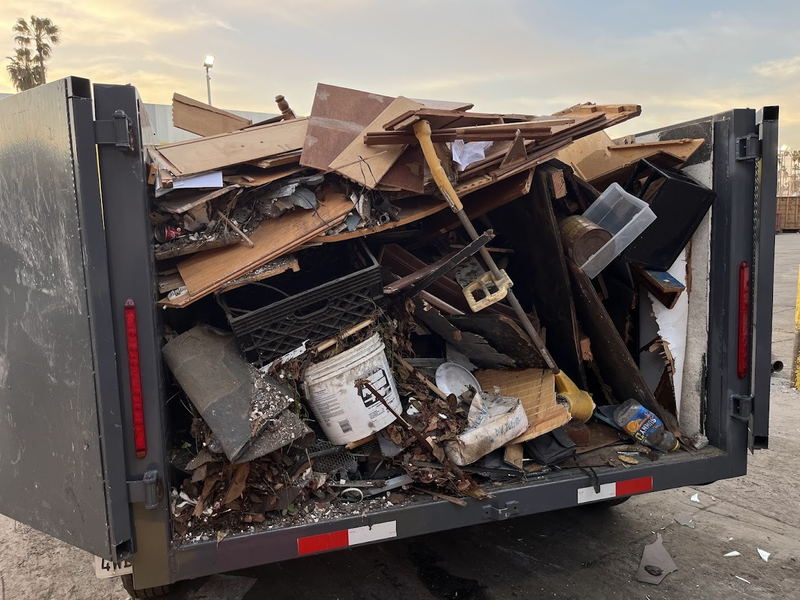
Our dump trailer loaded with mixed construction debris at dusk: cut timber, baseboard, a paint bucket, crates and broken fixtures stacked above the tailgate on a Los Angeles County job
A cleared room on a Los Angeles County job. The weight ticket matters as much as the empty room in a city that reads them.
In short

Santa Monica gates construction debris through the building permit: no permit is issued until the waste management plan is approved, at least 70% of the material must be diverted, and the January 2026 ordinance replaced the old deposit with a fine of up to 3% of project valuation. We clear, separate and document the load.

Santa Monica writes its own construction and demolition rules and enforces them through the building permit rather than at the curb. Chapter 8.108 of the municipal code, Subpart B, was substantially amended by Ordinance No. 2845CCS on 13 January 2026, and the shape of it now is this: every construction, demolition and deconstruction project requiring a building permit is a covered project, no building or demolition permit is issued until a waste management plan has been submitted and approved, and that plan has to show how at least 70% of all C&D material, 100% of inert materials, 100% of organic materials and all universal waste will be diverted through source separation. The old performance security section was repealed in the same ordinance and replaced with a fine of up to 3% of project valuation, minimum $500 and maximum $30,000, with the hold sitting on your final inspection until it is paid.

Most cities put their construction waste rule at the back of a webpage. Santa Monica puts it at the front of the permit counter. Nothing gets issued until the plan clears, and the compliance officer reads weight tickets at the other end with a fine schedule that names the failure modes individually, including one that catches people who simply started early.

This page is written for the person about to strip a bathroom in Ocean Park or pull a roof off in Sunset Park: what the code now says, what your tickets have to show, what the alley and the parking will allow, and which materials are not debris at all. Everything we haul in this city is on junk removal in Santa Monica, and the county-wide version of this service is on construction debris removal.

The chapter, as amended

Approval first, tickets after
— and a fine schedule with six named ways to fail.

Take the code as it now reads. Section 8.108.120 makes all construction, demolition and deconstruction projects requiring a building permit into covered projects, and adds all City-sponsored construction, demolition and renovation projects alongside them. There is no valuation or floor area carve-out in that section. Section 8.108.150 then states that no building or demolition permit shall be issued for any covered project unless and until the waste management plan has been submitted and approved, with one exception for an emergency demolition required to protect public health or safety.

The plan itself, under section 8.108.130, has to set out the estimated volume or weight of the project's C&D material by material type, the maximum volume or weight that can feasibly be diverted by reuse or recycling, the vendor or facility proposed to collect or receive it, the estimated volume or weight going to Class III landfills and inert disposal facilities, and a commitment that only City permitted waste haulers would be used. Estimates use the city's own standardized conversion rates rather than your own arithmetic. The plan must explain how at least 70% of all C&D material, 100% of inert materials, 100% of organic materials and all universal waste generated by the project will be diverted through source separation, unless an exemption has been granted.

The code defines its own terms tightly, and the definitions are where jobs go wrong. Inert materials means only rock, concrete, brick, sand, soil, ceramics and cured asphalt. Organic material means vegetative material from land clearing or landscaping. Universal waste means the hazardous waste identified as universal waste in Title 22 section 66273.9 — electronic devices, batteries, fluorescent lamps, mercury thermostats and other mercury-containing equipment. And C&D material itself is defined to include asphalt, concrete, Portland cement concrete, brick, lumber, gypsum wallboard, cardboard and packaging, roofing material, ceramic tile, carpeting, plastic pipe and steel, with an explicit instruction that C&D material may not be commingled with inert or organic material from land clearing and landscaping. Mixing your demolition rubble with your garden clearance is a code problem before it is an efficiency problem.

Compliance is documentary. Before applying for final inspection, section 8.108.160 requires weight tickets from the City approved facility that collected or received each material, showing the actual weight or volume of that material, plus weight slips or a count of anything salvaged or reused on the project, and anything else that supports a good faith effort. Material is to be weighed on scales wherever practical, and those scales must comply with state and county accuracy requirements.

Then the fines, which is where the January 2026 amendment changed the character of the program. Section 8.108.140, Performance security, was repealed. In its place, a failure to comply draws a fine not exceeding 3% of the total project valuation, with a minimum of $500 and a maximum of $30,000, and the hold on the building permit's final inspection is not lifted until the fine is paid in full. The code names six separate ways to earn one: completing a project without an approved waste management plan, using a non-City approved hauler, using a non-City approved facility, weight tickets dated prior to the plan approval date, failing to meet the required diversion rate, and altered or fraudulent weight tickets. The first four are assessed at 10% of the maximum fine or $500, whichever is greater. Falling short on diversion is prorated against how close you came. Fraudulent tickets attract the maximum. Appeals go to a Hearing Officer and have to be filed within 10 days of the ruling.

Two practical notes. First, the fourth category — tickets dated before the plan was approved — is the one that catches honest contractors, because it penalizes hauling on day one and filing paperwork on day three. Second, the city's public process explainer pages still describe the older arrangement, with a waste management plan triggered at $50,000 valuation or 1,000 square feet or any demolition, and a Performance Security Deposit refunded after a final compliance report filed within 30 days of final sign-off. The code chapter as published now says otherwise. If your permit is live, confirm with the Resource Recovery and Recycling division which version applies to it rather than assuming, and get that answer in writing.

Separately from the project side, the city permits the haulers themselves. Under municipal code section 5.08.410 a private hauler permit is required to haul C&D material in Santa Monica, the annual permit fee for fiscal year 2025-26 is published at $609.89, the one-time performance security deposit is $2,000 for refuse and demolition contractors and $1,000 for source-separated recyclable contractors, and proof of auto, general commercial liability and workers' compensation cover at $1,000,000 for each incident is required with the city named as certificate holder. A contractor using their own trucks has to register as a permitted private hauler too. Self-hauling is not a way around the rule here.

70%the diversion a Santa Monica covered project must reach, plus 100% of inert and organic material
Before the permitno building or demolition permit is issued until the waste management plan is approved
$30,000the cap on the fine for failing the chapter, assessed at up to 3% of project valuation

Source: Santa Monica Municipal Code Chapter 8.108, Subpart B, as amended by Ordinance No. 2845CCS. Cited in full below.

Governing lawSanta Monica Municipal Code Chapter 8.108, Subpart B, amended by Ordinance No. 2845CCS, adopted 13 January 2026
Covered projectsAll construction, demolition and deconstruction projects requiring a building permit, plus all City-sponsored projects
Permit gateNo building or demolition permit is issued until the waste management plan is submitted and approved
Diversion requirementAt least 70% of total C&D material by reuse or recycling
Also required100% of inert materials, 100% of organic materials and all universal waste diverted through source separation
Inert materials, as definedOnly rock, concrete, brick, sand, soil, ceramics and cured asphalt
Plan contentsEstimated quantities by material, maximum feasible diversion, the receiving facility, estimated landfill quantities, and a commitment to use only City permitted haulers
Evidence before finalWeight tickets from the City approved facility showing actual weight or volume of each material, plus slips for salvage and reuse
FineNot exceeding 3% of total project valuation, minimum $500, maximum $30,000, with a hold on final inspection until paid
Named failure categoriesNo approved plan; non-approved hauler; non-approved facility; tickets dated before plan approval; missing the diversion rate; altered or fraudulent tickets
Hauler permitRequired under municipal code 5.08.410; FY 2025-26 annual fee $609.89, with a one-time $2,000 deposit for refuse and demolition contractors

Sources: Santa Monica Municipal Code Chapter 8.108, construction and demolition waste management standards, as amended by Ordinance No. 2845CCS; City of Santa Monica, how to recycle construction and demolition material; City of Santa Monica, how to create a waste management plan; City of Santa Monica, how to apply to be a construction and demolition private hauler; CalRecycle, construction and demolition model ordinance guidance and the CALGreen 65% requirement.

Why a Santa Monica load is slow

Alleys, meters and a grid
that was drawn before anybody owned two cars.

Santa Monica is bounded by the Pacific on the west and by the City of Los Angeles on its other three sides, which means everything has to happen inside the city's own street network with no spillover. The recognized neighborhood organizations map the city out as North of Montana, Wilshire Montana, Mid City, Northeast, Pico, Ocean Park and Sunset Park, plus Downtown, and each of those has a different debris problem.

The older flat neighborhoods are alley-served. Behind the numbered streets and through Ocean Park and the Pico neighborhood, the service side of the block is the alley, and that is where the enclosures, the garages and the actual working access sit. An alley is the best possible place to load a debris job and the worst possible place to block one, because it is somebody's only way out. We work alleys with a spotter, keep the run short, and move the truck rather than leaving it sitting while a crew carries. Where an alley is too tight or too contested, the material comes to the street frontage by hand and the truck takes a legal space instead.

North of Montana is a different animal: larger lots, deeper setbacks, mature street trees and a long carry from the rear of the house to anywhere a vehicle can stand. The carry, not the volume, is what sets the crew size there. Ocean Park and the blocks either side of Main Street are the opposite — small parcels, two- and three-unit conversions, narrow side returns and bungalow courts where the only route out of a rear unit is a path barely wider than a wheelbarrow. A gutted bathroom in a rear unit is a bucket job before it is a truck job, and we price it as one.

Then the parking, which in Santa Monica is not an afterthought. Preferential parking districts cover much of the residential grid, meters run through Downtown and the commercial corridors, and street sweeping is posted on almost every block. For a debris job that means the truck's legal standing place is the first thing we work out, not the last. Where a job genuinely needs a stretch of curb or a set of spaces for a morning, that goes through a public property permit from Public Works rather than being improvised on the day, and it needs lead time.

The last constraint is the coast. Part of the city lies inside the California Coastal Zone, and work near the beach corridor collides with visitor traffic, event closures and the simple fact that Ocean Avenue and the streets running down to it are busy from mid-morning onward. Early is better than late in this city, every time. If what is coming out is closer to household than construction, estate cleanouts in Santa Monica and furniture removal in Santa Monica cover that ground, and bedroom strip-outs usually involve mattress removal in Santa Monica as well.

Santa Monica debris, kept separated and documented. Tell us the job and we will quote it free.

Free upfront quote, no obligation. One number, agreed before anything is lifted.

5.0 from 67 reviews on GoogleMon–Sat, open 24 hours

On the job
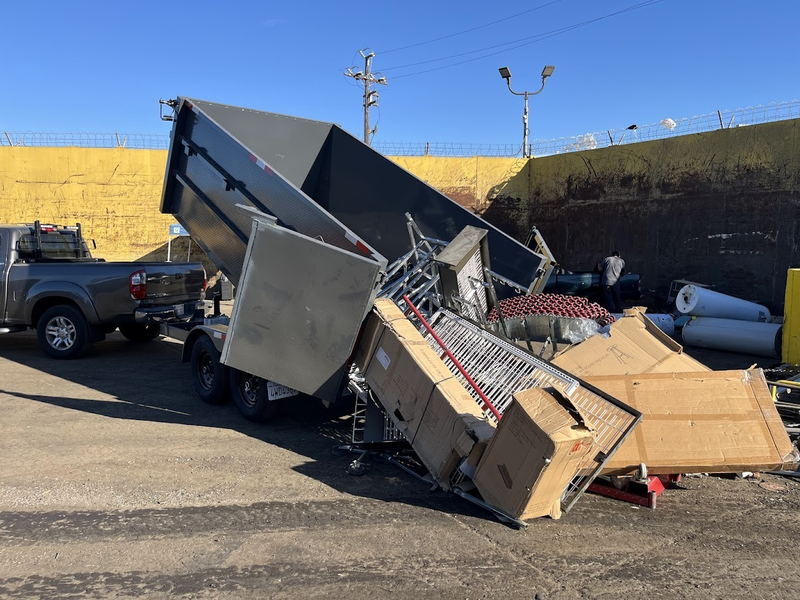
Our dump trailer raised and tipping a commercial load of flat-pack cartons and steel shelving out onto the floor of a Los Angeles County recycling yard
Tipping a commercial load at the recycling yard · Santa Monica
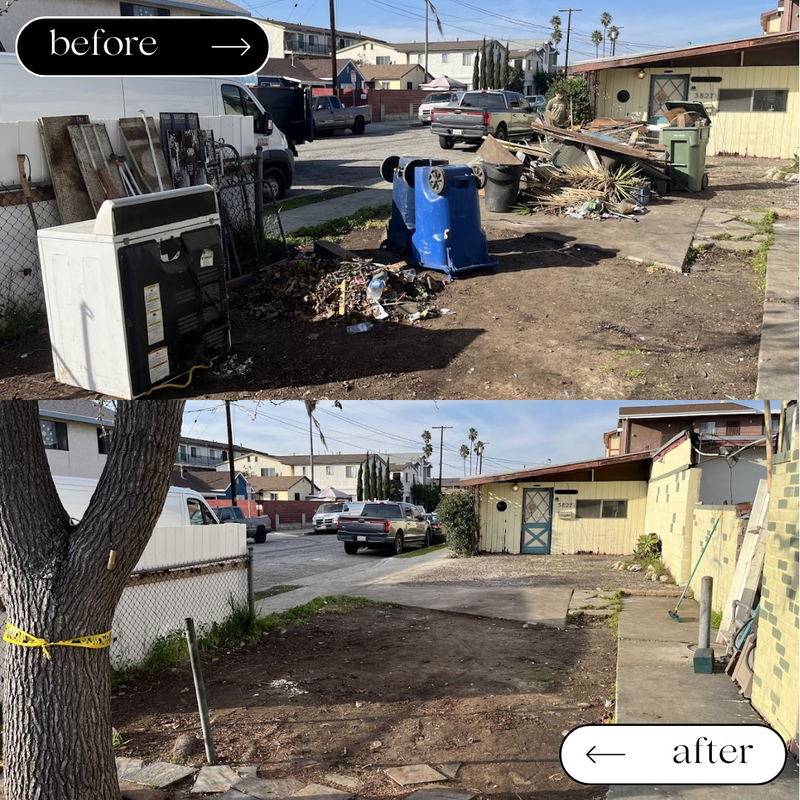
Before and after of a Los Angeles County front yard: a dumped washer and dryer, overflowing bins, cut palm fronds and scattered trash, then the same yard raked flat and completely clear
Before and after — a dumped front yard cleared · Santa Monica
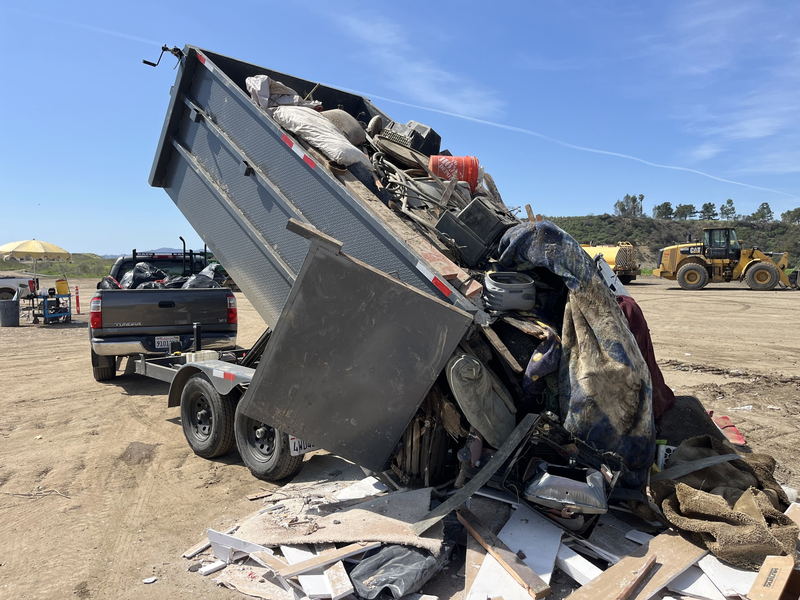
Our dump trailer raised and tipping a full household load onto the working face of a Los Angeles County transfer station, a wheel loader waiting in the background
Tipping a household load at the transfer station · Santa Monica

Our own crews on Los Angeles County jobs. The construction debris removal we run in Santa Monica looks like this too: side yards, narrow walkways and the back of the property is where the work actually is.

Where the material goes

Approved facility, approved hauler
and a ticket that says so.

Santa Monica's code does not simply ask you to recycle. It defines who may carry the material and who may receive it. A City approved facility is one the city has approved to accept C&D material, inert material, metal recycling, universal waste or anything else a covered project generates, and a City approved hauler is a company holding a valid approval letter from the city to collect and transport solid waste for recycling or disposal. Using anything outside those two lists is a named fine category on its own, independent of whether you hit the diversion number. The city's own guidance adds the detail that every weight ticket from an approved facility has to carry the facility information, the tonnage, the material type and the project address before it will be accepted, and that inert material — dirt, concrete, asphalt — must go to an approved inert facility rather than riding in a mixed load.

That is why separation at the property matters more here than in most cities. Concrete, brick, sand, soil, ceramics and cured asphalt are inert and have to be kept as inert. Vegetative material from clearing and landscaping is organic and, by the code's own wording, may not be commingled with C&D material. Clean untreated lumber, scrap metal and gypsum wallboard each recover far better as separate streams than they do inside a mixed load. Cardboard and packaging count too, and on a fit-out they are often the single largest volume nobody bothered to keep apart.

Under Santa Monica's number sits the state's. CALGreen requires a minimum 65% diversion of nonhazardous C&D debris on locally permitted projects, and CalRecycle's guidance says jurisdictions implement CALGreen or their own local ordinance, whichever is more stringent. Santa Monica's 70%, plus 100% of inert and organic, is more stringent, so Santa Monica's is the one you are held to.

Three materials sit outside all of this and are not ours to move. Asbestos-containing material is the first. Rule 1403 requires a survey signed by an asbestos consultant before any demolition or renovation, with the narrow exception of a residential single unit dwelling where less than 100 square feet of intact material is stripped, and an electronic notification to South Coast AQMD 10 working days before demolition or before removing more than 100 square feet of intact material above 1% asbestos. California Health and Safety Code 19827.5 keeps a city from issuing a demolition permit until it holds a copy of that notification, which is precisely why an asbestos question can stall a Santa Monica demolition before the plan check even starts. Only contractors on the Cal/OSHA asbestos registration may carry out the removal. That is a licensed abatement contractor, not a junk removal crew, and we will say so on site rather than load it.

Lead is the second. The US EPA's Renovation, Repair and Painting Rule requires anyone paid to disturb painted surfaces in pre-1978 homes, childcare facilities and preschools to be a certified firm using lead-safe work practices. A great deal of Santa Monica's housing predates 1978 by decades, so scraped, sanded or demolished painted woodwork is a containment job first.

Treated wood waste is the third. Under California Health and Safety Code Article 11.2, wood treated with a registered preservative may not be burned, scavenged, chipped for mulch, stored in contact with the ground or recycled except by reuse on the site where it was generated, and once segregated it may not be commingled with other waste before disposal. It has to reach a treated wood waste approved landfill — a class I hazardous waste landfill or the composite-lined portion of a solid waste landfill unit. A handler generating more than 10,000 pounds in a calendar year has to obtain an identification number and notify the department within 30 days of crossing that threshold. Old deck framing, sill plates and fence posts are where it usually turns up, and they must never end up in the clean wood pile that your diversion number depends on.

Sources: Santa Monica Municipal Code Chapter 8.108, construction and demolition waste management standards, as amended by Ordinance No. 2845CCS; City of Santa Monica, how to recycle construction and demolition material; CalRecycle, construction and demolition model ordinance guidance and the CALGreen 65% requirement; South Coast AQMD, Rule 1403, asbestos emissions from demolition and renovation; South Coast AQMD, Rule 1403 frequently asked questions; Cal/OSHA, asbestos contractor registration and certification; US EPA, Lead Renovation, Repair and Painting Program; California Health and Safety Code, Article 11.2, treated wood waste (AB 332).

The rule behind it
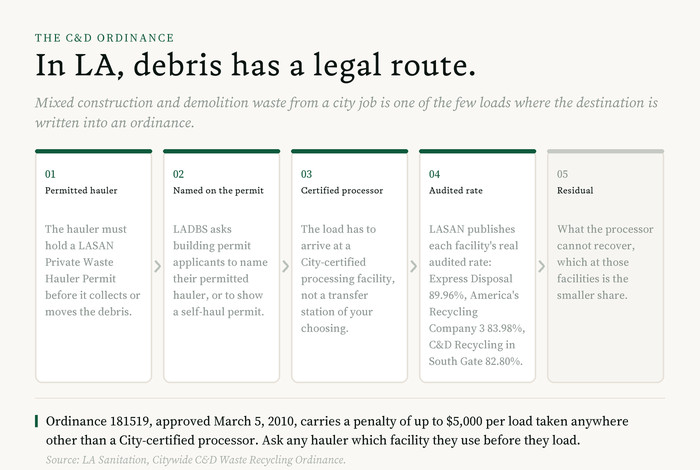
Diagram of the Los Angeles construction and demolition ordinance route: a LASAN-permitted hauler named on the building permit takes mixed debris to a City-certified processor with a published audited recycling rate
The route the C&D ordinance actually requires

Same rule in Santa Monica as anywhere else in Los Angeles County. The local part is the program above, not the disposal law. Full detail on construction debris removal.

Worth knowing

Santa Monica debris
in six lines.

Santa Monica C&D facts
  1. Santa Monica issues no building or demolition permit for a covered project until the waste management plan has been submitted and approved.
  2. Santa Monica's diversion requirement is at least 70% of total construction and demolition material, plus 100% of inert materials, 100% of organic materials and all universal waste through source separation.
  3. Ordinance No. 2845CCS, adopted 13 January 2026, repealed the performance security section of Chapter 8.108 and replaced it with a fine of up to 3% of project valuation, minimum $500 and maximum $30,000.
  4. Weight tickets dated before the waste management plan was approved are a named fine category in Santa Monica's code, alongside using a non-approved hauler or facility.
  5. Santa Monica defines inert materials as only rock, concrete, brick, sand, soil, ceramics and cured asphalt, and forbids commingling C&D material with inert or organic material from land clearing.
  6. Hauling C&D material in Santa Monica requires a private hauler permit under municipal code section 5.08.410, and contractors self-hauling in their own trucks must register as permitted haulers too.

This page is construction debris removal in Santa Monica specifically. The wider service is on construction debris removal across Los Angeles, and everything we haul in this city is on junk removal in Santa Monica. Same crew, different job: Appliance removal in Santa Monica, Estate cleanouts in Santa Monica, Furniture removal in Santa Monica, Mattress removal in Santa Monica. Pricing works the same way everywhere: how our pricing works, and the full map is on areas we serve.

Service area
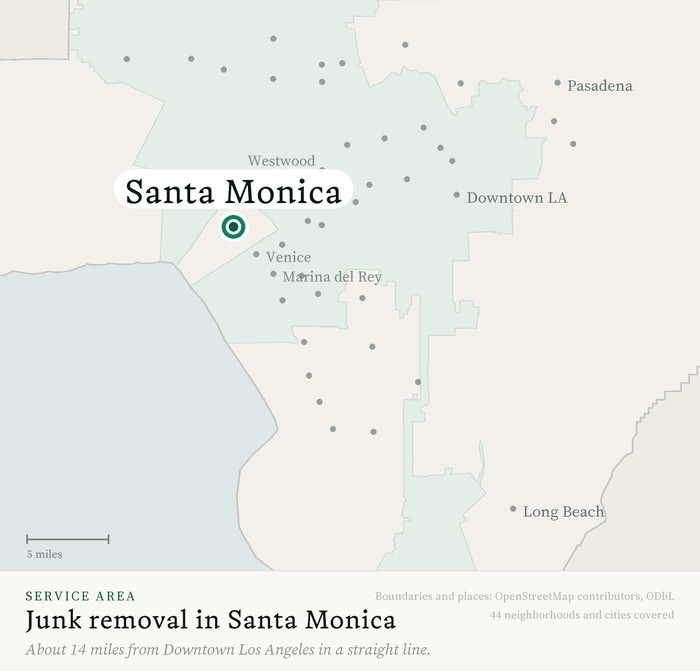
Map of our greater Los Angeles junk removal service area with Santa Monica marked, about 14 miles from Downtown Los Angeles, drawn from OpenStreetMap boundary data
Santa Monica in the greater Los Angeles service area. Boundaries and places from OpenStreetMap contributors, ODbL.

We are already next door most days. The whole list is on areas we serve.

What else leaves
on a Santa Monica job

Streams kept apart at the property, because the code says they have to be.

Santa Monica construction
debris questions

The plan, the tickets, the fine schedule and the materials that are not debris.

Does my small remodel in Santa Monica need a waste management plan?

Read the code rather than the summary. Section 8.108.120, as amended by Ordinance No. 2845CCS on 13 January 2026, makes all construction, demolition and deconstruction projects requiring a building permit into covered projects, with no valuation or floor area threshold in that section. The city's older process explainer pages still describe a $50,000 or 1,000 square foot trigger with all demolition projects included regardless. Those two do not agree, so ask the Resource Recovery and Recycling division which applies to your permit and keep the answer.

What happens if I start hauling before the plan is approved?

It is a named violation. Santa Monica's fine categories include weight tickets dated prior to the waste management plan approval date, sitting alongside completing a project without an approved plan, using a non-City approved hauler, using a non-City approved facility, missing the diversion rate and submitting altered tickets. The first four are assessed at 10% of the maximum fine or $500, whichever is greater. Practically, that means the paperwork has to lead the truck, not follow it.

How big can the fine actually get?

The code sets a fine not exceeding 3% of the total project valuation, with a minimum of $500 and a maximum of $30,000, and the hold on your building permit's final inspection is not lifted until it is paid in full. Missing the diversion rate is prorated against how close you came. Altered or fraudulent weight tickets attract the maximum. Any ruling can be appealed to a Hearing Officer, but notice has to be filed within 10 days.

Is there still a performance security deposit in Santa Monica?

Section 8.108.140, Performance security, was repealed by Ordinance No. 2845CCS on 13 January 2026, and the fine schedule described above took its place. The city's public explainer pages have not all caught up and still describe a deposit refunded after a final compliance report filed within 30 days of final sign-off, with checks mailed six to eight weeks later. Since there is real money on both readings, confirm with the city which one your permit sits under rather than working from a webpage.

Can you take the dirt and the concrete out with the rest of the debris?

Not in the same load if we can help it, and the code agrees. Santa Monica defines inert materials as only rock, concrete, brick, sand, soil, ceramics and cured asphalt, requires 100% of them to be diverted, and the city's guidance says inert material has to go to an approved inert facility. It also forbids commingling C&D material with inert or organic material from land clearing and landscaping. So dirt travels with dirt, rubble travels with rubble, and green waste travels on its own. That is also the cheapest way to move it.

How much does construction debris removal cost in Santa Monica?

By the load, with heavy material assessed by weight, and labor, transport and disposal all inside a single figure confirmed before we lift anything. The quote is free. The variables here are honest ones: how far the material has to be carried from a rear unit or an upper floor, whether the truck can stand in an alley or has to take a metered space, and whether the streams have been kept apart. A clean separated job costs less to place than the same material mixed together.

The proof

What our customers say

5.0from 67 reviews on Google

Word for word from Google. Nothing tidied.

  • 3 months ago

    Hunter is truly dedicated on providing the most excellent of removal of unwanted junk from your home or office. Always on time, very efficient at his job in a timely manner. I would recommend him for any junk removal you may have.

    James Russell3 reviewsHome and office junk removal
  • Fair pricing 11
  • Personable staff 10
  • Polite 5
  • Punctual staff 4
One city over

Construction debris removal near Santa Monica

Collection rules, transfer stations and permit counters change at the city line, so each of these is written for that city rather than for Santa Monica. A job that straddles two of them is still one visit and one number.

Everything we haul in the cities next door: Venice, Brentwood, Mar Vista. The whole list is on areas we serve.

Request a quote

Send a photo, get a flat number back. Free, no obligation, no pressure and no call-out fee — and if your city will haul it free instead, we will tell you that too. Most requests are answered within the hour during working hours.

Or call or text (323) 230-0777 — Mon–Sat around the clock, Sunday 1–10pm.

Call (323) 230-0777Text a photo