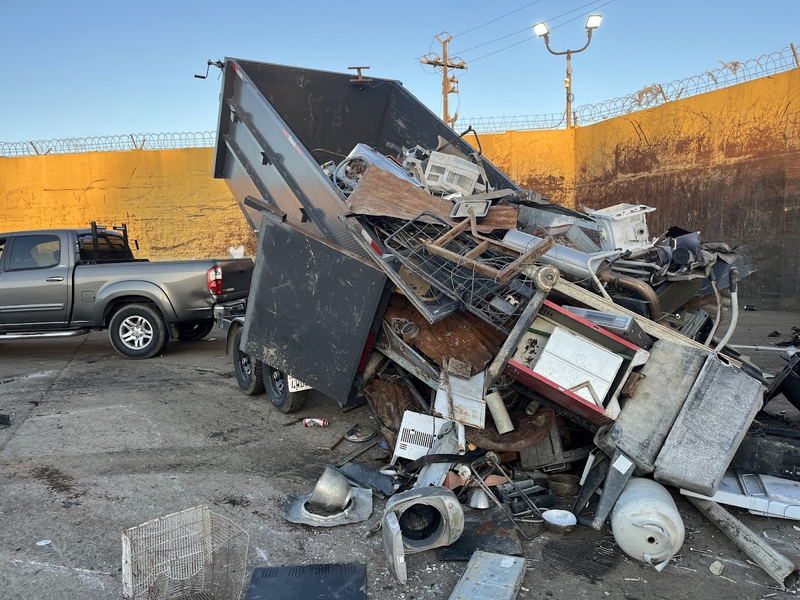
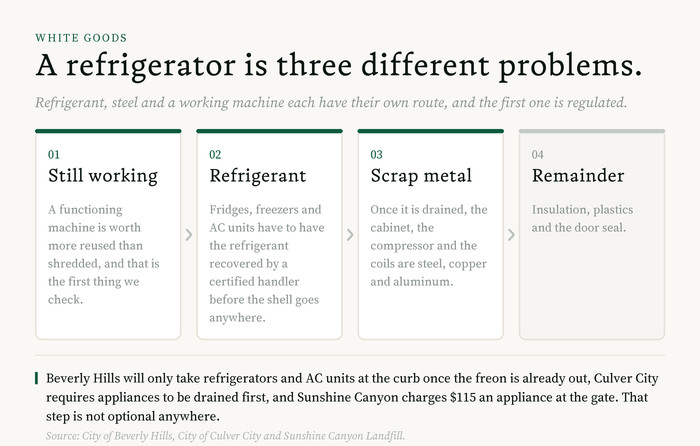
An appliance is dismantled in a fixed order and none of it happens at your address. First, refrigerant. Any unit with a sealed circuit — refrigerator, freezer, window or portable air conditioner, dehumidifier, wine cooler — holds a charge that has to be recovered by a certified technician with recovery equipment before the shell can be shredded. That is why the single most useful thing a hauler does with a refrigerator is keep the circuit intact in transit. A unit dragged on its side with the line set snagged has already vented, and nothing downstream undoes that.
Second, compressor oil, drained and handled separately. Third, the metal, which is most of the weight and most of the value: steel cabinet, aluminum and copper in the coil and the motor windings. Fourth, plastics and the foam insulation layer, which is why a refrigerator cannot simply be baled with scrap.
Fifth is the fraction that makes an appliance universal waste rather than scrap: control boards, displays, mercury switches in older chest freezers and dryer doors, and batteries in anything with a memory. California ended the household exemption for universal waste on February 9, 2006, banning household batteries, cell phones, computers, fluorescent lamps, mercury switches and thermostats, printers, microwaves, televisions and monitors from the trash. A microwave is not a borderline case, it is named on the list.
Santa Monica gives its residents an unusually good route for that small-electrical fraction. The city's free door-to-door household hazardous waste collection accepts electronic waste alongside paints, solvents, fuels, tubes and batteries, up to 125 pounds per pickup, booked on (877) 443-2371. For a microwave, a toaster oven and a bag of batteries that is a genuinely excellent free answer and we will tell you so. For a refrigerator, a stack laundry and a water heater it is not the route, and the choice is the city's separate appliance truck with its queue and its property-line rule, or us.