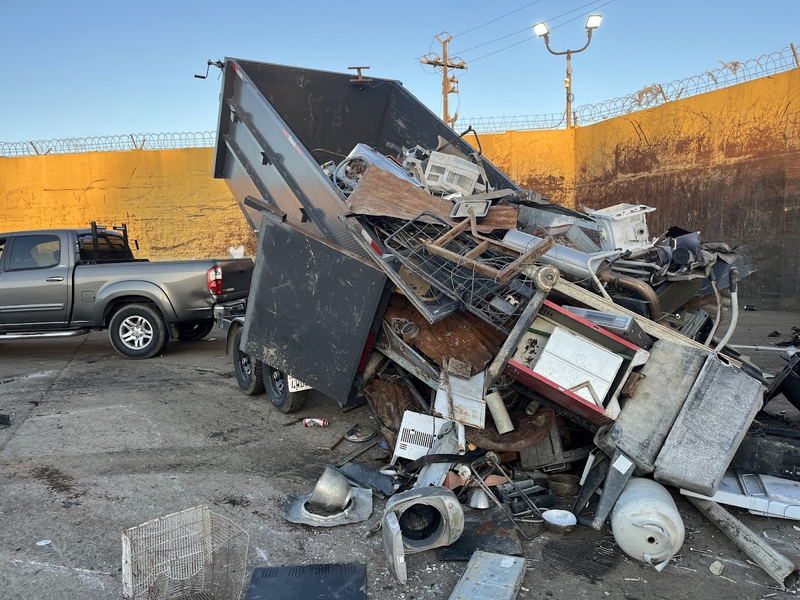
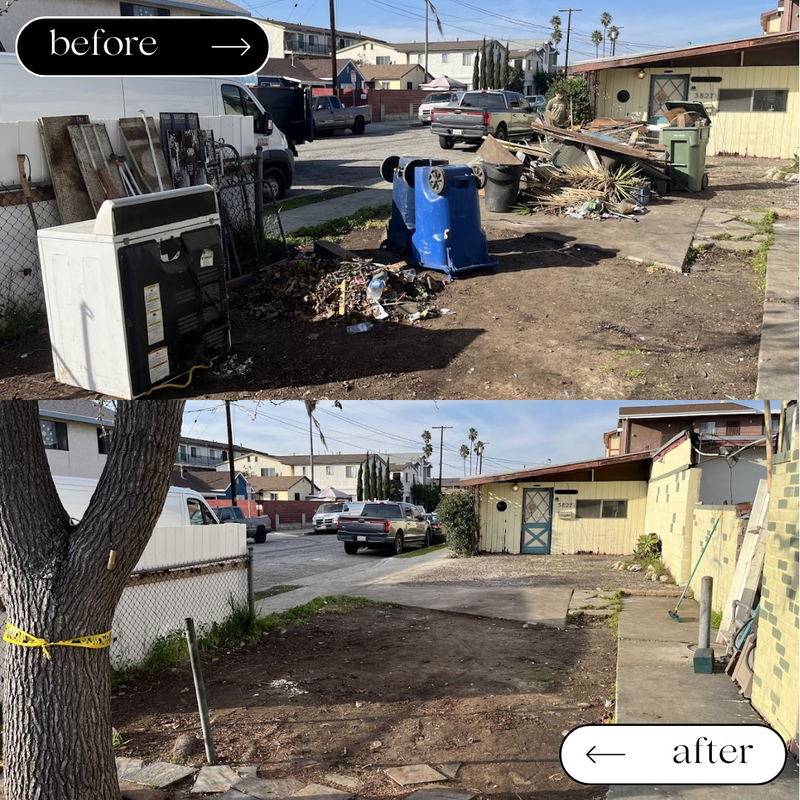
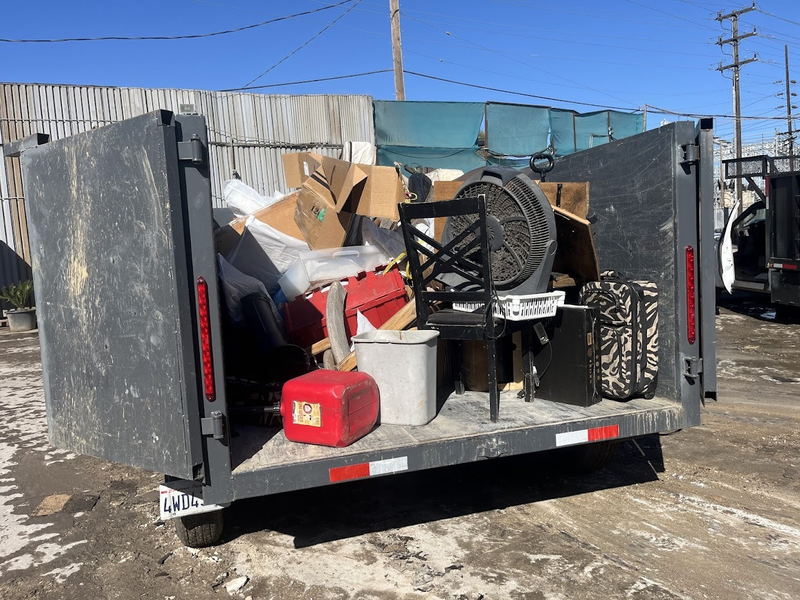
Working with Hunter and this company was great. Gave us a quick quote over the phone after sending photos and was able to help us the SAME day. Removal was fast and easy. We definitely recommend going with this company.
Refrigerators, freezers, washers, dryers, dishwashers, ovens, water heaters and air conditioning units taken out of any Long Beach property, disconnected, carried and routed for metal recovery. Free upfront quote first.
Free quote, no obligation · one flat number before we start · you can also text that number

Appliances in Long Beach ride a separate city truck from everything else, refrigerator doors must come off or be taped shut, and handling fees may apply. Curbside crews never enter private property. Los Angeles Junk Removal & Hauling disconnects the unit inside the house, carries it out, and routes it for metal recovery, quoted free.
Long Beach does collect appliances free through its Special Collection program, but not with everything else: appliances, televisions, computer monitors and tires are collected by a separate truck and must be kept apart from your other items, fees may apply for that special handling, and refrigerators and freezers must have their doors removed or taped shut before the truck arrives. Everything still has to be at your regular collection point by 6 a.m. on the confirmed day, and crews cannot enter private property, so a fridge in a second-floor kitchen or a water heater in a locked garage is not a curbside job. Los Angeles Junk Removal & Hauling disconnects it, carries it out, and routes it for metal recovery rather than burial, with a free upfront quote and no obligation.
An appliance is the one item where the physics and the law both push in the same direction. It is heavy, it is awkward on a stair, it usually has a water line or a gas line attached to it, and in California a sealed refrigeration system cannot simply be crushed with the refrigerant still inside it. That is why Long Beach runs white goods on their own vehicle and why the city asks for the doors off before it will touch a refrigerator.
This page is about what actually happens to an appliance in this city: what the free route will and will not do, what has to be dealt with before a compressor can be scrapped, and where the metal ends up. For the broader city picture see junk removal in Long Beach, and for how we handle appliances county-wide see appliance removal.
Appliances are on the Long Beach Special Collection eligible list, which means a City-serviced account can put a washer out for free, up to twelve times a year. The conditions are what separate an appliance from a chair. The city states that appliances, televisions, computer monitors and tires are collected by a separate truck and must be kept apart from your other items, and that fees may apply for special handling. So the free allowance is real, but the appliance does not ride with the sofa, and it may not be entirely free once handling is applied.
The refrigerator rule is published in the same place and is not optional: refrigerators and freezers must have doors removed or taped shut. It is an old safety rule with a real reason behind it, and a unit that turns up with a working door latch is a unit the crew is entitled to leave. Add the general set-out rules — at your regular collection location by 6 a.m. on the confirmed day, never before, incorrectly prepared items must be corrected and rescheduled — and a refrigerator that misses on a technicality costs you a week, not an afternoon.
Then there is the line that decides whether the free route is available at all. Collection crews cannot enter private property. An appliance is the single hardest item to move yourself: a full-size refrigerator through a kitchen doorway, down an exterior stair from a Belmont Heights duplex, out of a garage that shares an alley gate with four other units. If you can get it to the collection point, take the free pickup and we will say so. If you cannot, the carry is the job and that is what we are for.
One more Long Beach specific is worth knowing before you plan around it. Not every address in the city is serviced by the city. Long Beach permits a limited number of private waste haulers to operate within its boundaries and publishes their non-exclusive franchise agreements, and the free Special Collection allowance applies to City-serviced accounts. If your building is on a private hauler, confirm who services the address before you assume twelve free pickups are yours.
Sources: City of Long Beach, Special Collection 101 and SERRF. Cited in full below.
| Are appliances accepted | Yes, appliances are on the Long Beach Special Collection eligible list |
|---|---|
| How they travel | Appliances, televisions, computer monitors and tires are collected by a separate truck |
| Keep apart | Special-handling items must be kept apart from your other set-out items |
| Handling fees | The city states that fees may apply for items requiring special handling |
| Refrigerators and freezers | Doors must be removed or taped shut before collection |
| Televisions and monitors | Accepted, on the same separate special-handling truck |
| Tires | Accepted up to 16 inches, maximum of 5 per pickup |
| Set-out | At the regular collection location by 6 a.m. on the confirmed day, not before |
| Access | Collection crews cannot enter private property |
| Who services you | Only City-serviced accounts get the 12 free collections; some addresses use permitted private haulers |
Sources: City of Long Beach, Special Collection 101; City of Long Beach, Private Waste Haulers.
Appliance work starts before anything is lifted. A washer has a supply pair and a drain that has to be dealt with without soaking the floor below it. A dishwasher is plumbed and usually hard-wired under a counter. A gas range or a gas dryer has a shutoff that has to be closed and capped properly, and if there is any doubt about the condition of a gas connection, the right answer is a plumber first and a truck second — we will tell you that rather than pull on it. An electric water heater is a tank that is still full until somebody drains it, and a full fifty-gallon tank is not a two-person lift, it is a flood.
Then the carry. Long Beach is flat but vertical inside: the older courtyard and walk-up stock in Alamitos Beach and around Fourth Street puts kitchens on second and third floors with a single interior stair and a turn on the landing. A full-size refrigerator does not pivot on that turn without the doors coming off, which is one reason the doors-off rule exists at all. We strap, protect the jambs and the treads, and take doors off in the room rather than fighting the piece down a stairwell whole.
Garages and alleys are the other half of it. A great many Long Beach garages open onto the alley rather than the street, which is convenient for a truck and inconvenient for everything in front of the appliance: the alley apron is often shared, frequently blocked, and on trash day it belongs to the bins. Tell us which side of the building the working access is on when you call and we will send the vehicle that fits it.
Multifamily buildings add a layer. In a managed building an appliance swap is usually a scheduled thing — freight elevator, dock window, a certificate of insurance on file with the manager — and a unit left in a corridor overnight is a fire-door problem, not just a tidiness one. We book the window and take the old unit the same visit. If this is a whole-unit turnover rather than a single appliance, see commercial junk removal in Long Beach, and if it has to be gone today see same-day junk removal in Long Beach.
Tell us the appliance, the floor it is on and whether it still holds refrigerant. We will quote it free.
Free upfront quote, no obligation. One number, agreed before anything is lifted.
5.0 from 67 reviews on GoogleMon–Sat, open 24 hours


Our own crews on Los Angeles County jobs. The appliance removal we run in Long Beach looks like this too: side yards, narrow walkways and the back of the property is where the work actually is.
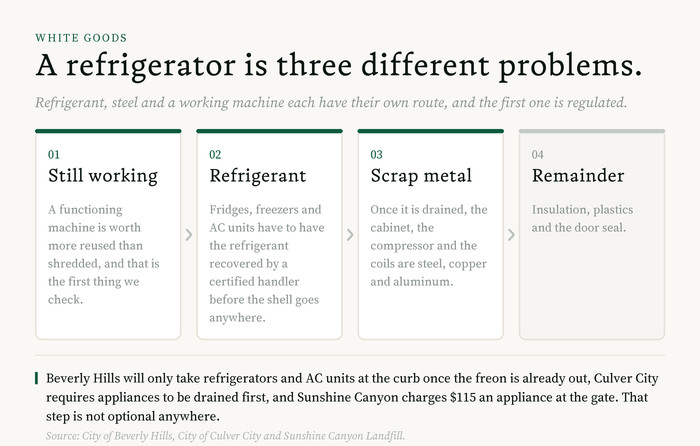
Anything with a sealed refrigeration circuit — refrigerators, freezers, window and split air conditioning units, dehumidifiers, some wine coolers — has refrigerant and compressor oil inside it, and that circuit has to be recovered by someone equipped to do it before the shell can be processed as scrap steel. That is the entire reason white goods travel separately from a sofa, in Long Beach and everywhere else. A unit that is crushed with a charged circuit vents the refrigerant, which is exactly what the rules exist to prevent. We route those units to a recycler set up for recovery instead of to a general disposal gate, and we say so on the quote so you know what you are paying for.
What happens to the rest of it in this city is genuinely unusual, and worth knowing. Long Beach does not simply bury its residual waste. It sends it to the Southeast Resource Recovery Facility on East Spring Street, its own waste-to-energy plant, where refuse is processed through one of three boilers and the steam drives a turbine. The city describes SERRF as performing front-end and back-end recycling by recovering items such as white goods before incineration and collecting metals removed from the boilers afterwards, and it puts a number on it: an average of 825 tons of metal are recycled every month rather than sent to a landfill. Ash from the process is treated and used as road base. So a Long Beach appliance is a metal recovery story from start to finish, whichever route it takes, which is the opposite of how most people picture an old fridge.
Electronics ride the same special-handling truck as appliances and are subject to a state rule rather than a city one. In California, televisions, monitors, computers, printers, microwaves, cell phones and household batteries are universal waste, banned from the household trash since the state's exemption ended on 9 February 2006. Long Beach lists e-waste in its own hazardous waste section for the same reason. Those items are separated at your address and routed to a certified handler.
Two smaller categories that always turn up next to an appliance. Tires: the city takes up to five per pickup at 16 inches or under, and the statewide California Tire Fee is charged at the point of sale on every new tire, which is why a legal tire route exists at all. And anything liquid or chemical that has been living behind the machine — a jug of antifreeze, half a can of paint, a bottle of pool acid — may never go in any cart in Long Beach and belongs at the EDCO Environmental Collection Center in Signal Hill or the Gaffey Street S.A.F.E. Center in San Pedro. Paint specifically has its own free statewide take-back through PaintCare. We separate all of it at the property.

Sources: City of Long Beach, SERRF waste-to-energy facility; City of Long Beach, Special Collection 101; City of Long Beach, Household Hazardous Waste; Californians Against Waste, background on universal waste and DTSC regulations; California Department of Tax and Fee Administration, California Tire Fee Law Guide; PaintCare, California program and recovery fees.

Same rule in Long Beach as anywhere else in Los Angeles County. The local part is the program above, not the disposal law. Full detail on appliance removal.
This page is appliance removal in Long Beach specifically. The wider service is on appliance removal across Los Angeles, and everything we haul in this city is on junk removal in Long Beach. Same crew, different job: Furniture removal in Long Beach, Garage cleanouts in Long Beach, Mattress removal in Long Beach, Commercial junk removal in Long Beach, Construction debris removal in Long Beach, Same-day junk removal in Long Beach. Pricing works the same way everywhere: how our pricing works, and the full map is on areas we serve.

We are already next door most days. The whole list is on areas we serve.
One visit, one quoted number, agreed before anything is disconnected.
TVs, CRT monitors and computers. Banned from the trash in California.
Couches, sectionals, mattresses in the same trip, beds, desks and wardrobes carried down rather than dragged.
The whole garage in one visit. We sort, donate what is usable and sweep the slab.
COIs, after-hours dock slots and property-manager invoicing.
Drywall, lumber, tile and concrete, hauled to a certified C&D processor.
Booked and cleared the same day, most days, across LA County.
Refrigerant, doors, stairs, and what the free city truck will actually take.
Appliances are on the Special Collection eligible list, so a City-serviced account can put one out within its twelve free collections a year. Two conditions apply: the doors must be removed or taped shut, and it rides a separate special-handling truck where the city says fees may apply. It also has to be at your regular collection point by 6 a.m. on the confirmed day, and crews cannot enter private property. If the fridge is inside, that last line is the one that matters.
Yes. Refrigerators, freezers, air conditioners and dehumidifiers contain a sealed refrigeration circuit, and that has to be recovered by someone equipped for it before the metal can be processed as scrap. It is the reason white goods are handled separately everywhere, not just here. We route those units to a recycler set up for recovery rather than to a general gate, and we tell you that is what is happening when we quote.
We disconnect standard water supply and drain lines and standard electrical connections as part of the job. For gas, we close and cap a sound shutoff, but if a gas connection looks perished, corroded or has been modified, the honest answer is a licensed plumber first and us second, and we will say so on site rather than pull on it. The same goes for a water heater that has not been drained — a full tank is a flood, not a lift.
No, but it is the job. Long Beach's older walk-up and courtyard stock puts kitchens above a single interior stair with a turn on the landing, and a full-size refrigerator does not make that turn intact. We take doors off in the room, strap it, protect the jambs and the treads, and walk it down. That is normal work here and it is why an upstairs appliance quote is not the same as a curbside one.
The refrigeration circuit is recovered where there is one, then the shell goes for metal recovery. Long Beach is unusual in that its residual waste goes to the city's own waste-to-energy facility, which recovers white goods before incineration and pulls an average of 825 tons of metal out every month. Either way an old appliance is mostly steel, and steel has somewhere better to go than a landfill.
Yes. Televisions, monitors, computers, printers, microwaves and batteries are universal waste in California and have been banned from household trash since 2006, which is why Long Beach runs them on the same special-handling truck as appliances. We separate them at your address and route them to a certified handler. Say what you have when you call so the right vehicle turns up.
Word for word from Google. Nothing tidied.
Working with Hunter and this company was great. Gave us a quick quote over the phone after sending photos and was able to help us the SAME day. Removal was fast and easy. We definitely recommend going with this company.
Read all 67 on GoogleSee us on YelpReviews, and how to check any LA hauler
Collection rules, transfer stations and permit counters change at the city line, so each of these is written for that city rather than for Long Beach. A job that straddles two of them is still one visit and one number.
Everything we haul in the cities next door: Gardena, Redondo Beach, Hawthorne. The whole list is on areas we serve.
Send a photo, get a flat number back. Free, no obligation, no pressure and no call-out fee — and if your city will haul it free instead, we will tell you that too. Most requests are answered within the hour during working hours.