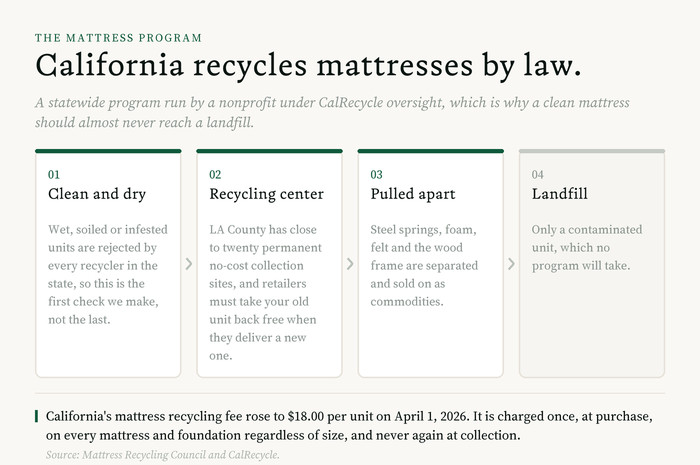
Underneath both routes sits one statewide system. The Mattress Recycling Council, a nonprofit stewardship organization created by mattress manufacturers, renovators and retailers, runs the Bye Bye Mattress program under CalRecycle oversight, funded by a recycling fee collected at the register. That fee rose from $16.00 to $18.00 per unit for units sold on or after 1 April 2026, applies per unit regardless of size or type, is exempt from sales tax, and has to be shown as a separate line item on every receipt, in store or online. Because it is collected in advance, qualifying used units are accepted at participating collection points at no additional cost.
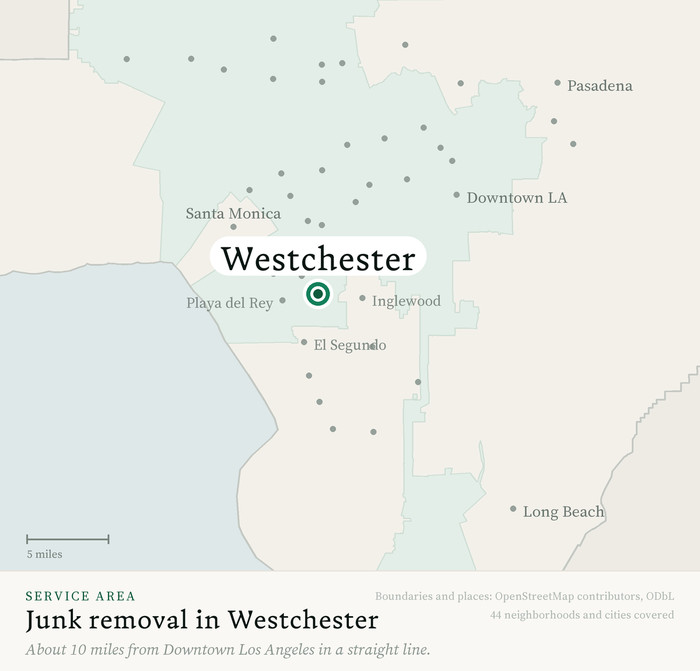
The covered list is narrow and specific: mattresses and foundations discarded by California consumers, individuals and businesses alike, with a futon mattress that separates from its frame or base counting as a mattress in California. The excluded list is long and is the part worth reading before a turnover. It leaves out bed frames, futon frames and bases, sofa beds, mattress pads and toppers, pillows, loose bedding, cushions, sleeping bags, roll-away beds, car beds, air mattresses and water beds with no upholstery material, partial units stripped of their padding, crib and bassinet mattresses and other juvenile products, and units that were not used in California. Clearing ten rooms in a Westchester building therefore produces two streams and not one, and we separate them at the property rather than letting a mixed load make the decision.
Condition needs handling honestly. Bye Bye Mattress states that the condition of the unit and the date of purchase do not matter for eligibility, and the damaged, heavily soiled, moldy, excessively wet or bedbug-infested caveat that circulates online is published by the program for Connecticut and Rhode Island rather than for this state. The practical effect is that a tired old bed is simply a tired old bed, while a contaminated one needs its destination confirmed before it goes on a truck.
Bed bugs are the specific case where the preparation is not optional. The California Department of Public Health recommends hiring a pest control operator licensed by the state's Structural Pest Control Board, and states that all materials removed from a bed bug infested room should be placed in tightly sealed plastic garbage bags before being thrown away or properly washed, to prevent the bugs being moved to other areas. In a building with shared corridors, that sealed bag is the difference between removing one problem and distributing it. We wrap and seal on the floor the bed is on rather than at the truck, and we plan the route out before the unit is disturbed.
What arrives at the other end is taken apart. Steel springs go to metal recycling, foam is recovered, the timber inside a foundation is recovered as wood, and textiles are separated; Los Angeles County Public Works reports that up to 75 percent of mattress material can be recycled into other consumer goods, and that the county has close to twenty permanent no-cost mattress collection centers. Statewide the program reports 14.2 million mattresses collected since 2016, 555 million pounds of material recycled, more than 240 permanent drop-off locations and around a hundred collection events a year. One more free route worth remembering if you are replacing rather than simply disposing: California retailers, online sellers included, must offer free take-back of your used mattress or box spring when they deliver the new one, which makes the delivery day the cheapest removal there is.