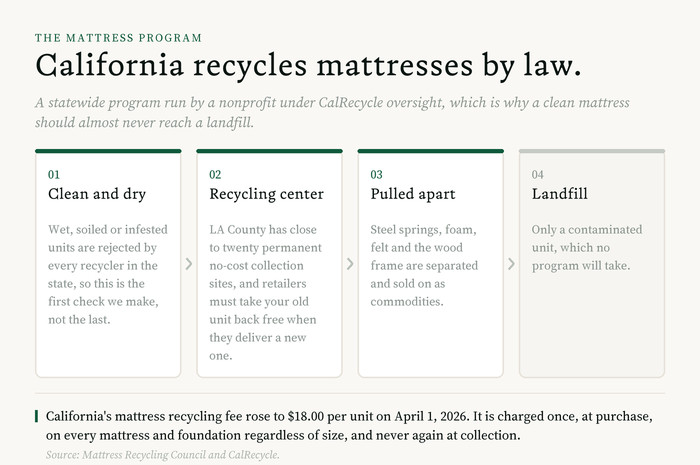
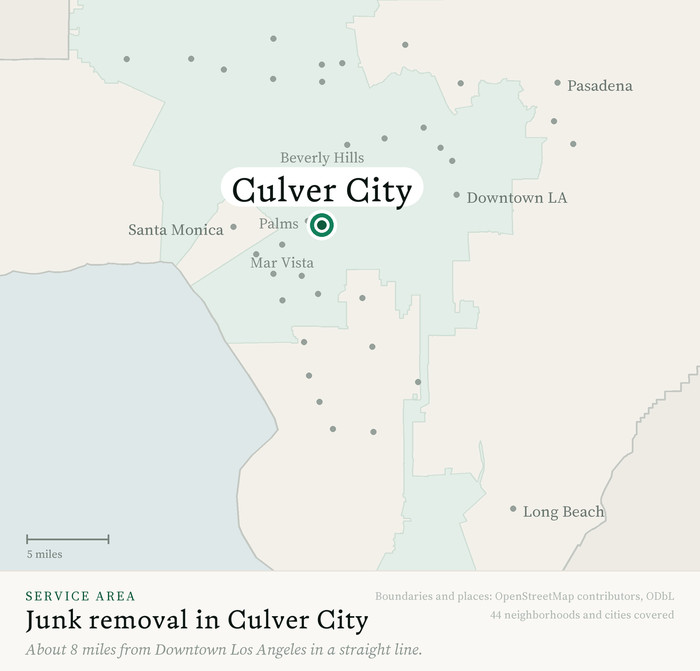
The collection rules change at the Culver City line. The recycling system does not. California runs a mattress stewardship program administered by the Mattress Recycling Council, a nonprofit created by mattress manufacturers, renovators and retailers, under CalRecycle oversight, and funded by a recycling fee charged at the point of sale on every mattress, futon and foundation sold for use in the state. The fee increased from $16.00 to $18.00 per unit for units sold on or after 1 April 2026, is charged per unit regardless of size or type, is not subject to sales tax, and must appear as a separate line item on the receipt whether you bought in a store or online. Every retailer selling to an end user has to collect and remit it, including online and marketplace sellers and commercial volume sellers such as hotels, colleges and nursing homes.
What that fee buys is a unit that can be discarded without a disposal charge attached to it. Mattresses and foundations used and discarded by California consumers qualify, and a futon mattress that separates from its frame or base counts as a mattress in California. The exclusions are where a bedroom clearance divides. Bed frames do not qualify. Futon frames and bases do not. Sofa beds do not. Neither do mattress pads, mattress toppers, pillows, loose bedding, cushions, sleeping bags, collapsible roll-away beds, car beds, air mattresses or water beds containing no upholstery material, partial units stripped of their padding, crib and bassinet mattresses and other juvenile products, or units that were not used in California. In a Culver City apartment turnover that usually means the mattress and box spring go one way and the frame, the topper and the bedding go another.
Condition is worth a separate paragraph because two rules sit side by side. Bye Bye Mattress says the condition of the unit and the date of purchase do not matter for eligibility. Its wider FAQ then adds a caveat for the Connecticut and Rhode Island programs only: that a severely damaged, heavily soiled, moldy, excessively wet or frozen unit, or one infested with bedbugs or other organisms, should be discussed with the intended drop-off location first. That caveat is not published for California. The practical reading here is that a normal worn-out bed is fine and a contaminated one needs a route confirmed in advance.
Bed bugs deserve their own note in a city with this much shared-wall housing. The California Department of Public Health advises calling a pest control operator licensed by the Structural Pest Control Board, and states that all materials removed from a bed bug infested room should be placed in tightly sealed plastic garbage bags before being thrown away or properly washed, to stop the bugs being moved to other areas. CDPH also sets out the rental side: a tenant gives the property owner written notice describing what was found, when and where, with their name, unit and contact details; the owner must have a pest control operator inspect within 48 hours; and written notice of the findings must reach the tenant within two business days of that inspection. In a courtyard building or a duplex, getting that order right protects the neighbors as much as it protects you, and it is also what lets us handle the unit safely rather than improvising in a hallway.
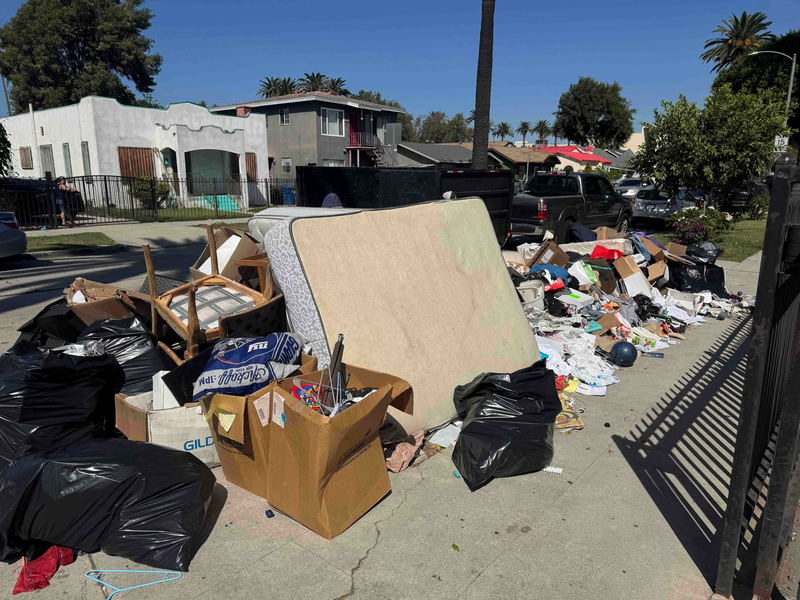
The last piece is why any of this is worth the trouble. A mattress that enters the program is taken apart rather than buried: steel to metal recycling, foam recovered, the timber of a foundation recovered as wood, textiles separated. Los Angeles County Public Works reports that up to 75 percent of mattress material can be recycled, and it is blunt about the alternative. The MRC funds an Illegally Dumped Mattress Collection Initiative at a million dollars a year, and reports that nearly 512,000 improperly discarded mattresses have been removed from alleys, sidewalks and other public spaces. In a city with as many alleys as this one, that statistic is a description of the local landscape rather than an abstraction.