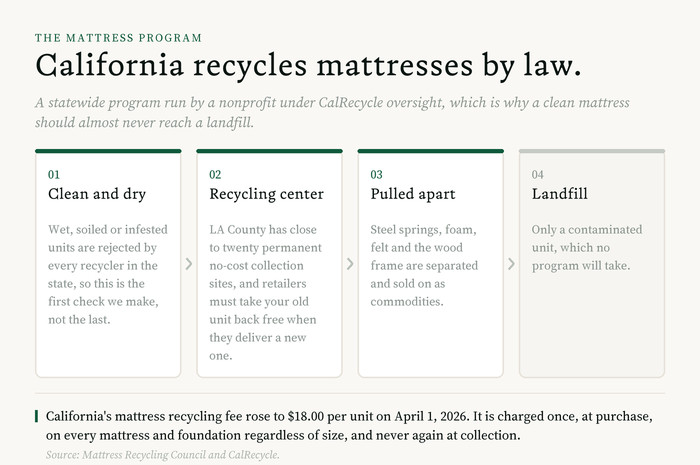
California does not leave mattress disposal to chance. The Mattress Recycling Council, a nonprofit stewardship organization created by mattress manufacturers, renovators and retailers, runs the Bye Bye Mattress program under CalRecycle oversight, and it is funded by a recycling fee collected at the point of sale. The fee rose from $16.00 to $18.00 per unit for units sold on or after 1 April 2026. It is charged per unit regardless of size or type, it is not subject to sales tax, and it has to appear as a separate line item on the receipt whether the sale happens in a store or online. Because that money is collected in advance, the used unit has somewhere to go later without a gate fee attached.
What the program covers is precise, and the precision is the useful part. It covers mattresses and foundations discarded by California consumers, individuals and businesses alike, and the program's own guidance says plainly that the condition of the unit and the date of purchase do not matter. A foundation, which most people call a box spring, counts. In California a futon mattress that separates from the futon's frame or base counts as a mattress. What does not qualify is a longer list than most people expect: bed frames, futon frames and bases, sofa beds, mattress pads, mattress toppers, pillows, loose bedding such as blankets, quilts and sheets, cushions from chairs or couches, sleeping bags, collapsible roll-away beds, car beds, air mattresses and water beds with no upholstery material, partial units that have been stripped of their padding, juvenile products including crib and bassinet mattresses, and any unit that was not used in California. So a bedroom clearance in a Brentwood house usually splits into two piles at the door, and only one of them is going into the stewardship stream.
Condition is the one place where the blanket rule softens. The program accepts units regardless of condition, and its California page says plainly that the condition of the unit and the date of purchase do not matter. The program's wider FAQ adds, for the Connecticut and Rhode Island programs, that if a mattress or box spring is severely damaged, heavily soiled, moldy, excessively wet or frozen, or infested with bedbugs or other organisms, you should contact the intended drop-off location for instructions, because no-cost drop-off of units in those conditions varies by location and fees may apply. That is a real distinction and it is worth knowing before you assume a unit from a flooded guest house or a long-closed pool house will be waved through. We check the unit at your address and confirm the receiving route rather than finding out at a gate.
There are two more free routes that exist independently of anything we do, and we will point you at them when they fit. California mattress retailers, including online sellers, are required by law to offer take-back of used residential mattresses and box springs free of charge when they deliver a new unit, which makes the delivery day the cheapest removal available if you are replacing rather than simply disposing. And Los Angeles County residents can use close to twenty permanent no-cost mattress collection centers spread across the county. Statewide the program reports more than 240 permanent drop-off locations, around a hundred collection events a year, and that 99 percent of California residents live within fifteen miles of a site or an event.
What happens at the other end is the reason any of this matters. A mattress that enters the program is dismantled rather than buried. Steel springs go to metal recycling, foam is recovered, the timber in a foundation is recovered as wood, and textiles are separated out; Los Angeles County Public Works reports that up to 75 percent of mattress material can be recycled into other consumer goods. Statewide the program reports 14.2 million mattresses collected since 2016 and 555 million pounds of material recycled. That is why we would rather route a Brentwood bed into the program than take it to a general disposal gate, and why the piece of the job you are paying for is the carry, not the mattress.