Mon–Sat open 24 hours · Sun 1–10pmFully insuredFamily-run, LA-based
team@lajunkhauling.com
Call us today(323) 230-0777
Home/Guides/Battery disposal

Every battery in your house,
and where it legally goes

No battery belongs in any of your three bins in California, and the lithium ones in the drawer are the reason sorting plants burn down.

Free quote, no obligation · one flat number before we start · you can also text that number

Published · last checked · written by the crew at Los Angeles Junk Removal & Hauling

The short answer

Every battery is banned from California trash, including ordinary alkaline AAs. In Los Angeles you drop them free at any of seven LA Sanitation S.A.F.E. Centers, open weekends 9:00am to 3:00pm, up to 125 pounds or 15 gallons per visit. Tape the terminals first.

There is no legal bin for a battery in this state. CalRecycle's list of waste banned from the trash names them outright: “AAA, AA, C, D, button cell, 9-volt, and all others, both rechargeable and single-use.” The free route here is LA Sanitation's S.A.F.E. Centers, open every weekend to City and County residents with no appointment. One instruction matters most: tape the terminals, or bag each cell, before they travel together.

Most people here know a car battery is not trash. Almost nobody knows the AA in the TV remote is not either. So: what the state classifies, which free LA site takes which chemistry, and what a crushed lithium cell does in a truck.

The rule under all of it

Every battery is universal waste

California treats batteries as hazardous waste on a simplified route called universal waste, under Title 22 of the California Code of Regulations, Division 4.5, Chapter 23. That is why you may drive a shoebox of dead AAs across town without a manifest. It is not permission to bin them.

CalRecycle's list of waste banned from the trash gives the reason in a line: batteries “cause fires with worker injuries in sorting and recycling facilities.” The city names them first on its black bin page among items that must go to a S.A.F.E. Center instead. The ban is usually quoted with a year attached; we could not read an effective date off any current state page today, so this guide states the rule and leaves the date alone.

Universal waste batteriesNickel-cadmium, silver button cells, mercury batteries, small sealed lead-acid alarm packs, most alkaline, carbon-zinc
Not universal wasteCar and similar lead-acid batteries: still hazardous, still banned from the trash, but on their own take-back law

Sources: CalRecycle's list of waste banned from the trash, its black bin page and LA County Fire's hazardous materials division. Read October 29, 2026.

The part no city page writes down

Battery by battery, where each one goes

Chemistry sets the prep step, not size. A plain alkaline AA is the one case where you can skip terminal protection. Anything with lithium on the case gets taped whatever shape it is, and so does every 9-volt, whose terminals sit side by side and short in a pile.

Household batteries in Los Angeles, by chemistry
BatteryWhere it legally goesPrep step
Alkaline AA, AAA, C, D, 9VS.A.F.E. Center, roundup, library bucket or retail boxNone on plain alkaline. Tape every 9-volt and anything marked lithium
Lithium primary: coin cells, CR123Same free routes. Never the black bin, never the blue binTape or bag each cell alone. A loose coin cell is a swallowing emergency for a toddler
Lithium-ion rechargeable: phones, laptops, tools, vapesS.A.F.E. Center, roundup, or any retailer selling rechargeablesOne battery to a bag, or tape it with clear packing, electrical or duct tape. Masking tape falls off
Lithium-ion packs: e-bike, scooter, mowerS.A.F.E. Centers accept e-bike and e-scooter batteries. The Battery Network's e-bike and high-energy programs take participating brands onlyCall first. Never post a pack this size into a drop box
Nickel-cadmium and NiMHSame free routes. Both are named universal wasteBag or tape. Nickel-cadmium is a cadmium waste
Button and silver-oxide cellsSame free routes. CalRecycle also lists button cells as mercury wasteTape or bag individually, never loose with keys and coins
Sealed lead-acid: backups, alarm panels, exit lightsUniversal waste. S.A.F.E. Centers and county events take itUpright, terminals taped, nothing metal on top
Lead-acid car, motorcycle, RV, marineAny retailer selling lead-acid must take yours back free, up to six a person a day. S.A.F.E. Centers take them tooUpright, in a tray, in the trunk. Keep the receipt for the deposit

Sources: LA Sanitation's S.A.F.E. Centers, The Battery Network, LA County Fire's hazardous materials division and the California Department of Tax and Fee Administration. Read October 29, 2026.

Rather not deal with any of it? Tell us what is there and we will price it.

Free upfront quote, no obligation. If your city will haul it free instead, we will tell you that first.

5.0 from 70 reviews on GoogleMon–Sat, open 24 hours

On the job
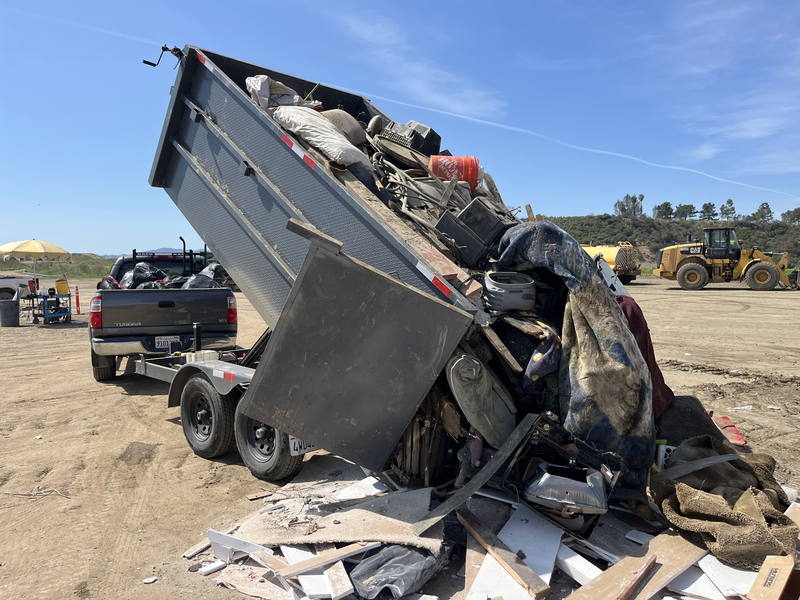
Our dump trailer raised and tipping a full household load onto the working face of a Los Angeles County transfer station, a wheel loader waiting in the background
Tipping a household load at the transfer station
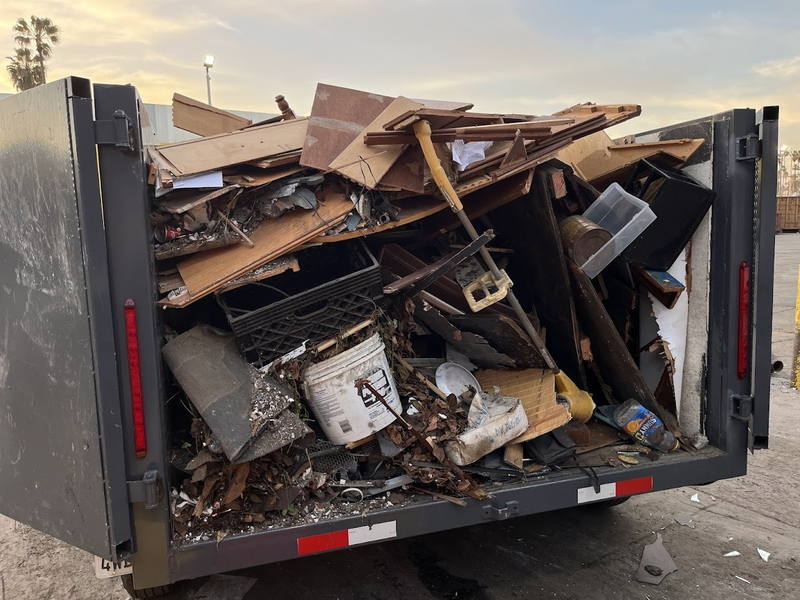
Our dump trailer loaded with mixed construction debris at dusk: cut timber, baseboard, a paint bucket, crates and broken fixtures stacked above the tailgate on a Los Angeles County job
A mixed construction load, ready for the transfer station
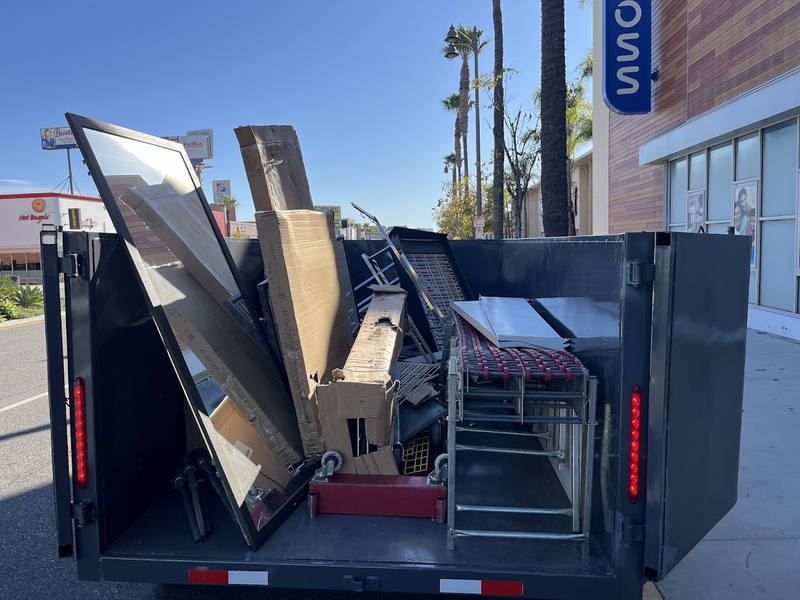
Our dump trailer loaded outside a Los Angeles County retail unit with flat-pack furniture cartons, steel gondola shelving, a stock trolley and display racking
Shop fixtures and flat-pack stripped out of a retail unit

Our own crews on Los Angeles County jobs. Side yards, narrow walkways and the back of the property is where most of the work actually happens.

Why the rule is this strict

What a crushed lithium cell does in a truck

A lithium-ion cell is an anode, a cathode and a thin plastic separator sitting in flammable electrolyte. The separator is all that holds the two ends apart. Crush it and the stored energy comes out at once as heat. That is thermal runaway, and the EPA's description is blunt: it “can quickly produce enough heat to ignite materials near the battery, even if the battery itself does not ignite.” The heat spreads to neighboring cells, which is why these fires reignite after they look out, and the damage need not be fresh: the EPA notes a crushed cell may catch later in its life.

Now put that cell in a collection truck, which crushes what it swallows with an onboard compactor. The EPA records the standard response: dump the burning load somewhere safe and wait for the fire department. A sorting plant is worse, being conveyors and shredders built to break material apart; one that counted pulled over 1,000 lithium-ion batteries from its recyclables in five weeks. A swollen case is the warning you can see, and that is the one battery that must not ride in a bag with others.

245fires at 64 US waste facilities, 2013 to 2020
78%of those sorting plants called the fire department
7,294tons of batteries landfilled in California a year

From the EPA's 2021 report on battery fires in waste management and CalRecycle, which calls batteries the top cause of fires at California’s waste facilities.

  1. 1

    Get it off anything that burns

    Off the carpet, off the bed, out of the backpack. Concrete or a metal tray, clear of paper.

  2. 2

    Do not bag it with the others

    The Battery Network states that swollen, leaking, overheating or punctured lithium-ion cells “cannot be dropped off with your other batteries.” LA Sanitation's prep list says the same.

  3. 3

    Tape it, keep it upright, call before you drive

    LA Sanitation publishes no policy on damaged cells, so ask on 1-800-773-2489 and tell the attendant on arrival. If it is hot, hissing or smoking, that is a 911 call.

Handling from The Battery Network and LA Sanitation's S.A.F.E. Centers. Read October 29, 2026.

The free routes, first

Where to take them in Los Angeles

Seven permanent city centers, free, no appointment, open to City and County residents alike. S.A.F.E. stands for Solvents, Automotive, Flammables and Electronics. The cap is 15 gallons or 125 pounds a visit, and the address the waste came from is asked for at the gate. All run 9:00am to 3:00pm; unless a row says otherwise, that is Saturday and Sunday.

Hyperion, Playa del Rey7660 W. Imperial Hwy, Gate B · driver's license asked for
UCLA, Westwood550 Charles E. Young Dr West · Fri and Sat, plus the first Sunday of each month
Nicole Bernson, Northridge10241 N. Balboa Blvd
Randall Street, Sun Valley11025 Randall St
Los Angeles-Glendale, Atwater Village4600 Colorado Blvd · Saturday only · photo ID asked for
Washington Boulevard, Central LA2649 E. Washington Blvd
Gaffey Street, San Pedro1400 N. Gaffey St
ClosuresAll seven close December 24 to January 3; UCLA also November 27. Bad weather may close any of them
LASAN Mobile Collection EventsSame list and cap, drive-thru. On the LASAN event calendar; none was listed for the rest of 2026
LA County, free to any county residentDrive-through roundups most Saturdays 9:00am–3:00pm in a different host city, no appointment, same cap, nothing from a business. Permanent centers in Palmdale and Signal Hill
Library bucketsSmall single-use and rechargeable cells only. No vape pens, bulbs, phones, e-waste or trash

Source: LA Sanitation's S.A.F.E. Centers and the facility pages for Hyperion, UCLA, Nicole Bernson, Randall Street, LA-Glendale, Washington Blvd and Gaffey Street, plus LASAN Mobile Collection Events and LA County Public Works. Read October 29, 2026.

The two laws that save you a trip

The store that sold it has to take it back

You may not need a S.A.F.E. Center. Per CalRecycle's legislative history, AB 1125 enacted the Rechargeable Battery Recycling Act of 2006: on and after July 1, 2006 a retailer selling rechargeable batteries here must have a system to accept used ones free, of a type or brand it sells. That is the store's obligation, not a favor; The Battery Network publishes a drop-off locator by ZIP code. Car batteries run on their own law.

Lead-acid take-backA retailer must accept used lead-acid batteries and may not charge to receive one, but need not take more than six a person a day. Health and Safety Code 25215.2
The two state feesThe CDTFA publishes both at $2.00 since April 1, 2022, $1.00 before: the California battery fee on the purchaser, collected by the retailer, and the manufacturer battery fee on the manufacturer or importer
The refundable deposit, or core chargeCharged whether or not you hand over the old battery, refunded if you return one of the same type and size within 45 days, and stated separately from the fee on the invoice. DTSC administers it
Statewide stewardship, not running yetThe Responsible Battery Recycling Act is law, but CalRecycle was still in informal rulemaking at a June 16, 2026 workshop. No statewide producer-funded program exists today

Sources: the California Department of Tax and Fee Administration, Lead-Acid Battery Fees Guide; CalRecycle's legislative history; and CalRecycle. Read October 29, 2026.

The four wrong answers

Where batteries must not go

Not the blue bin. The worst of the four: the blue bin is where the machinery is. Our blue bin guide lists what does belong there.

Not the black bin. LA Sanitation names batteries first among items that must go to a S.A.F.E. Center instead.

Never loose in a bag of mixed recycling. Terminals touching other metal is how a dead-looking battery still starts a fire. The EPA lists the best practices people miss as “taping the terminals and/or bagging batteries individually.”

Not on a bulky-item pickup. LASAN's free bulky collection refuses chemicals, automotive parts and hazardous waste. A box of batteries left beside a couch is a dumped load, not a pickup — see our guide to illegal dumping fines. Unlawful disposal of hazardous waste is a crime under Health and Safety Code 25189.5; we quote no dollar figure, because the legislature's own site was unreachable today.

Being straight about it

When we are the wrong call

A shoebox of dead AAs is a free errand. Tape the 9-volts, bag the lithium ones, drop the box at whichever S.A.F.E. Center is on your side of town. Hiring anyone to do that would waste your money.

There is also a hard limit on what we can do when you do want help. We are a general hauler, not a registered hazardous waste transporter, and we cannot legally carry hazardous waste on the truck. Batteries, paint, solvents and oil go in a resident's own car, or to a licensed contractor. A hauler who offers to throw your car battery on the back is telling you how they operate.

Where a crew earns its keep is the load around the batteries: a garage cleanout where one shelf is forty years of corroded D cells and the rest is shelving, bikes and particle board; an estate cleanout on a probate clock; a pile of electronics with the batteries sealed inside. The split that works: you box the batteries and chemicals and run them in, we take the rest in one visit.

Worth knowing

The parts people get wrong

What to know
  1. Every battery is banned from the trash in California, including ordinary alkaline AA, AAA, C, D and 9-volt cells.
  2. Los Angeles has seven S.A.F.E. Centers taking batteries free, capped at 15 gallons or 125 pounds per visit.
  3. The Los Angeles-Glendale S.A.F.E. Center opens Saturdays only; the UCLA center opens Fridays, Saturdays and the first Sunday of each month.
  4. Tape the terminals or bag each battery separately before transport; plain alkaline cells are the only exception.
  5. A swollen or punctured lithium-ion battery must never be bagged with others, and must be declared at the counter.
  6. A California retailer must take back used rechargeable batteries free, and used lead-acid batteries up to six a person a day.
Where this comes from

Sources

Every rule, fee, limit and deadline on this page is from the body that sets it. Checked on the date above; if a city changes its program we change the page.

  1. LA Sanitation — S.A.F.E. Centers and household hazardous wasteAccepted types, taping and bagging, swollen cells kept separate, the cap, the library buckets.
  2. LA Sanitation — Black bin collectionThat batteries go to a S.A.F.E. Center, not the trash.
  3. LA Sanitation — Mobile Collection EventsFree drive-thru events for City and County residents.
  4. CalRecycle — Waste Banned from the TrashAll batteries banned from trash, recycling and organics bins.
  5. CalRecycle — Battery StewardshipTop cause of fires at California waste facilities; 7,294 tons landfilled a year; the 2026 workshop.
  6. CalRecycle — History of California Solid Waste LawAB 1125 and the July 1, 2006 take-back duty.
  7. US EPA — Lithium-ion Battery Fires in Waste Management and Recycling245 fires at 64 facilities in 28 states, thermal runaway, the compactor failure mode, taping and bagging.
  8. CDTFA — Lead-Acid Battery Fees GuideBoth fees at $2.00 since April 1, 2022, the take-back duty, the 45-day deposit.
  9. LA County Public Works — HHW and E-Waste Collection CentersFree Saturday roundups, the cap, the Palmdale and Signal Hill centers.
  10. LA County Fire — Identifying Universal Waste GeneratorsWhich chemistries universal waste covers; car batteries excluded.
  11. The Battery Network (Call2Recycle) — What to RecyclePrep by chemistry; damaged cells cannot go in an ordinary drop-off.

If you would rather not do it yourself

Same crew, one visit, one number agreed before anything is lifted.

Related guides

The rest of the LA disposal manual.

Battery disposal, answered

The follow-up questions people ask after this one.

Can I throw away AA batteries in Los Angeles?

No. CalRecycle lists all batteries, including AAA, AA, C, D, button cell and 9-volt, rechargeable and single-use, among items banned from the trash, the recycling bin and the organics bin. LA Sanitation sends them free to a S.A.F.E. Center instead.

Where can I recycle batteries for free in Los Angeles?

Any of the seven city S.A.F.E. Centers, open weekends 9:00am to 3:00pm, no appointment, free to City and County of Los Angeles residents, up to 15 gallons or 125 pounds a visit. LA County runs free Saturday roundups, and library branches host buckets for small batteries.

Do I need to tape battery terminals before recycling them?

Yes for anything marked lithium, every 9-volt and all rechargeables. LA Sanitation's instruction is to tape terminals whenever possible and store batteries in a non-metal container or plastic bag, using clear packing, electrical or duct tape. Plain alkaline cells need none.

What do I do with a swollen lithium-ion battery?

Keep it clear of anything flammable, do not bag it with other batteries, tape the terminals and keep it upright. Damaged lithium cells cannot go in an ordinary drop-off box, so call ahead and say so at the counter. If it is smoking, call 911.

Does an auto parts store have to take my old car battery?

Yes. A California retailer selling lead-acid batteries must accept used ones and may not charge to receive one, though none has to take more than six from a person in a day. The deposit you paid is refunded if you return a battery of the same type and size within 45 days.

Why are batteries such a problem for recycling trucks?

A damaged lithium cell can enter thermal runaway, releasing its energy as heat fast enough to ignite everything around it, and garbage trucks crush what they collect. The EPA documented 245 fires at 64 US waste facilities between 2013 and 2020.

The proof

What our customers say

5.0from 70 reviews on Google

Word for word from Google. Nothing tidied.

  • 7 months ago

    Working with Hunter and this company was great. Gave us a quick quote over the phone after sending photos and was able to help us the SAME day. Removal was fast and easy. We definitely recommend going with this company.

    Ingrid Mira3 reviews · 1 photoSame-day pickup, quoted from photos
  • Fair pricing 11
  • Personable staff 10
  • Polite 5
  • Punctual staff 4

Request a quote

Send a photo, get a flat number back. Free, no obligation, no pressure and no call-out fee — and if your city will haul it free instead, we will tell you that too. Most requests are answered within the hour during working hours.

Or call or text (323) 230-0777 — Mon–Sat around the clock, Sunday 1–10pm.

Call (323) 230-0777Text a photo