Mon–Sat open 24 hours · Sun 1–10pmFully insuredFamily-run, LA-based
team@lajunkhauling.com
Call us today(323) 230-0777
Home/Guides/Who accepts a sealed fridge

Who will actually accept
an old refrigerator

A refrigerator is hazardous waste until a certified technician empties it, and that single fact decides which gates in Los Angeles County may legally take it at all.

Free quote, no obligation · one flat number before we start · you can also text that number

Published · last checked · written by the crew at Los Angeles Junk Removal & Hauling

The short answer

A sealed refrigerator may not be disposed of at any California solid waste facility until a certified technician removes the refrigerant, so a landfill or transfer station cannot legally accept one. The free routes are a retailer haul-away on delivery or your city's appliance program; a scrap yard may take it only if it holds a current state certification.

Under California Health and Safety Code 25212 the materials requiring special handling inside a major appliance may not be disposed of at a solid waste facility at all. A sealed refrigerator still holds its refrigerant, and often mercury switches, a PCB capacitor and used oil as well, so until a certified technician has taken them out the unit is not ordinary bulky waste and the dump is not an option. That rules out the route most people try first.

What is left is short. A retailer will haul the old unit away when the new one is delivered, usually free and usually on conditions checked at the door rather than at the point of order. Your city’s appliance program will take it from the curb. And a yard or facility may accept one directly only where it is certified to open a sealed appliance, which is fewer places than the internet suggests and the reason the two tables below exist.

This page is the gate list: who may legally take a refrigerator off your hands, who says on their own website that they will, and who has published a refusal. The refusals are sourced as carefully as the acceptances, because driving across the county to be turned away at a scale house is the most expensive mistake available here.

If you want the collection answer instead -- whether your city picks a refrigerator up and on what terms -- that is the per-city register. The routes in order of cost, the dead rebates and the working-fridge options are on the main refrigerator guide.

The answer nobody has published

It is illegal to take a sealed refrigerator to the dump

California Health and Safety Code section 25212 is one sentence long in the part that matters, and it closes the route almost every search result recommends. Subdivision (a), verbatim: “Materials that require special handling that are contained in major appliances shall not be disposed of at a solid waste facility and shall be removed from major appliances in which they are contained prior to the appliance being crushed, baled, shredded, sawed or sheared apart, disposed of, or otherwise processed in a manner that could result in the release or prevent the removal of materials that require special handling.”

Read the first clause again. It does not say handled carefully at a solid waste facility. It says those materials shall not be disposed of there. The statute’s term is solid waste facility, not landfill, and that is deliberate: it is the category that covers the tip face and the transfer station you would actually drive to. A posted gate fee is not a permission slip.

Subdivision (d) closes the gap, in eleven words. Subdivision (a) names nobody — not a certified recycler, not a scrap yard, not a hauler, not a homeowner — and (d) supplies the subject, verbatim: “A person who fails to comply with subdivision (a) is in violation of this chapter.” The chapter is chapter 6.5 of the Health and Safety Code, California’s hazardous waste control law.

Then subdivision (b) does something that surprises almost everyone. Subdivision (b) reads: “A person who, pursuant to subdivision (a), removes from a major appliance any material that requires special handling, that is a hazardous waste under this chapter, is a hazardous waste generator and shall comply with all provisions of this chapter applicable to generators of hazardous waste.” Pull the refrigerant and you become a hazardous waste generator, with the accumulation, labeling, transport and record duties that status carries. Subdivision (c) adds that once those materials are out of the appliance, the ones that are hazardous waste have to be managed under the same chapter.

Who enforces it explains why this has stayed invisible. Subdivision (e) puts enforcement with the Department of Toxic Substances Control and also with a local health officer or other local public officer acting under Article 8 of the chapter, beginning at section 25180. In practice that local officer is a Certified Unified Program Agency, a county or city body rather than a state one, which is why the San Bernardino County Fire hazardous materials CUPA publishes a compliance sheet about refrigerators at all.

What counts as a material that requires special handling. It is a defined term, not a judgment call:

  • Sodium azide canisters in unspent airbags that are determined to be hazardous by federal and state law or regulation
  • Encapsulated polychlorinated biphenyls (PCBs), Di(2-Ethylhexylphthalate) (DEHP), and metal encased capacitors in major appliances
  • Chlorofluorocarbons (CFCs), hydrochlorofluorocarbons (HCFCs), and other non-CFC replacement refrigerants injected in air-conditioning and refrigeration units
  • Used oil defined in California Health and Safety Code (CHSC) Section 25250.1 in major appliances
  • Mercury found in switches and temperature control devices in major appliances
  • Any other material that when removed from a major appliance is a hazardous waste regulated pursuant to chapter 6.5 of CHSC

Four of those six are in an ordinary kitchen refrigerator: the refrigerant, the compressor oil, the capacitor and the mercury switch. The list says CFCs, HCFCs and other non-CFC replacement refrigerants, which takes in the R-134a in a unit from the 2000s and the hydrocarbon blends in a new one. There is no model year after which a refrigerator stops being covered.

And major appliance is defined just as plainly: a domestic or commercial device including, but not limited to, a washing machine, clothes dryer, hot water heater, dehumidifier, conventional oven, microwave oven, stove, refrigerator, freezer, air-conditioner, trash compactor and residential furnace. The kitchen refrigerator, the garage chest freezer and the spare-room window air conditioner are three of those twelve, and every word of this section applies to all three identically.

25212(a)bans disposal at a solid waste facility
6classes of material that require special handling
12appliances the statute calls major

Subdivision (a) is the prohibition, subdivision (d) makes any person who breaks it in violation of the chapter, and subdivision (b) turns whoever removes the refrigerant into a hazardous waste generator. Four of the six material classes sit inside a normal refrigerator, which is why the appliance is treated as a sealed unit until someone qualified opens it.

The free route most people miss

What the store will take away, and what it will not

If a new refrigerator is being delivered, the delivery is the cheapest removal you will ever get: it costs nothing and it happens on a day you are already home. It is also the route with the most conditions attached, and almost all of them are checked at the door rather than at the point of order, which is why so many old appliances end up back in the kitchen.

Three conditions do most of the damage. The old unit usually has to be the same type as the new one. It usually has to be emptied, defrosted and disconnected before the truck arrives, by you. And a driver can refuse on sight for anything that makes the unit unsafe to handle. So ask at the point of order, in these words: is haul-away included, does it have to be the same type of appliance, and who disconnects it.

One honest note. A retailer is listed below only where we could read the terms on that retailer’s own policy page. Several of the obvious names serve that page behind a protection layer that blocks us, and the fees quoted for them elsewhere trace back to directory sites rather than to the retailer. A short table that is right beats a long one that is guessed, so if your retailer is not below, call and ask the three questions above.

Retailer haul-away on a new refrigerator delivery, read off each retailer’s own policy page
RetailerTakes the old one awayWhat it costsConditionsWhat gets refusedSource
Best Buy — haul-away with a replacement purchaseYes. Best Buy will take the old refrigerator when it delivers the new one, but only if the replacement is “delivered by Geek Squad® or Best Buy Home Delivery.”$49.99, in Best Buy’s words “haul-away with replacement product.” Read October 29, 2026; retailer pricing is set nationally and moves without notice.Conditional on buying the replacement from Best Buy and on Best Buy or Geek Squad doing the delivery. A separate $49.99 service fee is charged “for each appliance that is relocated within the delivery address,” so moving the old unit out of an upstairs kitchen is not necessarily included in the haul-away.Nothing refrigerator-specific is published. Best Buy publishes a disconnect requirement only for dishwashers: “Any dishwasher must be disconnected prior to appliance delivery … or it will not be eligible for haul-away.” We found no equivalent “must be emptied and defrosted” sentence for refrigerators, so do not assume one, and do not assume there is none either. Ask when you order.Best Buy recycling and haul-away
Best Buy — standalone haul-away, no purchase neededYes, and this is the one most people do not know exists. Best Buy will come and take an appliance away without you buying anything, covering “up to a total of 2 large products (including major appliances), along with an unlimited number of select smaller products.”$199.99 for the standalone haul-away, covering the visit rather than each item. Two large appliances on one visit is the cheapest version of this route. Read October 29, 2026.No purchase required, which makes it the only national retailer route we could verify for a refrigerator you are not replacing. Separately, Best Buy states “There are no store drop-off fees in California” — true, but the in-store drop-off program does not cover a full-size refrigerator, so do not drive one to a store.No refrigerant, bed-bug, mold or hazard-free refusal language appears on the page. Claims that Best Buy requires the unit to be “empty, disconnected and removable without disassembly” trace only to aggregator blogs, so we do not record them as fact.Best Buy recycling and haul-away
Pacific SalesNo separate policy exists any more. The Pacific Sales delivery page now returns a permanent redirect into Best Buy, which owns the brand, so Best Buy’s terms above are the operative published policy.Not published separately.Treat as Best Buy. We could not verify any Pacific-Sales-specific term on a Pacific Sales page, so we do not claim one.Not published separately.redirect target, read October 29, 2026
Home DepotCould not be verified. Home Depot’s appliance delivery page returned HTTP 403 to us on October 29, 2026, and its appliance-delivery FAQ host no longer resolves at all.Could not be verified. A flat haul-away fee is widely quoted online, but every retrievable source for it is an aggregator, not Home Depot, so we will not print it.Could not be verified. The commonly repeated rule is that the item hauled away must match the item being delivered. Again, aggregators only. Ask at the point of order and get it on the invoice.Could not be verified.page we tried, HTTP 403
Lowe’sCould not be verified. The appliance delivery help page returned HTTP 403 to us on October 29, 2026, serving a 402-byte block page rather than content.Could not be verified. A haul-away fee and a free-for-Pro claim circulate widely; both appear only in aggregator articles, so neither is recorded here.Could not be verified. Ask before you pay, and ask specifically whether the fee covers carrying it out of the kitchen.Could not be verified.page we tried, HTTP 403
CostcoCould not be verified, and the reason is worth knowing: the appliance delivery and installation page we were pointed to no longer exists. It returned HTTP 404 on October 29, 2026, serving a Costco-branded error page, so the host is fine and the policy path is simply gone.Not published at any URL we could find.Not published. Costco appliance delivery is run through a third-party logistics partner, so the terms you get are the ones on your order confirmation, not a public page.Not published.page we tried, HTTP 404
AmazonCould not be verified. Amazon’s appliance installation and haul-away help page returned HTTP 503 on October 29, 2026.Not verified. Haul-away on Amazon is sold as a per-item add-on at checkout, so the price you see in the cart is the only figure that binds.Not verified. Add-on availability depends on the seller and the ZIP code, so check it in the cart before you order rather than assuming it.Not verified.page we tried, HTTP 503

Each row was read on that retailer’s own delivery or haul-away policy page on October 29, 2026. Terms are set nationally and change without notice, so confirm at the point of order rather than at the door.

Rather not deal with any of it? Tell us what is there and we will price it.

Free upfront quote, no obligation. If your city will haul it free instead, we will tell you that first.

5.0 from 70 reviews on GoogleMon–Sat, open 24 hours

On the job
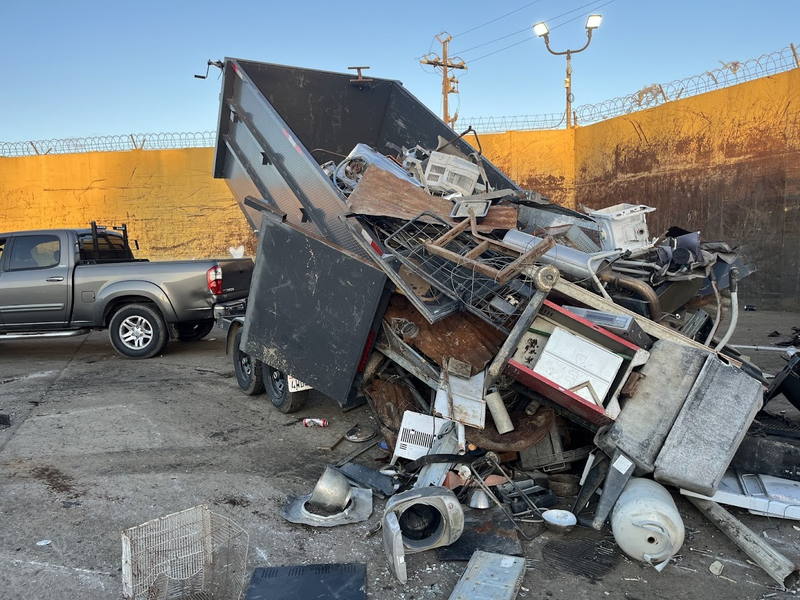
Our dump trailer tipping a load of scrap appliances at a Los Angeles County metal yard: stoves, air-conditioning units, a water heater and mixed steel sliding out onto the floor
Appliances and scrap metal going to the metal yard
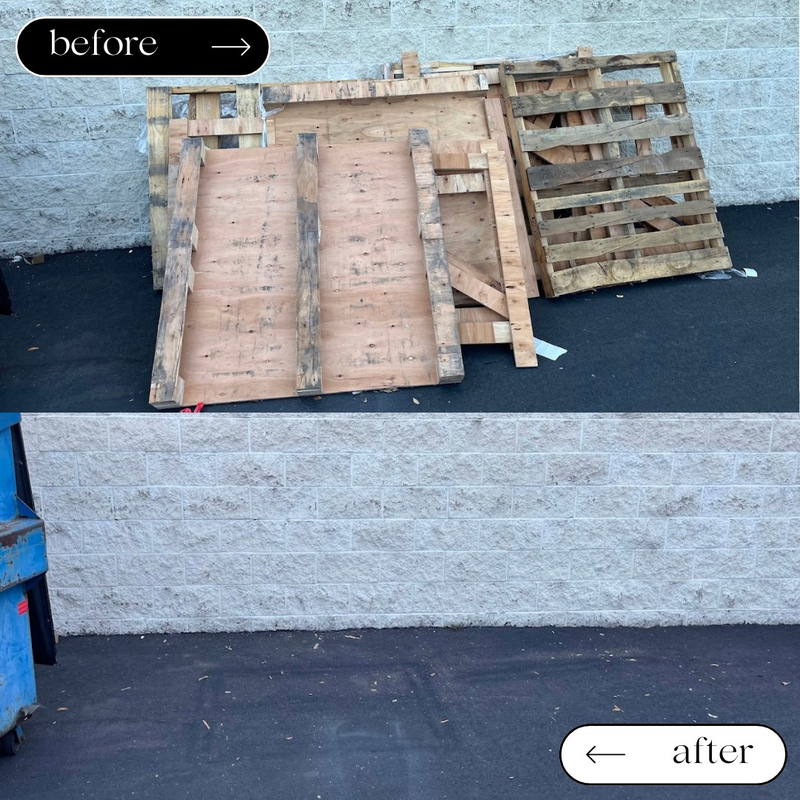
Before and after of a Los Angeles County loading bay: a stack of broken timber pallets heaped against the block wall, then the same wall with the asphalt completely clear
Before and after — a pallet stack cleared from a loading bay
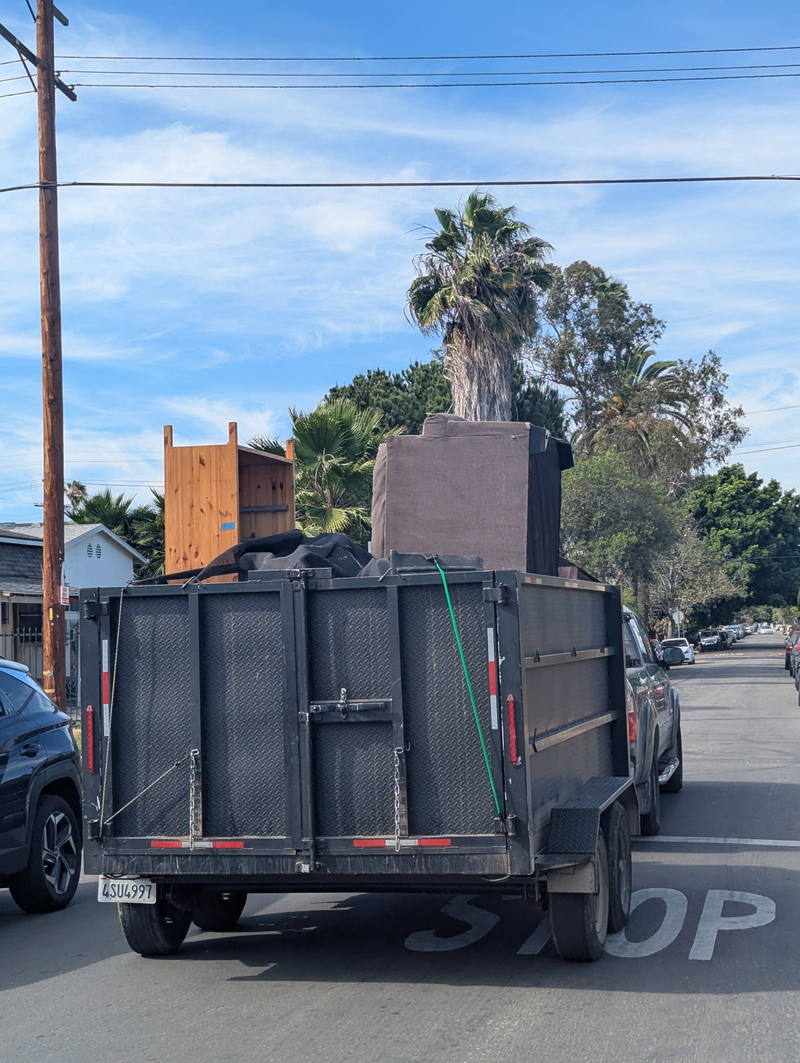
Our dump trailer pulling away down a palm-lined Los Angeles County street with a timber chest of drawers and a gray upholstered armchair strapped upright in the bed
Furniture strapped in and on its way out

Our own crews on Los Angeles County jobs. Side yards, narrow walkways and the back of the property is where most of the work actually happens.

The gate, and the refusal

Who in the county will actually accept a sealed fridge

Read this table before you load anything into a truck. A refrigerator that still holds its refrigerant is not ordinary bulky waste, and the list of facilities that will take one is far shorter than the list that takes everything else. The refusals below are sourced as carefully as the acceptances, because driving across the county to be turned away at a scale house is the most expensive mistake available here.

The register starts from the Department of Toxic Substances Control’s own list of certified appliance recyclers, because under state law that certification is what allows a business to take the hazardous materials out of a major appliance at all. Two things about that list have to be said out loud. The department’s own public page would not serve to us, so the copy behind the table below came off the department’s own content host instead. And the newest list the state publishes is dated May 19, 2020: all 35 Los Angeles County registrations on it have lapsed, the last of them in November 2022, and the state still presents that file as its approved register. We publish it anyway, labeled, because it is the only register of its kind and a stale official list is still the right starting point for a phone call. It is not evidence that any particular yard is certified today.

So the answer comes in two parts: the places whose own websites say something about a refrigerator, a short list that includes two outright refusals and one landfill now closed to all waste, and then the state’s register of businesses licensed to open a sealed appliance, a longer list and a weaker signal.

Transfer stations, scrap yards and charities in Los Angeles County, and what each one’s own site says about a sealed refrigerator
FacilityCityWhat it is, and whether it takes oneRefrigerant handlingFees or paymentHours and phoneSource
SA Recycling (yard locator)CountywideScrap recycler that lists “Appliance Recycling” among its own services and states it has “more than 150 locations” in the United States. Appliance recycling is a published service line, but whether a particular yard takes a sealed household refrigerator has to be confirmed yard by yard.The site names appliance recycling as a service but does not say whether refrigerant must be certified-removed before drop-off. Not published.Whether SA Recycling pays for a sealed refrigerator is not published; the what-we-buy page returned HTTP 404. Confirm by phone.Corporate line 1-800-GOT-SCRAP (1-800-468-7272); use the yard locator for a specific site. Per-yard hours not published.operator yard locator
Chiquita Canyon LandfillNot publishedLandfill, verified closed. The operator’s own words: “As of January 1, 2025, Chiquita Canyon Landfill is closed for the acceptance of waste.” That is a categorical refusal of all waste, refrigerators included.No refrigerant handling is published, and none applies: the site accepts no waste at all as of January 1, 2025.No gate rate applies because no waste is accepted. Not published.Closed to waste. Business office (661) 257-3655, after hours (877) 263-2561, info@chiquitacanyon.com.operator page
Sunshine Canyon LandfillSylmarLandfill. Accepted, verbatim: “Non-hazardous solid waste from residential and commercial establishments (municipal solid waste).” Prohibited, verbatim: “All hazardous and liquid wastes are prohibited from disposal at Sunshine Canyon as are many other waste types including untreated medical waste, car batteries, and whole tires.” White goods are named in neither list, so the operator’s own FAQ states neither acceptance nor refusal of a refrigerator. Self-haul by the public is not addressed either.Nothing about refrigerant or Freon handling appears on the operator’s FAQ. Not published.No gate fee and no self-haul rate are published on the FAQ. Not published.Open Monday through Friday 6 am to 6 pm and Saturday 7 am to 12 pm, closed Sunday and major holidays. Phone (818) 362-2124.operator FAQ
Allan Company, Baldwin ParkBaldwin ParkRecycling center. The published accepted-materials list reads “CRV beverage containers, cardboard, paper, plastics, metals and e-waste,” and the operator notes that acceptance varies by location. Refrigerators, appliances and white goods are not mentioned anywhere on the site, so this is not a refrigerator drop-off. That is an absence of acceptance language, not a quoted refusal.No refrigerant or Freon handling is published anywhere on the operator’s site. Not published.No fee and no payment for appliances is published. Not published.Weekdays 6 AM to 6 PM, Saturday 6 AM to 3:30 PM, Sunday closed. Phone (626) 962-4047.operator page
Allan Company, GlendaleGlendaleRecycling center. The published accepted-materials list reads “CRV beverage containers, cardboard, paper, plastics, metals and e-waste,” and the operator notes that acceptance varies by location. Refrigerators, appliances and white goods are not mentioned anywhere on the site, so this is not a refrigerator drop-off. That is an absence of acceptance language, not a quoted refusal.No refrigerant or Freon handling is published anywhere on the operator’s site. Not published.No fee and no payment for appliances is published. Not published.Weekdays 7:30 AM to 4:45 PM, Saturday 8 AM to 3:30 PM. Phone (818) 552-2870.operator page
Atlas Iron & MetalNot publishedScrap metal buyer whose published customer segments are “Contracting & Demolition” and “Machine Shops & Manufacturers.” Residential appliance acceptance is not addressed anywhere on the site, so it cannot be presented as a refrigerator drop-off on the strength of its own page.Refrigerant requirements are not addressed on the operator’s site. Not published.Payment for a sealed appliance is not addressed. The site asks you to call to discuss scrap metal or send photos. Not published.Phone 323-566-5184 or 800-540-5184; hours not published.operator page
Active RecyclingSouth LAScrap recycler with no working website: the domain redirects to a GoDaddy for-sale listing, so there is nothing operator-published to verify acceptance against. Do not treat this as an active option without a phone confirmation.There is no operator site to publish a refrigerant policy; the domain is parked. Not published.No pricing is published; the domain is parked and listed for sale. Not published.Not publishedoperator domain, parked
Athens Services bulky-item pickupNot publishedHauler whose own bulky-item request form offers “appliances” as a selectable category alongside mattresses, sofas, green waste, boxes and bags. No acceptance criteria and no refrigerator-specific rule are published, so a sealed refrigerator is unverified.No Freon or refrigerant language appears anywhere on the bulky-item pages. Not published.No price and no included-pickup allowance is published for bulky items. Not published.Phone (888) 336-6100 on the residential page and 1-800-773-2489 on the request form; hours not published.operator request form
Puente Hills Materials Recovery FacilityNot publishedCounty Sanitation Districts materials recovery facility. The host blocks automated retrieval site wide with HTTP 403, including from a browser user agent, so nothing could be read from the operator’s own page. Whether it accepts or refuses a household refrigerator is therefore unverified here. The load-requirements page linked in the source column is the current published path and is the one to read by hand.No refrigerant rule could be retrieved because of the site-wide block. Not published here.No gate rate could be retrieved because of the site-wide block. Not published here.Facility contact from LACSD’s own search metadata: (562) 908-4288 extension 6016. Hours not retrieved.LACSD load requirements
Commerce Refuse-to-Energy FacilityNot publishedCounty Sanitation Districts refuse-to-energy facility. The host blocks automated retrieval site wide with HTTP 403, including from a browser user agent, so nothing could be read from the operator’s own page. No accept or refuse claim is recorded for it here, in either direction.Nothing could be retrieved on refrigerant handling. Not published here.Nothing could be retrieved on gate rates. Not published here.Not publishedLACSD facilities list
Downtown DiversionNot publishedCounty Sanitation Districts solid-waste facility, so it sits behind the same site-wide HTTP 403 block. No facility-specific accept or refuse language was retrieved and no claim is recorded here.Nothing could be retrieved on refrigerant handling. Not published here.Nothing could be retrieved on gate rates. Not published here.Not publishedLACSD facilities list
Goodwill Southern CaliforniaNot publishedDonation centers. Verbatim: “we do not offer pick-up service.” What they accept is described as “small household appliances,” so a full-size refrigerator is outside the quoted scope, and even for an item they would take you have to transport it yourself. There is no quoted refusal of refrigerators, and the dedicated not-accepted page returned HTTP 404.Nothing about refrigerant or Freon appears in the donation guidance. Not published.No fee and no payment for an appliance donation is published. Not published.Not publishedoperator donation page
The Salvation ArmyNot publishedDonation pickup. “Schedule a Free Donation Pickup” is offered, and accepted appliances are “Appliances that still operate and are not built-in.” Not accepted: “Any appliances that have mechanical difficulties, missing power cord or is rusty or dirty. No gas appliances whatsoever,” plus built-in ovens, stoves, dishwashers and microwaves. Refrigerators are absent from the accepted examples, which are air conditioners, microwaves, TVs and washing machines or dryers, so a refrigerator is not affirmatively accepted and a dead one is refused by the quoted rule.No refrigerant or Freon rule is published on the pickup page. Not published.The pickup is published as free. No payment to the donor is published.Phone 1-800-SA-TRUCK (1-800-728-7825); hours not published. The scheduler is address driven and LA County availability was not confirmed.operator pickup page

Every row was read on that operator’s own website on October 29, 2026, and a refusal is recorded here as carefully as an acceptance, because the refusals are what send people home with the appliance still in the truck. Where an operator’s own site does not answer the question we say that instead of guessing, including the three county facilities whose host blocks automated reading entirely.

The state register: 35 certified appliance recyclers in Los Angeles County, and the date each certification lapsed

Read this as a call list, not as a set of open gates. Every row is a business that satisfied the Department of Toxic Substances Control that it could lawfully remove refrigerant, mercury switches, PCB capacitors and used oil from a major appliance. None publishes household drop-off terms, and every date in the Expired column is in the past, because the state has not published a newer list. SA Recycling holds 14 of the 35 registrations and is the only one that advertises appliance recycling on its own website, which makes it the realistic first call. Sun Valley is the densest cluster, five certified yards inside one ZIP code. When you call, the first question is whether their CAR number is current.

All 35 DTSC Certified Appliance Recycler registrations printed for Los Angeles County on the state’s most recent list, with the facility address and phone number DTSC published for each and the date each registration lapsed. Every one of the 35 has lapsed; none is current
CAR #Business name, as DTSC prints itFacility addressCityCertification expiredPhone
263SA Recycling, LLC dba SA Recycling12301 East Valley Boulevard, 91732El Monte2/1/2022(714) 632-2000
443SA Recycling, LLC dba SA Recycling16815 South Main Street, 90248Gardenanot legible on DTSC’s list(714) 688-4943
207SA Recycling, LLC dba SA Recycling2495 Buena Vista Street, 91706Irwindale8/29/2021(800) 468-7272
405SA Recycling, LLC dba SA Recycling45565 Division Street, 93535Lancasternot legible on DTSC’s list800-468-7272
529Unlimited Recycling45339 Division Street, 93535Lancasternot legible on DTSC’s list(661) 373-4350
517Pacific Auto Recycling, Inc.225 West Avenue H, 93534Lancasternot legible on DTSC’s list(661) 949-0048
218Williams Recycling Co., Inc.2225 East 92nd Street, 90002Los Angelesnot legible on DTSC’s list(323) 564-9011
126SA Recycling, LLC dba SA Recycling2104 East 15th Street, 90021Los Angeles7/5/2021(760) 343-0499
448SA Recycling2047 East 15th Street, 90021Los Angelesnot legible on DTSC’s list(714) 632-2000
301Ekco Metals2777 East Washington Boulevard, 90023Los Angeles8/17/2021(323) 264-1615
206SA Recycling, LLC dba SA Recycling3248 Long Beach Avenue, 90058Los Angeles8/29/2021(800) 468-7272
491City Fibers, Inc.2211 East Washington Boulevard, 90021Los Angelesnot legible on DTSC’s list(323) 583-1013
0541City Fibers, Inc.3033 East Washington Boulevard, 90058Los Angeles10/5/2021(323) 583-1013
204SA Recycling, LLC dba SA Recycling10313 South Alameda Street, 90002Lynwood1/3/2022(800) 468-7272
418SA Recycling, LLC dba SA Recycling1545 Gage Road, 90640Montebellonot legible on DTSC’s list(323) 725-3331
528North Hollywood Recycling DBA Eagle Recycling10825 Vanowen Street, 91605North Hollywood10/5/2020(818) 579-4247
539Zavala Family Inc DBA C&S Metal6850 Farmdale Avenue, 91605North Hollywoodnot legible on DTSC’s list(818) 853-7888
535H & P Recycling11801 Sherman Way, 91605North Hollywoodnot legible on DTSC’s list(818) 748-9102
411Alameda Metals Corp.37815 East 6th Street, 93550Palmdalenot legible on DTSC’s list(661) 538-0299
532United Scrap Force, Inc.13952 Saticoy Street, 91402Panorama Citynot legible on DTSC’s list(213) 822-6322
143SA Recycling, LLC dba SA Recycling1475 East Franklin Avenue, 91766Pomona7/6/2021(760) 343-0499
299Pomona Scrap Metal, Inc.1432 East First Street, 91766Pomona1/22/2022(909) 623-1373
208SA Recycling, LLC dba SA Recycling901 New Dock Street, 90731San Pedronot legible on DTSC’s list(800) 468-7272
525Ecology Recycling Services, LLC.13750 E. Imperial Highway, 90670Santa Fe Springsnot legible on DTSC’s list(562) 921-9974
538ARCA Recycling Inc15058 Shoemaker Avenue, 90670Santa Fe Springs6/2/2020(310) 223-2800
527Ecology Recycling Services, LLC.9309 Rayo Avenue, 90280South gate9/19/2020(562) 921-9974
259SA Recycling, LLC dba SA Recycling12428 Center Street, 90280South Gate1/25/2022(800) 468-7272
515Construction & Demolition Recycling9309 Rayo Avenue, 90280South Gatenot legible on DTSC’s list(323) 357-6900
131SA Recycling, LLC dba SA Recycling8250 Tujunga Avenue, 91352Sun Valleynot legible on DTSC’s list(760) 343-0499
209SA Recycling, LLC dba SA Recycling9748 San Fernando Road, 91352Sun Valley9/10/2021(800) 468-7272
414Kramar’s Iron & Metal, Inc.8821 San Fernando Road, 91352Sun Valleynot legible on DTSC’s list(818) 767-4303
469Express Metals Recycling12207 Branford Street, 91352Sun Valleynot legible on DTSC’s list(818) 897-0633
530CJ Metals Recycling Inc8973 Norrris Avenue, 91352Sun Valley12/7/2020(818) 771-9262
485Zavala Family Inc DBA SCV Recycling14654 Raymer Street, 91405Van Nuys10/1/2022(818) 782-5050
523Ecology Recycling Services, LLC.1813 E. Robidoux Street, 90744Wilmingtonnot legible on DTSC’s list(562) 921-9974

Transcribed from “Approved Certified Appliance Recycler List By City, Updated 5/19/2020” at the Department of Toxic Substances Control’s own content host, read October 29, 2026. DTSC’s own spellings and inconsistencies are preserved rather than corrected, including the header misspelling “Bussiness,” “South gate,” “Norrris Avenue,” the leading zero on CAR #0541, and the Lynwood row carrying a Los Angeles ZIP.

The Freon tag does not exist

The EPA says no sticker is required, in exactly those words

the EPA’s appliance disposal page ends the Freon-tag argument in one line: “Please note that no sticker is required for disposal.”

And the sentence underneath it is the one that gets repeated wrong most often. Verbatim: “Persons recovering refrigerant from small appliances (i.e., appliances containing five pounds or less of refrigerant) in the waste stream are not required to be Clean Air Act section 608 certified.” A household refrigerator is normally well under five pounds of charge, so the flat claim that recovering its refrigerant requires a Section 608 certification is false. The five-pound line is real, and it cuts the other way for bigger equipment: a walk-in cooler, a rooftop unit or a commercial system carrying far more than five pounds is not a small appliance, so for a restaurant kitchen treat the certification question as live.

What is actually true for a household unit is a duty rather than a document. The same page says: “The final disposer of appliances is responsible for recovering any refrigerant contained in appliances. If the entity that recovers the refrigerant is not the final disposer of the appliance, EPA requires a signed statement containing the name and address of the person who recovered the refrigerant, and the date that the refrigerant was recovered.” Read that as a chain of custody: responsibility lands on the last party in the line, and when somebody earlier in the chain did the recovery, the federal paperwork is a signed statement with three facts on it — a name, an address and a date. A scrap yard or a landfill that accepts your refrigerator may be the final disposer, and of course it wants that evidence before it puts a sealed box on a shredder. If you are selling a house, clearing an estate or emptying a rental, that is the document to ask for and photograph, not a tag.

So when someone insists on a Freon tag, ask which rule they mean. There are three honest possibilities. It can be the yard’s or the landfill’s own acceptance policy, which is entirely their right and usually satisfied by that signed statement. It can be a municipal requirement, which the EPA page explicitly contemplates: “Municipalities may also require the refrigerant to be recovered from appliances before they will accept it for pick-up. In such cases, you would need a professional, such as an employee of an appliance repair shop, to remove the refrigerant prior to disposal.” At least one city in Los Angeles County writes its accepted-items list as refrigerators with the refrigerant already out, and your city’s own row on this page is where to confirm whether yours does. Or it is claimed to be a federal requirement, in which case the page quoted above is the answer.

And if a quote carries a separate Freon or refrigerant line. Ask what the charge pays for. There are good answers: a technician’s time, recovery into a cylinder, the cost of sending the recovered refrigerant and the drained oil somewhere licensed, the fee the receiving yard charges for a refrigerated unit. The answer that should stop you is any version of “it is the federal certification fee” or “it pays for the EPA sticker,” because for a household refrigerator neither of those things exists.

None of this makes venting it yourself a good idea. Section 608 exists to keep refrigerant out of the atmosphere, and the state rule in the section above adds a second consequence: whoever removes the refrigerant becomes a hazardous waste generator and has to manage what came out. The federal exemption is about who is allowed to do the recovery, not about whether it has to happen.

The other federal duties are about the parts, not the gas. The same EPA page states: “Hazardous components, including PCBs, mercury, and compressor oil, must be removed from appliances before disposal in accordance with 40 CFR Parts 273, 279, 761. However, the treatment of foam is not regulated.” The consequence is immediate: “Because there are no requirements for foam recovery, the blowing agent contained in the foam insulation is typically emitted during shredding and landfilling.” The part of a refrigerator with the least regulation attached is the thick white layer that makes up most of its volume.

5 lbcharge at or below which no 608 certification applies
0stickers federal rules require for disposal
3parts of 40 CFR that govern the components

Five pounds is the EPA’s own small-appliance threshold and a household refrigerator is normally well below it. The three parts are 40 CFR 273 for universal waste, 279 for used oil and 761 for PCBs. The foam insulation falls under none of them, and the EPA says so in writing.

Eight questions, one phone call

A certified recycler already swore to all of this, so ask

Every certified appliance recycler in California has a document on file with the Department of Toxic Substances Control, signed under penalty of perjury, that answers nearly every question you would want to put to a stranger about to drive off with a sealed refrigerator. Health and Safety Code section 25211.4 sets out what has to be in it, and read once the list is a phone script. The certification requirement took effect on January 1, 2008, so no company is young enough to have missed it.

  • “What is the legal name of the business, and who owns it?” A good answer is an entity name that matches the name on the truck, the invoice and the business license, offered without hesitation. A bad answer is a first name and a cell number.
  • “Do you have a hazardous waste generator ID number from DTSC?” A good answer is a number read out without a search, or an honest “we do not, because we deliver appliances to a certified recycler who does, and here is who that is.” Both are fine. A bad answer is “we are fully licensed and insured,” which is a sentence about insurance, not about hazardous waste.
  • “Have you filed for a stormwater permit, or are you exempt?” A good answer picks one of the two and knows which; the permit exists because an appliance yard is a place where oil and refrigerant can reach a storm drain. A bad answer is “what is that?” from a company that also runs its own yard.
  • “Have you filed a hazardous materials business plan, or are you exempt?” A good answer names the agency it was filed with, which will be the local CUPA rather than Sacramento. The plan is the document that tells firefighters what is in the building.
  • “Will the invoice carry a business tax ID?” A good answer is yes, with an invoice emailed afterward. A bad answer is cash only and no paperwork.
  • “Can you send the business license, and a conditional use permit if you run a yard?” A good answer is a license number for the city it operates in, texted while you are still on the phone. A bad answer is that licenses are not needed for pickups.
  • “Who takes the refrigerant out, where does that happen, and what becomes of the oil and the capacitor?” The statute asks a certified recycler for exactly this: a technical description of how each material that requires special handling is removed and managed. A good answer is specific and boring: a named yard, recovery into a cylinder, oil drained and sent to a used-oil handler, capacitor and switches pulled before anything is crushed. A bad answer is “the recycler takes care of all that” with no name attached.
  • “Can you show documentation for the last three years?” A certified appliance recycler is required to be able to demonstrate that all materials requiring special handling have been properly removed and managed for the past three years, and failure to produce it is one of the violations the San Bernardino County Fire hazardous materials CUPA lists on its own compliance sheet. You are listening for whether the question is familiar.

Most junk removal companies are not certified appliance recyclers and do not need to be. Certification is for the business that removes the materials; a hauler’s job can lawfully be to move the appliance intact to somebody who is certified to open it. The one question that always applies, whoever you call, is: where does the appliance physically go, and is that place certified to strip it? A name and a city can be checked; an adjective cannot, which is why “Eco-friendly disposal” and “we recycle everything” appear most often on the sites of companies that take an appliance to the nearest transfer station.

Ask us the same eight. Our number is 323-230-0777, and the answer you should want from anybody, including us, is a name and an address you can look up rather than a reassurance.

25211.4the section that lists the filings
7items in the application
2008year certification became mandatory

The application is submitted under penalty of perjury, which is why this list is worth more than a company’s own promises: every item on it is something a certified business has already sworn to, and something an uncertified one has to improvise on the phone.

Where it actually goes

Even the recycling route landfills the foam and the plastic

the EPA’s appliance disposal page opens with the scale of it: “An estimated 11 – 13 million refrigerated household appliances reach their end-of-life annually.” Yours is one unit inside that number, and the same page describes the two things that happen to those units.

Route one is the landfill, and it is more structured than you would guess. Verbatim: “Typically, when a waste hauler brings appliances to a landfill, refrigerated appliances are separated until a technician recovers refrigerant and other hazardous components. The appliances are then landfilled. Sometimes disposed appliances are landfilled whole, without shredding or removal of durable components.” The normal case is that somebody pulls the refrigerant and the hazardous components first, which is the landfill satisfying the duty the previous section describes.

Route two is recycling, and it is not as complete as the word suggests. Verbatim again: “Appliance recycling typically entails recovery of refrigerant and removal of hazardous components followed by shredding of evacuated appliances. Metal components are typically separated and recycled, while glass, plastics and polyurethane foam, are typically sent to a landfill.” So the steel carcass and the copper come back as material, and the shelving, the liner and the insulation do not. This is the sentence to keep in mind when a company promises that your refrigerator will be fully recycled. The metal will be. The foam is landfilled on the EPA’s own description of the standard process, and because no rule governs foam recovery, the blowing agent inside it is typically released when the cabinet is shredded.

Those two descriptions also explain why one site accepts a sealed refrigerator and the next one refuses it. A landfill or transfer station that separates refrigerated appliances and recovers the refrigerant on site has a technician, a recovery machine and somewhere for the oil to go, and it can take your unit sealed. One that is not set up that way can only refuse the appliance or break the rule in the section above, and the better operators refuse. A published acceptance policy is a description of a site’s equipment rather than an opinion about your refrigerator, which is why calling first is never wasted.

The worst route is the one the EPA names. “Appliances left curbside might be landfilled or otherwise disposed of in an unsafe manner. To the extent possible, schedule the collection of your appliance with your Department of Public Works, a retailer, rebate or bounty program, or other recyclers.” An unscheduled refrigerator on a parkway is not in any system at all. Scheduling the collection is the entire difference, and in most of Los Angeles County it is free.

One new hazard, which is the reason to tell a crew what model you have. The same page notes that “some new refrigerated appliances are being manufactured with non-fluorinated refrigerants such as R-290 (propane).” Propane is flammable. A sealed system holding a hydrocarbon charge is a different object from one holding R-134a: no cutting, no puncturing of lines, no grinders near the compressor, and no assumption that a sealed unit is inert. The refrigerant type is printed on the data plate inside the cabinet or on the back, and reading it aloud to whoever is coming changes how the appliance is handled.

Finally, the program every older article still sends people to is closed. The EPA ran Responsible Appliance Disposal from 2006 to 2025 as a voluntary partnership. While it ran, RAD partners processed over 9 million refrigerated appliances and recycled 1.5 billion pounds of metals, plastics and other durable materials, against 11 to 13 million units a year. The program’s own address, epa.gov/rad, now returns a 404, and the pre-2025 RAD pages survive only on the January 2025 snapshot of epa.gov. A guide that points you at a RAD partner or a RAD bounty has not been checked since before 2025.

11-13MUS refrigerated appliances retired each year
9Mappliances RAD partners processed, 2006 to 2025
1.5Bpounds of material RAD recycled

The annual retirement estimate and the RAD totals are the EPA’s own, from its appliance disposal page. RAD closed in 2025 and its site now 404s, so its partner lists are not a route you can use today. The EPA publishes no figure for what share of a single refrigerator comes back as material, so none is stated here.

Worth knowing

The parts people get wrong

What to know
  1. A solid waste facility in California may not accept a refrigerator that still holds its refrigerant, so a landfill or transfer station is not a lawful route for a sealed unit under Health and Safety Code 25212.
  2. Retailer haul-away is the cheapest removal available, but almost every condition on it is checked at the door rather than at the point of order, so ask three questions when you buy: is haul-away included, must the old unit be the same type, and who disconnects it.
  3. The state's own register of certified appliance recyclers is dated May 19, 2020 and all 35 Los Angeles County registrations on it have lapsed, so treat it as a call list and ask whether the CAR number is current.
  4. California Health and Safety Code 25212(a) says materials that require special handling shall not be disposed of at a solid waste facility, so a sealed refrigerator has no lawful route to a landfill or transfer station until the refrigerant, oil, capacitor and switches have come out.
  5. There is no federal Freon sticker: the EPA states that no sticker is required for disposal, and recovering refrigerant from a household unit of five pounds or less does not require a Clean Air Act section 608 certification, though the final disposer is still responsible for making sure the recovery happens.
  6. Ask any hauler the questions HSC 25211.4 already asks a certified recycler, above all which certified yard the appliance physically goes to, because the EPA's own description of appliance recycling has the metal recycled and the foam, glass and plastics landfilled.
Where this comes from

Sources

Every rule, fee, limit and deadline on this page is from the body that sets it. Checked on the date above; if a city changes its program we change the page.

  1. LA Sanitation and Environment, Metal Appliance PickupThat a refrigerator in the City of Los Angeles is collected free on a separate appliance program rather than Bulky Item Pickup, on a different truck, with one business day’s notice and the doors removed.
  2. Department of Toxic Substances Control, certified appliance recycler listThe register of businesses certified to remove materials requiring special handling from a major appliance. The department’s own public page would not serve to us; the copy behind the table on this page came off its content host, is dated May 19, 2020, and shows all 35 Los Angeles County registrations already expired.
  3. LA Sanitation and Environment, Metal Appliance PickupThat a refrigerator in the City of Los Angeles is collected under Metal Appliance Pickup rather than the bulky-item program; that LASAN will pick up large metal and household appliances at no extra cost for residents with curbside collection; the accepted list of refrigerators and freezers, washers and dryers, dishwashers, air conditioners, water heaters and standard heaters; the invitation to call 1-800-773-2489 about any item that is mostly metal; the one business day’s notice before your regular trash day; that metal appliances often require a different truck and that a list of items is needed so the right truck is sent; that drivers can only pick up the specific items listed on their daily work order; the doors-off requirement and the reason given for it; the “Single-Family Residents” heading; the two booking routes, the 24-hour Customer Care Center and the MyLA311 Service Request Form; and the banner asking readers to update their bookmarks to sanitation.lacity.gov.
  4. LA Sanitation and Environment, Multi-family Bulky Item FeeThat the City operates an on-call service to collect bulky items including appliances for multifamily buildings, and that the Multi-family Bulky Item Fee is for ratepayers who receive their waste hauling service from a recycLA Service Provider. This is the source for appliances being named inside the bulky definition at five units and up.
  5. LA Sanitation and Environment, recycLA programWhat recycLA is: the City of Los Angeles franchise system under which private haulers service commercial and multifamily properties instead of LASAN crews, which is the billing relationship that decides which appliance program a building has.
  6. U.S. EPA, Appliance Disposal, Section 608The federal recommendation to schedule collection of a refrigerated appliance with a public works department, a retailer, a rebate or bounty program or another recycler rather than leaving it at the curb, which is the basis for the route order on this page.
  7. California Health and Safety Code 25212That materials requiring special handling in a major appliance shall not be disposed of at a solid waste facility and must be removed before the appliance is crushed, baled, shredded, sawed or sheared apart, and that a person who fails to comply is in violation of the chapter. This is why a scrap yard that is not itself certified cannot take a sealed refrigerator.
  8. LA Sanitation and Environment, Cleanup and Illegal DumpingThat dumping can be reported at myla311.lacity.org or on 800-773-2489 around the clock, that LASAN tracks every cleanup request through MyLA311, and that CleanStat surveys every city street at least twice a year and logs unreported items by category, metal and white goods among them.
  9. California Health and Safety Code section 25212Subdivision (a), that materials requiring special handling in major appliances shall not be disposed of at a solid waste facility and must be removed before the appliance is crushed, baled, shredded, sawed or sheared apart; (b), that whoever removes them is a hazardous waste generator; (c), management under chapter 6.5; (d), that any person who fails to comply with (a) is in violation of the chapter; (e), enforcement by DTSC or a local health officer or other local public officer under Article 8, beginning at section 25180. Read October 29, 2026.
  10. California Health and Safety Code section 25211.4What a certified appliance recycler must file with DTSC under penalty of perjury: business name, address and owner, a hazardous waste generator ID number, a stormwater permit filing or exemption, a hazardous materials business plan filing or exemption, a Franchise Tax Board tax ID, a copy of the business license and any conditional use permits, and a technical description of how each material requiring special handling is removed and managed; certification required from January 1, 2008. Read October 29, 2026.
  11. U.S. EPA, Appliance Disposal (Clean Air Act section 608)That no sticker is required for disposal; that persons recovering refrigerant from small appliances of five pounds or less of charge in the waste stream are not required to be section 608 certified; that the final disposer is responsible for recovery and that a signed statement with name, address and date is required when the recoverer is not the final disposer; that PCBs, mercury and compressor oil must be removed under 40 CFR 273, 279 and 761 while the treatment of foam is not regulated; that blowing agent is typically emitted during shredding and landfilling; that municipalities may require refrigerant recovery before pickup; the 11 to 13 million annual end-of-life estimate; the landfill and recycling process descriptions; the curbside warning; R-290 propane in new units; and the Responsible Appliance Disposal program history for 2006 to 2025, including over 9 million appliances processed and 1.5 billion pounds of material recycled. Read October 29, 2026.
  12. San Bernardino County Fire, Hazardous Materials CUPAIts Compliance Made Easy sheet for certified appliance recyclers, revised May 2024, which prints the verbatim list of materials that require special handling, the statutory list of major appliances, and the common violations including failure to produce three years of documentation that all such materials were properly removed and managed under HSC 25211.2 and 25211.3. Read October 29, 2026.
  13. EPA January 2025 web snapshotWhere the pre-2025 Responsible Appliance Disposal pages survive, now that epa.gov/rad and epa.gov/responsible-appliance-disposal both return 404. Checked October 29, 2026.
  14. U.S. EPA, Appliance Disposal (Section 608)Live at HTTP 200 on October 29, 2026. Carries the past-tense heading "Responsible Appliance Disposal (RAD) Program History" with the years 2006 to 2025, the EPA's own confirmation that the program has concluded.
  15. Goodwill Southern California, DonateLive at HTTP 200 on October 29, 2026. Source of the verbatim "We are sorry for any inconvenience; however, we do not offer pick-up service" and of the accepted-items description that reaches only small household appliances.

If you would rather not do it yourself

Same crew, one visit, one number agreed before anything is lifted.

Related guides

The rest of the LA disposal manual.

Gates and refusals, answered

The follow-up questions people ask before they load anything into a truck.

Can I take a refrigerator to the dump in Los Angeles?

Not while it is still sealed. California Health and Safety Code section 25212 states that materials requiring special handling contained in major appliances “shall not be disposed of at a solid waste facility” and have to be removed before the appliance is crushed, baled, shredded, sawed or sheared apart or otherwise processed. A refrigerator still holding its refrigerant, compressor oil, capacitor and switches is carrying four of those materials, so a landfill or transfer station is not a lawful destination for it in that condition, with or without a gate fee.

Subdivision (d) adds that “a person who fails to comply with subdivision (a) is in violation of this chapter,” and that means any person, not only a certified recycler. The lawful sequence is removal first, by a business set up to do it, and scrap metal afterward. Book a collection through your city’s appliance program or a hauler who can name the certified yard the appliance goes to.

Do I need a Freon tag to get rid of a fridge?

No. the EPA’s appliance disposal page says it outright: “Please note that no sticker is required for disposal.” There is no federal Freon tag, sticker or certificate that must be attached to a refrigerator before disposal. What the EPA does require, when the party that recovered the refrigerant is not the party finally disposing of the appliance, is “a signed statement containing the name and address of the person who recovered the refrigerant, and the date that the refrigerant was recovered.”

A scrap yard, landfill or city program can still set its own condition of entry, and the EPA notes that municipalities may require the refrigerant to be recovered before they will collect an appliance. Those are legitimate local rules. If someone tells you the tag is a federal requirement, ask which rule they mean, because that one is not.

Who is supposed to remove the refrigerant from an old refrigerator?

The EPA puts the responsibility on the final disposer: “The final disposer of appliances is responsible for recovering any refrigerant contained in appliances.” In practice that is the yard, landfill or recycler at the end of the chain, which is why they ask for evidence before accepting a sealed unit.

For a household refrigerator, the person doing the recovery does not have to hold a Clean Air Act section 608 certification: the EPA states that persons recovering refrigerant from small appliances of five pounds or less of charge in the waste stream are not required to be certified. That is not an invitation to do it in the driveway. Under California Health and Safety Code section 25212, whoever removes the material becomes a hazardous waste generator and has to manage what came out, and a larger commercial system is outside the five-pound exemption entirely.

How do I know a junk removal company can legally take my refrigerator?

Ask the questions the state already asks. Health and Safety Code section 25211.4 requires a certified appliance recycler to file, under penalty of perjury, its legal name and owner, a DTSC hazardous waste generator ID number, a stormwater permit filing or an exemption, a hazardous materials business plan or an exemption, a tax identification number, its business license and any conditional use permits, and a technical description of how each material requiring special handling is removed and managed.

Most haulers are not certified recyclers and do not need to be, so the question that always works is where the appliance physically goes and whether that place is certified to strip it. A name and a city can be checked; “we recycle everything” cannot. Ask us the same questions on 323-230-0777.

What actually happens to an old refrigerator after it is picked up?

One of two things, both described by the EPA’s appliance disposal page. On the recycling path, “appliance recycling typically entails recovery of refrigerant and removal of hazardous components followed by shredding of evacuated appliances. Metal components are typically separated and recycled, while glass, plastics and polyurethane foam, are typically sent to a landfill.” On the disposal path, refrigerated appliances are separated at the landfill until a technician recovers the refrigerant and hazardous components, and the appliance is then landfilled, though the EPA notes that units are sometimes landfilled whole.

So the steel and copper come back as material and the insulation does not, and because foam recovery is unregulated the blowing agent is typically emitted during shredding. No refrigerator is fully recycled, and nobody who promises that is quoting the EPA.

The proof

What our customers say

5.0from 70 reviews on Google

Word for word from Google. Nothing tidied.

  • 7 months ago

    Working with Hunter and this company was great. Gave us a quick quote over the phone after sending photos and was able to help us the SAME day. Removal was fast and easy. We definitely recommend going with this company.

    Ingrid Mira3 reviews · 1 photoSame-day pickup, quoted from photos
  • Fair pricing 11
  • Personable staff 10
  • Polite 5
  • Punctual staff 4

Request a quote

Send a photo, get a flat number back. Free, no obligation, no pressure and no call-out fee — and if your city will haul it free instead, we will tell you that too. Most requests are answered within the hour during working hours.

Or call or text (323) 230-0777 — Mon–Sat around the clock, Sunday 1–10pm.

Call (323) 230-0777Text a photo