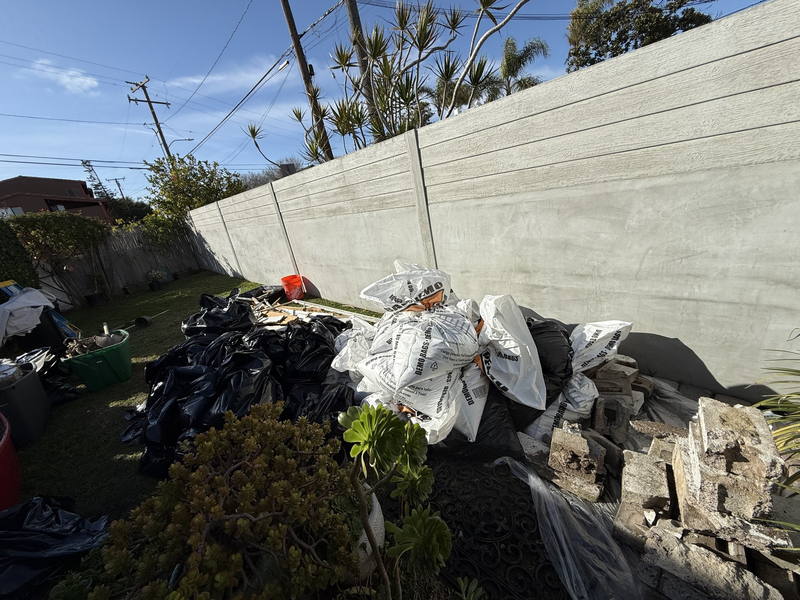
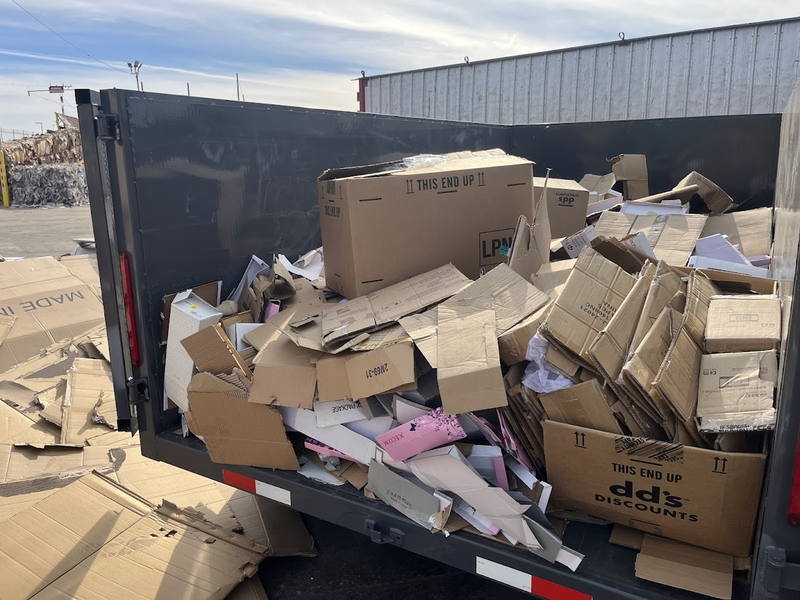
Working with Hunter and this company was great. Gave us a quick quote over the phone after sending photos and was able to help us the SAME day. Removal was fast and easy. We definitely recommend going with this company.
A refrigerator is not furniture and it is not a bulky item. It is a major appliance under state hazardous waste law, and that one fact decides which program collects it, which gate may legally accept it and what has to come off before it reaches the curb.
Free quote, no obligation · one flat number before we start · you can also text that number
Published · last checked · written by the crew at Los Angeles Junk Removal & Hauling
In the City of Los Angeles a refrigerator is not a bulky item. LA Sanitation collects it free on Metal Appliance Pickup, a separate program with its own truck, booked at least one business day ahead on 1-800-773-2489, and the doors have to come off before it goes to the curb.
We read every residential appliance program in and around Los Angeles County on the body’s own page: 32 of them. Twenty-four publish a free route. Fourteen attach a charge somewhere inside it. Six will not take the unit until the doors are off. Four run it on a different program from the bulky truck, which is the most common reason a booked collection leaves a refrigerator standing on the curb.
A refrigerator does not ride the program people assume it does. In the City of Los Angeles a sofa is a bulky item and a refrigerator is not: it is collected free under Metal Appliance Pickup, a separate program with its own page, its own truck and its own conditions, and if you do not name the appliance on the call the truck that arrives cannot take it. Most cities in the county work the same way, and several charge a special handling fee on an appliance they collect free otherwise.
The second thing to know is that the dump is not an option. Under California Health and Safety Code 25212 the materials requiring special handling inside a major appliance may not be disposed of at a solid waste facility at all, so a sealed refrigerator cannot legally go to a landfill or a transfer station until they have been removed. That one sentence rules out the route most people try first.
Five routes get a refrigerator out of a Los Angeles kitchen, and they are not equally good. This page puts them in order of cost, says which one your week actually allows, and then deals with the two things people lose money on: a rebate that almost everybody still links to and that no longer exists, and a second fridge running in a garage that costs more every year than having it taken away.
It exists because a refrigerator sits in a gap. Refuse is a local service in California, so the collection answer changes at a street line. Hazardous waste is state law, so the disposal answer does not. Refrigerant is federal. Three authorities answer one question and no page puts them together, which is why people pay for something that was free, or drive an appliance to a gate that is not allowed to accept it. The two registers behind those answers have their own pages: your city’s program and who may legally accept the unit.
A refrigerator leaves a Los Angeles address by one of five routes, and four of them are decided before you ever touch the thing: by who bills you for trash, by whether a new unit is being delivered, by how many dwelling units are on your building, and by what day of the week it is.
Route one, haul-away when the new refrigerator is delivered. This is the cheapest route that exists and it is only open for about ten minutes, at checkout, on the day you order the replacement. the U.S. Environmental Protection Agency’s appliance disposal guidance puts retailer haul-away in its own short list of what a household should do with a refrigerated appliance: “To the extent possible, schedule the collection of your appliance with your Department of Public Works, a retailer, rebate or bounty program, or other recyclers.” It is free, or close to it, because the delivery truck is already standing at your curb with two people on it and an empty deck going back.
What disqualifies you is almost never the refrigerator. It is the paperwork: haul-away is normally tied to buying the replacement from that retailer, to having it delivered rather than carried out of the store, and to a like-for-like swap, one appliance out for one appliance in. On the day, the crew needs the unit emptied, defrosted, disconnected and clear of the wall, with a path to the door. If the new fridge is already on order and haul-away was not added, call the retailer today rather than the morning of delivery.
Route two, your city’s appliance or metal-appliance program. If no new refrigerator is coming, this is the route almost everybody should use, and in the City of Los Angeles it is not the program you are expecting. LA Sanitation and Environment’s Metal Appliance Pickup page is a service of its own, separate from the bulky-item program, and it collects large metal and household appliances from the curb on your normal collection day. The city states the price in one line: “If you are a resident with curbside collection service from LA Sanitation and Environment (LASAN), we will pick up your large metal and household appliances at no extra cost.” The next section of this page is about that program in detail, because our own earlier version of this guide got it wrong and the correction is the reason the page was rebuilt.
Why is it free? Because a refrigerator is a steel box. Strip the regulated parts out and what is left is scrap with a market, which means the collection very nearly pays for itself, and because your city is already billing you for refuse collection: the words in LASAN’s sentence are “no extra cost,” not “free,” and the difference matters.
Route three, a certified appliance recycler. For anybody whose city program will not take the unit, who missed the booking window, or who has a truck and an afternoon. In California the regulated parts of a major appliance have to be removed and managed by someone certified to do it, and a certified appliance recycler is the business built around exactly that. Drop-off is often free and sometimes carries a per-appliance fee, and the reason it can be free at all is the same steel. Expect weekday hours, expect to load and drive it yourself, and expect to be asked where the unit came from. One warning: bring it whole. A carcass somebody has already pulled the compressor out of is a liability rather than a feedstock, and it gets refused.
Route four, a scrap metal yard. This is the one route that can put money in your hand, and the one most likely to waste your morning. A yard buys the shell by weight, and the weight of a household refrigerator is not much money. The disqualifier is legal and it is absolute: Health and Safety Code 25212 provides that materials requiring special handling in a major appliance “shall not be disposed of at a solid waste facility and shall be removed from major appliances in which they are contained prior to the appliance being crushed, baled, shredded, sawed or sheared apart,” and subdivision (d) states that a person who fails to comply is in violation of the chapter. A yard whose business is shearing and baling therefore cannot take a sealed unit unless it is itself certified to pull those materials first. Many will tell you on the phone that they need the refrigerant certified as removed. Ask before you load, every time, because yard policy changes and a refused fridge in the back of a borrowed truck is still your fridge.
Route five, paying a crew. Ours or anybody’s. It costs money and it is the only route on this list that starts inside the house. Every free route above begins at the curb or at a gate, which is fine until the refrigerator is on a second floor, around a stair turn. A crew has no notice period, no annual allowance, no unit-count test and no condition test. If you use one, use a hauler you have checked: the City’s own list of permitted private haulers is published by the City, and our guide to vetting a junk removal company is about the questions worth asking first. You can reach us on 323-230-0777, and the quote comes before anything is lifted.
Take the first free route that fits your week. If the week is the problem rather than the money, skip to the last two.
Retailer haul-away, a city appliance program and a drop-off at a certified recycler can all cost a household nothing, and all three are free for the same two reasons: the steel has a buyer, and the appliance is already paid for in a delivery charge or a refuse bill. Not one of them comes inside and carries it down a staircase. That gap is the whole reason the paid route exists.
Five situations cover almost everybody. Find yours, then jump to the section that answers it. The rest of the page is reference.
A new fridge is being delivered. Take the retailer haul-away, confirm the terms when you order rather than at the door, and have the old unit emptied, defrosted and unplugged the night before. → What the store will take away
No new fridge, and you can wait for your collection day. Book your city’s appliance program. Name the appliance on the call, ask whether it rides a separate truck, and take the doors off before it goes out. In the City of Los Angeles that is free, with one business day’s notice on 1-800-773-2489. → Find your city in the table of all 32 programs
You are in a building of five units or more in the City of Los Angeles. The request goes through your building rather than LASAN, because the address is served under the city’s commercial franchise. Start with the manager. → Why your building decides
You want to drive it somewhere yourself. Read the law before you load it: a sealed unit may not legally be taken to a landfill or a transfer station, and the list of gates that can accept one is short. → The landfill ban and who will actually accept one
It still runs and somebody could use it. Expect to deliver it yourself. The two charities most people reach for will not collect, and a second fridge in a garage costs its owner money every month it keeps running. → The working-fridge routes
It has to be gone today, or it is not at the curb. That is the one case the free routes cannot cover, because every one of them is a curbside collection on a schedule. That is the case we exist for.
Rather not deal with any of it? Tell us what is there and we will price it.
Free upfront quote, no obligation. If your city will haul it free instead, we will tell you that first.
5.0 from 70 reviews on GoogleMon–Sat, open 24 hours


Our own crews on Los Angeles County jobs. Side yards, narrow walkways and the back of the property is where most of the work actually happens.
Two questions carry almost all of the detail, and each one now has its own page so you are not reading the other one first.
Refrigerator pickup in Los Angeles County, city by city. Every residential appliance program we could read on the body’s own page, 32 of them, with whether an appliance rides a separate truck from the bulky load, what the body charges, how much notice it needs and whether the doors have to come off. This is the page to open if you want to know what your own address is entitled to.
Who will actually accept an old refrigerator. The landfill ban in plain words, what a retailer will and will not haul away on delivery, the facilities in the county whose own websites address a sealed unit, and the state’s register of businesses certified to open one. This is the page to open before you load anything into a truck.
The doors-off condition is not advice. It is a published condition of collection in every jurisdiction counted above, and a crew that finds the doors on is entitled to leave the appliance where it is.
The EPA program is closed, and the EPA says so in the past tense. Responsible Appliance Disposal, usually written RAD, was the federal partnership program that paid utilities and retailers to recover the refrigerant and the blowing agent locked in an old appliance’s foam insulation. It is the program behind almost every “get paid to recycle your fridge” article written before 2025. Three of its URLs are now dead. epa.gov/rad returns 404. epa.gov/responsible-appliance-disposal returns 404. the RAD program history page returns 404. The pre-2025 RAD content survives only on the EPA’s archive host, 19january2025snapshot.epa.gov, which refused our own plain fetch with a 403, so we are naming it rather than linking it. Still live is the EPA’s Appliance Disposal page, which returns 200 and carries a section headed “Responsible Appliance Disposal (RAD) Program History”, with the years 2006 to 2025 printed after it. There is no RAD rebate to claim and no RAD partner to call.
Southern California Edison has no appliance recycling pickup. Southern California Edison’s appliance recycling URL returns 404, and the detail that matters is that it is a 404 rendered on SCE’s own not-found template, 35,777 bytes of branded page with the utility’s navigation and search box on it. That is the utility’s own web server saying, in its own layout, that this program page does not exist. For years SCE ran a free haul-away with a check attached, and that is what the aggregator articles are still describing. It does not exist at that address today.
LADWP returns a 403, which is a different animal entirely. LADWP’s Refrigerator Exchange Program URL returns 403, an access-denied response from the Drupal site LADWP runs, at 73,576 bytes. A 404 means the server has no idea what you are asking for; a 403 means it knows exactly what you are asking for and will not show it to you, which is what an unpublished page looks like from outside. We then checked the two places LADWP lists what it actually offers: LADWP’s All Programs and Rebates directory returns 200 and contains no occurrence of the words refrigerator, fridge, exchange or recycle anywhere on it, and its residential Programs and Rebates index returns 200 and does not name a refrigerator program either.
The last public offer, with its own printed dates. Two LADWP newsletter articles are still live and still carry the dates the utility printed on them. On February 1, 2022, Recycle Your ’Fridge read: “Save energy and money! Recycling an old refrigerator/freezer can reduce your energy bill by up to $192 per year”, with the call to action “Get $60” and the footer “February 2022 Customer News”. On April 1, 2022, Retire Your ’Fridge read: “Recycling your old or second refrigerator can reduce your energy bill by up to $192 per year!” Both pages return 200 today. The $192 and the $60 are LADWP’s own published figures from its 2022 customer newsletters, not a current offer.
Now the part we want to be careful about. We are writing that LADWP’s refrigerator program was last publicly offered on April 1, 2022, and is no longer listed in LADWP’s own program directory as of October 29, 2026, and not that it was cancelled. What we observed is a program page that returns an access-denied response and a program directory that no longer names the program; we found no board resolution, no press release and no sunset notice. “No longer listed” is something we can show you: here is the URL, here is the status code, here is the directory with the word absent from it. “Cancelled” is an inference about a decision inside a municipal utility, and we did not see the decision.
Either way, there is no refrigerator rebate you can apply for at LADWP today, so do not plan around one and do not let an article from 2021 talk you into holding a dead refrigerator in your kitchen for another three weeks. SoCalGas does not apply either. A household refrigerator is an electric appliance, so there is no mechanism by which replacing one saves a gas utility a therm and no reason for a gas utility to pay you to do it. It appears in refrigerator articles only because a writer assembling a list of large Southern California utilities never checked the page.
Read on October 29, 2026. The three EPA URLs return 404, LADWP’s Refrigerator Exchange Program URL returns a Drupal access-denied 403, and the most recent public offer we can date is the April 1, 2022 newsletter.
Burbank Water and Power runs a live refrigerator rebate, and as of October 29, 2026 it is the only utility program for a refrigerator we can confirm anywhere in Los Angeles County. Burbank Water and Power’s Residential Rebates page returns 200 and carries every figure quoted below. It survives because BWP is a municipal utility owned by the City of Burbank, with an efficiency budget set by a city council rather than by a state commission balancing the books of a utility serving fifteen million.
BWP publishes: “Get up to a $75 rebate for replacing your refrigerator with an Energy Star certified model purchased.” That is a replacement rebate, not a haul-away bounty, and that single distinction disqualifies most of the people who arrive at a refrigerator rebate page.
The eligibility line is next. BWP: “Refrigerator or freezer must be 15 cubic feet minimum, Energy Star certified, and replace your refrigerator/freezer.” Three tests in one sentence. Fifteen cubic feet rules out apartment-sized and bar fridges. Energy Star certification is a specific listing, printed on the yellow label and searchable by model number. And the new unit has to replace an existing one, so a second refrigerator added to a garage does not qualify.
There is substantially more money for customers on income assistance. BWP publishes: “Low-income customers and certain affordable housing providers may qualify for up to $875. For the additional low-income rebate, the purchase price of the refrigerator must not exceed $1,700, excluding delivery charges and sales tax.” Those are BWP’s figures from BWP’s page: the rebate can reach $875, capped by a purchase price ceiling of $1,700 before delivery and tax. If you are eligible, that is most of the cost of the appliance and the single largest piece of consumer money attached to a refrigerator anywhere in this county.
And there is a route with no purchase at all. BWP: “Are you on or eligible for one of BWP’s rate assistance programs? You may be able to exchange your old refrigerator for free.” Read the hedge in the utility’s own sentence: may be able to. That is an invitation to call and ask, not a published entitlement, and the page names the assistance programs it means, the Burbank Utility Service Subsidy and Lifeline. If you are on either one, this is the first call to make, because a free exchange beats every other route on this page.
Attached to that is a timing clause that is easy to read past. BWP: “Customers must also have been approved or re-approved for either program within the past 18 months.” Enrollment in an assistance program is not permanent standing: if you signed up years ago and never re-certified, you may be receiving the rate discount and still be outside the eighteen-month window for the appliance incentive. Confirm your approval date before you buy anything.
Take the photographs before the old refrigerator leaves the kitchen. A delivery crew swaps appliances in about fifteen minutes, and if you were not standing there with a phone you now have a rebate application you cannot complete. Three minutes of work, on the one morning when it is possible.
Then wait. BWP publishes that your rebate “should arrive 6-8 weeks from the date we receive your application”, and the process on its page is download the application, make the purchase, fill the application out with copies of the documentation attached, and mail it in or drop it off. Six to eight weeks from receipt, not from purchase, so a form that sits in a drawer for a month has not started the clock. The same page notes that the requirements on the website and on the application are cumulative, so read the application itself.
The $75 and $875 are Burbank Water and Power’s own rebate amounts, published on its Residential Rebates page and read on October 29, 2026. BWP is the only live utility refrigerator program we can confirm in Los Angeles County.
A refrigerator that still cools is worth more to a household than it is to a scrapper, because the scrap value of the cabinet is the weight of its steel whether the compressor runs or not. That gap is the reason to spend twenty minutes trying to rehome a working unit before you treat it as waste. Then the part nobody puts at the top of a donation article: almost nobody in Los Angeles County will collect one. We checked, and we will name the pages.
The condition test at the door is whether it would sell, not whether it works. A charity accepting household goods is running a retail operation, and a refrigerator is the worst version of that bet: heavy, two-person to move, impossible to assess from a photograph, and worthless the moment it stops cooling on the sales floor. So the question being answered on the phone is not “does this help somebody”. It is “will this move at a price that covers collecting it”.
Goodwill will not come, and publishes so. Goodwill Southern California’s donation page states, in its own words: “We are sorry for any inconvenience; however, we do not offer pick-up service.” Read 200 on October 29, 2026. The same page describes what the organization accepts as “everything from clothing and accessories to small household appliances and furnishings”, and a refrigerator is not a small household appliance by anyone’s definition. With no truck and no pickup, it is not a route at all.
The Salvation Army is not collecting in Los Angeles County. the Salvation Army’s satruck.org is the organization’s national donation pickup scheduler, and it decides what to show you from the ZIP code you type in. On October 29, 2026 we queried the lookup behind it for ZIP codes across Los Angeles County, and every one came back flagged as not serviced. For Pasadena it returned an explicit message: “Thank you for your generous donation offer. Due the Covid-19 virus we have indefinitely suspended pickup services. Please check for drop-off locations by entering zip code under Find a Drop-off Location.” The grammar is theirs, quoted as published. To make sure the lookup was discriminating rather than failing, we ran the same query for ZIP codes in New York and Chicago, and both returned as serviced. So the tool works, and the answer for Los Angeles County is no.
One Los Angeles charity does name refrigerators, with real limits. St. Vincent de Paul of Los Angeles’ Donation of Goods page returns 200 and lists on its accepted-items catalog “Refrigerators *Mint Condition*” and “Freezers *Mint Condition*”, and the asterisked condition note is theirs. The same page offers free collection: “For free truck pick-up of your item donation please call our call center at 1-800-974-3571”, and the organization describes serving Los Angeles, Ventura and Santa Barbara Counties. That is the only free collection of a working refrigerator we were able to confirm in the county on October 29, 2026.
Read its limits before you call. On stairs the page is unambiguous: “No. Due to liability issues, we do not use elevators or go upstairs or downstairs. Three to four steps are okay if items are not too heavy.” On where items must be: “For pick-ups, please have items outside on the street level and clearly labeled for St. Vincent de Paul.” And on entering the house: “Due to COVID-19 safety protocols, we are currently unable to enter homes.” So a refrigerator standing in a kitchen is not yet eligible for this pickup, and one standing at street level, upright, clean, empty, defrosted and labeled, is. Moving it those first forty feet takes two people with straps and an appliance dolly.
Where we could not confirm, we are saying so. Habitat for Humanity of Greater Los Angeles’ ReStore Donate Items page is titled “Donate Building Materials, Appliances, & More”, returns 200, offers scheduled pickups on (424) 246-3637, and sets the condition bar at “All donated items must be in good, clean, working, and sellable condition”, with the note that “acceptability is at the discretion of the driver and the ReStore donation staff” and a suggested fuel donation of $25 for each pickup, which is the ReStore’s figure. What that page does not do is name a refrigerator: the word appears nowhere in its body text, and the accepted-items and FAQ pages linked from the ReStore section returned 404 to us. So call the number and ask about your specific unit before you plan around it.
Now the argument against rehoming. An old refrigerator that still runs is not free to own. ENERGY STAR’s refrigerator page publishes that “Refrigerators over 15 years old could be costing you more about $95 per year to run”, phrasing theirs, and that “On average, an old refrigerator uses about 20% more energy than a model that has earned the ENERGY STAR”. LADWP put the figure higher in its own last public offer, telling customers in February and April of 2022 that recycling an old or second refrigerator could reduce an energy bill “by up to $192 per year”.
The case that comes up most is the garage second refrigerator. A unit from the 1990s in an unheated Valley garage is doing the hardest work a refrigerator can do: worn gaskets, dusty condenser coils and an ambient temperature well above the 35 to 38 degrees Fahrenheit ENERGY STAR recommends. ENERGY STAR’s own advice is to “Consider replacing your old fridge and recycling your old second refrigerator.” If an appliance costs its owner something like a hundred dollars a year to run, passing it to a household with less money than you is not generosity, it is transferring a bill.
So: if the refrigerator is under about ten years old, cools properly and has intact gaskets and no smell, it is a sellable appliance and worth the call. Measure it, note the brand, model and cubic footage, then call St. Vincent de Paul or list it locally, ready to say where it is standing and how many steps are involved. If it is fifteen years old or more, or a second unit in a garage, or it has any smell, rust, water damage, torn gaskets or a compressor that runs constantly, no charity in this county wants it. It is a disposal job, the routes are elsewhere on this page, and the doors come off before it goes near a curb.
Goodwill Southern California publishes that it does not offer a pickup service, and the Salvation Army’s own scheduler returned not serviced for every Los Angeles County ZIP code we tested on October 29, 2026. The $95 a year is ENERGY STAR’s published figure for a refrigerator over fifteen years old.
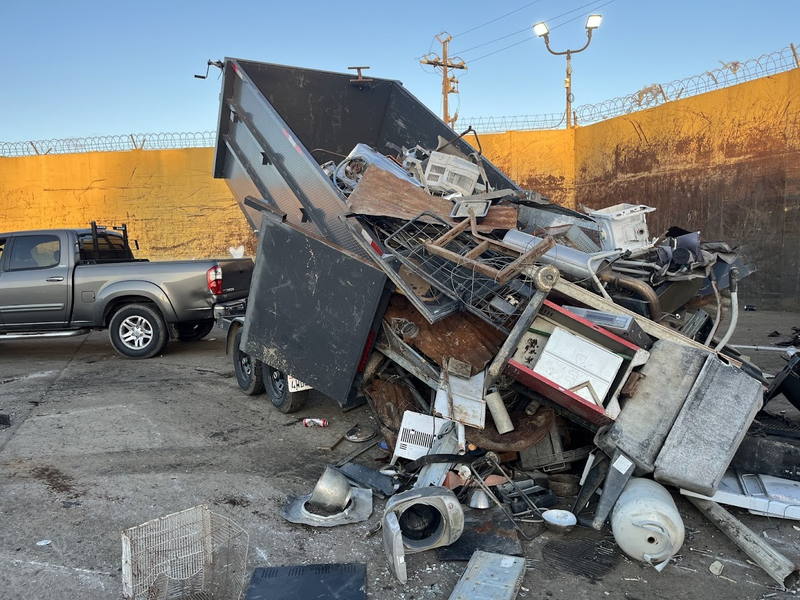
California Penal Code 374.3 makes it an infraction to dump waste matter on a public road or its right-of-way, on private property the public enters by easement or license, or in a public park. The mandatory fine runs from $250 to $1,000 on a first conviction, $500 to $1,500 on a second and $750 to $3,000 on a third or subsequent one, and those minimums cannot ordinarily be waived. Then the clause that does the real damage: each day the waste remains unabated is a separate violation. An appliance left out over a long weekend is not one offense, it is four.
For a refrigerator, the tier is not as obvious as people assume. The misdemeanor tier in the same section applies to commercial quantities, which the statute defines as waste matter generated in the course of a trade, business, profession or occupation, or an amount equal to or in excess of one cubic yard. A cubic yard is twenty-seven cubic feet, and a full-size refrigerator standing on a parkway is a far larger object than most people picture when they read that number. For this item the volume trigger is genuinely in play, which is not true of a chair.
The origin trigger has no ambiguity at all, and it is the reason to care who you hand the thing to. Waste that came out of a job is commercial by origin whatever it weighs, so the man who offers to take your refrigerator for cash out of the back of a pickup is exposed to a misdemeanor, up to six months in county jail and a mandatory fine from $1,000 for dumping a single unit. Assembly Bill 2374, Chapter 784 of 2022 made that worse on purpose. It raised the maximum mandatory fine for commercial-quantity dumping by anyone employing more than ten full-time staff to $5,000 on a first conviction, $10,000 on a second and $20,000 on a third; it requires the court to order a person convicted of illegal dumping to remove the waste or pay the cost of removing it; and where the person convicted holds a license or permit to do business, the court must notify the licensing body, which has to record the conviction and post it on that licensee’s public profile on its website. A dumping conviction is now a public fact attached to a trading name. Our guide to vetting a junk removal company is about how to use that before you let anyone load an appliance.
Inside the city limits there is a second, faster layer that does not need a court. LAMC 66.25 bars depositing solid waste of any kind on any street or on any premises in the city. It carries administrative penalties that reset each calendar year: a warning or up to $500 for a first violation, up to $750 for a second, $1,000 for a third, and more than three administrative fines in one calendar year means the violation is charged as a misdemeanor in Superior Court. LA Sanitation may add a processing fee set by the Board of Public Works to a citation, and the first appeal is an administrative hearing rather than a judge. If your address is in unincorporated county territory instead, Los Angeles County Public Works publishes a set-out window rather than a prohibition: nothing goes out before 5:00pm the day before collection, and nothing stays at the collection point after 8:00pm on collection day. An appliance waiting three days for a correctly booked truck is outside that window for two of them.
An unbooked appliance on the sidewalk is the most reportable object that can appear on a residential block in this city. It is chest high, it is usually white, it is visible from a moving car at thirty miles an hour, and it is the thing neighbors photograph. LA Sanitation’s illegal dumping page asks residents to report illegal dumping at myla311.lacity.org or on 1-800-773-2489 around the clock, says it tracks every single cleanup request through the MyLA311 system, and runs CleanStat, a street-by-street assessment that surveys the whole city at least twice a year, grades each street for cleanliness and logs unreported items by category. Metal and white goods are one of the named categories, and the locations get passed to the collection yards.
It is also traceable in a way furniture is not. A refrigerator carries a model and serial plate, usually inside the door frame or on the back. If the replacement was delivered, there is a delivery record tying a matching appliance to your address on a date. The old unit often still has a repair sticker, a warranty card or a utility rebate label on it. And LAMC 66.25 makes “any person whose identifying information is found in” deposited waste responsible for it. For a sofa that clause is mostly theoretical. For an appliance with a service company’s phone number stuck to the side of it, it is a name on a file.
The person who owns the address wears it. The investigation starts at the nearest front door and works outward from the serial plate, and a landlord who paid cash to a van with no permit has bought a citation with their own name on it. The cheapest version of this entire page is one phone call made one business day early, with the word refrigerator said out loud. Our illegal dumping guide covers the other side of it, reporting something somebody else left.
Penal Code 374.3 carries a mandatory fine of $250 to $1,000 on a first household conviction, rising to $750 to $3,000 on a third, with each day the waste remains unabated counted as a separate violation. Above a cubic yard, or where the waste came out of a trade or business, it is a misdemeanor instead. Inside the City of Los Angeles the administrative track runs alongside it and needs no court at all.
Every rule, fee, limit and deadline on this page is from the body that sets it. Checked on the date above; if a city changes its program we change the page.
Same crew, one visit, one number agreed before anything is lifted.
Fridges, washers and AC units. Refrigerant units are handled as universal waste.
Booked and cleared the same day, most days, across LA County.
The whole garage in one visit. We sort, donate what is usable and sweep the slab.
TVs, CRT monitors and computers. Banned from the trash in California.
The rest of the LA disposal manual.
Every residential appliance program in and around the county in one table: who collects a fridge free, who charges a handling fee, who runs it on a separate truck and who makes you take the doors off.
A sealed refrigerator is banned from every landfill in California until a certified technician empties it. The gates that will take one, the retailers that haul away, and the state register of certified recyclers.
The four routes out of a living room in the order to try them: the free city pickup, the two charities that still send a truck, the public gates and their one-ton minimum, and what a crew should cost.
Thirteen Los Angeles-area programs in one table: how many free pickups a year, how many items, who to call and what each one refuses.
The follow-up questions people ask after this one, in the phrasing they ask them in.
Not as of October 29, 2026. LADWP’s Refrigerator Exchange Program URL returns a 403 access-denied response, which is what an unpublished page looks like from outside. LADWP’s own All Programs and Rebates directory returns 200 and contains no occurrence of the words refrigerator, fridge, exchange or recycle, and its residential Programs and Rebates index does not name a refrigerator program either.
The last public offer we can date from LADWP’s own live pages is an April 1, 2022 newsletter article, following a February 1, 2022 one that advertised “Get $60” and said recycling an old refrigerator or freezer “can reduce your energy bill by up to $192 per year”. Both of those pages are still live, which is why so many articles still describe the program. We write that it was last publicly offered in 2022 and is no longer listed in LADWP’s own program directory, rather than that it was cancelled, because we saw an unpublished page and a directory with the program absent from it, not a cancellation notice.
In almost all of Los Angeles County, no. The EPA’s Responsible Appliance Disposal program is closed: three of its URLs return 404 and the surviving EPA page carries the past-tense heading “Responsible Appliance Disposal (RAD) Program History” with the years 2006 to 2025 after it. Southern California Edison’s appliance recycling URL returns a 404 on the utility’s own branded not-found template. LADWP returns a 403. SoCalGas is a gas utility and a refrigerator is an electric appliance, so it never applied.
The one exception we can confirm is Burbank Water and Power, which publishes “Get up to a $75 rebate for replacing your refrigerator with an Energy Star certified model purchased,” with up to $875 for low-income customers and certain affordable housing providers. It is a replacement rebate rather than a payment for disposal, it requires a BWP account, and it is one city out of eighty-eight. All status codes read October 29, 2026.
Goodwill will not collect one. Goodwill Southern California states on its own donation page: “We are sorry for any inconvenience; however, we do not offer pick-up service.” The same page describes what it accepts as clothing, accessories, small household appliances and furnishings, and a refrigerator is not a small household appliance. With no truck and no pickup, there is no practical Goodwill route unless you deliver it yourself, and even then acceptance is at the donation center’s discretion.
The Salvation Army is the other name people try, and its own national pickup scheduler returned not serviced for every Los Angeles County ZIP code we tested on October 29, 2026, with an explicit message for Pasadena that pickup services are indefinitely suspended. The one free collection of a working refrigerator we could confirm in the county is St. Vincent de Paul of Los Angeles, which lists “Refrigerators *Mint Condition*” and collects free on 1-800-974-3571, but will not use elevators or stairs and asks for items at street level.
If it is fifteen years old or more, retire it. ENERGY STAR publishes that refrigerators over fifteen years old “could be costing you more about $95 per year to run” and that an old refrigerator uses about 20 percent more energy than an ENERGY STAR certified model, and LADWP told its own customers in 2022 that recycling an old or second refrigerator could cut an energy bill by up to $192 a year. Handing an old unit to a household with less money than you is transferring a monthly bill rather than doing a favor.
If it is under about ten years old, cools properly, and has intact gaskets and no smell, it is genuinely worth rehoming. Measure it and have the brand, model and cubic footage ready, then call a charity that names refrigerators and be prepared to answer where it is standing and how many steps are involved. That last question is what ends most of these calls.
Keeping it is usually the expensive option. A second refrigerator from the 1990s running in an uninsulated Los Angeles garage draws far more power than a modern unit in a kitchen, because the compressor fights an ambient temperature well above the 35 to 38 degrees the thermostat is chasing. That cost repeats every month. A removal happens once, and in most of the county the curbside appliance program does it for nothing — see your city’s program.
Word for word from Google. Nothing tidied.
Working with Hunter and this company was great. Gave us a quick quote over the phone after sending photos and was able to help us the SAME day. Removal was fast and easy. We definitely recommend going with this company.
Read all 70 on GoogleSee us on YelpReviews, and how to check any LA hauler Count checked on .
Who collects a household appliance for free, who refuses it outright and where the refrigerant goes is a local question with a different answer in each of these. Each of these is written for that city rather than for Los Angeles in general, and the quote is free either way.
The full map is on areas we serve, and how the number is worked out is on how our pricing works.
Send a photo, get a flat number back. Free, no obligation, no pressure and no call-out fee — and if your city will haul it free instead, we will tell you that too. Most requests are answered within the hour during working hours.