Mon–Sat open 24 hours · Sun 1–10pmFully insuredFamily-run, LA-based
team@lajunkhauling.com
Call us today(323) 230-0777
Home/Guides/Tenant left belongings

A tenant left their things behind,
and the statute decides what happens next

You cannot throw it out the day the keys come back, and you cannot hold it against the rent they owe you. California wrote a procedure, and the procedure is the only thing that protects you.

Free quote, no obligation · one flat number before we start · you can also text that number

Published · last checked · written by the crew at Los Angeles Junk Removal & Hauling

The short answer

Civil Code 1983 requires a written Notice of Right to Reclaim Abandoned Property, then at least 15 days after personal delivery or 18 after mailing. After an eviction, Code of Civil Procedure 715.010 gives 15 days from when you retake possession. Section 1988 lets you keep or dump only property reasonably believed worth under $700.

Those two clocks are the page. A voluntary move-out puts you on the Civil Code track, Civil Code 1983 to Civil Code 1988: serve a notice, count from the day you serve it. A tenant removed by the sheriff puts you on the Code of Civil Procedure 715.010 and Code of Civil Procedure 1174 track, where the deadline is printed on the writ.

This is general information about those statutes, read off the statute text. It is not legal advice; a landlord with a disputed case should talk to a lawyer.

Civil Code 1981 calls the chapter “an optional procedure,” and that word has cost landlords money. Nobody forces you to use it, but 1981(e) adds that if its requirements are not satisfied, nothing in the chapter affects the landlord's rights and liabilities. The shield in Civil Code 1989 exists only if you did the paperwork.

The distinction everything turns on

Two tracks, two different clocks

On the eviction track the deadline is a term of the writ. 715.010(b)(3) has the writ state that property left behind goes for disposal under Section 1174 unless the judgment debtor or other owner pays the reasonable cost of storage and takes possession no later than 15 days after the judgment creditor takes possession. No separate 1983 notice goes to that tenant; one does go to any other owner, under 1174(f).

The two statutory tracks, compared
Voluntary move-outAfter a writ of possession
TriggerTenancy ended, premises vacatedLevying officer restores possession
StatuteCivil Code 1980–1991CCP 715.010 and 1174
Notice requiredNotice of Right to Reclaim Abandoned Property: form at 1984 for the tenant, 1985 for any other ownerThe tenant's deadline is in the writ, 715.010(b)(3); other owners get the 1983 notice, per 1174(f)
Waiting period15 days after personal delivery, 18 days after mailing15 days from the landlord retaking possession
Storage, and who paysThe premises or a place of safekeeping, reasonable care (1986); whoever reclaims it pays, assessed under 1990A place of safekeeping (1174(g)); same payer, same section
At the endKeep or dump under $700 total resale value, else public sale (1988)Disposal under 1988, the same line (1174(i))

Sources: Civil Code 1981, Civil Code 1983, Civil Code 1986, Civil Code 1988, Civil Code 1990, Code of Civil Procedure 715.010 and Code of Civil Procedure 1174, read October 29, 2026.

This is the procedure

The notice does all the work

Civil Code 1983 is short and specific, and Civil Code 1984 and Civil Code 1985 print the form. Use the form; a notice in substantially that shape satisfies Section 1983. Describing only part of what is there is a trap: Civil Code 1989 does not shield property left out of the notice. 1984(b) then makes you pick a closing statement: a public sale with the right to bid and proceeds claimable from the county for a year, or a declaration that the property is believed worth under $700 and may be kept, sold or destroyed.

FormNotice of Right to Reclaim Abandoned Property: Civil Code 1984 for the former tenant, 1985 for any other owner
Must stateThe property, described adequately enough for its owner to identify it (a locked or tied container may be named without its contents); that storage costs may be charged; where it may be claimed; the claim date
The claim dateNot less than 15 days after personal delivery, or not less than 18 days after it is deposited in the mail. The form also carries an earlier date, not less than 2 days after vacating, by which claiming minimizes storage costs
ServicePersonal delivery, or first-class mail to the last known address plus any other address it may reach them at; one copy to the vacated premises. Email may be added, never substituted

Sources: Civil Code 1983, Civil Code 1984, Civil Code 1985 and Civil Code 1989, read October 29, 2026.

Rather not deal with any of it? Tell us what is there and we will price it.

Free upfront quote, no obligation. If your city will haul it free instead, we will tell you that first.

5.0 from 70 reviews on GoogleMon–Sat, open 24 hours

On the job
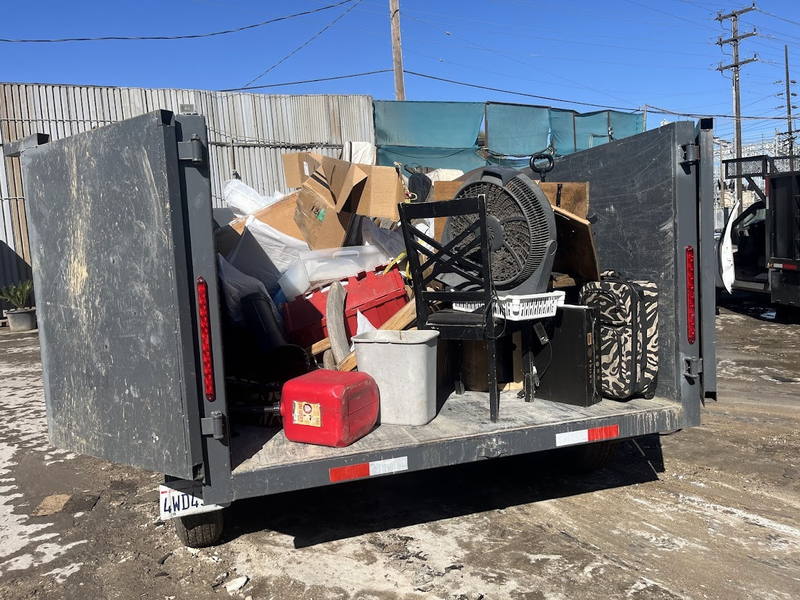
Our dump trailer loaded with a mixed household clear-out on a Los Angeles County job: an office chair, a pedestal fan, a cooler, suitcases, a fuel can and cartons stacked against the headboard
A whole household clear-out in one load
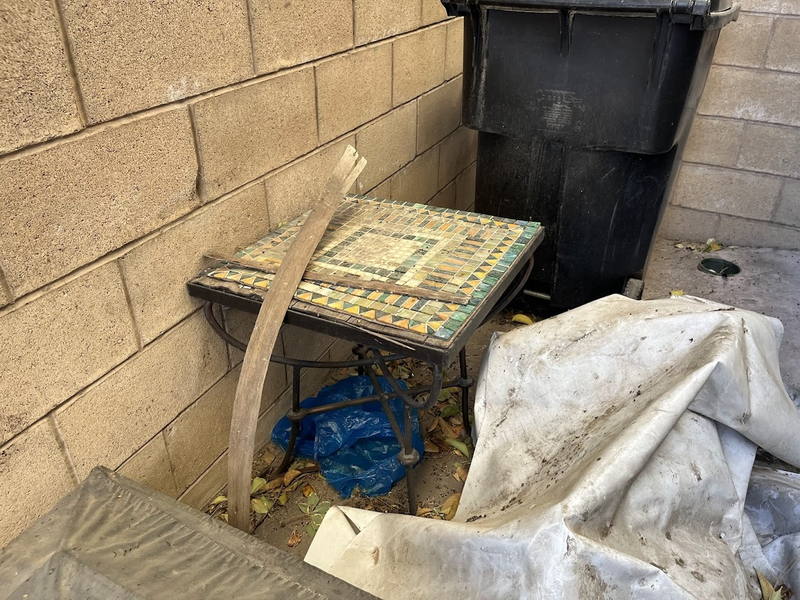
A mosaic-topped patio side table, a torn tarp and bagged waste tucked into the corner of a block-wall side yard beside a wheeled trash bin on a Los Angeles County pickup
The awkward corner nobody wants to clear out
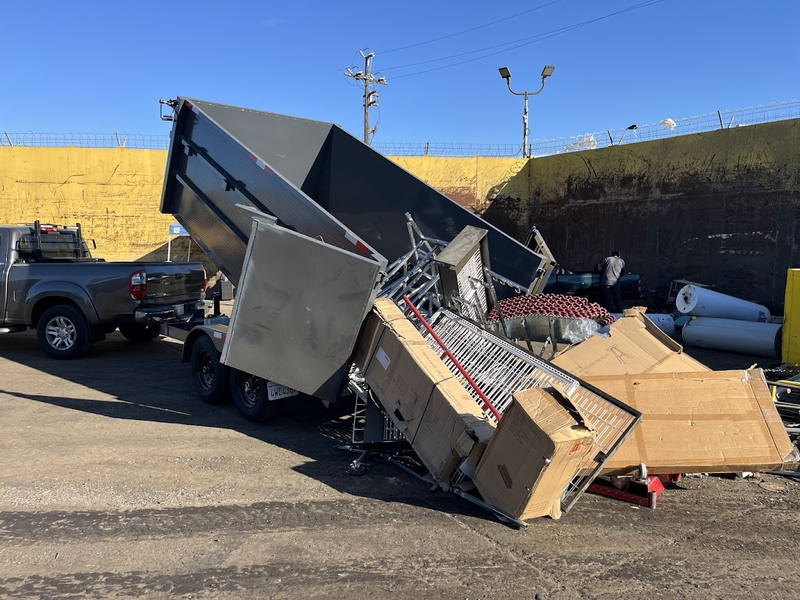
Our dump trailer raised and tipping a full load of flat-pack cartons and steel shelving out onto the floor of a Los Angeles County recycling yard
Tipping a full load at the recycling yard

Our own crews on Los Angeles County jobs. Side yards, narrow walkways and the back of the property is where most of the work actually happens.

The working order

What to do, in order

The voluntary move-out sequence: photographs before anything moves, the deadline before anything is thrown away.

  1. 1

    Photograph everything in place

    Before one item moves. Wide shots of each room, close shots of anything of value, dates on the files. If the tenant later says a television was in there, this is the answer.

  2. 2

    Inventory it, with values, minus what the chapter excludes

    Item by item with a total, because Civil Code 1988 turns on the total resale value of what is not released. Property believed lost goes to the police under 1982; mobilehomes and animals are outside the chapter.

  3. 3

    Serve the notice on the 1984 or 1985 form

    Personal delivery or first-class mail, a copy to the vacated unit if mailed, a separate one to every other owner.

  4. 4

    Calculate the deadline and diarize it

    Not less than 15 days from personal delivery, 18 from mailing. The date you write binds you.

  5. 5

    Store it safely and log the clock

    The vacated premises or a place of safekeeping, with reasonable care. In the unit, 1990(c) values storage at the fair rental value of the space.

  6. 6

    Release it if claimed, dispose of it if not

    Release on payment of reasonable storage, or free under 1987(c) within two days of vacating. On expiry, under $700 of reasonably believed total resale value you may keep or dump it; at or above, it goes to public sale.

  7. 7

    Keep the file

    Photographs, inventory, notice, proof of service, storage log, dated receipt. That file is why 1989 protects you.

The end of the clock

Reclaimed, sold, or disposed of

They come and get it. Civil Code 1987 requires release on payment of reasonable storage, by the date in the notice, and 1987(b) makes you release it any time before an advertised sale happens. Civil Code 1990 caps the charge: a non-tenant owner pays only for what they claim, you may not charge two people for the same costs, and nothing is chargeable where property left in the dwelling is reclaimed within two days of vacating.

Nobody comes, and it is worth little. Civil Code 1988 lets you keep it or dispose of it in any manner where you reasonably believe the total resale value of what was not released is under $700. Civil Code 1980 defines it as a prudent person's belief without investigating, rising higher where specific information makes an affordable investigation worthwhile. Record how you got to the number.

Nobody comes, and it is worth more. Public sale by competitive bidding, advertised under Government Code 6066 in a newspaper of general circulation in the county of the sale: once a week for two successive weeks, five days intervening, with the last publication not less than five days before the sale. Both sides may bid. After storage, advertising and sale costs, any unclaimed balance goes to the county treasury within 30 days, claimable there for a year.

Do all that and Civil Code 1989 protects you from any claim by a person you noticed, and from anyone else unless they prove you should have known both their interest and their address. (Civil Code 1991 lets the notice be combined with a notice of belief of abandonment under Section 1951.3.) Which is why both common beliefs are wrong: Civil Code 1986 gives the property two lawful exits only, and storage and sale costs are the only money the chapter releases to you.

Before any of this applies

The eviction itself has its own rules

These sections govern what happens to the property, not whether you were entitled to end the tenancy. For a rent-stabilized unit that is the part with teeth: a flawless 1983 notice does not cure a bad termination. The Los Angeles Housing Department runs the Rent Stabilization Ordinance and the Just Cause Ordinance and takes a landlord's filing of a tenant's eviction notice. For unincorporated areas, LA County Consumer and Business Affairs administers the county Rent Stabilization and Tenant Protections Ordinance.

Both read October 29, 2026.

Our half of it

The clock has run. Now it has to go somewhere

Building size decides the first question. At four units and under you are a single-family customer of LA Sanitation, whose bulky-item pickup is, in the city's words, an unlimited curbside service at no additional charge, booked a business day ahead on 1-800-773-2489. At five units and up the building is on recycLA, which LASAN describes as serving multi-family properties of five or more units. The zone's franchise hauler is your route.

The hazardous shelf goes nowhere near either truck. Paint, solvents, pool chemicals, automotive fluids and batteries go to a S.A.F.E. Collection Center, free to City and County residents and open every weekend. Televisions are the catch: banned from the bins, taken at the curb on a bulky pickup. Anything unlabeled, or a propane cylinder, call the 24-hour line first. See our guides to paint, electronics, batteries and hazardous waste.

Not the alley. The liability follows the property owner. Penal Code 374.3 sets a mandatory fine of $250 to $1,000 on a first conviction, with each day the waste remains a separate violation. Subdivision (h) makes dumping in commercial quantities a misdemeanor carrying up to six months in county jail plus a mandatory $1,000 to $3,000 fine, and commercial quantities means waste from a trade or business, or one cubic yard or more. A cleared unit is both. Municipal Code 66.25 adds city penalties of up to $500, $750 and $1,000 across the first three violations in a calendar year. More in our illegal dumping guide.

1 to 4 units vs 5 or moreLASAN single-family service, free and unlimited at the curb on one business day of notice, against recycLA franchise service through the zone's exclusive provider
Refused at the curbAutomotive parts and used oil, concrete, bricks and dirt, commercial appliances, paints, solvents and chemicals, medicines and needles, fluorescent lights, cardboard
The hazardous shelfSeven S.A.F.E. Centers, free to City and County residents, open every weekend: aerosols, automotive fluids, solvents, e-waste, batteries, paint and thinner, pool chemicals, sharps, medications

Sources: LA Sanitation, recycLA, S.A.F.E. Collection Center, Penal Code 374.3 and Municipal Code 66.25, read October 29, 2026.

Being honest about it

When the free route is the right answer

A mattress, a desk and four bags in a fourplex in the City of Los Angeles: book the free pickup and stop reading. We would rather say that than take the job. It stops working where it is curbside only, where it runs on the city's collection day rather than your deadline, and at five units or more.

What a landlord needs here is not only an empty unit. It is a dated record that the property left on a particular day and went to a particular place, filed beside the photographs and the notice. A unit cleared in one visit on a date you choose is what we are for — as an estate cleanout, furniture removal, same-day removal, or commercial junk removal across several units at once. How we price, where we work. One caution on sequence: do not book the truck before the deadline has passed.

Worth knowing

The parts landlords get wrong

What to know
  1. California Civil Code 1983 requires a landlord to serve a written Notice of Right to Reclaim Abandoned Property before disposing of property a tenant left behind.
  2. That notice must set a deadline not less than 15 days after personal delivery, or not less than 18 days after mailing.
  3. Civil Code 1988 lets a landlord keep or dispose of the property where the total resale value is reasonably believed to be under $700, and requires public sale at or above that.
  4. After an eviction the tenant has 15 days from the landlord retaking possession under Code of Civil Procedure 715.010, and the remainder goes to disposal under Civil Code 1988.
  5. No part of Civil Code 1980 through 1991 lets a landlord hold a former tenant's property against unpaid rent.
  6. Free bulky-item pickup in the City of Los Angeles covers buildings of one to four units; five or more is recycLA franchise service.
Where this comes from

Sources

Every rule, fee, limit and deadline on this page is from the body that sets it. Checked on the date above; if a city changes its program we change the page.

  1. Civil Code 1980Definitions, including “reasonable belief.”
  2. Civil Code 1981 and 1982The optional-procedure wording and 1981(e).
  3. Civil Code 1983Notice contents, the 15-day and 18-day minimums.
  4. Civil Code 1984 and 1985The notice forms and the two closing statements.
  5. Civil Code 1986 and 1987Safekeeping, release, the two-day no-charge window.
  6. Civil Code 1988The $700 threshold and public sale.
  7. Civil Code 1989, 1990 and 1991Liability limits and storage cost assessment.
  8. Code of Civil Procedure 715.010The tenant’s 15 days from the landlord retaking possession.
  9. Code of Civil Procedure 1174Notice to other owners; disposal under 1988.
  10. Government Code 6066The manner of publication 1988 incorporates.
  11. Penal Code 374.3Dumping fines and the commercial-quantities rule.
  12. LA Municipal Code 66.25The graduated city administrative penalties.
  13. LA Sanitation — Bulky Item PickupThe free single-family service and refused list.
  14. LA Sanitation — recycLAThe five-or-more-units franchise line.
  15. LASAN S.A.F.E. CentersThe seven centers and what they take.
  16. Los Angeles Housing DepartmentThe Rent Stabilization and Just Cause Ordinances.
  17. LA County Consumer and Business AffairsThe county ordinance for unincorporated areas.

If you would rather not do it yourself

Same crew, one visit, one number agreed before anything is lifted.

Related guides

The rest of the LA disposal manual.

Abandoned tenant property, answered

The follow-up questions people ask after this one.

How long do I have to keep property a tenant left behind in California?

Civil Code 1983 requires the deadline in the Notice of Right to Reclaim Abandoned Property to be not less than 15 days after personal delivery, or 18 after mailing. After an eviction, Code of Civil Procedure 715.010 gives 15 days from the landlord retaking possession.

Can I throw out a tenant's belongings as soon as they move out?

No. Civil Code 1986 allows two things only: leave the property on the vacated premises, or store it in a place of safekeeping with reasonable care, until it is released under Section 1987 or disposed of under Section 1988. Both come after the notice and the wait.

Can a landlord keep a tenant's property to cover unpaid rent?

No. Nothing in Civil Code 1980 through 1991 makes abandoned property security for rent. The only recoverable sums are reasonable storage under Section 1990 and, on a sale, advertising and sale costs. The balance goes to the county treasury.

What is the dollar limit for throwing away abandoned tenant property?

Civil Code 1988 sets it at a total resale value of less than $700. Below that, a landlord who reasonably believes it may retain the property or dispose of it in any manner. At or above, it must go to public sale by competitive bidding.

How is the public sale advertised?

Under Government Code 6066, in a newspaper of general circulation in the county of the sale, once a week for two successive weeks, the last publication not less than five days before the sale. Both sides may bid.

Who clears the unit once the waiting period is over in Los Angeles?

In a building of one to four units in the City of Los Angeles, LA Sanitation's free curbside bulky-item pickup covers it, booked a business day ahead on 1-800-773-2489. At five units or more the building is on recycLA and must use the zone's hauler. Paint and batteries go to a S.A.F.E. Center instead.

The proof

What our customers say

5.0from 70 reviews on Google

Word for word from Google. Nothing tidied.

  • 5 months ago

    Hunter is truly dedicated on providing the most excellent of removal of unwanted junk from your home or office. Always on time, very efficient at his job in a timely manner. I would recommend him for any junk removal you may have.

    James Russell3 reviewsHome and office junk removal
  • Fair pricing 11
  • Personable staff 10
  • Polite 5
  • Punctual staff 4
If you would rather not

Estate cleanouts
city by city

Notice periods, storage obligations and what a building will allow through its service entrance are local. Each of these is written for that city rather than for Los Angeles in general, and the quote is free either way.

The full map is on areas we serve, and how the number is worked out is on how our pricing works.

Request a quote

Send a photo, get a flat number back. Free, no obligation, no pressure and no call-out fee — and if your city will haul it free instead, we will tell you that too. Most requests are answered within the hour during working hours.

Or call or text (323) 230-0777 — Mon–Sat around the clock, Sunday 1–10pm.

Call (323) 230-0777Text a photo