Mon–Sat open 24 hours · Sun 1–10pmFully insuredFamily-run, LA-based
team@lajunkhauling.com
Call us today(323) 230-0777
Home/Services/Yard waste removal/Woodland Hills

Yard waste removal in Woodland Hills
The clearance rule ends with a disposal clause.

Cut brush, limbs, hedge rows, fronds and whole-slope clearance hauled off Woodland Hills properties, including the hillside lots where a wheelbarrow is the only way down.

Free quote, no obligation · one flat number before we start · you can also text that number

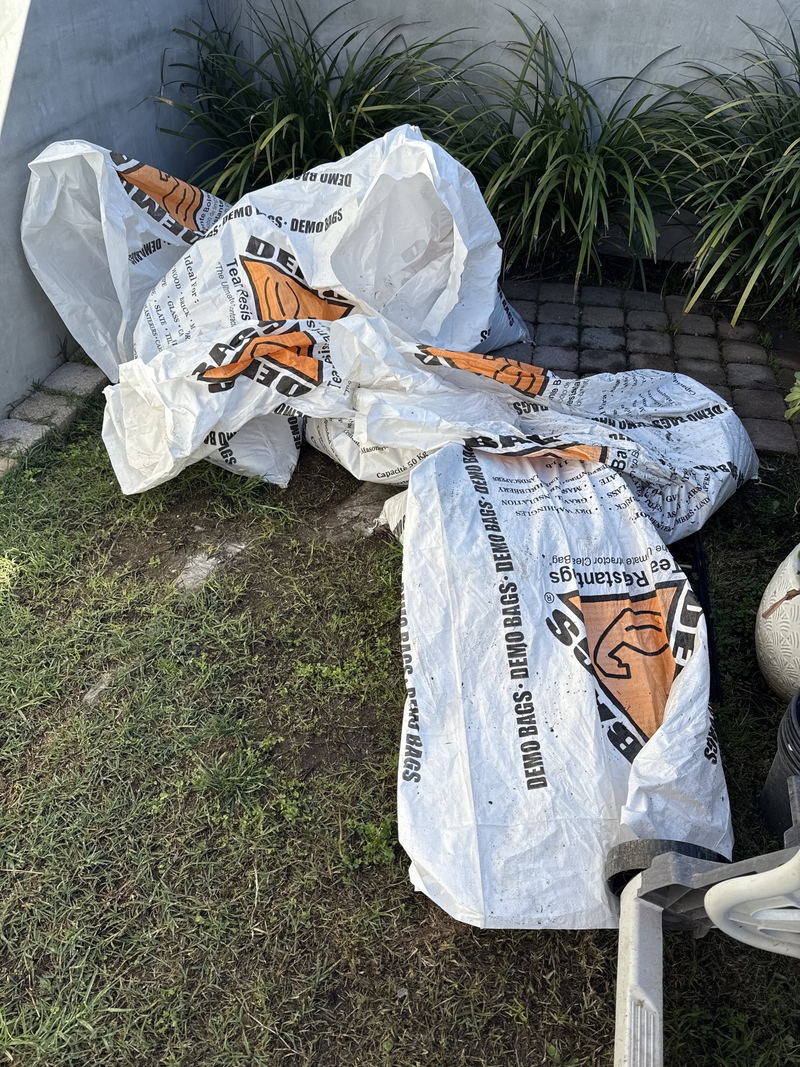
Heavy-duty white demolition bags packed full of renovation waste lying on the lawn and paved patio of a Los Angeles County property, staged for a hand carry to the trailer
Cut green material staged for loading on a Los Angeles County job. Brush is priced by what it weighs, not by how tall the pile looks.
In short

Woodland Hills properties inside the Very High Fire Hazard Severity Zone are inspected every year by the Los Angeles Fire Department, and the clearance standard ends with a disposal clause: all cut vegetation must be removed in a legal manner. A weekly green bin holds a small fraction of what one hillside cut produces.

The Los Angeles Fire Department administers the City's Defensible Space and Brush Clearance Program inside the Very High Fire Hazard Severity Zone, and the 2026 cycle worked like this: owners had to be compliant by May 1, 2026, initial inspections ran from May 1 through June 30, and nobody needed to call and book one, because the department inspects automatically. A parcel that passes pays nothing. A parcel that fails is charged a $31.00 initial inspection fee for 2026 and is automatically re-inspected, and a second failure adds a $758.00 non-compliance fee. Parcels still out of compliance after that second look are cleared by City contractors and billed a $1,740.00 administrative cost fee plus the contractor's lowest bid on top of both earlier fees. Unpaid invoices are forwarded to the Los Angeles County Tax Assessor and added to the property taxes as a special assessment.

The requirement list itself is about cutting, but its last line is about hauling: all cut vegetation and debris shall be removed in a legal manner. That is the sentence that turns a weekend of cutting into a disposal problem, because the free routes a City of Los Angeles household has — a weekly green bin and one free brush collection a year with no bundle over four feet or 30 pounds — were not built for a cleared slope. Los Angeles Junk Removal & Hauling moves the pile, quoted flat and free upfront, with nothing owed for the visit if you decide not to go ahead.

Green waste in this part of the west Valley is not gardening waste. It is the annual argument between a fire inspector and a hillside, and the inspector has a calendar. Properties on the south side of Woodland Hills run up against the Santa Monica Mountains, the lots are deep, and the planting that makes them beautiful — mature oaks and eucalyptus, long hedge lines, ivy banks and decades of self-seeded brush — is exactly the material a clearance standard is written about.

What follows is the honest shape of the job: what the City actually requires, which free routes a Woodland Hills household already pays for, where those routes run out, and what happens to the material afterwards. If you want the wider county picture first, the rules are collected in our guide to green waste and yard trimmings in Los Angeles, and the general service is on yard waste removal.

The free routes you already have

A bin, and one collection a year.
Then it is a truck.

Start with the bin, because it is free, weekly and already paid for. LA Sanitation runs the green bin as an organics container rather than a garden container: every City of Los Angeles household is required to put food waste and green waste in it each week, which is the local expression of SB 1383, the state law requiring every California jurisdiction to provide organic waste collection to all residents and businesses. On the yard side LASAN names flowers, grass clippings, tree and bush trimmings, and clean untreated wood. Plastic bags and pet waste belong in the black bin, and so does anything sold as compostable or biodegradable, because LASAN says items certified to ASTM D6400 or BPI often do not break down fast enough in the process Los Angeles uses and end up degrading the finished compost.

Behind the bin sits a second free route that far too few hillside owners know about. LASAN offers a once-a-year collection of extra yard trimmings and brush, free, to every household it services. The preparation rule is specific: bundle and tie the material so no bundle is longer than four feet or heavier than 30 pounds, then book it with a service request through MyLA311 or the 24-hour Customer Care Center on 1-800-773-2489. It is worth saying plainly that the Fire Department itself advertises this collection — the annual owner notification that lands in Woodland Hills mailboxes tells property owners about the once-a-year free collection and prints that same phone number.

Now the honest part. Those two routes are sized for maintenance, not for compliance. A four-foot, 30-pound bundle is a hedge trim. A parcel cut to the 200-foot standard produces limbs longer than the bundle limit, root crowns heavier than it, and a volume that arrives all at once in the same weeks the whole neighborhood is cutting. The City does allow some of it to stay: cut vegetation may be machine processed — chipped — and spread back onto the property, but no deeper than three inches within 30 feet of structures and six inches beyond 30 feet, and never within 10 feet of a usable roadside, under Fire Prevention Bureau Procedure No. 25. On a steep lot with a narrow apron, there is rarely anywhere legal to put that much mulch, and what is left over still has to leave.

One more boundary, and it catches re-landscaping jobs more than clearance jobs: several things that come out of a Woodland Hills yard are not green waste at all. The City's own green waste facility in Sylmar takes branches, logs, stumps, roots, brush, shrubs, leaves, grass clippings and untreated wood, and refuses palm of any type, yucca, tumbleweeds, hazardous materials, concrete, dirt, rocks and treated wood. Fronds, a torn-out yucca, a broken pathway and the soil clinging to a root ball are four different destinations, and mixing them is how a clean load gets reclassified at the gate.

May 1the 2026 City of Los Angeles compliance date; initial inspections ran to June 30
200 feetthe clearance band around structures in the Very High Fire Hazard Severity Zone
4 ft / 30 lbthe bundle limit on LA Sanitation's free once-a-year brush collection

Sources: LAFD Owner Notification Mailer and Brush Clearance Requirements; LA Sanitation, Annual Brush Pickup. Cited in full below.

Weekly green binOrganics collection — yard trimmings alongside food waste and food-soiled paper, every week
Yard material acceptedFlowers, grass clippings, tree and bush trimmings, clean untreated wood
Keep out of the green binPlastic bags, pet waste, and anything labeled compostable or biodegradable
State backdropSB 1383 requires every California jurisdiction to collect organic waste from all residents
Free brush collectionOnce a year, free, for every household LA Sanitation services
Bundle limitNo bundle longer than 4 feet or heavier than 30 pounds
BookingService request through MyLA311, or the 24-hour Customer Care Center on 1-800-773-2489
Named in the fire noticeLAFD's annual owner notification points property owners at that free collection
Chipping back on siteAllowed up to 3 inches deep within 30 feet of structures, 6 inches beyond, never within 10 feet of a usable roadside
Not green wastePalm of any type, yucca, tumbleweeds, concrete, dirt, rocks and treated wood are refused at the City green waste facility
Where the free route stopsA parcel cut to the 200-foot standard leaves in truckloads, not in four-foot bundles

Sources: LA Sanitation, Weekly Curbside Green Bin Collection (Organics); LA Sanitation, Annual Brush Pickup; CalRecycle, SB 1383 Short-Lived Climate Pollutant Reduction Strategy; Los Angeles Fire Department, Brush Clearance Requirements; Los Angeles Fire Department, Owner Notification Mailer; LA Sanitation, Commercial Green Waste Disposal at Lopez Canyon.

What the inspector is measuring

Two hundred feet, three inches,
and a slope in between.

Read the standard before you cut, because it is more specific than most people expect. Year-round compliance applies to native brush, weeds, grass, trees and hazardous vegetation within 200 feet of any structure — and the Fire Department is explicit that this includes structures on adjoining properties, not only your own — and within 10 feet of any combustible fence or any roadway or driveway used for vehicular travel. Inside that band, grass is cut to three inches and native brush is reduced in quantity to three inches. Individual native shrubs are the exception: they may stay if they are spaced a minimum of 18 feet apart and trimmed up from the ground to a third of their height with all dead material removed.

Trees are handled by height. Anything taller than 18 feet has its lower branches trimmed so no foliage sits within six feet of the ground; trees and shrubs under 18 feet lose lower branches to a third of their height. All dead trees and vegetation must be removed. Foliage has to be kept at least 10 feet from the outlet of a chimney, roof surfaces must be kept clear of any substantial accumulation of leaves, needles and twigs, and five feet of vertical clearance is maintained between a roof and the parts of a tree overhanging it. Those last two are the ones that keep needing attention after an inspection has passed, because oak and eucalyptus go on dropping into the fall. The same requirements apply to landscape planting, not only to native brush, and all of it must be done in compliance with the City's rules on native protected trees and shrubs under L.A.M.C. 46.00-46.06, which is the bit that matters on a lot with old oaks on it.

The City ordinance covering clearance in the Very High Fire Hazard Severity Zone added safety conditions to the cutting itself, and they are worth knowing whether you cut or somebody cuts for you: metal cutting blades used on grass or brush must be non-ferrous and non-sparking, clearance work must not be done on red flag days, an approved fire extinguisher or a pressurized garden hose with a nozzle has to be within 10 feet of the operation, a charged cell phone capable of dialing 9-1-1 has to be to hand, and whoever is clearing must not be doing anything else at the same time. Hauling is our part of this, not cutting, and on a red flag day nobody should be running a blade in this neighborhood anyway.

Then there is the geometry, which is the part that actually decides how long a Woodland Hills job takes. South of Ventura Boulevard the streets climb and switchback toward Mulholland Drive, and a great many of those houses sit below their own street, so the cut material has to come up a slope on foot rather than down a driveway. There is often nowhere to stage a pile except the apron, and no room to leave a vehicle without closing a lane. North of the boulevard the tract streets are flat, wide and generous by comparison, with long driveways and side gates, and the same volume of brush is a much shorter day. We size the vehicle to the street rather than sending the largest truck, and we ask where the pile is before we ask how big it is. If the job also involves a shed, a patio cover or a pergola coming out of the cleared area, that is shed removal and it is quoted in the same visit.

Tell us roughly how much was cut, where it is sitting, and whether a vehicle can reach it. The number is fixed before the first armful moves.

Free upfront quote, no obligation. One number, agreed before anything is lifted.

5.0 from 67 reviews on GoogleMon–Sat, open 24 hours

On the job
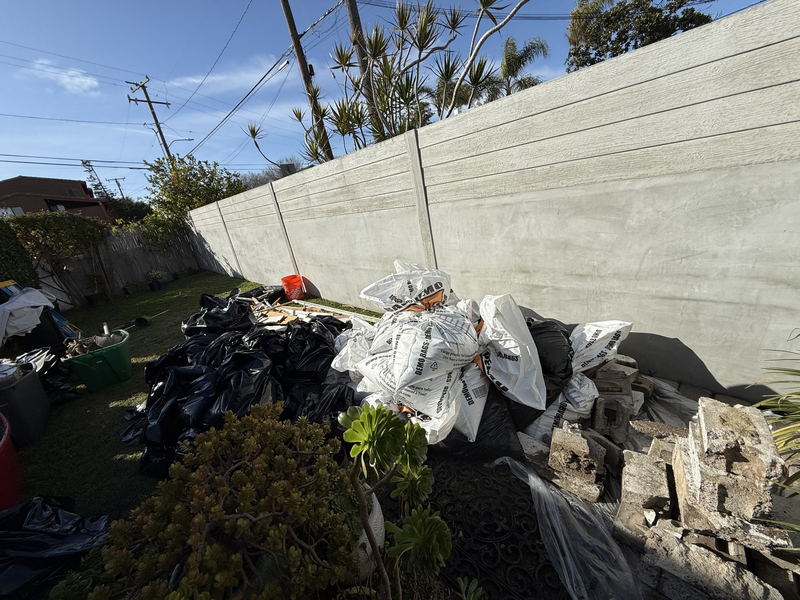
Bagged garden waste, filled white demolition bags and broken concrete rubble lined up along a poured concrete wall in a Los Angeles County back yard
Green waste and broken concrete, stacked and ready · Woodland Hills
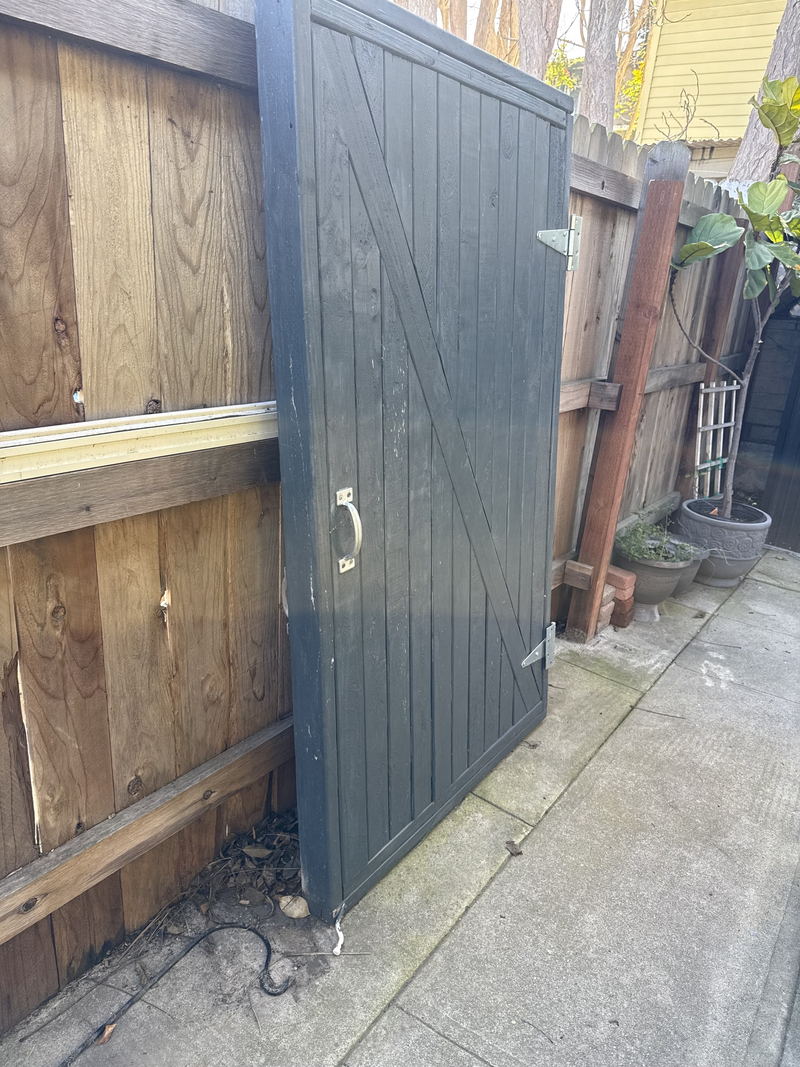
A heavy timber garden gate lifted off its hinges and leaned against a failing board fence along a narrow Los Angeles County side path, ready to be carried out
An old gate and fence panels pulled for removal · Woodland Hills
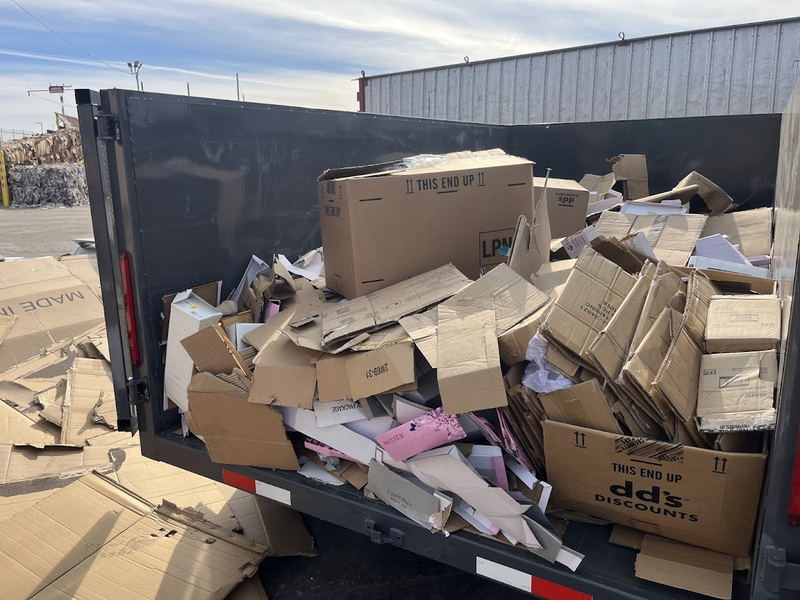
The bed of our dump trailer filled to the rail with flattened cardboard cartons and packing waste from a retail clear-out, parked at a Los Angeles County recycling facility
A full load of cardboard going straight to recycling · Woodland Hills

Our own crews on Los Angeles County jobs. The yard waste removal we run in Woodland Hills looks like this too: side yards, narrow walkways and the back of the property is where the work actually is.

Where the green goes

Back into the soil
in thirty to sixty days.

Clean green waste from the City of Los Angeles does not go into a hole. LASAN delivers it to a processing facility where contamination is picked out by hand, the material is ground down, built into piles and composted aerobically for 30 to 60 days, then screened. The composting temperatures destroy pathogens, and the finished products are tested quarterly under the US Composting Council's Seal of Testing Assurance program. That is why keeping a green load clean matters commercially as well as environmentally: a load with plastic pots, bags or rubble in it is a different product at the gate.

The loop closes back in the Valley. LASAN gives its mulch and TOPGRO compost away free to City residents at self-serve yards — bring your own shovel and containers — and one of those yards is in Van Nuys at 15800 Victory Boulevard, open weekdays from 7:00 a.m. to 3:30 p.m., with mulch delivered there on Mondays. There are four TOPGRO products, from a premium soil amendment made of composted yard trimmings, horse manure and wood chips down to ground yard trimmings that are not composted at all and are meant only as a surface cover. If you have just paid to have a slope stripped, that is a useful thing to know before you buy mulch for the beds at the top of it.

Sorting on the truck is the other half of the chain. Branches, logs, stumps, roots, brush, shrubs, leaves, grass and untreated wood are one stream. Palm and yucca are a separate problem, because the City's own facility refuses palm of any type and yucca outright, so a load of fronds cannot simply ride along with a load of limbs. Soil, rock and broken hardscape are not green waste in any program and are handled as their own material. Treated and painted timber — an old fence line, a decayed deck — is excluded from the green stream as well.

Finally, the things that come out of a garden shed during a clearance and must never ride on a green load: weed killer, pesticide, pool acid and chlorine, mower fuel and used engine oil. Those are household hazardous waste, and LA Sanitation's S.A.F.E. centers take them free from City and County residents every weekend. The North Valley center closest to Woodland Hills is Nicole Bernson at 10241 North Balboa Boulevard, Northridge, open Saturday and Sunday from 9:00 a.m. to 3:00 p.m. One practical detail from LASAN's own page for that site: the queue forms on Devonshire Street between Amestoy Avenue and Balboa Boulevard, and left turns into the facility from Balboa are not permitted.

Sources: LA Sanitation, Green Waste Processing and Composting; LA Sanitation, Free Mulch and TOPGRO Compost; LA Sanitation, Commercial Green Waste Disposal at Lopez Canyon; LA Sanitation, S.A.F.E. Centers and Household Hazardous Waste; LA Sanitation, Nicole Bernson S.A.F.E. Center.

The rule behind it
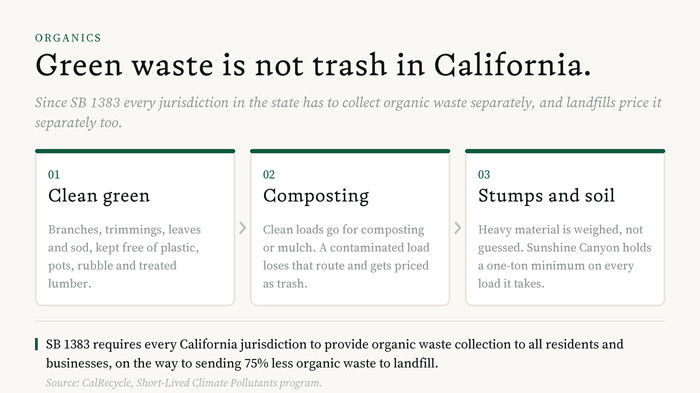
Diagram of the green waste route under California SB 1383: clean trimmings go for composting or mulch, a contaminated load loses that route, and heavy soil and stumps are weighed at the gate
Clean green goes to compost, contaminated green does not

Same rule in Woodland Hills as anywhere else in Los Angeles County. The local part is the program above, not the disposal law. Full detail on yard waste removal.

Worth knowing

Brush clearance here
in six lines.

Clearance facts
  1. The LAFD inspects properties in the Very High Fire Hazard Severity Zone automatically; for 2026 the compliance date was May 1 and initial inspections ran through June 30.
  2. A failed first inspection carries a $31.00 fee for 2026 and an automatic re-inspection, and a failed second inspection adds a $758.00 non-compliance fee.
  3. If a parcel is still non-compliant after the second inspection, City contractors clear it and the owner is billed a $1,740.00 administrative cost fee plus the contractor's lowest bid.
  4. The clearance band is 200 feet from any structure, including structures on adjoining properties, and 10 feet from any combustible fence or roadway used for vehicular travel.
  5. The requirement ends with disposal: all cut vegetation and debris shall be removed in a legal manner, with chipped material spread back no deeper than three inches within 30 feet of structures.
  6. LA Sanitation's free once-a-year brush collection accepts tied bundles no longer than four feet and no heavier than 30 pounds, booked through MyLA311 or 1-800-773-2489.

This page is yard waste removal in Woodland Hills specifically. The wider service is on yard waste removal across Los Angeles, and everything we haul in this city is on junk removal in Woodland Hills. Same crew, different job: Garage cleanouts in Woodland Hills, Furniture removal in Woodland Hills. Pricing works the same way everywhere: how our pricing works, and the full map is on areas we serve.

Service area
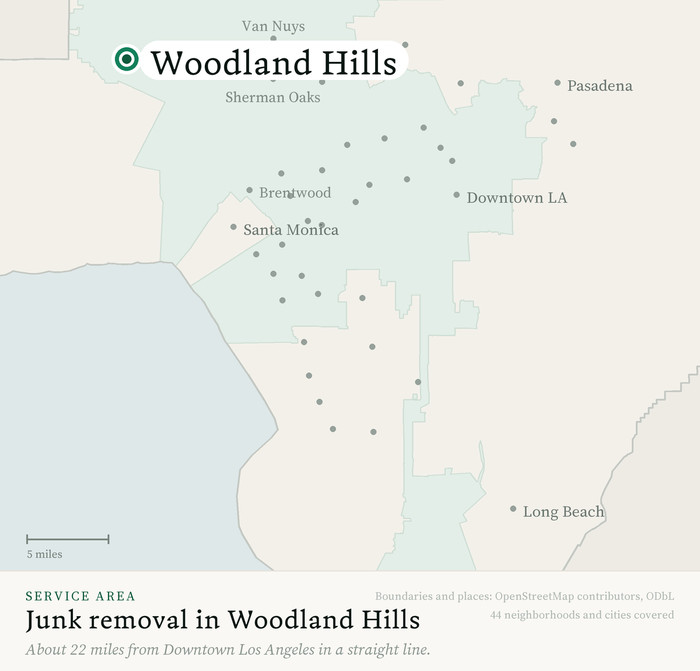
Map of our greater Los Angeles junk removal service area with Woodland Hills marked, about 22 miles from Downtown Los Angeles, drawn from OpenStreetMap boundary data
Woodland Hills in the greater Los Angeles service area. Boundaries and places from OpenStreetMap contributors, ODbL.

We are already next door most days. The whole list is on areas we serve.

What usually goes
with a clearance

Brush rarely leaves on its own. One visit, one number, agreed before anything is lifted.

Woodland Hills brush
questions

Inspection dates, fees, bundle limits and what happens to the pile afterwards.

When does the City inspect for brush clearance?

Automatically, and you do not book it. The LAFD's owner notification for the 2026 program set the compliance date at May 1, 2026 and ran initial inspections from May 1 through June 30. The department's computer system flags parcels that are due, so there is no inspection to request and no call to make. Compliance is described as a year-round responsibility, and the department says a thorough clearing may be needed more than once a year.

What does it cost if the property fails?

For 2026 a failed initial inspection carries a $31.00 brush inspection fee per parcel, and every failed parcel gets a second inspection. Pass the second and the $31.00 stands alone. Fail it and a $758.00 non-compliance fee is added. Parcels still non-compliant after that are cleared by City contractors and billed a $1,740.00 administrative cost fee plus the contractor's lowest bid price, and unpaid invoices are added to the property tax bill as a special assessment.

Can I just put the cut brush in the green bin?

A little of it, yes. The green bin takes tree and bush trimmings, grass clippings and clean untreated wood every week. It is simply the wrong size for a compliance cut: a slope cleared to the three-inch standard produces more material in an afternoon than the bin takes in a season. Use the bin for the maintenance, then use the free once-a-year brush collection for tied bundles under four feet and 30 pounds, and call us for what is left.

Do I have to remove the cuttings, or can I leave them at the boundary?

They have to go. The requirement list finishes by saying all cut vegetation and debris shall be removed in a legal manner. There is one alternative the City allows: the material may be chipped and spread back onto the property, no deeper than three inches within 30 feet of structures and six inches beyond that, and never within 10 feet of a usable roadside. A stacked pile at the property line is fuel, not compliance.

How is a brush load priced?

By weight rather than by how the pile looks, because that is how a green waste gate charges. Freshly cut material is full of water, and soil on a root ball is heavier again, so a pile that looks like half a truck can weigh more than a full load of furniture. You get one flat number before we start, and we will tell you on the call if soil, rock or old fence timber in the pile changes which facility the load goes to.

We have oaks on the lot. Does clearance override that?

No. The LAFD states that all fire clearance must be performed in compliance with the City's rules on native protected trees and shrubs at L.A.M.C. 46.00-46.06, so protected trees are worked around rather than through. We are haulers rather than arborists: climbing, rigging and canopy work belong with a tree crew, and once the material is on the ground, moving it off the property is our part.

The proof

What our customers say

5.0from 67 reviews on Google

Word for word from Google. Nothing tidied.

  • 5 months ago

    Working with Hunter and this company was great. Gave us a quick quote over the phone after sending photos and was able to help us the SAME day. Removal was fast and easy. We definitely recommend going with this company.

    Ingrid Mira3 reviews · 1 photoSame-day pickup, quoted from photos
  • Fair pricing 11
  • Personable staff 10
  • Polite 5
  • Punctual staff 4
One city over

Yard waste removal near Woodland Hills

Collection rules, transfer stations and permit counters change at the city line, so each of these is written for that city rather than for Woodland Hills. A job that straddles two of them is still one visit and one number.

Everything we haul in the cities next door: Tarzana, Encino, Sherman Oaks. The whole list is on areas we serve.

Request a quote

Send a photo, get a flat number back. Free, no obligation, no pressure and no call-out fee — and if your city will haul it free instead, we will tell you that too. Most requests are answered within the hour during working hours.

Or call or text (323) 230-0777 — Mon–Sat around the clock, Sunday 1–10pm.

Call (323) 230-0777Text a photo