Mon–Sat open 24 hours · Sun 1–10pmFully insuredFamily-run, LA-based
team@lajunkhauling.com
Call us today(323) 230-0777
Home/Guides/Where to get rid of a TV

Getting rid of a television in LA County,
without paying a fee you already paid

Electronics are banned from the trash in California, which sounds like a problem and is in fact the reason almost every route on this page is free: the recycling was paid for at the register the day the set was bought.

Free quote, no obligation · one flat number before we start · you can also text that number

Published · last checked · written by the crew at Los Angeles Junk Removal & Hauling

The short answer

Putting a television in the trash is illegal in California, and there are nine permanent free drop-off centers in Los Angeles County that take one from any county resident at no charge. Inside the City of Los Angeles, LA Sanitation also collects a TV from the curb free, with no annual cap.

There are four ways a television legally leaves a home in Los Angeles County and three of them cost nothing. Your own city may collect it from the curb, which is the only route that works without a car. Nine permanent collection centers will take it off you free, every one of them open to any county resident, most of them only at weekends. A retailer or a certified recycler will take it on a weekday. And a crew will carry it down the stairs today, which is the one thing none of the free routes will do. What decides between them is your calendar and your staircase, not the set.

Whichever you choose, do not pay a separate recycling fee for a television in California. the Covered Electronic Waste recycling fee was charged on the set when it was sold, which is what funds the free collection network, and an approved collector is reimbursed by the State for taking it. Anyone asking you for a recycling charge on a household TV in this county is charging you for something already paid.

A sofa is ordinary waste that some cities happen to collect. A television is not. CalRecycle’s list of waste banned from the trash lists televisions and monitors among the items that may not go in a trash, recycling or organics bin at all, and states plainly that it is illegal to put hazardous waste in the garbage. That single rule removes the answer most people were about to reach for, and it is why the real question is not who will take a TV but which of the free routes is open on a day you can actually get to it.

That turns out to be the hard part, because the City of Los Angeles and the County publish their halves of the answer separately and no city publishes the other eighty-seven. The collection centers keep weekend hours that differ site by site. Some cities put a TV on a curbside truck and others will not touch e-waste at the curb. The charities that take televisions take only recent flat panels. This page puts all of it in one place, with every row traced to the body that publishes it.

Two parts of this answer are registers, and each one now has a page of its own so you are not scrolling a table to reach a paragraph. Television pickup city by city is every curbside program we could read in and around the county, with whether e-waste rides the bulky truck, what it costs and how much notice it needs. Who actually takes an old television is the gates: the nine permanent free drop-offs with the hours each operator publishes, the retailers that take one on a weekday, the charities that will take a recent flat panel, and what changes when the set is a tube or a projection television.

Four routes, one television

A television has four legal exits, and three of them are free

Route one, your own city collects it. This is the only route that asks nothing of you but a phone call, and it is the right one for anybody without a vehicle. Inside the City of Los Angeles it is unambiguous: LA Sanitation and Environment names “Electronic waste (TVs, computers, monitors)” among the items it will collect at the curb, the service is free with no annual limit, and the request has to be in at least one business day before your normal collection day. Outside the city limit it is genuinely a lottery, because e-waste sits outside most bulky-item contracts and plenty of cities say so. Find your street in the city-by-city register, and read the City of Los Angeles route in full under the city program.

Route two, drive it to a permanent collection center. Nine sites in the county take a television off a resident free. Seven are City of Los Angeles S.A.F.E. Centers, which stands for Solvents, Automotive, Flammables and Electronics, and the other two are the County centers at Palmdale and Signal Hill. The thing worth knowing before you plan a day around one: Los Angeles County Public Works confirms that every one of them is open to any Los Angeles County resident, not just to the city the site sits in, so the nearest one is the right one regardless of your address. The catch is the calendar, and it is covered under the collection centers.

Route three, a retailer or a certified recycler. The weekday answer. Large electronics retailers run in-store take-back, and in California the store drop-off fee that gets quoted everywhere online does not apply, so it is free here within the chain’s own quantity and screen-size limits. Homeboy Recycling in South Gate takes CRT televisions, flat screens and monitors free, Monday to Friday, 10:00am to 3:00pm, and is an approved collector with CalRecycle under state covered electronic waste rules, which is the part worth checking before you hand a set to anybody. If the set still works and is reasonably new, this is also where donation belongs: it is a narrower route than people expect, and the terms are in who actually takes a working set. The retail terms are in store take-back, and if what you have is a tube or console set, read the CRT problem first, because that is the one category most charities name as a refusal.

Route four, a crew. Ours or anybody’s. It is the only route that begins inside the room the television is in, which is the entire reason it exists, and the only one with no weekend, no weight limit and no screen-size rule attached. It is also the only one you pay for, which is why it is last on this page and why the honest version of when it earns the call is under paying a crew.

One warning about route one, because the canonical source for it is self-contradictory and we would rather say so than paper over it. The City of Los Angeles bulky-item page opens by defining a bulky item as “anything non-hazardous and non-electronic you’d like to dispose of that is too large to fit in your black trash bin”, and then, nine lines further down, lists “Electronic waste (TVs, computers, monitors)” among the things the crews will gladly take. Both sentences are on the same page on the same day. The operative one is the second: the accepted-items list is what the dispatcher works from, the prohibited list names fluorescent lights and paints rather than televisions, and the city sends a truck for a TV. But if a call taker tells you a television is not a bulky item, they are quoting the first sentence, and the fix is to ask for it as an electronic waste collection by name.

The other thing to settle before you start is which question you are actually asking, because two of these routes answer different ones. “Who will take this television” has a long list of answers. “Who will take this television on Tuesday” has three, and “who will take it out of my bedroom” has one. The free network in Los Angeles County is wide and it is genuinely free, and almost every complaint about it is really a complaint about its calendar. Decide which of those three questions is yours, then use the table in the next section rather than reading the rest of this page.

9permanent free drop-off centers countywide
1of the nine open on a weekday
0legal routes that end in a black bin

Seven of the nine are City of Los Angeles S.A.F.E. Centers and two are County permanent collection centers, and all nine are free to any Los Angeles County resident. the S.A.F.E. Center at UCLA is the only one of them that opens on a weekday, publishing Fridays, Saturdays and the first Sunday of each month, 9:00am to 3:00pm. The zero is not rhetorical: CalRecycle’s list of waste banned from the trash lists televisions and monitors among the items banned from the trash, recycling and organics bins alike.

  1. 1

    If it still works, give it away before you recycle it

    A working flat panel is worth more to somebody than it is to a shredder, and the handover costs nothing. Be honest about the test though: Habitat for Humanity of Greater Los Angeles accepts “Televisions (flatscreens only, less than 8 years old)”, and The Salvation Army states its thrift stores cannot accept “Large console model televisions and stereos” or “Televisions older than 5 years”. A tube set fails both tests, so skip this step and go to step four.

  2. 2

    Check whether your own city will take it at the curb

    Free, and no driving. In the City of Los Angeles the answer is yes, unlimited, with one business day’s notice on 1-800-773-2489. Everywhere else, find your row in the register, because a good many cities collect furniture at the curb and specifically will not collect electronics.

  3. 3

    If your city will not, find the nearest free center and read its day

    The nine centers do not share a schedule, so this is the step people get wrong. Check the site you intend to use rather than assuming a Saturday, then read the collection centers for the per-visit limit and what you will be asked for at the gate.

  4. 4

    If you only have weekdays, use a store or a certified recycler

    Homeboy Recycling is open Monday to Friday and the S.A.F.E. Center at UCLA is open on Fridays as well as Saturdays. Retail take-back runs on store hours. Between them, see store take-back and the centers.

  5. 5

    Only then consider paying anyone, and never a recycling fee

    A crew is for the staircase, the deadline and the volume, and nothing else. The recycling itself was already paid for at the register: see what the law actually says. If a free route fits, take it.

The answer every other page gets wrong

In California there is no legal way to put a television in the trash

The first makes your television hazardous waste. E-waste in this state is universal waste, and the Department of Toxic Substances Control says so in one sentence: “In California, e-waste is a universal waste which is a type of hazardous waste. It is hazardous because it may contain materials such as lead and mercury.” CRT televisions are the first entry on its own list of typical e-waste devices, followed by LCD, OLED and plasma televisions. Nothing in that depends on the set working, on its age, or on how it got to you.

The second bans it from the bin, households included. The universal waste rule lives in Title 22 of the California Code of Regulations, division 4.5, chapter 23, and DTSC’s e-waste reference is blunt about who it binds: households are exempt from the handling requirements that regulate a business, and then, “These groups are not exempt from the requirements of the Universal Waste Rule. This Rule prohibits them from disposing of e-waste in the trash.” the Legislature’s own 2006 record of the rule dates it precisely. Writing in April 2006, the Assembly Committee on Environmental Safety and Toxic Materials noted that under DTSC regulations, “as of February 9, 2006, all ‘u-waste’ items including those generated by households and small businesses are banned from disposal at a solid waste landfill.” Your black bin ends at a landfill. That is the whole argument.

CalRecycle’s list of wastes banned from the trash says the same thing to the public in plainer words. Under the heading “Do not throw electronic devices in the trash” the state lists televisions first, then monitors, laptops, computer CPUs, printers, radios, microwave ovens, VCRs and phones.

Now the part that should change what you do next. The recycling on that television was paid for at the register the day it was bought. The Electronic Waste Recycling Act of 2003, Senate Bill 20, signed on September 24, 2003, put a recycling fee on every video display device sold in California with a screen over four inches measured diagonally. CalRecycle’s fee schedule sets it at $4 for a screen more than four inches but less than 15, $5 from 15 inches to under 35, and $6 at 35 inches or more. the California Department of Tax and Fee Administration collects it through the retailer, which is allowed to keep three percent for the trouble, and the money goes into a state account that pays approved collectors and recyclers to take the set back at the end of its life.

Read the consequence carefully, because it is the single most useful fact on this page. Those are the state’s figures, not ours, and they are not a deposit. CalRecycle is explicit that the fee “does not contain a ‘redemption value’” and is not refunded to you. What you bought was a prepaid route. Every free drop-off in this guide exists because that fee already moved; a company charging you a recycling fee on top of it is charging you for something the state has already funded.

Who actually enforces any of this. Three agencies divide the work and none of them is your city. The CDTFA collects the fee. CalRecycle runs the Covered Electronic Waste Recycling Program, approves the collectors and recyclers, and pays the claims. DTSC writes the hazardous waste rules and, in CalRecycle’s words, “is responsible for regulating and enforcing the physical management of e-waste,” conducting inspections and compliance activities at recyclers and collectors. Nobody opens your bin. What does get enforced, by the city and the county and with published fines, is the television on the sidewalk, and that is the last section on this page.

What the law calls itUniversal waste, a category of hazardous waste, under Title 22 of the California Code of Regulations, division 4.5, chapter 23
Banned from landfill sinceFebruary 9, 2006, for all universal waste including waste generated by households and small businesses
What counts as a covered deviceA video display device with a screen greater than four inches measured diagonally: CRT, LCD, LED, plasma and OLED televisions and monitors
The fee you already paid$4 on a screen more than four inches but less than 15 inches, $5 from 15 inches to under 35 inches, $6 at 35 inches or more, charged by the retailer at the register
Is the fee refundableNo. CalRecycle states the fee is not a deposit and carries no redemption value. It funds the collection network instead
Who administers itCalRecycle pays the collectors and recyclers, the CDTFA collects the fee, DTSC regulates and enforces the physical handling of the waste

Sources: the Department of Toxic Substances Control and DTSC’s e-waste reference on universal waste and the trash ban, the Legislature’s own 2006 record of the rule for the February 9, 2006 date, CalRecycle’s list of wastes banned from the trash, Electronic Waste Recycling Act of 2003, CalRecycle’s fee schedule and the California Department of Tax and Fee Administration. Read October 29, 2026.

Rather not deal with any of it? Tell us what is there and we will price it.

Free upfront quote, no obligation. If your city will haul it free instead, we will tell you that first.

5.0 from 70 reviews on GoogleMon–Sat, open 24 hours

On the job
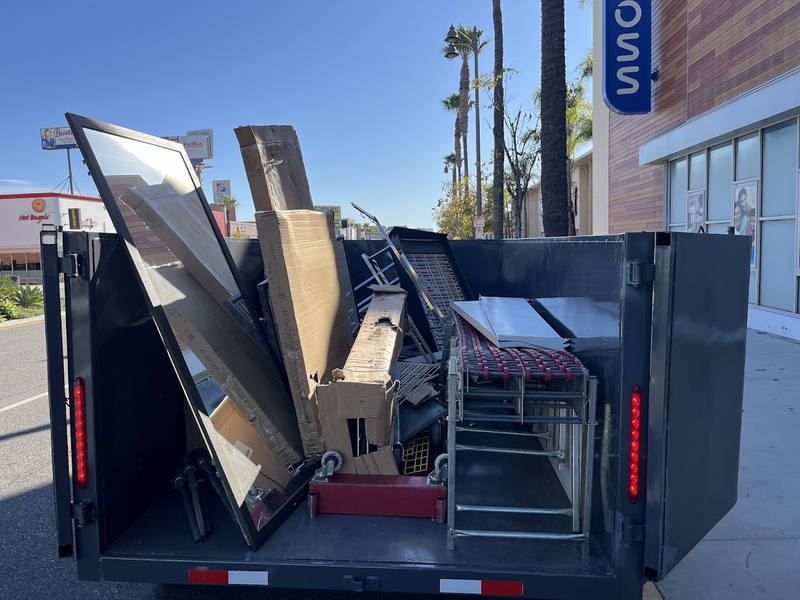
Our dump trailer loaded outside a Los Angeles County retail unit with flat-pack furniture cartons, steel gondola shelving, a stock trolley and display racking
Shop fixtures and flat-pack stripped out of a retail unit
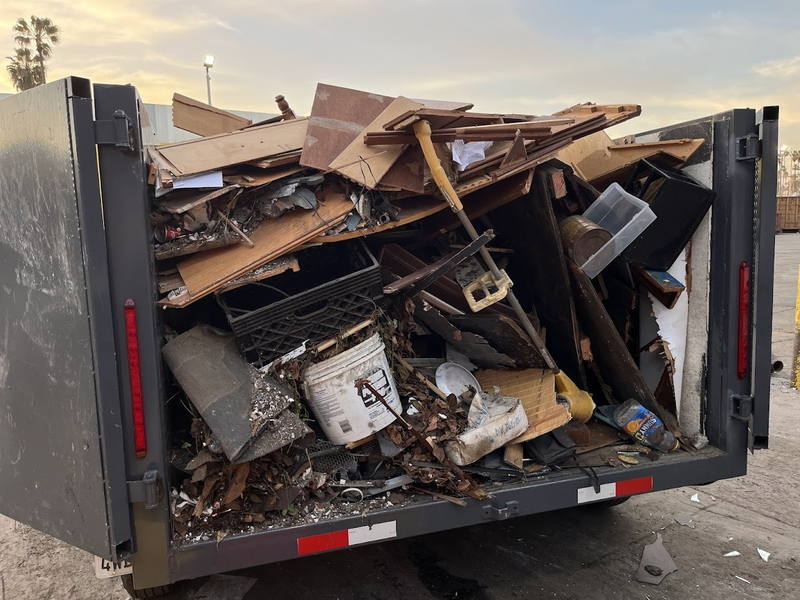
Our dump trailer loaded with mixed construction debris at dusk: cut timber, baseboard, a paint bucket, crates and broken fixtures stacked above the tailgate on a Los Angeles County job
A mixed construction load, ready for the transfer station
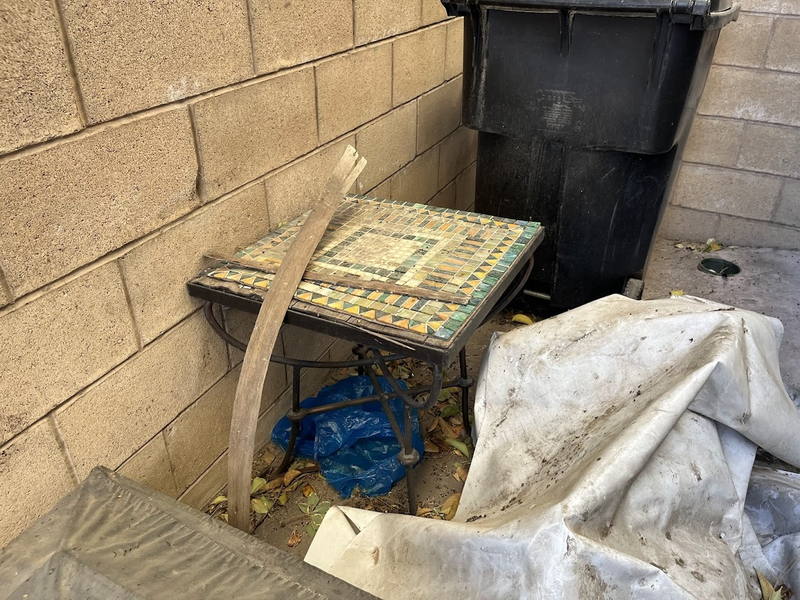
A mosaic-topped patio side table, a torn tarp and bagged waste tucked into the corner of a block-wall side yard beside a wheeled trash bin on a Los Angeles County pickup
The awkward corner nobody wants to clear out

Our own crews on Los Angeles County jobs. Side yards, narrow walkways and the back of the property is where most of the work actually happens.

The roving gates

The one-day events are free and genuinely good, and you cannot plan around them

Somebody will tell you the city or the county runs a collection day, and they are right. The County and the Sanitation Districts operate free one-day drive-through household hazardous waste and electronic waste events, hosted in turn by individual cities in school lots and public works yards. the County’s collection-center list sets the pattern in one sentence: most events are held on Saturdays from 9 a.m. to 3 p.m., they are open to all Los Angeles County residents, and no appointment is needed. A television is squarely in scope. The City of Los Angeles runs its own version, which it calls Mobile Collection Events, in neighborhoods without a nearby S.A.F.E. Center.

Read the refusal list before you load, because it is not the same list as a bulky-item truck’s. These events will not take household hazardous waste or electronic waste from a business, explosives, ammunition, marine flares, radioactive materials, controlled substances, trash, tires, solar panels, or what the County calls white goods, meaning refrigerators, stoves and washing machines. Your television is accepted and the broken refrigerator standing next to it in the garage is not, which is the most common wasted trip to one of these.

Now the problem, and it is a real one rather than a complaint about government websites. The County publishes its schedule at the CleanLA event calendar, and that page is a rolling window rather than a year. We read it on October 29, 2026 and its own page title was “Events from October 31 – November 12”. It returned seven entries. Two of those were the Antelope Valley permanent center listed as though it were a one-day event, one was a composting workshop, one a tire recycling day, one a repair clinic, and two were genuine city household hazardous waste and e-waste collection days. So a reader who needs a date three weeks out gets nothing at all, and a reader who skims can easily mistake a permanent center for an event or a composting class for a disposal day.

  1. 1

    Open the County calendar first

    Go to the CleanLA event calendar and use the City and Day filters. Read the event titles rather than the dates: only the entries titled as household hazardous waste and e-waste collection events take a television. A tire event, a composting workshop and a repair clinic will not.

  2. 2

    Read the venue, not just the city name

    Each listing carries a venue and a street address, usually a school lot or a public works yard, and that address is the gate. The host city is not a restriction: the County states these events are open to all Los Angeles County residents, so a Covina event will take a television from an Alhambra address.

  3. 3

    If you are in the City of Los Angeles, check its calendar too

    LASAN’s own event calendar carries both the Mobile Collection Events and the monthly bulky-item drop-off Saturdays. It is a separate schedule from the County’s and the two do not cross-list each other.

  4. 4

    When both calendars are empty, use the phone

    The County’s hazardous waste line is 1-888-CLEAN-LA, which dials as (888) 253-2652. For the City, LASAN’s 24-hour Customer Care Center is on 1-800-773-2489. Ask for the next household hazardous waste and e-waste event near your zip code.

  5. 5

    Assume it can be called off

    LASAN publishes that Mobile Collection Events may be canceled or rescheduled because of holidays, rain, severe weather or operational conditions. Confirm on the morning you plan to go, not the week before.

WhenMost events are held on Saturdays from 9 a.m. to 3 p.m.
CostFree
Who may use themAll Los Angeles County residents. No appointment is needed, and the host city is not a restriction
Per-visit limit15 gallons or 125 pounds per trip, published as the household hazardous waste limit
Without a carLASAN states that residents arriving by alternative forms of transportation, without access to a vehicle, will also be accommodated at its Mobile Collection Events
Proof of residencyThe origin address is requested. LASAN states an ID or utility bill is not required at a Mobile Collection Event
Will not takeBusiness waste, explosives, ammunition, marine flares, radioactive materials, controlled substances, trash, tires, solar panels, and white goods such as refrigerators, stoves and washing machines
Where the schedule livesthe CleanLA event calendar for the County and LASAN’s own event calendar for the City of Los Angeles. Both show a short forward window, so there is no annual list to plan from

Sources: the County’s collection-center list, the CleanLA event calendar, CleanLA’s electronic waste page, LASAN’s Mobile Collection Events page and LASAN’s own event calendar. All read October 29, 2026. The calendars are live schedules; the pattern above is what the operators publish about the events, not a promise about any particular date.

The honest part

What actually happens to the set after you hand it over

The stream has a shape and it runs on your fee. The retailer collects the $4, $5 or $6 and remits it to the CDTFA, which deposits it in the state’s e-waste account. A collector takes the set from you. A recycler processes it and files a payment claim by weight. CalRecycle pays the recycler a combined recovery and recycling payment, currently $1.19 a pound for CRT waste, $1.16 for non-CRT and $1.15 for battery-embedded waste, and the recycler is then required to pass the recovery portion, 40 cents a pound since July 1, 2025, back to the collector who actually took it off your hands. Nobody in that chain is paid by you.

The approval is a real gate, not a logo. the program’s application and claim rules require a prospective collector, recycler or dual entity to apply on a named form, and CalRecycle notes that applicants must comply with DTSC’s notification and inspection requirements before they apply at all. CalRecycle’s annual program update puts it the other way round: “DTSC inspections of recycling facilities and compliance with environmental standards are required for participant approval and eligibility to receive payments.” Approval lasts two years, has to be renewed 90 days before it lapses, and can be revoked for failing to keep CalRecycle informed of a change of location or operating status. Claims are audited: CalRecycle has denied between one and twelve percent of the money claimed in a year for non-compliant documentation, about $27 million in total adjustments since 2005, and it holds statutory authority to impose administrative civil penalties for false statements. It even works with the Department of Food and Agriculture’s Division of Measurement Standards to check that recyclers are weighing honestly.

So “certified” is worth exactly one question. The question is not whether a company has a certificate on the wall. It is whether it is a CalRecycle-approved collector or recycler, because that status is a funding relationship with the state that carries DTSC inspection with it. An approved collector publishes an identifying number for the covered electronic waste it handles: Homeboy Electronics Recycling, for instance, states on its own site that it is “an approved Collector with CalRecycle” and gives CEWID 116626. The place to check anybody’s claim is CalRecycle’s eRecycle directory, the state’s own searchable list of program participants with a Los Angeles entry in its county dropdown. Two warnings come with it, both CalRecycle’s: the list is of participants and “does not constitute an endorsement of that organization’s regulatory status or environmental performance,” and you should “contact any of the listed organizations to determine the details of their services, hours, and any potential charges before loading up your vehicle.” Note also that R2 and e-Stewards are private third-party audits, not state approval. They are good signals. They are a different thing, and most retail and charity drop-offs in Los Angeles County hold neither.

Now the part we will not dress up. The program is not a recycling-rate scheme and the state does not publish one. CalRecycle publishes pounds claimed and money paid, not what fraction of your television comes back as material, so anyone quoting you a percentage recovered from a TV is quoting something California does not measure. What is published is where tube glass goes, and it goes to permitted landfill. What is also published is the composition shift: in 2015, 84 percent of the units moving through this program were CRTs; in 2025, 9 percent were, out of 2.2 million units and 67 million pounds claimed. The legacy stockpile is nearly gone, and the glass problem is going with it.

One more honest note, because it changes what you can take in one trip. DTSC points out that many electronic wastes are not covered by the Act at all, that those are “still hazardous wastes” you “can not discard in the trash,” and that no payment is made for them. CalRecycle adds that the same infrastructure recovers them anyway. In practice that is why a S.A.F.E. Center will take the printer and the cables alongside the television even though nobody is paid for them, and it is also why a route driven purely on the payment rate will not.

291CalRecycle-approved collectors statewide
21approved recyclers behind them
9%of units claimed in 2025 were CRTs

Participant counts are CalRecycle’s as of June 2025 and the unit split is from its 2025 reporting year. CRTs were 84 percent of units in 2015. Twenty-one approved recyclers for the whole state is the number worth holding on to: whatever happens to your television, it happens at one of a very small number of audited sites.

Who pays whomCalRecycle pays the approved recycler a combined recovery and recycling payment; the recycler must pass the recovery payment to the approved collector who took the set from you
Current payment rates$1.19 a pound for CRT covered e-waste, $1.16 for non-CRT, $1.15 for battery-embedded, with the collector recovery rate at 40 cents a pound since July 1, 2025
How approval worksApplication as a collector, recycler or dual entity, valid two years, renewable 90 days before expiry, revocable, and conditional on DTSC inspection
How claims are policedBetween 1 and 12 percent of money claimed is denied each year for non-compliant documentation; roughly $27 million in adjustments since 2005
How to check a companyCalRecycle’s eRecycle directory of program participants, searchable by county and city
What is not publishedAny recovery or recycling yield for a television. The state publishes weight collected and money paid, not material recovered

Sources: Covered Electronic Waste Recycling Program, CalRecycle’s annual program update, the program’s application and claim rules, CalRecycle’s own payment-rate analysis, CalRecycle’s eRecycle directory and DTSC’s e-waste reference. The CEWID and approved-collector claim quoted is published by Homeboy Electronics Recycling on its own site. Read October 29, 2026.

The route that costs the most

A television on the sidewalk is a criminal matter, not a parking ticket

California Penal Code 374.3 makes it an infraction to dump waste matter on a public road or its right-of-way, on private property the public enters by easement or license, or in a public park. The mandatory fine runs from $250 to $1,000 on a first conviction, $500 to $1,500 on a second and $750 to $3,000 on a third or subsequent one, and the minimums cannot be waived except where the interests of justice require it. Then the clause that does the damage: each day the waste remains unabated is a separate violation. A set left out over a holiday weekend is not one offense.

Volume is not the only trigger. The misdemeanor tier applies to “commercial quantities,” which the section defines as waste generated in the course of a trade, business, profession or occupation, or an amount of a cubic yard or more. One household television is nowhere near a cubic yard, so a resident sits in the infraction tier. A hauler does not: waste that came out of a job is commercial by origin whatever it weighs, which means the man who took your TV for forty dollars in cash is exposed to up to six months in county jail and a mandatory fine from $1,000 for dumping a single set.

The 2022 amendment made that worse for him, on purpose. Assembly Bill 2374, Chapter 784 of 2022 raised the maximum mandatory fine for commercial-quantity dumping by anyone employing more than ten full-time staff to $5,000 on a first conviction, $10,000 on a second and $20,000 on a third. It also stopped removal being optional: the court must now order a person convicted of illegal dumping to remove the waste or pay the cost of removing it. And it added the consequence that should decide who you hand a television to. Where the person convicted holds a license or permit to do business, the court must notify the licensing body, which has to record the conviction and post it on that licensee’s public profile on its website. A dumping conviction is now a public fact attached to a trading name. Our guide to vetting a junk removal company is about how to use that.

Inside the City of Los Angeles there is a second, faster layer. LAMC 66.25 states that “No person shall deposit or cause to be deposited any solid waste of any kind whatsoever upon or in any street, or upon any premises in this City, or in the Los Angeles River.” It does not need a court. The section carries administrative penalties that reset annually: a warning or up to $500 for a first violation in a calendar year, up to $750 for a second, $1,000 for a third, and more than three administrative fines in one calendar year means the violation is charged as a misdemeanor in Superior Court. LA Sanitation may add a processing fee set by the Board of Public Works to any citation, and you appeal through the administrative hearing process under Government Code section 53069.4, not to a judge in the first instance.

Read subsection (b) before you tape a label to anything. It makes “any person whose identifying information is found in” the deposited waste responsible for it. For furniture that clause is theoretical. For electronics it is not: a television goes out with the box it was swapped out of, a delivery docket, a warranty card or an address label on the carton, and that is a name on a file.

If your address is unincorporated, the rule is a clock rather than a prohibition. County Public Works quotes County Code Title 20, Section 72 verbatim: “No person shall place any solid waste, or any container containing solid waste, at any place of collection before 5:00 p.m. of the day preceding the scheduled collection of said solid waste, or leave any such container at the place of collection after 8:00 p.m. on the day of actual collection, or more than two hours after actual collection, whichever is later.” Put the set out on Friday for a Monday truck and you are outside that window for three days.

How Los Angeles actually finds it. Not by patrol, and not only by complaint. LA Sanitation and Environment asks residents to report dumping at myla311.lacity.org or on 800-773-2489, around the clock, and tracks every cleanup request through MyLA311. It also runs CleanStat, a street-by-street survey that scans every neighborhood in the city at least twice a year, grades each street from 1 to 3 for cleanliness, and logs unreported items by category. E-waste is one of the named categories, alongside mattresses, tires and white goods, and the locations get passed to the collection yards. An abandoned television is not invisible for long. In unincorporated areas, report to the County’s illegal dumping page online, by email, or on 1-888-253-2652; that page also notes that the County adopted an ordinance in August 2005 allowing the Sheriff to seize a vehicle used in the act of illegal dumping, and points to Health and Safety Code section 117555 for a further jail exposure. Our illegal dumping guide covers reporting something somebody else left.

The state statuteCalifornia Penal Code 374.3. An infraction, with each day the waste remains unabated a separate violation, and minimum fines that cannot ordinarily be waived
Household tiersA mandatory fine of $250 to $1,000 on a first conviction, $500 to $1,500 on a second, $750 to $3,000 on a third or subsequent conviction
Commercial quantitiesWaste from a trade or business, or a cubic yard or more: a misdemeanor, up to six months in county jail plus a mandatory fine from $1,000. A hauler qualifies by origin, not volume
Since 2022AB 2374 raised the commercial maximum to $5,000, $10,000 and $20,000 for operators with more than ten full-time staff, made the removal order mandatory, and requires the conviction to be posted on a licensee’s public profile
City of Los AngelesLAMC 66.25 bars depositing solid waste on any street or premises. Administrative penalties of up to $500, then $750, then $1,000 within a calendar year, and a misdemeanor beyond three
Unincorporated countyCounty Code Title 20, Section 72: nothing out before 5:00pm the day before collection, and nothing left after 8:00pm on collection day
How to report itMyLA311 or 800-773-2489 in the City of Los Angeles; 1-888-253-2652, The Works app or dumping@pw.lacounty.gov in unincorporated areas

Sources: California Penal Code 374.3 as recorded in the Senate Public Safety Committee analysis of AB 2374, Assembly Bill 2374, Chapter 784 of 2022 as summarized by the Assembly Public Safety Committee, LAMC 66.25 as published by the Los Angeles City Clerk, County Public Works quoting County Code Title 20, Section 72, LA Sanitation and Environment and the County’s illegal dumping page. Read October 29, 2026.

Match it to your week

The right route is decided by your week, not by your television

There is a third trap that the table cannot carry in a cell. A city that collects furniture at the curb has not thereby agreed to collect electronics at the curb, and people assume otherwise because both arrive on the same truck in the City of Los Angeles. Outside it, bulky-item collection and household hazardous waste are usually two separate programs with two separate budgets, and e-waste belongs to the second one. So the useful question to ask your city is not “do you collect bulky items”, which will get you a yes almost everywhere, but “do you collect electronic waste at the curb, and is a television included”. Ask it that way and the answer is actionable.

I have no carYour city’s curbside collection. In the City of Los Angeles that is free, unlimited and one business day’s notice. Outside it, check your row in the register first, because e-waste is excluded from a surprising number of bulky-item programs
I can only do this on a weekdayHomeboy Recycling in South Gate, Monday to Friday 10:00am to 3:00pm, or the S.A.F.E. Center at UCLA on a Friday. See store take-back and the collection centers
It is a console or tube TVA certified recycler, not a charity. Read the CRT problem: Habitat LA takes flat screens only, and The Salvation Army names large console televisions as something its thrift stores cannot accept
It is a flat panel, it works, and it is under eight years oldDonation, and nothing on this page beats it. The condition tests are in who actually takes a working set, and they are stricter than the word donation suggests
I live in an apartment buildingDepends on who bills the building rather than on the television. The apartment case has it, and in the City of Los Angeles the answer is better than most tenants assume
Five sets coming out of an officeBusiness waste, so the resident routes are closed. A certified recycler that handles commercial volume, or a crew. See the recyclers and paying a crew
It is Saturday, I have a car, and I want this gone todayThe nearest of the nine permanent centers. Check its own day and hours first under the collection centers, because the Los Angeles-Glendale site does not open on a Sunday and two of the nine open on only some Saturdays of the month
My address is not in any city at allCall County Public Works on 1-888-CLEAN-LA and ask which hauler holds your area. Collection in unincorporated Los Angeles County runs through the Franchise Solid Waste Collection System and the Garbage Disposal Districts, and the terms belong to the hauler. The nine centers are open to you either way
Somebody told me to just put it out with the trashThey were wrong, and it is the most expensive wrong answer here. The law bans electronics from the bin and the dumping section has what it costs when an unbooked set sits on a sidewalk
It is a sixty-inch panel on a wall, or a console I cannot liftA crew, or two people and a van. No free program in this county comes inside a room. Paying a crew says plainly when that is the right call and when it is not

Sources: LA Sanitation and Environment, S.A.F.E. Centers, Los Angeles County Public Works, the County’s free HHW and E-Waste Collection Program, CleanLA trash collection, Homeboy Recycling, Habitat for Humanity of Greater Los Angeles and The Salvation Army, each read October 29, 2026. The hours, limits and refusals are the ones those bodies publish. Which route suits which situation is our own judgment from doing this work in Los Angeles, and you are free to disagree with it.

Where the free routes stop

What a crew is for, and what it is not for

We move junk for a living and we have just spent a page explaining how to avoid needing us. That is on purpose. The free network for televisions in this county is real, it is funded, and for most people it is the right answer. What no city page will tell you is where it stops, so here it is.

So: if you have a weekday morning and a car, use Homeboy Recycling or a store. If you have a Saturday, use a center. If you are in the City of Los Angeles and can get the set to the curb, use the city, and read CalRecycle’s eRecycle directory if you want to confirm that whoever you are handing it to is approved by the State. If none of that describes your week, that is the gap we fill, and it is a narrow one by design.

If you want us to take it, call 323-230-0777 or ask for a free upfront quote. We are a service-area business covering greater Los Angeles, with no storefront, so the estimate comes before anything is lifted and it carries no obligation. Televisions and monitors go out through our e-waste disposal service. And the free routes above will still be there tomorrow if you decide you would rather use them, which is the point of writing them down.

Worth knowing

The parts people get wrong

What to know
  1. In Los Angeles County there are nine permanent collection centers that accept a television free of charge from any county resident: seven City of Los Angeles S.A.F.E. Centers and two County centers, at Palmdale and Signal Hill.
  2. In California it is illegal to put a television in a household trash bin, because CalRecycle lists televisions and monitors among the electronic devices banned from the trash, recycling and organics bins alike.
  3. In the City of Los Angeles, LA Sanitation and Environment collects a television from the curb free of charge with no annual cap, booked at least one business day before your regular collection day on 1-800-773-2489.
  4. Of the nine permanent free e-waste drop-off centers in Los Angeles County, only the S.A.F.E. Center at UCLA opens on a weekday, publishing Fridays, Saturdays and the first Sunday of each month from 9:00am to 3:00pm.
  5. In Los Angeles County the S.A.F.E. Centers and the County collection centers both publish a disposal limit of up to 15 gallons or 125 pounds per visit, which a console television with its cabinet can exceed on its own.
  6. In California the recycling on a television was paid at the register as the state Covered Electronic Waste recycling fee, which is $4 to $6 depending on screen size, so no household should pay a second recycling charge to dispose of one.
Where this comes from

Sources

Every rule, fee, limit and deadline on this page is from the body that sets it. Checked on the date above; if a city changes its program we change the page.

  1. CalRecycle, Waste Banned from the TrashThat televisions and monitors are on the state’s list of electronic devices banned from the trash, recycling and organics bins.
  2. CalRecycle, Electronic Waste ManagementThe recycling fee on electronic devices sold in California since January 1, 2005, and that a nonfunctioning cathode ray tube is hazardous waste.
  3. CalRecycle, Covered Electronic Waste Recycling FeeThe point-of-sale fee by screen size, and that it funds approved collectors and recyclers rather than being refundable.
  4. CalRecycle, eRecycle directory of e-waste collectorsThe State’s searchable list of approved e-waste collectors by county and city.
  5. LA Sanitation and Environment, S.A.F.E. CentersWhat S.A.F.E. stands for, free acceptance of televisions, the 15 gallon or 125 pound per-visit limit, and the address request at the gate.
  6. LA Sanitation and Environment, S.A.F.E. Center at UCLAThe only one of the nine with weekday hours: Fridays, Saturdays and the first Sunday of each month, 9:00am to 3:00pm, free to City and County residents.
  7. LA Sanitation and Environment, Schedule a Bulky Item PickupFree unlimited City of Los Angeles curbside collection of TVs, computers and monitors, the one-business-day notice, and 1-800-773-2489.
  8. Los Angeles County Public Works, HHW and E-Waste Collection CentersThat any County resident may use the S.A.F.E. centers, the Antelope Valley center and EDCO free, the per-trip limit, and the County centers’ hours.
  9. Los Angeles County Public Works, Household Hazardous Waste programThat the County program is free to residents, its events need no appointment, and it refuses business e-waste.
  10. Los Angeles County Public Works, CleanLA trash collectionThat unincorporated collection runs through the franchise system and the Garbage Disposal Districts, so the terms are the hauler’s.
  11. Homeboy Recycling, Los Angeles e-waste drop-offFree weekday drop-off of TVs and monitors at 4940 Branyon Ave., South Gate, and why contact details are requested at the counter.
  12. Homeboy Recycling, certificationsR2v3 certification, “an approved Collector with CalRecycle”, and the published CEWID number.
  13. Habitat for Humanity of Greater Los Angeles, Donate ItemsFlat screens only, under eight years old, the $50 pickup fee, and free drop-off at any ReStore.
  14. The Salvation Army, donation guideThat its stores refuse large console televisions and any set older than five years.

If you would rather not do it yourself

Same crew, one visit, one number agreed before anything is lifted.

Related guides

The rest of the LA disposal manual.

Getting rid of a TV, answered

The follow-up questions people ask after this one, in the phrasing they ask them in.

Where can I get rid of an old TV in Los Angeles County for free?

At any of the nine permanent collection centers in the county, all of which take a television from any Los Angeles County resident at no charge: seven City of Los Angeles S.A.F.E. Centers plus the County centers in Palmdale and Signal Hill. If you are inside the City of Los Angeles you do not even need to drive, because LA Sanitation collects electronic waste from the curb free and without an annual limit.

Is it illegal to throw a TV in the trash in California?

Yes. CalRecycle lists televisions and monitors among the electronic devices banned from the trash, recycling and organics bins, and states that it is illegal to dispose of hazardous waste in the garbage. There is no household quantity that makes it legal and no exemption for a small set. Every lawful route for a television in Los Angeles County ends at a collection center, a curbside e-waste pickup, a retailer or a certified recycler.

Does the city pick up TVs in Los Angeles?

Yes, if your address is in the City of Los Angeles. LA Sanitation and Environment names electronic waste, specifically TVs, computers and monitors, among the items it collects at the curb, the service is free with no cap on how often you use it, and the request has to be in at least one business day before your normal collection day. Call 1-800-773-2489 or use MyLA311. Outside the city limit, check your own city first.

Do I have to pay to recycle a TV in California?

No, not as a recycling charge. The state Covered Electronic Waste recycling fee was collected when the set was sold, at $4 to $6 depending on screen size, and that money funds the collection network and reimburses approved collectors. So the collection centers are free, in-store drop-off is free in California, and a certified recycler that is an approved collector is paid by the State rather than by you.

Who picks up an old TV the same day in Los Angeles?

No municipal program does. The fastest published city turnaround is one business day in the City of Los Angeles, and the collection centers are drop-off only, so same-day means driving it to a recycler yourself or hiring a crew. Homeboy Recycling in South Gate is open weekdays from 10:00am to 3:00pm. If the deadline is today and you cannot drive, our quote is free and given before anything is lifted.

The proof

What our customers say

5.0from 70 reviews on Google

Word for word from Google. Nothing tidied.

  • 6 months ago

    We needed a last min mattress removal and called these guys up and hunter came by to pick up the mattress and haul it away for a fair price and had great communication. Very friendly and quick. Callem up for any junk removal they got you ๐Ÿ‘the rest is on Google

    Jose G MunozLocal Guide ยท 16 reviews ยท 6 photosLast-minute mattress removal
  • Fair pricing 11
  • Personable staff 10
  • Polite 5
  • Punctual staff 4
If you would rather not

Appliance removal
city by city

Who collects a household appliance for free, who refuses it outright and where the refrigerant goes is a local question with a different answer in each of these. Each of these is written for that city rather than for Los Angeles in general, and the quote is free either way.

The full map is on areas we serve, and how the number is worked out is on how our pricing works.

Request a quote

Send a photo, get a flat number back. Free, no obligation, no pressure and no call-out fee — and if your city will haul it free instead, we will tell you that too. Most requests are answered within the hour during working hours.

Or call or text (323) 230-0777 — Mon–Sat around the clock, Sunday 1–10pm.

Call (323) 230-0777Text a photo