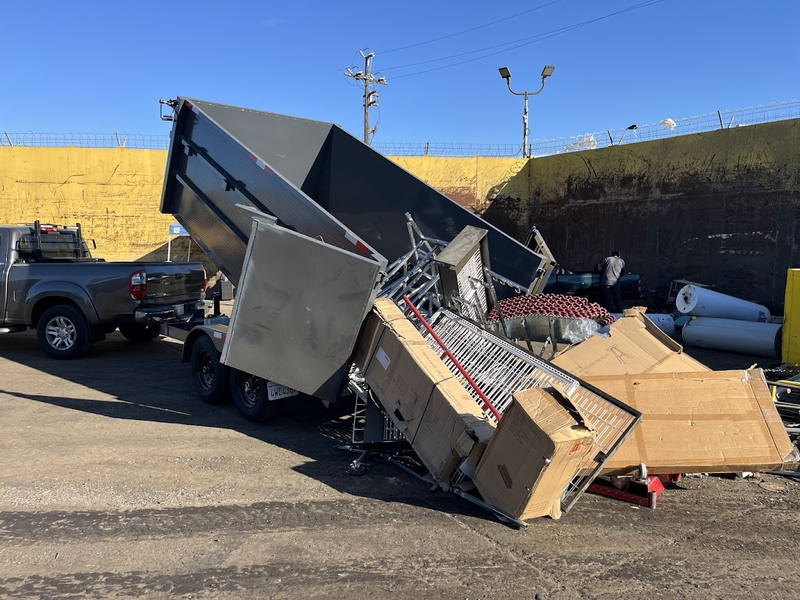
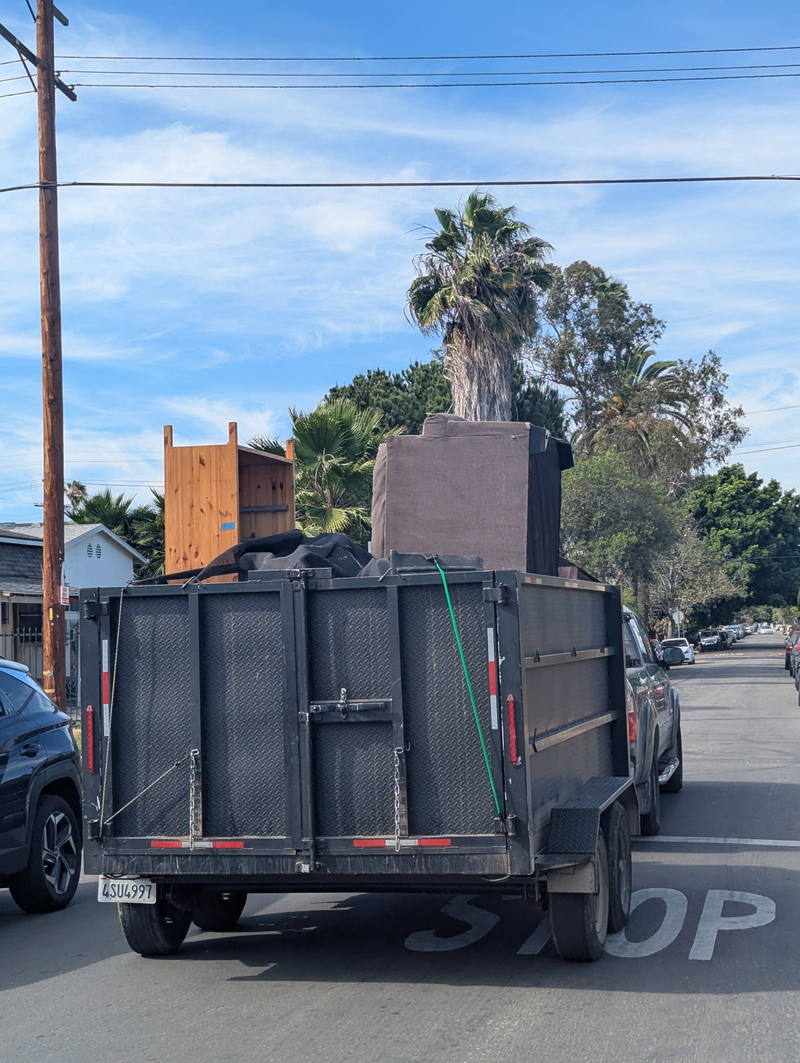
Hunter is truly dedicated on providing the most excellent of removal of unwanted junk from your home or office. Always on time, very efficient at his job in a timely manner. I would recommend him for any junk removal you may have.
This is the one waste stream in Los Angeles where the destination is written into law, into your building permit, and onto the weight ticket in your glovebox.
Free quote, no obligation · one flat number before we start · you can also text that number
Published · last checked · written by the crew at Los Angeles Junk Removal & Hauling
Mixed construction and demolition debris generated in the City of Los Angeles must be hauled by a permitted hauler to one of the City-certified C&D processors, and LA Sanitation assesses penalties of up to $5,000 for every load taken anywhere else. Clean concrete, asphalt and soil go to inert debris and soil-only sites instead.
Before distance, price or hours, one question decides your gate: is the load mixed or inert? Clean broken concrete is inert, and a recycler or quarry will crush it into road base. Drywall, lumber, carpet and tile together are mixed C&D, and inside city limits LA Sanitation allows one class of destination.
There is no free route for this: LA Sanitation's bulky-item pickup, the program that takes a couch for nothing, names construction material on its prohibited list. What is left is a certified processor, an inert or soil site, a roll-off box, or a crew. And if you pulled a permit, proof of where the debris went is part of closing it — scale tickets from a named facility, against a tonnage the building department holds.
LA Sanitation publishes it on its own program page. On March 5, 2010 the City Council approved Council File 09-3029, establishing a citywide construction and demolition waste recycling ordinance: all mixed C&D generated in the city must be transported by a permitted private waste hauler and processed at a City-certified facility. LASAN's wording on the penalty: “up to $5,000 are assessed for every load not taken to certified processors.” Twelve facilities hold that certification for 2026, each published with an audited recycling rate, and a permitted hauler is one holding a LASAN Waste Hauler Permit, also called an AB 939 permit.
Read the word mixed carefully, because it is the hinge. Source-separated material is a different route, and the city's own 2026 C&D Recycling Guide says why it is cheaper: the facilities it lists are mostly recyclers taking separated material, and they typically charge less than the landfill.
Source: LASAN, C&D Recycling Program, read October 29, 2026.
Los Angeles County Public Works splits its list of approved C&D facilities into mixed debris, inert only, soil only, land clearing and deconstructed materials, and warns that inert debris tickets from a soil-only site “will NOT be counted towards compliance.” What the list does not show is the money. Two sites below are wasteshed-restricted and turn you away on the address the waste came from rather than the load. Burbank is not listed at all: its fee schedule states that “outside public dumping is not allowed at the City's landfill.” Vulcan Sun Valley, Vulcan Durbin and Peck Road Gravel publish no rates and carry one permitted waste type in SWIS. Call the gate the same morning either way — both CalRecycle and the County say check first, and CalRecycle’s SWIS database confirms permitted waste types and operating status.
| Site and what it takes | Published rate | Before you go |
|---|---|---|
| CWS-DTLA 3720 Noakes St, Los Angeles Mixed C&D, wood, drywall, inert, dirt | Mixed C&D and wood $135/ton · clean inert $90 · clean dirt or sand $85 · clean drywall, asphalt and concrete $80. One-ton minimum | Open 24 hours, no appointment. Enter from Union Pacific Ave, not Noakes St. No asbestos. The CWS Gardena yard posts $180/ton |
| Sunshine Canyon 14747 San Fernando Rd, Sylmar Municipal solid waste, which its footnote defines to include C&D | MSW $120/ton · asphalt $150 per load · environmental fee $19.71 · untarped loads $175 per load. “All materials are charged a one-ton minimum.” Rates as of July 1, 2024 | Monday to Friday 6:00am to 6:00pm, Saturday 7:00am to noon, earlier if unloading by hand. Needs an Origin Report Form, not an appointment. No asbestos |
| Scholl Canyon 3001 Scholl Canyon Rd, Glendale Municipal solid and inert waste, clean dirt, clean asphalt | Municipal solid and inert $85.91/ton · clean asphalt $30 · clean dirt $10/ton, $20 per load minimum. Effective July 15, 2026 | Wasteshed-limited to Glendale, Pasadena, South Pasadena, San Marino, Sierra Madre, La Cañada Flintridge, Altadena, La Crescenta and Montrose, so closed to City of LA waste. No dirt from bottom dump trucks |
| Calabasas Landfill 5300 Lost Hills Rd, Agoura Municipal solid and inert waste, green waste, asphalt, dirt | Municipal solid and inert $83.13/ton · clean segregated asphalt $20 · one-ton minimum. Effective July 15, 2026 | Wasteshed-limited under County Ordinance 91-0003 to the Agoura Hills, Hidden Hills, Westlake Village and Thousand Oaks area plus part of west Los Angeles. “Clean dirt is not accepted for free” |
Sources: California Waste Services, Sunshine Canyon Landfill, LA County Sanitation Districts tipping fees, Scholl Canyon, Calabasas and the Burbank fee schedule, October 29, 2026.
Rather not deal with any of it? Tell us what is there and we will price it.
Free upfront quote, no obligation. If your city will haul it free instead, we will tell you that first.
5.0 from 70 reviews on GoogleMon–Sat, open 24 hours


Our own crews on Los Angeles County jobs. Side yards, narrow walkways and the back of the property is where most of the work actually happens.
Household junk is priced by the space it fills. C&D is weighed. A cubic yard of loose scrap concrete is 1,855 pounds against 329.5 for loose wood scrap: same hole in the trailer, five and a half times the weight, so set the table below against the rate card above. LA County Sanitation Districts adds $5.40 per ton or per load on anything uncovered.
| Gypsum, drywall | 3,834 lbs per cubic yard |
|---|---|
| Brick, common hard | 3,199.5 lbs per cubic yard |
| Soil, dry | 2,025 lbs per cubic yard |
| Concrete, scrap, loose | 1,855 lbs per cubic yard |
| Asphalt, crushed | 1,380 lbs per cubic yard |
| Wood scrap, loose | 329.5 lbs per cubic yard |
Source: LA County Public Works, Converting from Volume to Weight, October 29, 2026.
CalRecycle's summary of the CALGreen construction waste management requirements records a minimum of 65 percent diversion at section 4.408.1 for residential work and 5.408.1 for non-residential, covering new construction, demolition, and additions and alterations that increase a building's conditioned area, documented either by a waste management plan or by a company supplying verifiable records. Which number is yours turns on one rule: a jurisdiction must implement CALGreen or its own ordinance, whichever is more stringent.
In unincorporated Los Angeles County, Los Angeles County Public Works publishes the mechanics. A Recycle Reuse Plan goes in before work starts through the EPIC-LA portal, and the approval sheet you show Building and Safety states the minimum tonnage your project must recycle at the facility you named. During the job, in the County's words, “keep all weight tickets to show that all debris is being taken to the agreed upon facility/facilities listed on the online RRP application.” Every ticket is filed within 45 days of the estimated end date, and failing to submit them “may result in a penalty fee up to $50,000.” The County's page contradicts itself on the target — the banner says the August 19, 2024 update raises mixed C&D from 50 to 70 percent and soil to 100 percent, the body says 65 percent is enforced — so ask which figure is on your permit. The sentence to tape to the fridge is not in dispute: approval of the Final Compliance Report “will be required prior to final Building inspection and to qualify for the Certificate of Occupancy.”
Which is why your hauler's permit is your problem rather than his. LASAN states that City building permit applications require contractors to either identify their permitted hauler or provide their own self-haul permit, and that it verifies those permits with the Department of Building and Safety. The obligation attaches to the project, not the truck. If the man with the flatbed and the flat cash number cannot name his permit and his facility, his ticket may be worth nothing at your final inspection.
Sources: LA County Public Works and CalRecycle CALGreen requirements, October 29, 2026.
Most Los Angeles housing went up between the 1920s and the 1970s, so a renovation here routinely turns up material regulated as something other than debris.
Asbestos. South Coast AQMD Rule 1403 requires the facility or its components to be thoroughly surveyed for asbestos before any demolition or renovation, by a surveyor certified by Cal/OSHA who has passed an EPA-approved Building Inspector Course. Notification must reach the District no later than 10 working days before work begins, carry the Rule 301 fee and name the disposal site, and the waste travels on a Waste Shipment Record signed by the generator. One narrow exemption matters: Rule 1403 does not apply to an owner-occupant personally renovating a residential single-unit dwelling, defined as a structure containing only one residential unit, not an apartment, townhouse or condominium. Sunshine Canyon and CWS refuse asbestos.
Lead paint debris. The federal government banned the sale of lead-based paint for homes in 1978, and the EPA estimates roughly three-quarters of US homes built before then still contain some. Its Renovation, Repair and Painting Rule requires anyone paid to disturb painted surfaces in pre-1978 homes, childcare facilities or preschools to be certified and trained in lead-safe work practices. It generally does not apply to a homeowner working on their own home, but it does apply if you rent out any part of the property.
Treated wood. Pressure-treated posts, fence rails and old decking are not clean lumber. CalRecycle's position is that wood treated against insects and microbes may need managing by alternative methods rather than entering a recycling stream. Those standards sit with the California Department of Toxic Substances Control and have changed more than once recently, so confirm the current requirement with DTSC.
Universal waste. Fluorescent tubes and lamps, mercury switches, thermostats and batteries are universal waste, which CalRecycle describes as common hazardous waste generally not allowed in solid waste landfills. The 2016 CALGreen revision requires it to be accounted for and disposed of properly. Take it, with any leftover paint, to a LASAN S.A.F.E. Center: our hazardous waste guide has that route.
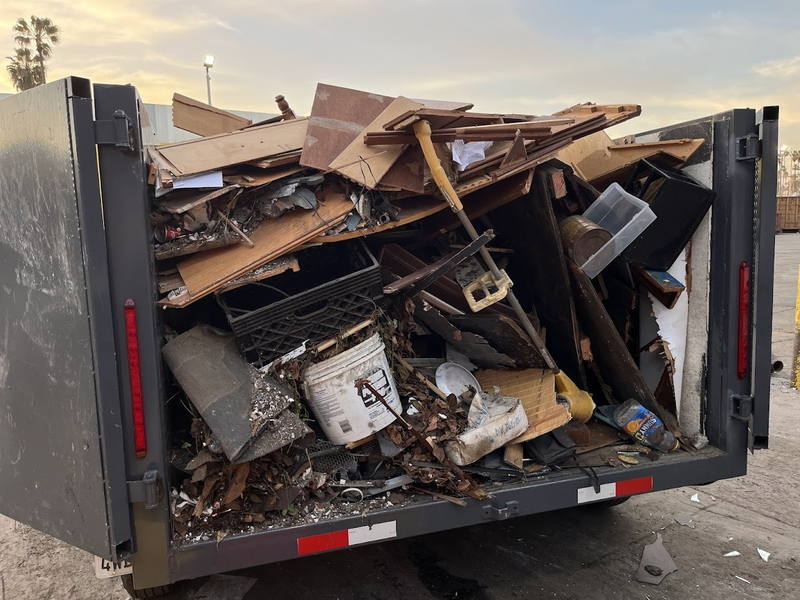
Sources: AQMD Rule 1403, EPA Lead RRP and CalRecycle, October 29, 2026.
We haul construction debris for a living, so take this in that light. A trailer of clean concrete to an inert site is one of the few genuinely cheap disposal trips in this county, and we are the wrong call for it. CalRecycle notes that recycled aggregate is crushed concrete sold mainly as road base, so you are delivering feedstock, not garbage. Same for sound doors and cabinets: Freeway Building Materials, Pasadena Architectural Salvage and The Reuse People are on the County's deconstructed tier.
Four things flip it. The load is mixed and cannot be sorted — a gut remodel makes drywall, lumber, tile and carpet together, four trips in a pickup. You have no truck, or nowhere legal for a box — a roll-off in a City street needs a right-of-way permit, which our dumpster against a crew guide works through. The tickets have to come from a permitted hauler — if an inspection is waiting on your compliance report, the permit and the certification are the deliverable. It has to be gone by a date, and scale hours are short.
Our landfills and transfer stations guide covers the public gates generally; what we do is construction debris removal, priced as the pricing page explains.
Every rule, fee, limit and deadline on this page is from the body that sets it. Checked on the date above; if a city changes its program we change the page.
Same crew, one visit, one number agreed before anything is lifted.
Drywall, lumber, tile and concrete, hauled to a certified C&D processor.
The whole garage in one visit. We sort, donate what is usable and sweep the slab.
COIs, after-hours dock slots and property-manager invoicing.
Booked and cleared the same day, most days, across LA County.
The rest of the LA disposal manual.
The landfills and transfer stations open to the public, their hours, what each one refuses at the gate, and when a pickup truck is cheaper than a crew.
A dumpster on an LA street needs a permit and a hauler permit behind it. Which one is right depends on four things, not on price alone.
The state and city penalties, why liability follows the waste back to whoever produced it, and how to get a pile cleared off your street.
The follow-up questions people ask after this one.
A mixed load must go to one of the twelve facilities the City of Los Angeles certifies to process mixed construction and demolition debris. Clean inert material — concrete, asphalt, brick, rock or soil — has more options, including quarries and recyclers on the County's list.
Not if it is mixed C&D generated inside City of Los Angeles limits, where LA Sanitation assesses penalties of up to $5,000 per load taken anywhere but a certified processor. Sunshine Canyon in Sylmar does define its $120 a ton municipal solid waste rate to include C&D waste.
Soil is its own class and almost everywhere charges for it. Scholl Canyon in Glendale posts clean dirt at $10 a ton with a $20 per load minimum but refuses dirt from bottom dump trucks; Calabasas states clean dirt is not accepted free. Both are wasteshed-restricted.
No. The free bulky-item program names construction material on its prohibited list, concrete, brick and dirt included. What is left is a certified processor, an inert or soil site, a permitted roll-off box, or a permitted hauler.
On a permitted project, yes. In unincorporated Los Angeles County, Public Works requires every weight ticket within 45 days of the estimated end date, compares the tonnage against your approved plan, and requires Final Compliance Report approval before a Certificate of Occupancy.
Because C&D is charged by weight. The County puts a cubic yard of loose scrap concrete at 1,855 pounds against 329.5 pounds for loose wood scrap, and most gates run a one-ton minimum, so even a quarter-ton trip is billed as a full ton.
Word for word from Google. Nothing tidied.
Hunter is truly dedicated on providing the most excellent of removal of unwanted junk from your home or office. Always on time, very efficient at his job in a timely manner. I would recommend him for any junk removal you may have.
Read all 70 on GoogleSee us on YelpReviews, and how to check any LA hauler Count checked on .
Permits, certified processors and diversion paperwork are municipal, and they do not match across the county line. Each of these is written for that city rather than for Los Angeles in general, and the quote is free either way.
The full map is on areas we serve, and how the number is worked out is on how our pricing works.
Send a photo, get a flat number back. Free, no obligation, no pressure and no call-out fee — and if your city will haul it free instead, we will tell you that too. Most requests are answered within the hour during working hours.